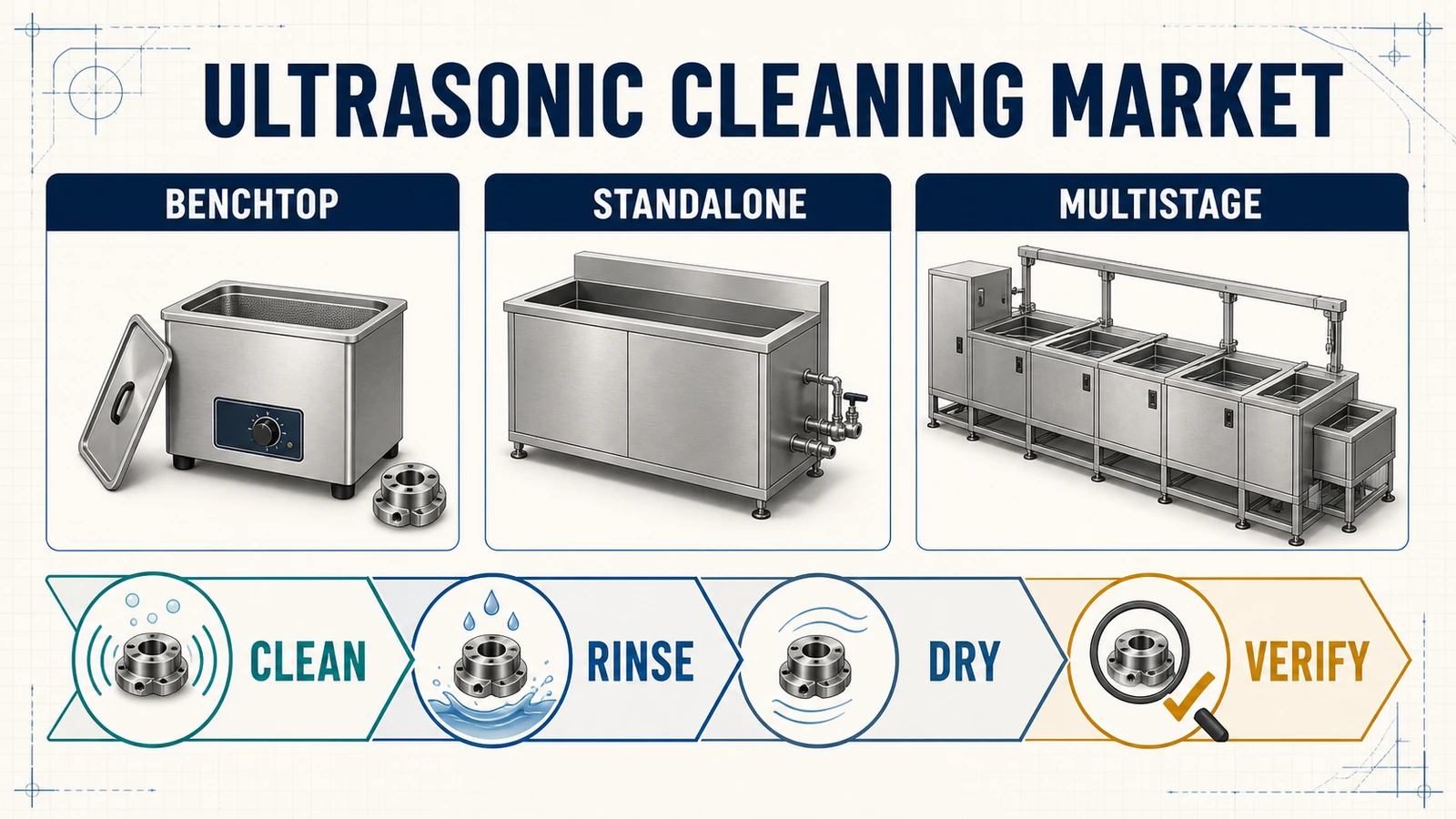
- The ultrasonic cleaning market spans benchtop baths, standalone industrial machines, multistage lines, components, process chemistry and service.
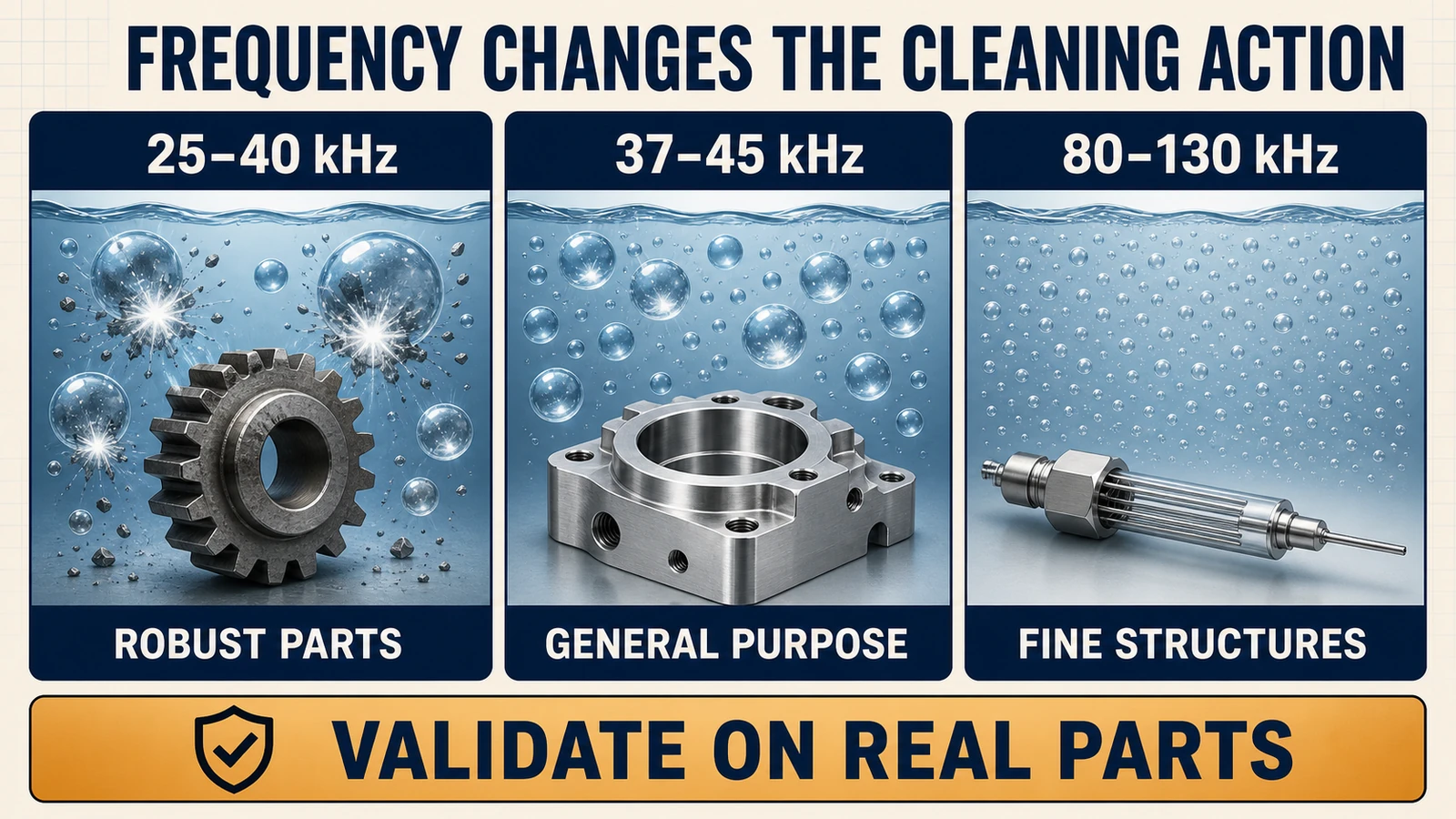
- Frequency affects cavitation intensity, but material, contamination, chemistry, power, loading and cleanliness targets determine the usable process.
- Buyers should validate the complete clean-rinse-dry process on real parts and compare lifecycle cost rather than tank capacity alone.
In this article 13 sections
The ultrasonic cleaning market covers much more than stainless-steel tanks. It includes benchtop baths, standalone industrial machines, multistage cleaning lines, ultrasonic generators and transducers, process chemistry, filtration, automation, validation and service. A buyer should define the part, contamination, cleanliness target, throughput and downstream process before comparing frequency, tank volume or price.
Public market reports commonly divide the category into benchtop, standalone and multistage equipment. That is a useful commercial map, but it does not make every published market-size number interchangeable. Some studies count only complete machines. Others extend the value chain to components, installation, detergents or maintenance.
For manufacturers and procurement teams, the practical market question is therefore twofold: what equipment and revenue layers are being measured, and what process can repeatedly deliver the required cleanliness without damaging the part?
Ultrasonic Cleaning Market at a Glance
Two public reports illustrate the scale and definition problem.
| Public source | Published estimate | Product structure disclosed publicly | Limitation |
|---|---|---|---|
| KBV Research, distributed by ResearchAndMarkets in 2023 | Global market forecast to reach US$2.3 billion by 2030 | Benchtop, standalone and multistage | Commercial report summary; the full methodology is not public |
| Arizton, published in 2025 | US$2.13 billion in 2024, forecast to reach US$3.13 billion in 2030 | Benchtop, standalone and multistage | Different publication date, database and modeling assumptions |
The figures should remain attributed to their publishers. Averaging them would not produce a more reliable result. A useful market estimate must state whether it includes complete systems only or also generators, transducers, chemistry, filtration, integration and aftermarket revenue.
This definition discipline is the same one required across the wider industrial cleaning equipment market. Ultrasonic equipment is a specialized segment inside that larger system, not a substitute for every spray, immersion or mechanical cleaning process.
What Equipment Is Included?
The market is best understood as four equipment layers.
| Equipment layer | Typical configuration | Best commercial fit | Main buying question |
|---|---|---|---|
| Benchtop bath | Compact tank, integrated generator and transducers, timer and optional heat | Laboratories, dental facilities, jewelry, repair and low-volume parts | Can the usable working zone hold the real part and fixture? |
| Standalone industrial system | Larger tank with heating, filtration, oil separation, programmable cycles or lift-and-lower handling | Workshops and batch production | Can it maintain process performance across the required load and shift pattern? |
| Multistage system | Separate cleaning, rinsing, passivation or preservation, and drying stations | Precision production and regulated or high-cleanliness work | Can every stage be controlled, documented and reproduced? |
| Integrated production line | Automated handling, PLC recipes, water treatment, traceability and upstream/downstream interfaces | High-volume or high-purity manufacturing | Can the supplier guarantee the complete process, throughput and factory integration? |
The component layer also matters. Emerson's Branson GCX generator, for example, is offered across 25, 40, 80, 120 and 170 kHz output frequencies. A generator or immersible transducer can be sold separately from a complete cleaning line. Market research that excludes these components will have a different denominator from research that includes them.
The aftermarket can include replacement transducers, generators, baskets, fixtures, filters, cleaning chemistry, calibration, maintenance and field service. These are commercially important, but they should not be mixed into an equipment-only estimate without being labeled.
How Ultrasonic Cleaning Works
An ultrasonic system converts electrical energy into high-frequency mechanical vibration.
The generator supplies electrical energy at a controlled frequency. Transducers attached to a tank or installed as immersible units convert that energy into pressure fluctuations in the liquid. Those fluctuations create microscopic cavities. Their collapse produces localized pressure effects that help detach particles and films from immersed surfaces.
Elma describes the process as cavitation in the cleaning medium. The effect can reach pores, holes and gaps that are difficult to contact with a brush or direct spray. ASTM G131 nevertheless treats ultrasonic cleaning as a controlled procedure, not an automatic guarantee. Cleaning efficiency varies with frequency and power density, while aggressive conditions can damage sensitive materials.
The liquid is part of the process. Water alone is not a universal cleaning agent. Chemistry must match the contamination and substrate, and the process may also depend on concentration, temperature, time and bath condition. Newly prepared liquid can contain dissolved gas that weakens cavitation, which is why industrial equipment often provides a degassing mode.
Loading changes performance as well. Parts, baskets and fixtures absorb or block acoustic energy. Dense loading, trapped air and poor orientation can leave blind areas even when an empty tank appears active. A quoted tank volume therefore says little about usable production capacity unless the supplier also defines the working zone, basket, load pattern and cycle.
How Frequency Changes the Process
Frequency influences the size and energy of cavitation events. Lower frequency generally produces larger, more energetic bubbles. Higher frequency produces smaller and more numerous events that act more gently on fine structures.
| Frequency | Typical direction supported by official technical material | Buyer caution |
|---|---|---|
| 20–25 kHz | Heavy contamination on robust parts | ASTM G131 reports damage risk for soft metals such as aluminum and silver at low frequency |
| 25–40 kHz | Oils, polishing compounds, rust and robust industrial components | Part finish, edges and coatings still require trials |
| 37–45 kHz | Broad general-purpose cleaning | A common range is not a universal process setting |
| 80–130 kHz | Sensitive materials, fine structures, capillaries and some electronic or precision parts | Gentler cavitation may need different time, chemistry and power |
| Above 130 kHz | Specialized precision applications | Availability does not prove suitability for a specific part |
Elma's current industrial guidance places robust surfaces and heavy contamination around 25–40 kHz, while 80–130 kHz is positioned for sensitive materials and fine structures. Its Elmasonic P equipment combines 37 and 80 kHz with adjustable power. Branson's tabletop systems use 40 kHz and sweep frequency to reduce standing-wave effects.
These examples establish engineering options, not universal recipes. Frequency must be tested together with power, chemistry, temperature, time and loading. A supplier that recommends a frequency before seeing the part and contamination has skipped the core process question.
Where Market Demand Comes From
Automotive and machinery
Ultrasonic systems are used for components with internal passages, blind holes and complex surfaces. The U.S. EPA's aqueous parts-cleaning work identified transmissions, carburetors and other hard-to-clean parts as applications where ultrasonics could reach hidden areas and reduce manual cleaning.
Automotive production also creates measurable technical-cleanliness requirements. ISO 16232:2018 specifies methods for applying and documenting particulate cleanliness inspection for functionally relevant road-vehicle components. It does not set one universal cleanliness limit. The component, system and downstream risk determine the specification.
Precision manufacturing, optics and electronics
Fine particles, polishing compounds, flux and filmic residues can affect coating, assembly or optical performance. Higher frequencies and multistage rinsing can support delicate and complex components, but cleanliness after the tank is only one part of the result. Rinse-water quality, drying, handling and the surrounding environment can recontaminate a part.
Ecoclean positions ultrasonic multistage immersion lines for precision mechanics, optics, medical technology, watches and other high-purity work. Its published system architecture includes configurable cleaning, rinsing, passivation, preservation and drying stages, plus filtration, water treatment and automated handling.
Medical and dental instrument processing
Medical demand requires a strict terminology boundary. Ultrasonic cleaning removes soil; it does not automatically disinfect or sterilize an instrument.
The U.S. CDC cleaning guidance lists ultrasonic cleaners among mechanical cleaning equipment. It also states that used ultrasonic solutions can carry bacterial contamination and that ultrasound alone does not significantly inactivate bacteria. Cleaning must be followed by the applicable disinfection or sterilization process and the device manufacturer's instructions.
This distinction affects market analysis. A benchtop ultrasonic cleaner is not equivalent to a washer-disinfector or sterilizer, even when the products appear in the same healthcare procurement workflow.
Laboratories, jewelry and specialist repair
Benchtop systems serve cleaning as well as sample preparation, degassing, dispersing and dissolving tasks. A market study must decide whether non-cleaning laboratory uses of the same equipment are included. Jewelry and watch applications also create demand for small precision systems, baskets and application-specific chemistry.
A Complete Process Goes Beyond the Cleaning Tank
A production-ready process normally follows this sequence:
`Preclean if required → ultrasonic clean → rinse → optional passivation or preservation → dry → inspect and measure`
ASTM G131 notes that visibly contaminated parts used in high-cleanliness applications may require precleaning. Rinsing removes detached soil and cleaning-agent residue. Drying prevents retained water, spotting or corrosion from becoming the next defect.
Current equipment shows how quickly the system expands beyond one bath. The Branson OMNI 1620P combines an ultrasonic cleaning tank, two-stage cascade rinse, ultrasonics in the first rinse stage, hot-air drying and PLC control. Multistage systems can also add filtration, oil separation, deionized water, passivation, vacuum drying and automated transfer.
For a buyer, this changes the RFQ. Asking only for tank liters, watts and frequency will not reveal whether the process can meet residue, corrosion, throughput or traceability requirements.
What Buyers Should Specify Before Requesting a Quote
A useful specification begins with the work, not the machine.
- Part family: Record material, dimensions, mass, surface finish, coatings, joints, holes and internal passages.
- Contamination: Identify particles, oil, grease, polishing compound, flux, carbonized soil or biological residue.
- Incoming condition: State whether soil is fresh, dried, baked on or mixed, and whether precleaning is allowed.
- Cleanliness target: Define the inspection method, unit and acceptance limit. Visual cleanliness alone is insufficient for a precision-cleaning claim.
- Throughput: Give parts per basket, baskets per hour, shifts, changeover pattern and maximum queue time.
- Downstream process: Explain whether the part will be assembled, coated, bonded, packaged, sterilized or placed in a clean environment.
- Factory constraints: Include floor space, utilities, ventilation, water quality, drainage, noise, operator access and automation interfaces.
The same discipline applies when comparing OEM and ODM cleaning equipment. A standard platform can shorten delivery, while a custom line can fit the part and factory more closely. The correct route depends on process ownership and validation responsibility.
How to Run a Sample Cleaning Trial
The trial should use representative production parts and contamination.
ASTM G122 states that cleaning-agent capability depends on the method of use and on article characteristics such as size, shape and material. It calls for final evaluation on actual products and the production process.
For each trial, record:
- part identity and incoming contamination;
- frequency and actual power setting;
- chemistry, concentration and bath age;
- temperature, degassing and cycle time;
- basket, load quantity and orientation;
- rinse-water condition and drying method;
- cleanliness result, surface change and corrosion or staining;
- cycle time, operator work and rejected parts.
A pass should mean the agreed measurement was achieved without unacceptable damage. A clean-looking sample is not enough if the downstream process depends on particle count, nonvolatile residue, bonding performance or corrosion resistance.
Supplier trials also provide evidence for sample testing and factory evaluation. Buyers should preserve settings, images, measurement reports and sample identities so the production acceptance test can reproduce the approved condition.
Compare Lifecycle Cost, Not Tank Price
The capital price can be a small part of the decision once filtration, rinsing, drying and automation are added.
`Lifecycle cost = equipment + fixtures + installation + chemistry + water + energy + filtration + waste treatment + labor + maintenance + downtime + rework`
The main variables are site-specific. A filter can extend bath life but adds consumables and maintenance. More automation can reduce handling but raises integration and service requirements. A low-cost tank can become expensive if transducers fail early, cleaning performance drifts or the supplier cannot provide generators and control components.
Ask each supplier to separate:
- base equipment and options;
- baskets, fixtures and handling;
- utility and installation scope;
- consumables and recommended change intervals;
- preventive maintenance and calibration;
- warranty, remote support and field service;
- critical spare parts and replacement lead times;
- process trials, acceptance testing and training.
These fields make quotations comparable without pretending that one universal price exists. They also connect purchasing to a broader quality-control plan.
Common Buying Mistakes
Selecting frequency before defining the part
Frequency is a process variable. The substrate, contamination and cleanliness target come first.
Treating nominal volume as production capacity
The basket, working zone, load density, handling and cycle determine usable throughput.
Testing one clean sample
A production process must handle representative variation and repeat the result across loads and bath life.
Ignoring rinse and drying
Residual chemistry, water spots, corrosion and recontamination can erase the benefit of the cleaning stage.
Calling cleaning sterilization
Ultrasonic action removes soil. Medical instruments still require the applicable disinfection or sterilization process.
Comparing suppliers only by watts and price
Power numbers, peak power and effective power may be reported differently. Process evidence, serviceability and acceptance criteria matter more than an isolated specification.
Supplier Evaluation Checklist
- [ ] Has the supplier reviewed real parts, contaminants and cleanliness requirements?
- [ ] Is the working zone defined separately from total tank volume?
- [ ] Are frequency, effective power and control modes documented?
- [ ] Are chemistry, temperature, time and loading included in the approved process?
- [ ] Does the system include the required rinse, dry, filtration and water-treatment stages?
- [ ] Can recipes and process parameters be controlled and recorded?
- [ ] Has the supplier completed repeatable trials on representative loads?
- [ ] Are surface damage, corrosion, staining and residue part of acceptance?
- [ ] Are utilities, ventilation, drainage and waste treatment defined?
- [ ] Are maintenance access, transducer replacement and critical spares documented?
- [ ] Are warranty, service response and training included?
- [ ] Is the production acceptance test tied to the approved sample result?
FAQ
What is included in the ultrasonic cleaning market?
It commonly includes benchtop cleaners, standalone industrial systems and multistage lines. Depending on the study, it can also include generators, transducers, automated handling, chemistry, filtration, installation and service.
What frequency is best for ultrasonic cleaning?
There is no universal best frequency. Lower frequencies generally provide more aggressive cavitation for robust parts and heavy contamination. Higher frequencies act more gently on delicate or fine structures. The final setting requires trials with the real material, contamination, chemistry and load.
Is more ultrasonic power always better?
No. Insufficient energy can leave contamination, while excessive intensity can damage surfaces or accelerate equipment wear. Power must be evaluated with frequency, tank loading, chemistry and the acceptance requirement.
Does an ultrasonic cleaner sterilize instruments?
No. Ultrasonic cleaning removes soil and supports later reprocessing. It does not replace the required disinfection or sterilization step.
How should buyers compare ultrasonic cleaning systems?
Compare the validated process, usable working zone, throughput, rinse and drying stages, controls, filtration, lifecycle cost, service and acceptance test. Tank size and quoted power alone are not enough.
Bottom Line
The ultrasonic cleaning market connects compact baths, industrial tanks and automated precision-cleaning lines. Its commercial value is created by the process around the ultrasound: chemistry, loading, rinsing, drying, measurement and service.
Buyers who define the part and cleanliness target first can compare equipment on repeatable results. Buyers who start with liters, kilohertz and price are comparing machine labels before they have defined the cleaning job.