- The robotic trimmer market is better understood as an emerging capability layer inside robotic mowing and modular yard platforms, not yet as a separately measured mature market.
- Modular trimmers, built-in line trimmers, dedicated edge discs, offset decks and ride-on paths solve different boundary conditions and should not be compared by one headline distance.
- Buyers should test open edges, walls, planted borders, drop-offs and narrow obstacles separately, then verify tool safety, consumables, service and configuration status.
In this article 13 sections
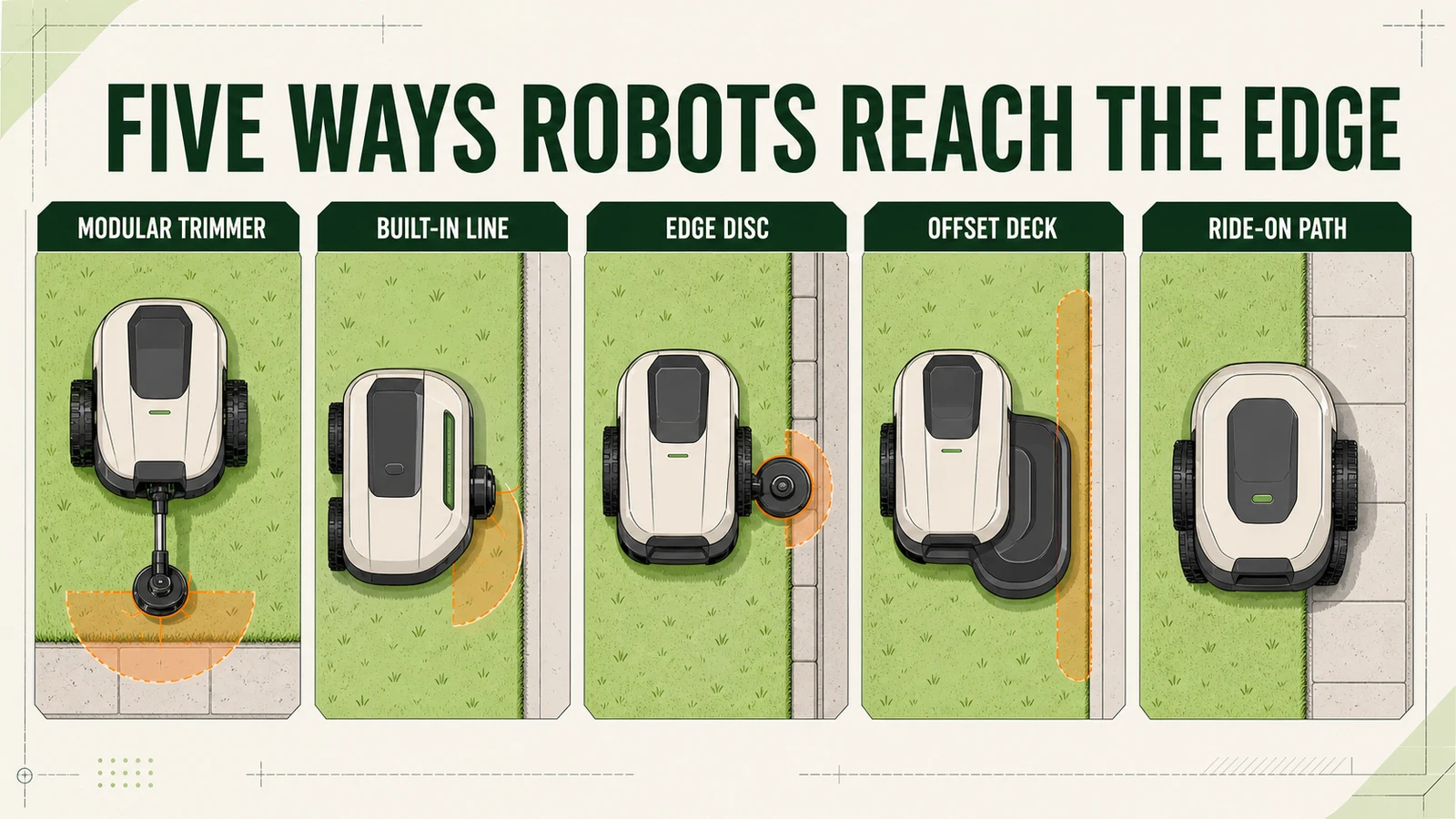
The robotic trimmer market is not yet a clean, separately measured market. It is better understood as an emerging capability layer inside robotic mowing and modular yard automation. Products now reach lawn edges through several architectures: a separate trimmer module, a line trimmer built into the mower, a dedicated edge-cutting disc, an offset main cutting deck, or a boundary path that lets the machine ride onto a safe hard surface.
Those approaches should not be grouped under one promise such as “zero-edge cutting.” They use different tools, work on different boundary types and create different safety, consumables and service requirements. A buyer should first define the edge that needs to be maintained, then test the machine in that condition.
Why Robot Mowers Still Leave Edge Work
A conventional robotic mower keeps its cutting system inside the outer body. The housing, wheels and required protection create distance between the blade path and a wall, fence or raised border. Better positioning can make the robot follow a planned line more accurately, but it cannot remove that physical offset.
The problem changes when the boundary is flat and crossable. If grass meets paving at the same level, a mower can place one or more wheels over the hard surface and bring its cutting path closer to the seam. The same strategy is unsafe at a retaining wall, pond edge or drop-off. A tree, curved flowerbed or narrow obstacle creates another geometry again.
This is why edge finishing cannot be judged only by the navigation label. Our guide to RTK versus LiDAR robot lawn mowers explains how positioning systems behave, but edge performance also depends on tool placement, vehicle width, turning behavior and the boundary itself.
Five Ways Robots Reach the Edge
| Architecture | How it works | Best fit | Main trade-off |
|---|---|---|---|
| Modular trimmer | A separate line-trimming tool attaches to a mobile yard-robot core | Dedicated trimming routes and multi-tool platforms | More vehicle length, attachment control and consumable management |
| Built-in line trimmer | A string or line head is integrated beside the mower system | Walls, fences and edges where the main deck cannot reach | Adds a second cutting system and thrown-object risk |
| Dedicated edge disc | A smaller blade disc operates near the perimeter | Repeated lawn-edge finishing within a mower platform | Extra blades, tool geometry and turning logic |
| Offset main deck | The primary cutting disc sits closer to one side of the body | Reducing the uncut strip without a second tool | Still limited by housing, wheels and required protection |
| Ride-on boundary path | The robot drives partly over a flat, safe border | Grass beside level paving or a crossable seam | Not suitable for walls, fragile borders or drop-offs |
These are product architectures, not quality rankings. A simple offset deck can outperform a more complex tool on a well-designed flat border. A line trimmer can reach a wall that no ride-on path can solve, but its control and maintenance burden is higher.
Modular Trimmers Turn the Mower Into a Yard Platform
Yarbo provides the clearest current example of the modular route. Its official Trimmer Package connects to the Yarbo Core through a Back Brace Mount and can be used with the company’s mower modules. Yarbo describes automatic line feed, adjustable trimming height, obstacle response and autonomous recharging. The product page dated for 2026 delivery also identifies the trimmer line and spool as service items.
This architecture separates mobility from the work tool. The same tracked core can carry different attachments, which makes the commercial question larger than lawn mowing: can one autonomous platform manage several seasonal yard tasks?
The advantage is tool specialization. The trimming head can be designed around edge work instead of being squeezed into a conventional mower shell. The disadvantage is integration. The control system must understand the attachment’s new length, swept area, contact behavior and stopping requirements. Mapping created for a mower is not automatically a safe trimming path.
A modular trimmer is therefore closer to a small outdoor tool carrier than an accessory in the usual retail sense. Dealers must configure the core, mount, tool, consumables and software as one operating system. That reinforces the importance of a verified robot mower dealer network, especially when installation and service cross several modules.
Built-In Trimmers Combine Mowing and Edge Finishing
ECOVACS’ 2026 GOAT A3000 LiDAR PRO illustrates the integrated line-trimmer route. The company presents TruEdge Trimmer as a built-in edge tool working alongside the main mower. Its US support catalog separately lists a trimmer kit, brush and line for compatible GOAT models.
That parts list matters. An integrated feature can reduce the number of passes and machines needed in the yard, but it does not eliminate the trimmer’s operating logic. The line wears, feeds and eventually needs replacement. The tool must also start only where the planned path and local environment allow it.
The integrated architecture gives the product team one chassis, one battery system and one navigation stack. It also makes the manufacturer responsible for the interaction between two cutting systems. If the mower approaches a boundary conservatively, the trimmer may not reach the target. If the route becomes too aggressive, the edge tool works closer to people, pets, decorative surfaces and objects that can be struck or projected.
The important product question is not whether a mower “has a trimmer.” It is whether the main deck, edge tool and path planner operate as one validated task.
Dedicated Edge Discs Add a Second Blade System
Husqvarna’s EdgeCut uses a dedicated cutting disc positioned at the rear of selected Automower models. The company’s support material explains that the function activates near a physical or virtual boundary and uses a sweeping turn to place the edge disc along the perimeter.
Roborock’s PreciEdge takes a related approach. On the RockMow X1 page, Roborock describes a separate edge-cutting module and carefully distinguishes the module’s structural distance from the actual result. The company says lawn-edge conditions and software logic influence the cut, and its accessory page notes that installing the module changes obstacle clearance.
That disclosure provides a useful purchasing rule: a hardware distance is not the same as residual uncut grass. Three layers must align:
- the cutting element’s position inside the machine envelope;
- the route the robot can safely drive;
- the real boundary, grass growth and surface condition.
A dedicated disc can stay within a familiar blade-and-screw maintenance system. It still adds another rotating tool, more replacement parts and another zone that technicians must inspect. The edge module can also change the machine’s effective width and access through narrow spaces.
Offset Decks and Ride-On Paths Solve Simpler Edges
WORX describes Landroid Cut-to-Edge as an off-centred blade-disc design. Instead of adding a second cutting tool, the main disc is placed closer to one side of the mower. This can reduce the remaining strip while preserving a relatively simple machine architecture.
The limitation is geometric. The deck still sits inside a protected vehicle body. It can get closer, but a vertical wall remains different from a level paved edge.
Segway Navimow makes the path distinction explicit. Its official material separates a standard boundary mode, which retains a buffer, from a ride-on mode for crossable edges. Newer product pages also describe closer cutting near walls and fences for specific models.
These claims should remain tied to the named model and boundary condition. Ride-on cutting can be highly effective where the landscape has been designed for it. It is not a software substitute for a physical edge tool at every wall, flowerbed or drop-off.
Boundary Type Determines the Right Tool
| Boundary | Preferred approach | What can go wrong | Acceptance evidence |
|---|---|---|---|
| Grass beside level paving | Offset deck or ride-on path | Robot avoids the seam, leaves wheel marks or crosses too far | Residual strip, track position and repeatability over several runs |
| Wall or fence | Line trimmer or dedicated edge disc | Tool remains too far away, contacts the surface or throws debris | Measured residual grass, surface inspection and controlled stop |
| Tree or flowerbed | Protected tool with a mapped contour | Bark, edging or plants are struck during repeated passes | Contact check, missed sections and path stability |
| Drop-off, pond or steep edge | Conservative boundary and exclusion zone | Coverage is gained by accepting fall or slide risk | Safe stopping margin under normal and degraded positioning |
| Narrow or obstacle-dense area | Compact envelope and attachment-aware routing | Added tool width causes trapping, scraping or incomplete turns | Full route replay with the final production attachment installed |
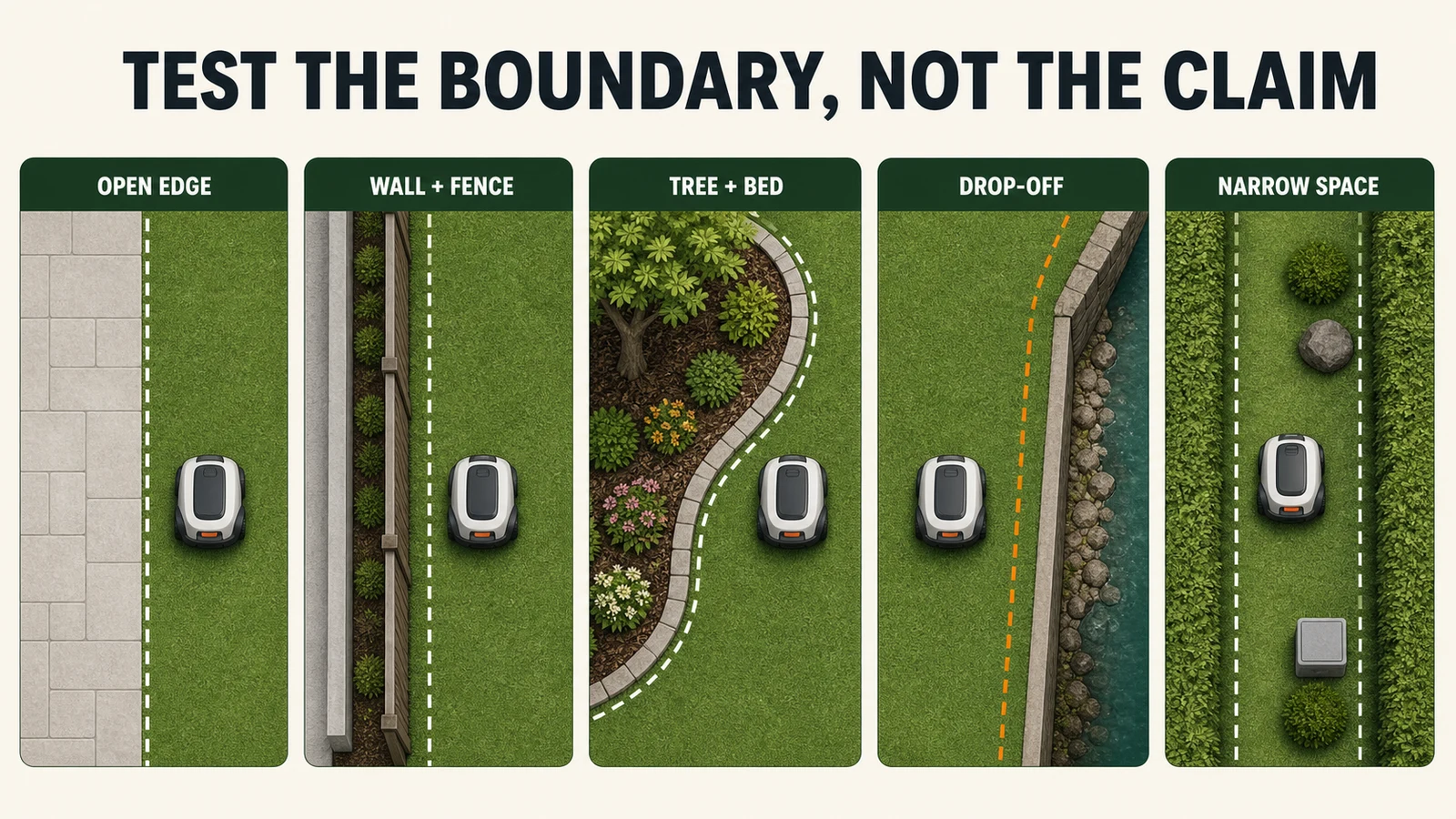
The correct acceptance test uses the buyer’s difficult boundaries, not only an open demonstration lawn. The installer should identify each edge type during the same site process used for robot lawn mower installation, then record which mode or tool is permitted in each zone.
Navigation Accuracy Is Not Cutting Accuracy
Centimetre-level positioning is valuable, but it is only one input. A robot can know its location accurately and still leave grass because the cutting element is far inside the body. It can also follow the planned centerline while the attached trimmer sweeps a larger area than the chassis.
The full edge-control chain is:
`position estimate → boundary model → allowed vehicle path → tool envelope → cutting interaction`
An error or conservative setting at any layer changes the result. Dense vegetation can hide a border. A mapped line can become outdated after landscaping. Wheel slip can shift the body on a slope. A flexible trimmer line can behave differently against grass, fence mesh and hard decorative edging.
This is why the market should stop treating “wire-free,” “RTK,” “LiDAR” or “AI vision” as a complete edge-performance specification. Those terms describe parts of localization and perception. They do not define the installed cutting outcome.
Edge Tools Change the Safety Case
IEC 60335-2-107 covers significant hazards for battery-powered robotic rotary lawnmowers and their peripherals within its scope. The IEC summary highlights requirements around manual stop, cutting-means stopping time, traction stopping, restart procedures, disabling devices, work areas and sensors.
IEC 62841-4-4 covers hand-held and walk-behind lawn and grass trimmers used by a standing operator. Its published scope explicitly excludes self-propelled lawn and edge trimmers.
That boundary is important. A product team should not assume that calling a device a robot mower or a grass trimmer automatically supplies the complete conformity route for an autonomous combined machine. The final assessment depends on the product’s tool, movement, controls, battery system, intended use and target market.
For buyers, the practical questions are more immediate:
- Does the edge tool have an independent enable and stop state?
- What happens after lost positioning, lift, tilt, blockage or obstacle detection?
- Can a user service line or blades without an unintended restart?
- Does the protective structure manage contact and projected debris?
- Are children, pets and wildlife addressed by operating restrictions as well as detection claims?
- Does installing the module change slopes, clearances or prohibited zones?
These questions extend the broader framework in Are Robot Lawn Mowers Safe?. A camera label or object-count claim is not a substitute for tool-specific risk control.
Consumables and Service Will Shape the Category
Edge finishing introduces components that the main mower may not use: trimmer line, spools, guide discs, edge blades, fasteners, guards and sometimes a separate motor or transmission. A product that performs well in a demonstration can still disappoint if those parts are unavailable locally or difficult to replace.
Brands and distributors should define:
| Service question | Why it matters |
|---|---|
| Is the edge system standard, optional or market-specific? | The same mower name may ship with different capability |
| Which parts are consumables? | Dealers need stocking and replacement guidance |
| Can the owner replace them safely? | Maintenance affects training, liability and downtime |
| Does the attachment change transport or storage? | A longer or wider machine may need different handling |
| Is the feature active at launch or dependent on an update? | Announced software should not be sold as verified current behavior |
| Who validates the final boundary map? | Successful edge performance is site-dependent |
This service layer will determine whether robotic trimming becomes a durable category rather than a launch-season feature race.
How Buyers Should Run an Acceptance Test
Use the production machine, final attachment and current software. Do not accept a test performed with a different tool configuration.
- Classify the edges. Mark open hard borders, walls, fences, trees, flowerbeds, drop-offs and narrow areas separately.
- Record the mode. Identify whether each boundary uses ride-on cutting, an offset deck, an edge disc or a line trimmer.
- Test normal operation. Measure the remaining strip and inspect adjacent surfaces after repeated passes.
- Test interruptions. Verify safe behavior after pause, obstacle response, lift, blockage and positioning degradation according to the manufacturer’s approved procedures.
- Inspect consumables. Check line feed, blade condition, fasteners, guards and replacement access.
- Confirm exclusions. Document areas where the edge tool must remain disabled, especially drop-offs, fragile borders and public access.
- Assign service responsibility. Record who changes parts, updates maps, handles warranty work and approves software changes.
The pass criterion should be a repeatable result for each boundary type, not the smallest distance printed on a product page.
What Would Make Robotic Trimming a Standalone Category?
The current evidence shows real product movement. Yarbo treats trimming as a modular yard task. ECOVACS integrates a line trimmer into the mower. Husqvarna and Roborock use dedicated edge discs. WORX and Segway show how deck placement and boundary routing reduce manual finishing without a separate autonomous trimmer.
That is enough to identify a technology direction, but not enough to claim a separately measured mature market. A standalone category would need clearer product definitions, comparable shipment or revenue data, stable safety and conformity routes, repeatable performance metrics, a consumables channel and service practices that work across brands.
The larger robotic lawn mower market is moving beyond basic autonomous mowing. The next competitive question is how much manual finishing remains after the robot returns to its dock.
Frequently Asked Questions
Is there a robotic trimmer market?
There is an emerging product field, but public products currently span mower features, optional modules and multi-tool yard platforms. Without a consistent product definition and comparable audited data, it should not be treated as a separately measured mature market.
What is the difference between a robotic trimmer and edge-cutting robot mower?
A robotic trimmer uses a dedicated trimming tool, often line-based, to work along boundaries. An edge-cutting mower can instead use an edge disc, offset main deck or ride-on path. The terms are not standardized, so the hardware and operating mode must be checked.
Can RTK or LiDAR eliminate the need for an edge tool?
No. Better positioning can improve the route, but it cannot remove the distance between an inward-mounted blade and a vertical wall. On a level crossable border, accurate ride-on routing can reduce or eliminate the remaining strip without a separate tool.
Does “zero-edge” mean no manual trimming?
Not in every yard. The result depends on boundary geometry, tool position, route logic, grass condition and safety limits. Buyers should test each important boundary type on site.
What should dealers verify before selling a trimmer-equipped mower?
Dealers should verify final configuration, boundary mapping, safe tool operation, consumable supply, maintenance responsibility, software status and acceptance criteria for the customer’s actual yard.