- A country sales page or dealer count does not prove that a robot mower can be surveyed, installed, repaired and supported at a specific site.
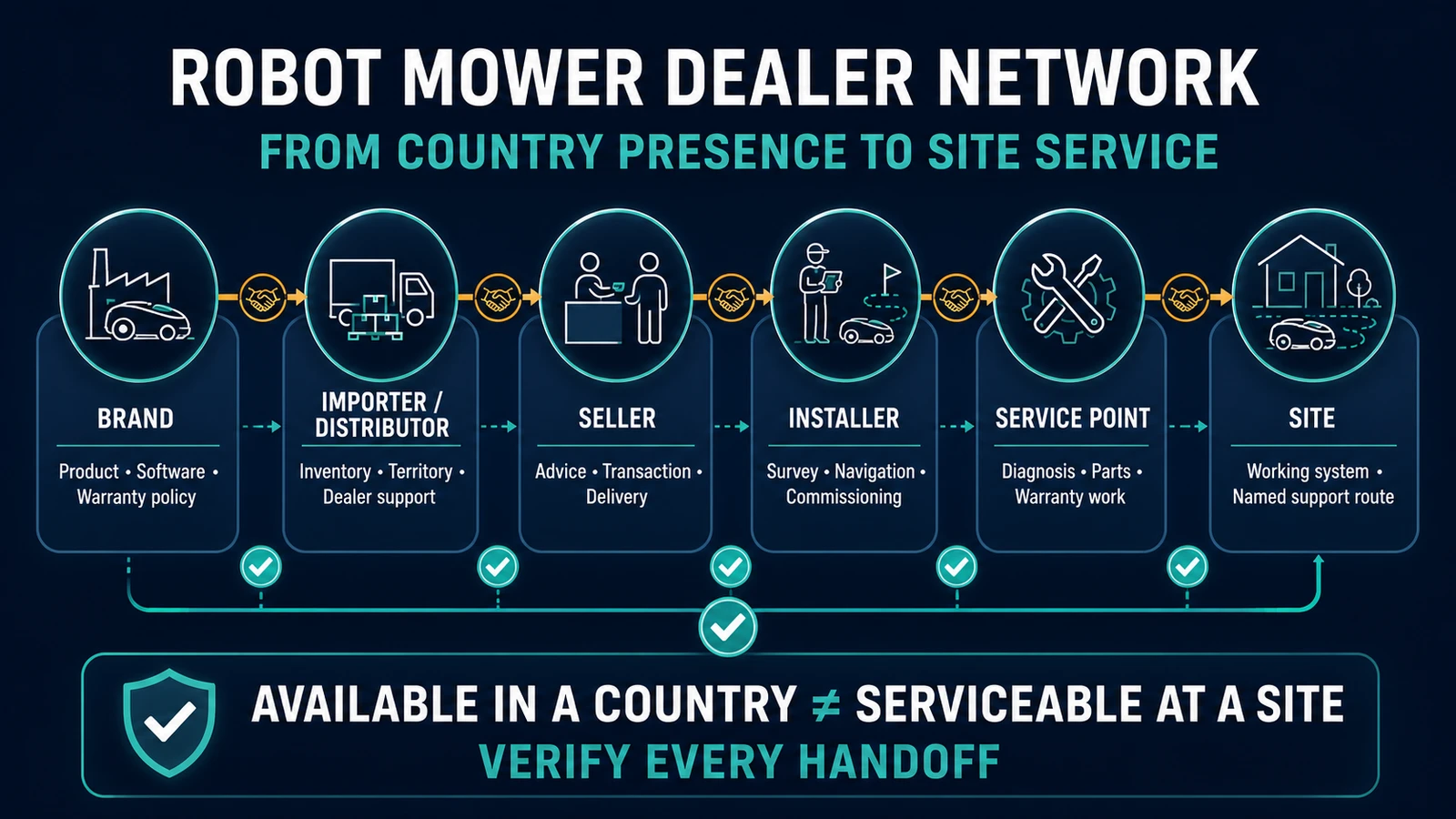
- Dealer-network due diligence should separate the brand, importer, distributor, seller, installer and authorized service point, then assign responsibility for each handoff.
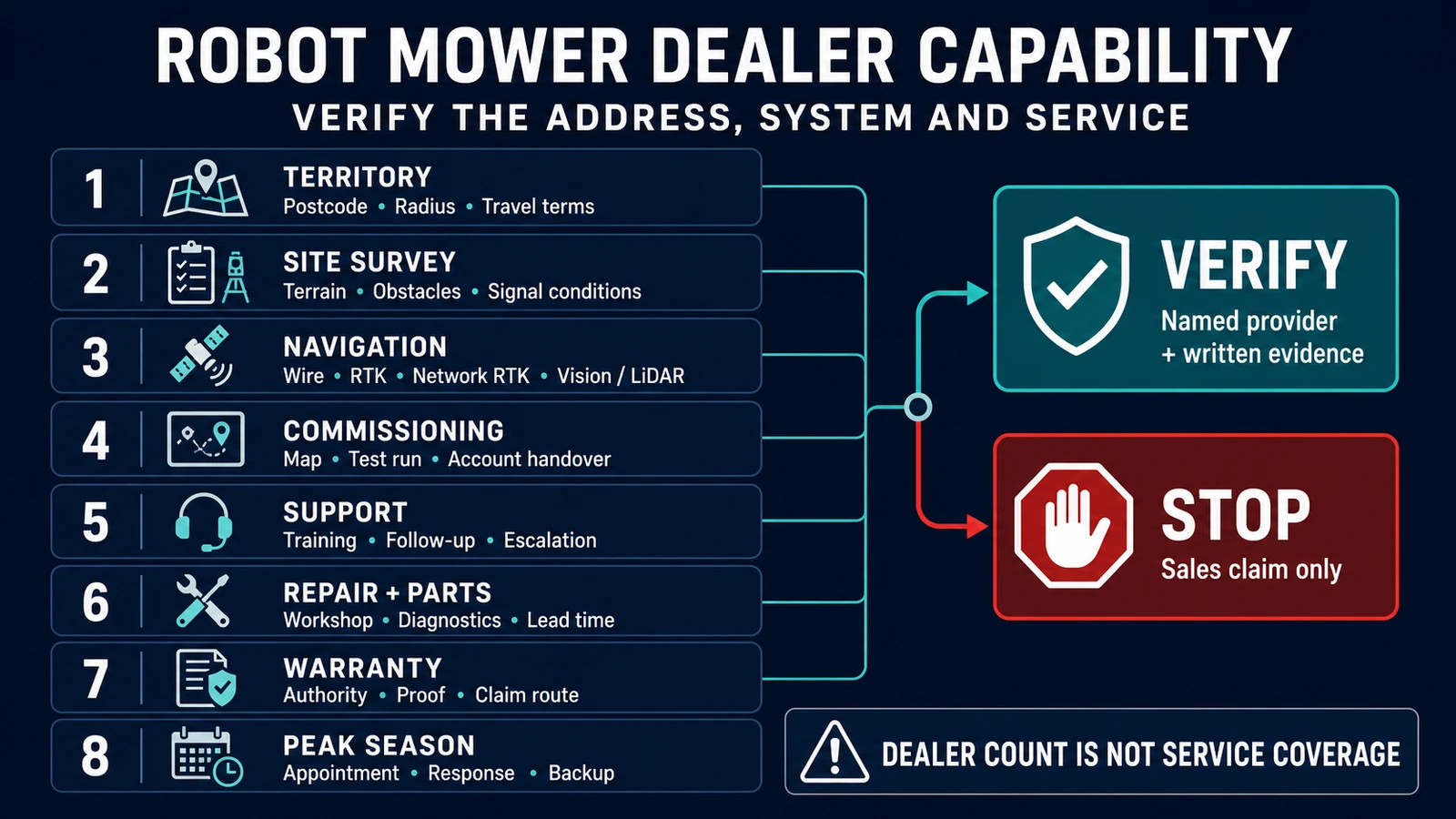
- Verify coverage with postcode-level service evidence, navigation-specific installation capability, parts and warranty authority, and seasonal response commitments.
In this article 10 sections
A robot mower dealer network is not proved by a country website, an online checkout or a headline dealer count. A usable network must deliver at the site: lawn assessment, the correct navigation setup, commissioning, owner training, repair, parts and warranty handling. Buyers and brands should therefore verify coverage by postcode or service radius and identify who owns every handoff—from import and sale to installation and after-sales support.
The distinction matters because robot mowers are installed systems. A machine can be available for purchase while the nearest seller cannot survey satellite visibility, configure a reference station, repair the product or process a warranty claim.
Sales Presence Is Not Service Coverage
Four claims are often treated as interchangeable:
| Claim | What it proves | What it does not prove |
|---|---|---|
| “Available in this country” | At least one sales route exists | Local installation, repair or parts |
| “Sold by a national retailer” | The product has retail reach | Robot-mower-trained technicians |
| “Hundreds of dealers” | A locator contains many entries | Every entry supports the model and navigation system |
| “Local service” | Some support function exists | Postcode coverage, response time or warranty authority |
Mammotion’s official purchase page, for example, separates its own online stores, official dealers and online retailers. Its warranty policy separately describes the roles of a local dealer, Mammotion customer service and a designated service station. Those are different capabilities, even when they carry the same product.
This page therefore does not rank brands by dealer count. A large unqualified number can mix sales-only shops, inactive records and outlets that do not install or repair robot mowers.
Who Does What in a Robot-Mower Channel?
| Role | Primary job | Evidence to request |
|---|---|---|
| Brand or manufacturer | Product, software, training system and warranty policy | Regional entity, support route, approved models and escalation owner |
| Importer | Customs, inventory and local market entry | Legal entity, stocked products and warranty relationship |
| Distributor | Recruits and supplies dealers | Territory, dealer list, training and parts process |
| Retailer or ecommerce seller | Transaction and delivery | Authorized status, return route and service referral |
| Authorized dealer | Advice, sale and often installation | Current authorization, trained staff and supported navigation types |
| Installer | Site survey, setup and commissioning | Survey record, installation checklist and acceptance test |
| Service point | Diagnosis, repair, parts and warranty work | Workshop capability, parts access and warranty authority |
One company can hold several roles. The buyer still needs the responsibility map. “Contact your dealer” is incomplete when the selling dealer sends installation to a contractor and warranty repair to another city.
What Installation Capability Actually Means
Husqvarna’s US professional-installation offer starts before the mower is unpacked. It includes a consultation and property walk-through, charging-station placement, wired or wireless boundary setup, firmware and app pairing, owner instruction and a follow-up whose format varies by dealer.
Kress describes a similar professional sequence for its robotic systems: site assessment, mower selection, navigation configuration, system testing and commissioning. Its official installation page adds that RTK-based systems require accurate site mapping with specialized equipment.
STIHL’s iMOW material assigns its dealer the lawn layout, perimeter wire, docking station and mowing-program review, then keeps maintenance, repair and annual service within the dealer relationship. Segway Navimow’s installation guidance likewise treats charging position, digital mapping, test runs and user training as parts of the installation—not optional retail extras.
A credible quotation should therefore define the deliverable:
- a recorded site survey;
- the selected mower and navigation method;
- installed charging and positioning hardware;
- mapped work areas, exclusions and transitions;
- firmware, connectivity and account setup;
- a witnessed test run;
- owner or operator training;
- an acceptance and follow-up record.
Wired, RTK, Network RTK and Vision/LiDAR Need Different Skills
Boundary-wire systems
The installer must design the loop and guide paths, protect high-consequence edges, manage narrow passages and document cable routes for future repairs. A retailer that can sell blades and batteries is not automatically a boundary-wire installer.
Local-reference-station RTK
The survey must check satellite visibility and the relationship among the reference station, charging station and work areas. Husqvarna’s EPOS guidance shows that model and market determine whether cloud correction or a local station is used, and that some models require dealer installation.
Network RTK
The dealer must first prove that correction coverage exists at the actual site. Kress tells buyers to check RTKn network availability with the dealer. A mower listed on a national website can still lack usable correction service at a particular address.
Vision or LiDAR systems
Less external infrastructure does not eliminate commissioning. The provider still needs to confirm terrain, transitions, lighting or vegetation conditions, map quality, obstacle behavior and the support route when the environment changes.
For a technology-level comparison, see RTK vs LiDAR Robot Lawn Mowers. That page owns the navigation mechanisms; this page owns the channel capability needed to deploy and support them.
How to Verify Dealer Coverage
Start with one address, one product and one required service. Ask the brand or distributor to identify:
- the selling entity;
- the named installation provider;
- the servicing workshop;
- the parts source;
- the warranty decision maker;
- the escalation route if the first provider cannot respond.
Then verify the chain directly. A locator entry is useful evidence that a relationship is claimed; it is not proof that the outlet currently supports the selected model. Husqvarna’s US locator distinguishes Automower locations and servicing dealers, which is more informative than one undifferentiated list.
Dealer-Network Scorecard
| Capability | Minimum evidence | Stronger evidence | Stop condition |
|---|---|---|---|
| Territory | Postcode accepted | Written radius and travel terms | “Nationwide” with no assigned provider |
| Site survey | Phone or photo review | On-site record with constraints | Model selected before the lawn is assessed |
| Navigation | Supported system named | Trained installer and tools | No proof for the selected RTK/vision method |
| Commissioning | Setup included | Signed test and handover | Delivery only |
| Training | Basic owner guidance | Operator checklist and account handover | App belongs to installer with no transfer |
| Repair | Contact route | Named workshop and diagnostic capability | Seller only redirects to a generic inbox |
| Parts | Orderable items | Local fast-moving stock | No lead-time owner |
| Warranty | Policy link | Authorized claim workflow | Unauthorized repair risk is unexplained |
| Peak season | Best-effort response | Written appointment and escalation | No capacity statement |
Questions for Brands, Distributors and Dealers
For a brand entering a market
- Which partner owns the customer after the sale?
- Which dealer types can install each navigation architecture?
- How are technicians trained and authorization kept current?
- Where are diagnostic tools and fast-moving parts held?
- How are failed installations, software issues and warranty disputes escalated?
- What coverage and response data can be audited by territory?
For the wider supplier map, use Robotic Lawn Mower Manufacturers in China. Manufacturer identity and export capacity do not by themselves establish local service.
For a buyer choosing a dealer
- Will the named company survey this exact address?
- Who performs the work, and is subcontracting disclosed?
- Which site conditions can cause the quotation to change?
- What is included in mapping, testing, training and follow-up?
- Where will the mower go for diagnosis and repair?
- Who provides a replacement part or warranty decision during peak season?
Common Network Claims That Need Evidence
“Global coverage” needs a country and postcode test. “Authorized dealer” needs a current authorization and supported-product scope. “Professional installation” needs a written deliverable. “Local repair” needs a workshop and warranty route. “Parts available” needs a source, lead time and owner.
Mammotion says it operates across more than 30 countries and lists local operational and service centers in several major markets. That is useful company-level evidence, but it does not prove equal service density in every country. The same boundary applies to every brand claim.
The Robot Lawn Mower Market Size and Yard Automation page explains category adoption. Dealer-network verification answers a different question: whether a sale can become a working, supportable installation.
Frequently Asked Questions
How do I find robot mower dealers near me?
Start with the brand’s official locator, then call the listed outlet and verify the selected model, navigation system, installation area, repair capability and warranty role. Do not assume every locator entry provides every service.
Does an authorized dealer always provide installation?
No. Authorization scopes differ by brand, market and outlet. Some locations sell products, some install, and some perform repair or warranty work. Ask for the exact service scope in writing.
Is online purchase a problem?
Not by itself. The risk is an incomplete service chain. Before buying, identify who will survey the site, commission the mower, handle returns, provide parts and process warranty work.
Do wire-free robot mowers eliminate installation?
They can remove boundary-wire work, but they still require site compatibility, mapping, charging setup, testing and handover. RTK services may also depend on a reference station, network coverage or clear satellite visibility.
What is the most important dealer-network metric?
There is no single useful count. For one project, the decisive metric is whether a named provider can deliver and support the selected system at the address within the required time.
Final Decision
Evaluate a robot mower dealer network from the site backward. Verify the address, mower, navigation method and service task; then name the provider responsible for each handoff.
A brand has a functioning network only when distribution becomes repeatable local delivery: survey, installation, commissioning, repair, parts and warranty support. Everything else is market presence, not yet service coverage.