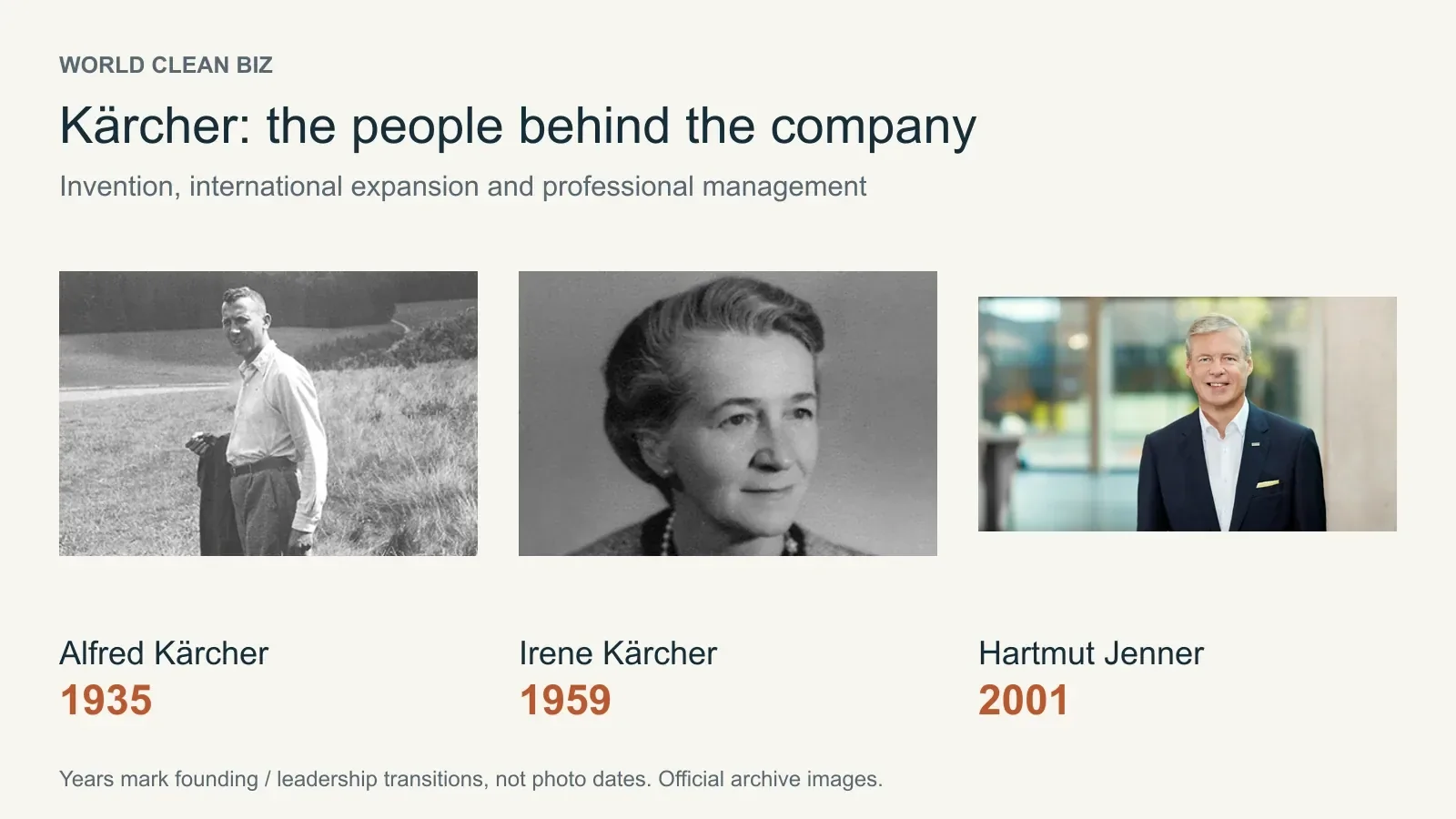
- Irene Kärcher led the company for three decades after Alfred's death, overseeing international expansion and a sharper focus on cleaning.
- Family ownership has continued alongside professional management, with Hartmut Jenner leading the business since 2001.
- Kärcher's next chapter includes commercial cleaning robots and a professional battery alliance with STIHL.
In July 2005, a German cleaning team arrived at Mount Rushmore. Its assignment was to wash the faces of four American presidents.
Each carved head stands about 18 meters tall. Algae and lichen had accumulated on the granite over decades, discoloring the surface and contributing to deterioration. Working with National Park Service staff, the German specialists cleaned the enormous faces a little at a time. The project took about a month.
The company was Kärcher. In China's cleaning industry, it was long known by the Chinese name Kaichi; its official Chinese brand name today is Kahe.
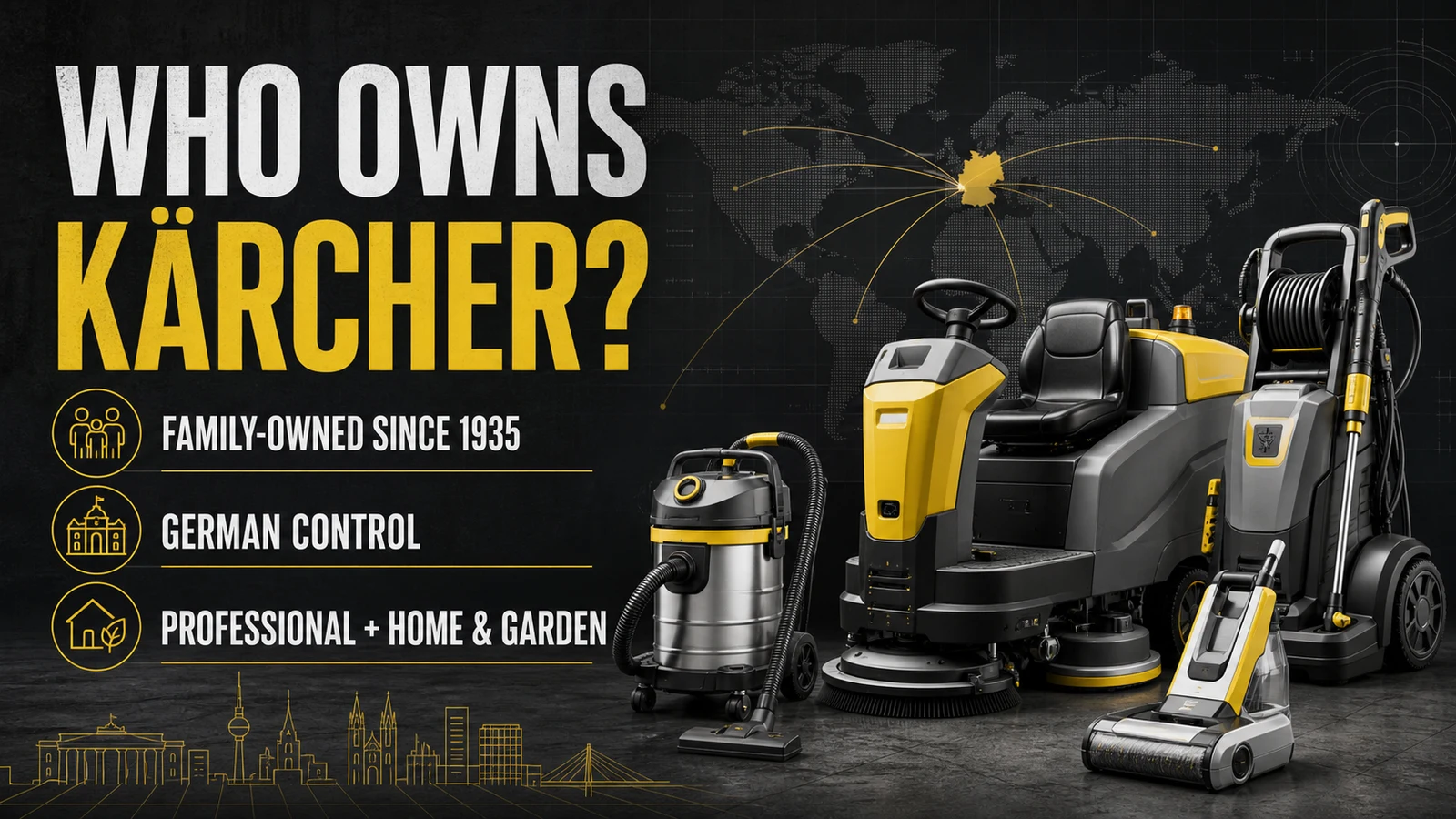
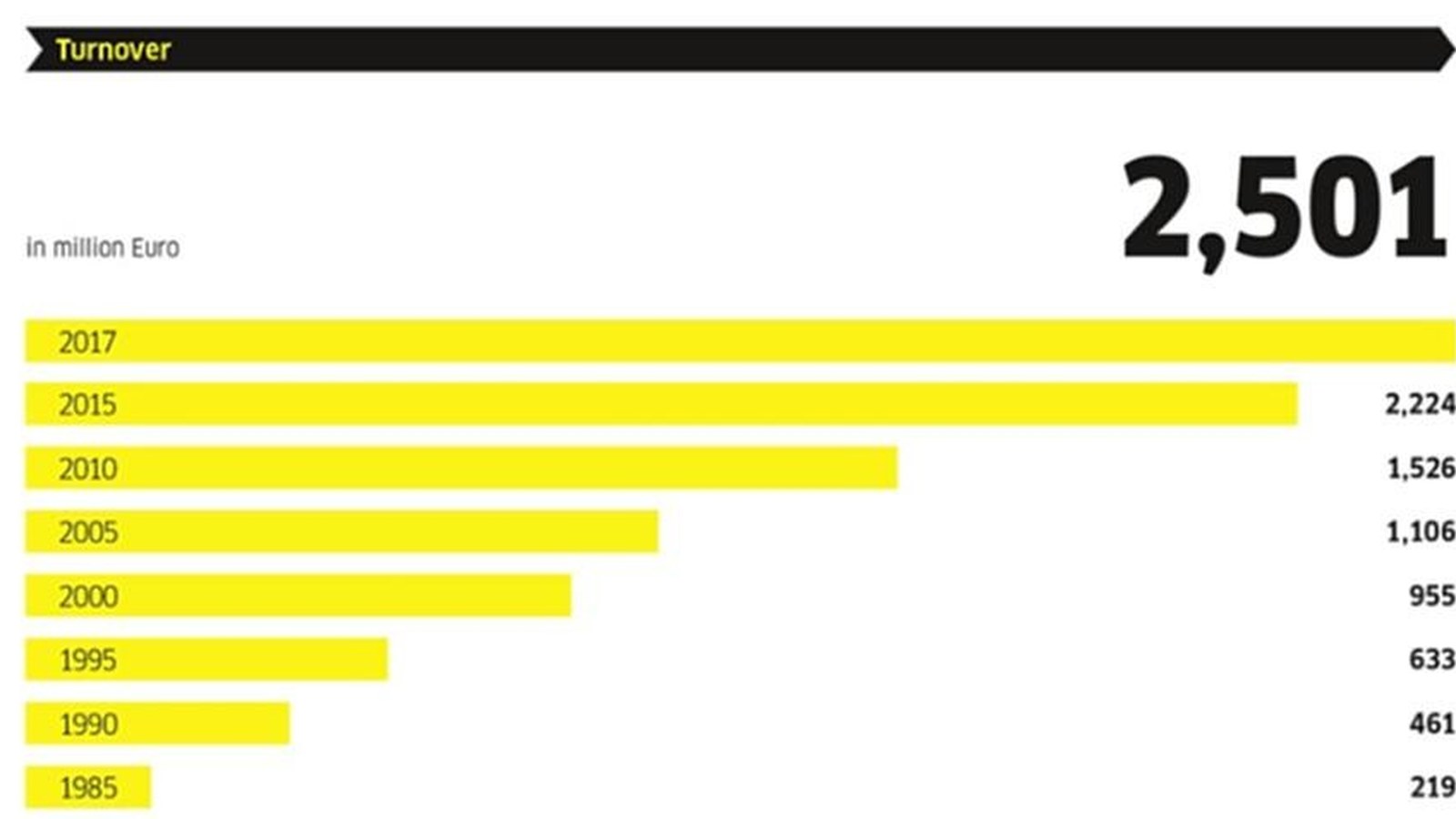
Kärcher is a characteristic German hidden champion. Its name does not have the international recognition of Mercedes-Benz or Siemens, yet a household pressure washer and a petrochemical plant's tank-cleaning system can come from the same business. In 2025, it generated €3.483 billion in revenue. Its operations span the world; ownership remains with the founder's family.
Mount Rushmore was one of many such assignments. Kärcher has also cleaned Christ the Redeemer in Rio de Janeiro and the colonnades of St. Peter's Square at the Vatican. It brought engineers, pumps and cleaning equipment to these landmarks.
Alfred Kärcher, the founder, lived to see none of those projects.
He died suddenly of a heart attack in 1959, aged 58. His wife, Irene, was 39. Their children were nine and two. The business she inherited employed about 250 people and was still a long way from becoming a multinational.
Alfred had left behind a factory with engineering expertise and products. Taking it beyond Germany and building a global cleaning brand fell to Irene.
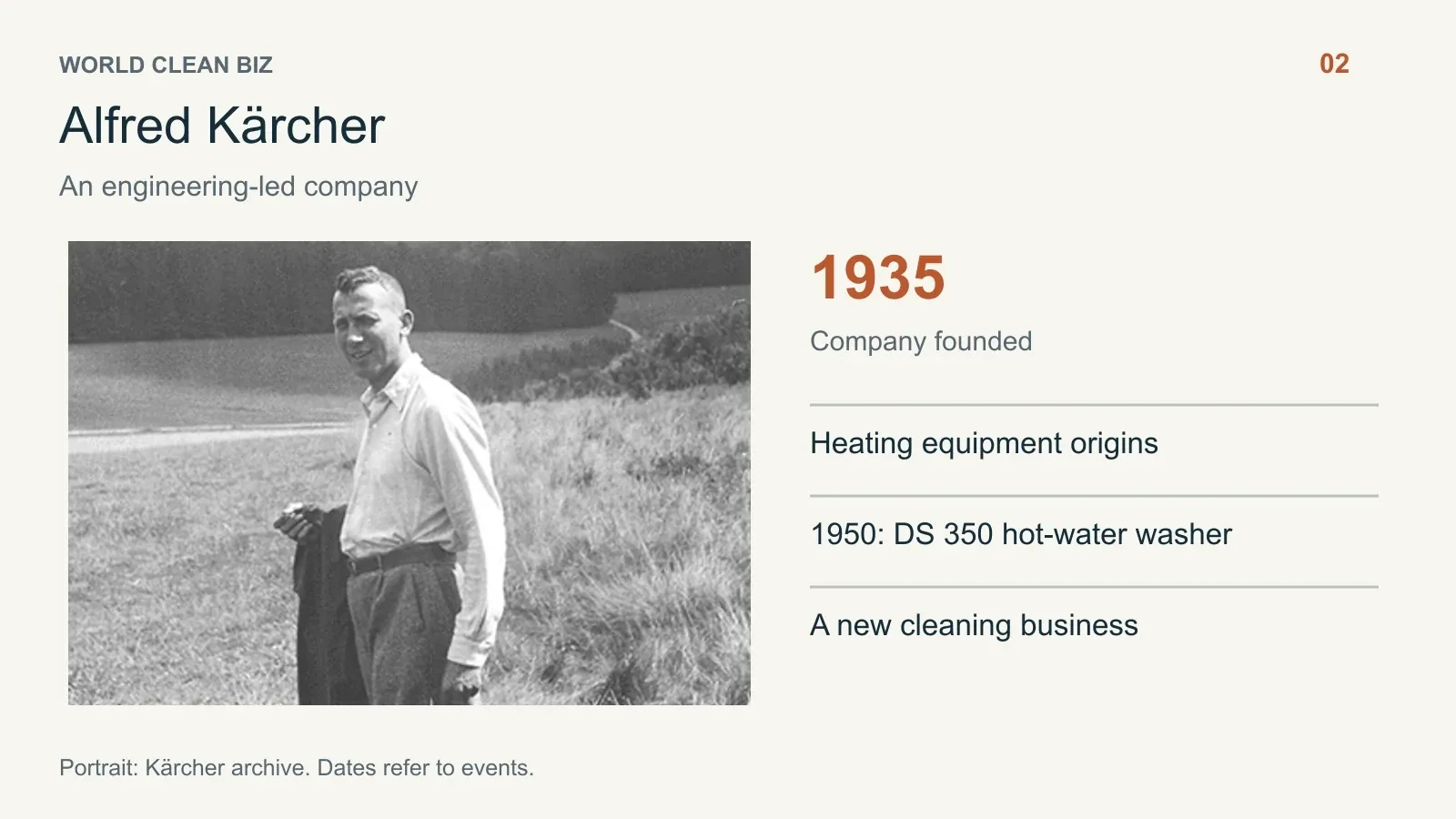
Alfred was an engineer. When he founded the company in 1935, it developed heating equipment rather than the cleaning machines now associated with its name. During the war, the business also manufactured heating equipment for Germany's armed forces.
After the war, the factory made stoves and handcarts. Cleaning began to emerge as an important business with Alfred's introduction of the DS 350 hot-water pressure washer in 1950.
Hot water combined with pressure could remove oily dirt that ordinary rinsing left behind. The technology had clear applications in factories, vehicle servicing and agriculture. But Kärcher still made several kinds of equipment. Becoming a company dedicated to cleaning would take considerably longer.
Irene was not entering business without experience. Before marrying Alfred, she had worked as secretary to the general director of Daimler-Benz, gaining exposure to the management of a large industrial company. After her husband's death, she took charge of the business—and stayed.
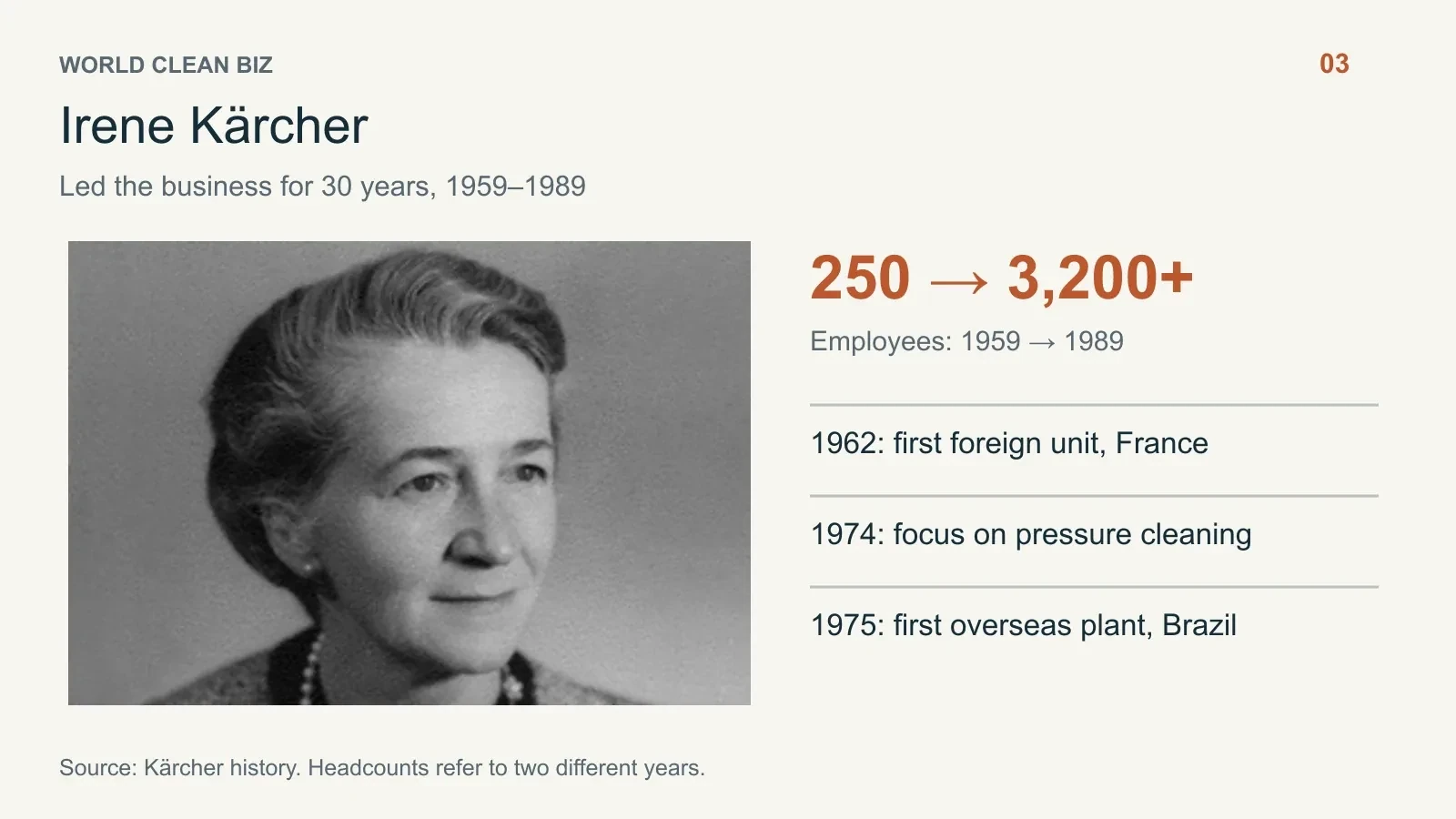
In 1962, only three years after she took over, Kärcher established its first foreign subsidiary in France. Sales organizations in more countries followed.
Exporting a machine created obligations beyond delivery. Someone had to demonstrate it, repair it and keep spare parts locally. For customers who earned their living with the equipment, repair time could determine whether they bought from the same supplier again. Kärcher's expansion abroad included building that service capability.
One of the most consequential decisions of Irene's tenure came in 1974. Management concentrated the business on pressure-cleaning equipment for professional users and withdrew from other product categories. Heating equipment, once an important source of revenue, gradually gave way.
To concentrate resources, Irene helped steer the company away from part of the business her husband had built.
Around the same period, the machines changed from blue to yellow. The equipment that would fill European garages, gardens and tool stores was beginning to take its familiar form. In 1975, Kärcher opened its first factory outside Germany, in Brazil.
As its machines reached more countries, the company found an unusual way to demonstrate what they could do: cleaning landmarks in public view.
It helped clean Rio's Christ the Redeemer statue in 1980. Cultural heritage cleaning subsequently became a continuing program. Buildings and sculptures of different ages and materials required an assessment of their surfaces before a cleaning method could be selected. Simply turning the pressure to its highest setting was no solution.
These projects gave Kärcher visibility that industrial equipment suppliers rarely enjoy. A business selling pumps, hoses and pressure washers began appearing in photographs alongside some of the world's best-known buildings.
A much smaller machine expanded its consumer base.
In 1984, Kärcher introduced the HD 555 household pressure washer, weighing about 15 kilograms. Equipment previously associated mainly with professional work became accessible to ordinary households. Washing a car, patio or driveway no longer required borrowing a cumbersome industrial machine.
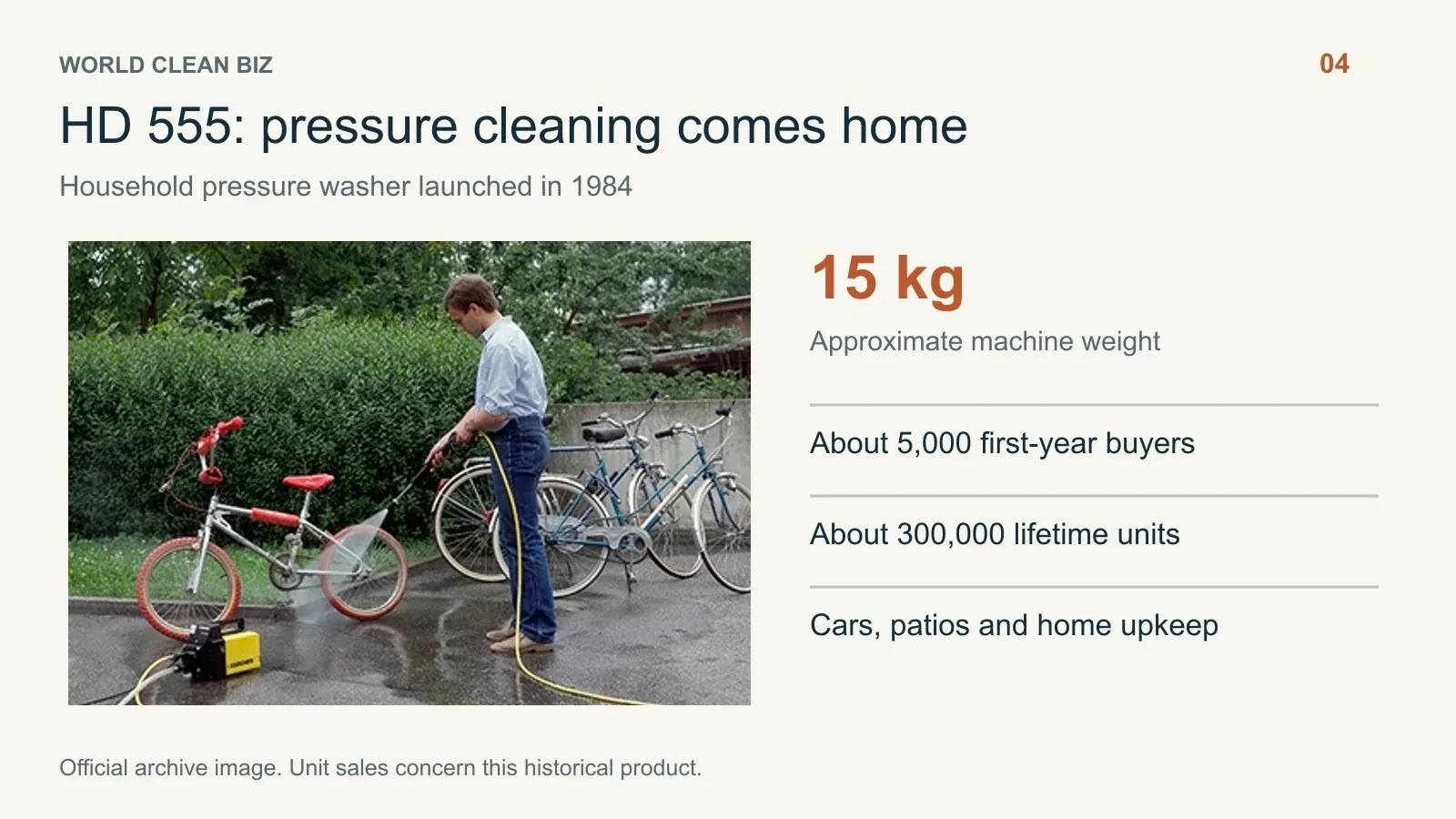
The product found about 5,000 buyers in its first year and sold roughly 300,000 units over its life. For European households with garages and gardens, a pressure washer became a tool they could own and operate themselves. Kärcher gained access to a much larger consumer market.
When Irene died in 1989, she had led the company for 30 years. Its workforce had grown from about 250 people to more than 3,200.
Her husband's name remained on the company, but she had profoundly changed its direction. An account of Kärcher that stops at Alfred's inventions misses much of how the multinational was built.
After Irene, the family retained ownership while professional executives assumed day-to-day management.
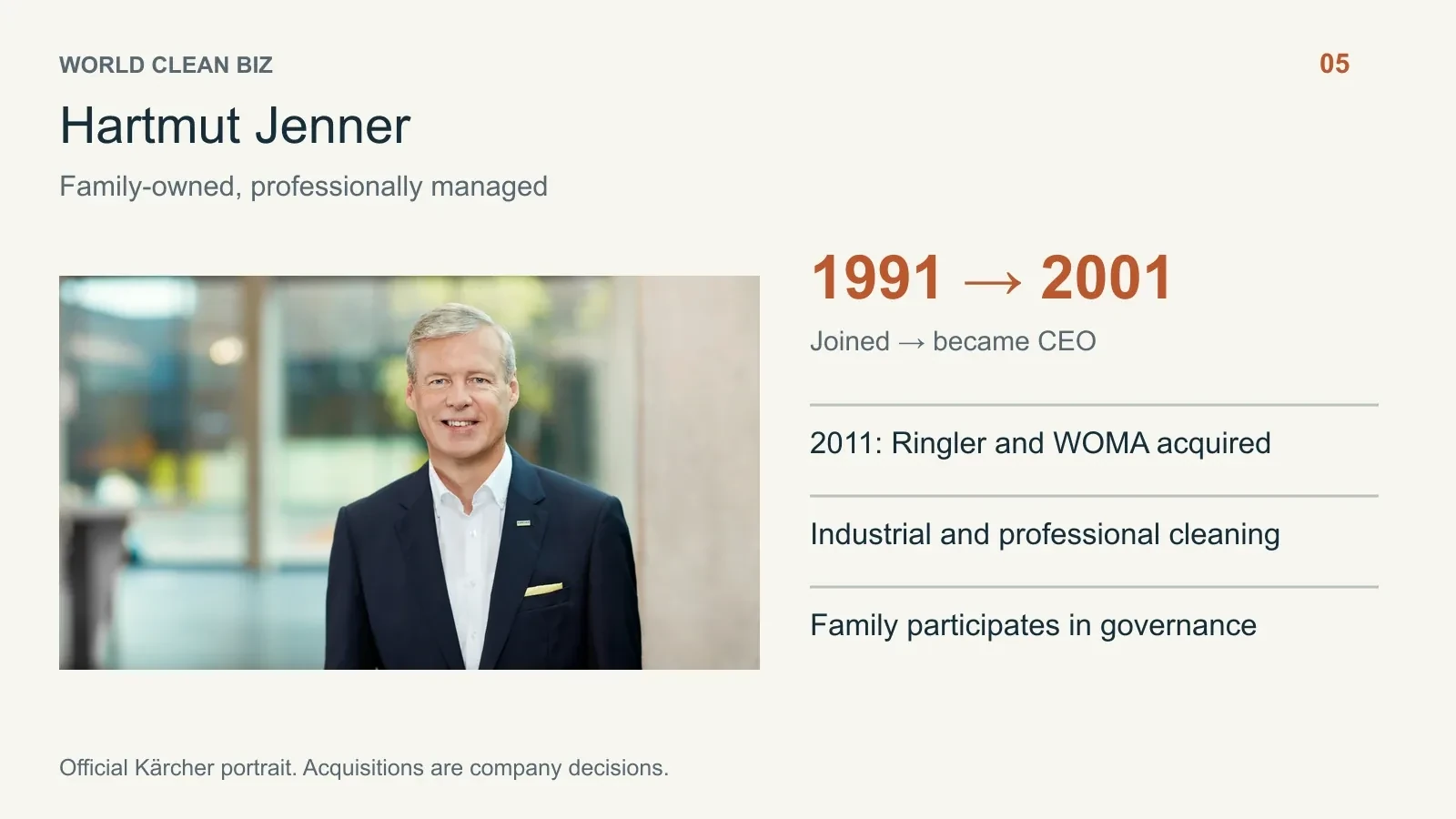
In 1991, a young man who had grown up on a farm near Winnenden joined the company. Hartmut Jenner had studied engineering and business administration and had already interned at Kärcher. He began as an assistant to management, later ran the consumer division and became chief executive in 2001.
He is still there. A manager who does not bear the founding family's surname has now led the company for a quarter of a century.
Jenner's enthusiasm for the products can be surprisingly specific. In a 2021 interview, he said he had 37 Kärcher appliances at home.
He singled out an electric sweeper. He kept one on every floor, thought it exceptionally useful and could not understand why it had not become a much bigger seller. His interviewer admitted not knowing the product.
Even after years at the head of the company, Jenner still encountered products he liked more than the market appeared to.
He described himself as an employed entrepreneur. The family retained ownership while giving management room to run the business, subject to transparent communication. He has described regularly explaining the company's operations to younger members of the family.
Today, Franziska Kärcher chairs the supervisory board while Jenner leads the business. The family remains involved without requiring every important job to be held by a relative.
During Jenner's tenure, Kärcher continued expanding into additional cleaning markets. In 2011, it acquired industrial vacuum specialist Ringler and ultra-high-pressure equipment company WOMA. Industrial cleaning, commercial floor care and municipal equipment became part of a broader business alongside household products.
In 2013, professional equipment changed to gray, with yellow primarily reserved for consumers. Many people still associate Kärcher with a yellow pressure washer. The customers buying gray machines are equally important to understanding the company.
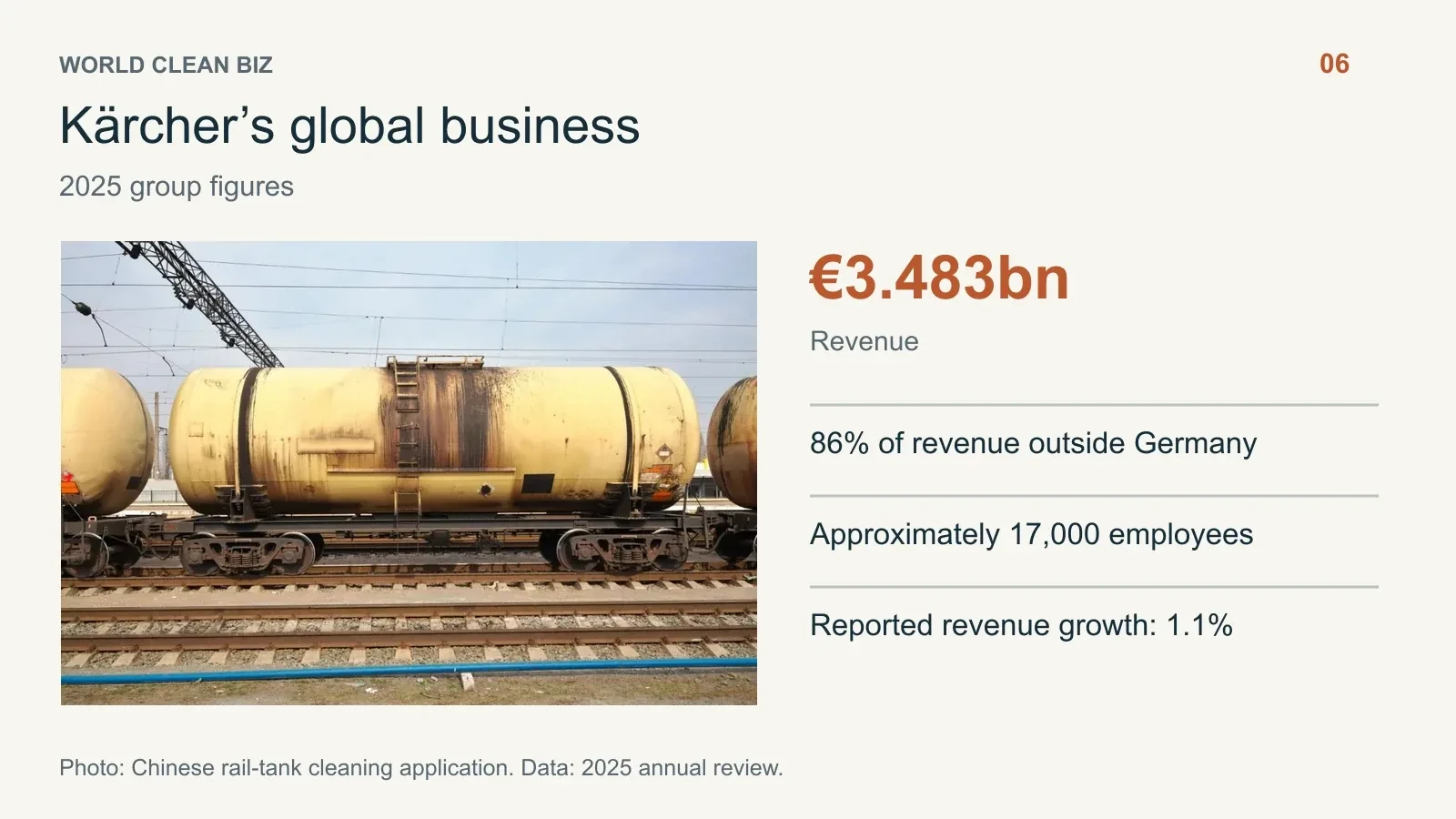
In China's Xinjiang region, a petrochemical company needed to clean railway tank cars. Workers previously entered the tanks, spending six to 12 hours cleaning a single car in hot, confined conditions.
Kärcher's automated cleaning system entered service in 2015. According to a case study the company published in 2023, it reduced cleaning time to less than an hour and had processed almost 120,000 tank cars over eight years.
Cleaning time and equipment availability affect tank-car turnaround and plant operations. After delivery, the system still needs maintenance to keep it running.
That is a different business from selling an appliance to a household. Kärcher has to persuade one customer to buy a window vacuum and another to trust a cleaning installation to operate reliably for years.
By 2025, the group employed about 17,000 people, with 86% of revenue generated outside Germany. It had become a highly international cleaning-equipment group, well beyond its beginnings as a German factory exporting pressure washers.
China is an important part of that network. Changshu hosts manufacturing and headquarters functions, while the Suzhou research center includes robotics laboratories and battery-related development capabilities. The Chinese operation's role extends beyond bringing German products into the local market.
The change in Chinese brand name from Kaichi to Kahe had a practical commercial rationale, too. Kärcher has explained that it involved protecting its Chinese-language trademark. The name long familiar to Chinese industry insiders gradually gave way to the one consumers see today.
Scale and history, however, do not ensure that every new business succeeds.
In 2003, Kärcher introduced the RC 3000 cleaning robot with a base station that charged the machine and collected its dust. Automatic dust emptying, now familiar to many robot-vacuum buyers, appeared in a Kärcher product more than two decades ago.
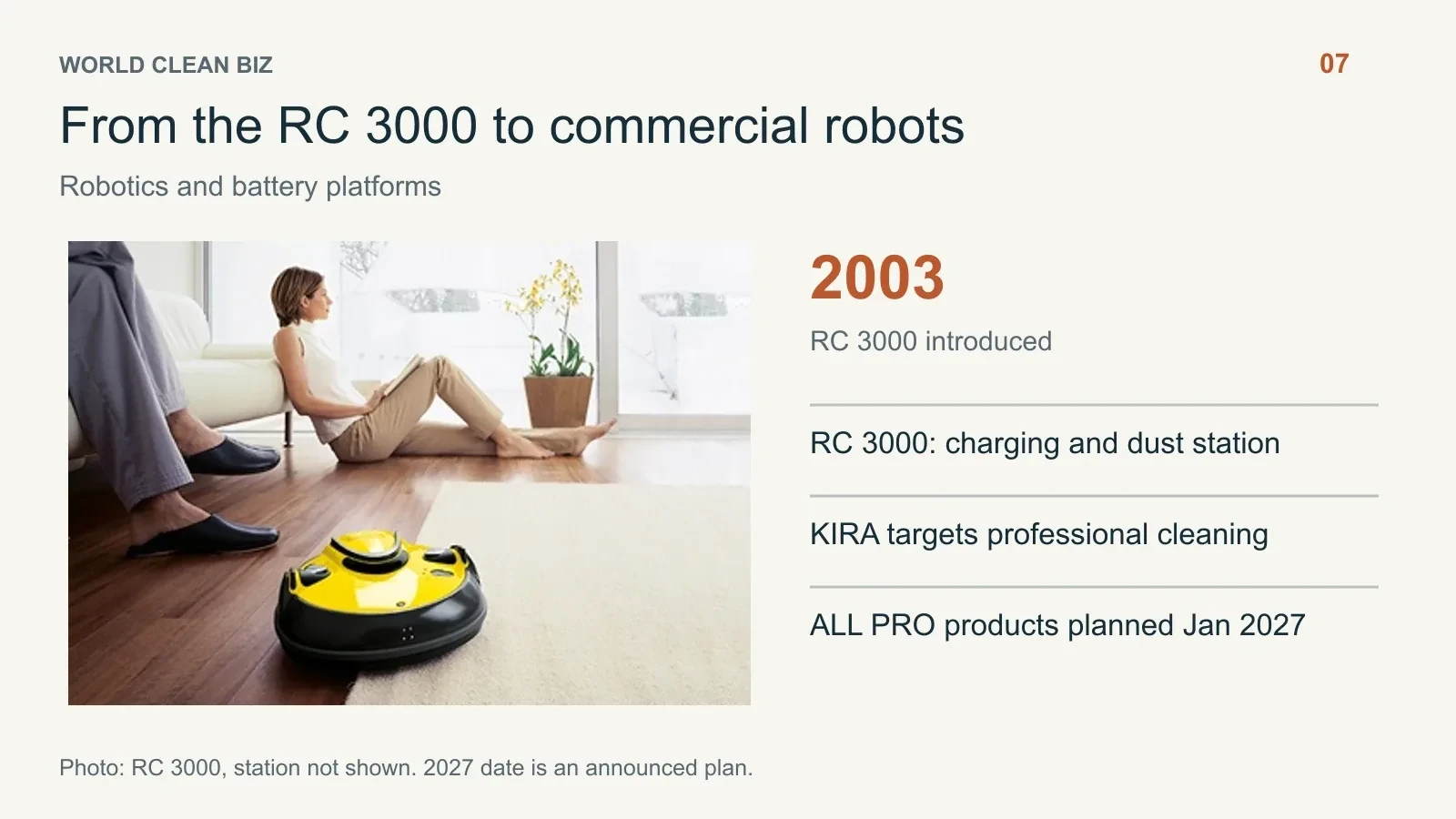
That early introduction did not make Kärcher a leader in the household robot-vacuum market that subsequently developed. The category never gave it the market position it achieved in pressure washers.
Today, it is taking robots further into professional cleaning. The KIRA range covers commercial vacuuming and floor-scrubbing tasks for customers who must repeatedly clean large areas.
Those applications are closely connected to Kärcher's established business. Customers buying floor scrubbers already calculate labor, maintenance and cleaning time. They can assess a robot's ability to reduce manual intervention at the same site. Kärcher's existing sales and service network can support the equipment.
The company must also contend with competition in its established markets. Revenue rose 1.1% in 2025, or 3.2% after adjusting for currency effects. Its annual review explicitly cited pricing pressure from Chinese competitors.
The family business continues to grow, but cannot avoid the faster product cycles and tougher pricing of the global cleaning market.
In July 2026, Kärcher and STIHL announced their ALL PRO battery alliance. Under the announced schedule, Kärcher's first related products are due in January 2027, compatible with STIHL's AP battery system.
Professional users handling both grounds maintenance and cleaning could use batteries across a wider range of equipment, reducing duplicate purchases. The two German equipment companies are beginning to connect the machines their customers own.
From Alfred's hot-water pressure washer to Irene's international expansion and Jenner's moves into additional categories, Kärcher has passed through successive generations of leadership. The family still owns it, but today's products and customers reach far beyond the founder's factory.
For most of that history, Kärcher put machines into cleaners' hands. Now it is asking machines to take on some of their work. The next chapter for this family business, more than 90 years old, will unfold in the factories, shopping centers and public buildings preparing to use its robots.
*This family-business feature follows the people and decisions behind Kärcher's development. For a different perspective, see our earlier hidden-champion industry analysis and the separate Kärcher ownership and manufacturing reference.*
Sources and image credits: Kärcher's corporate history and Mount Rushmore project account; ISSA's Irene Kärcher profile; the 2021 BILANZ interview with Hartmut Jenner; Kärcher's 2025 annual review, Xinjiang rail-tank cleaning case study and Chinese brand-name explanation; STIHL's July 2026 battery-alliance announcement. Photographs are official Kärcher corporate, archive and case-study materials; the Jenner portrait comes from its corporate compliance page. Historical images retain their available source resolution.
 Kärcher