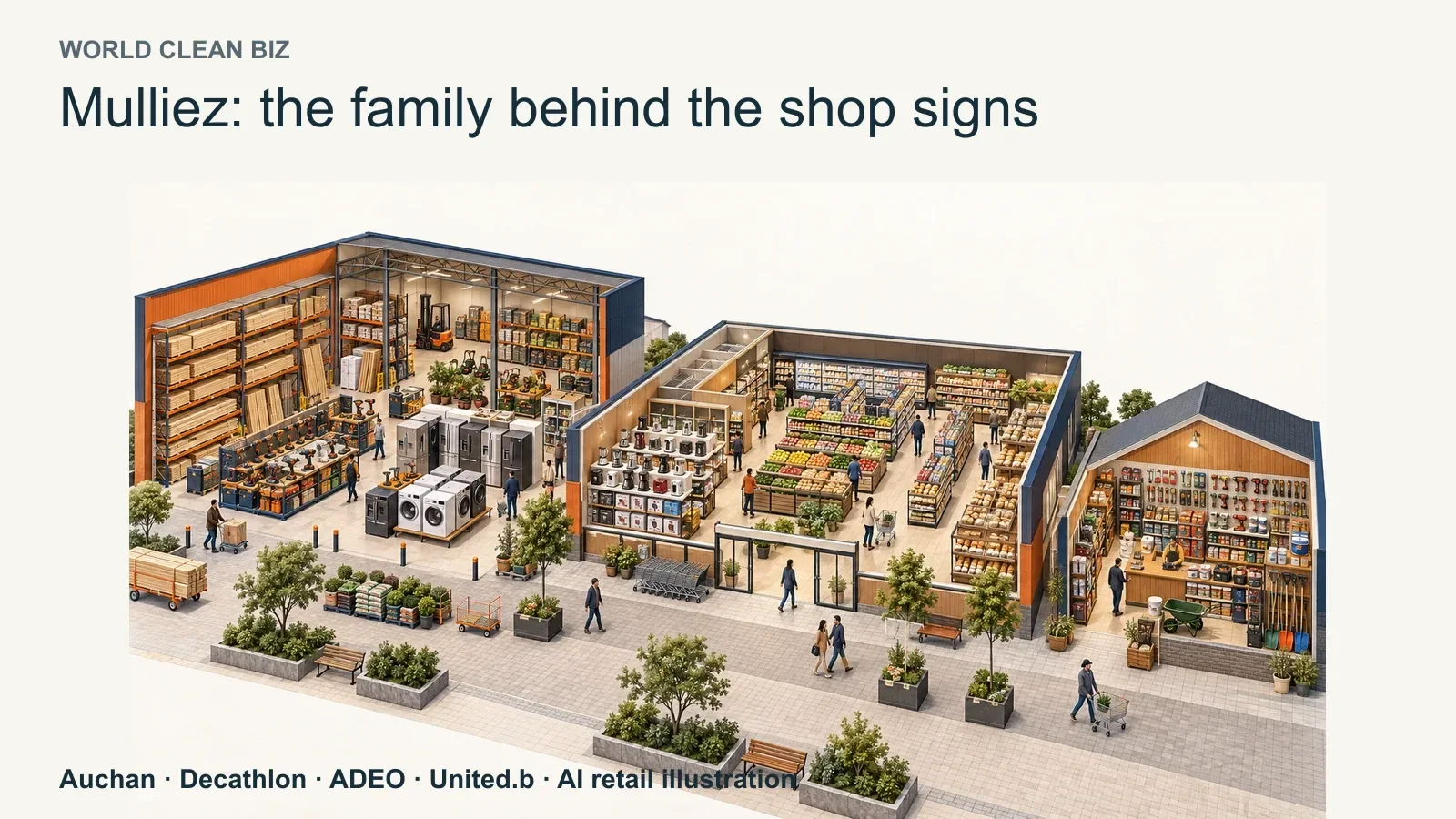
- The Mulliez business network grew through ventures founded by different family members and entrepreneurs outside the family.
- Shared ownership did not give a founder's children an automatic right to run the business.
- The family's interests extend well beyond Auchan, but strength elsewhere cannot by itself repair the supermarket business.
Decathlon, Auchan, Leroy Merlin and Electro Dépôt sell very different things: sports equipment, groceries, home-improvement supplies and electrical appliances. Behind them stands the same French family, the Mulliez.
The surname is absent from the shop signs. Most customers know the brands far better than the people connected to them.
As a child, Margaux Mulliez did not fully grasp what her name meant either. She knew her grandfather had founded Auchan. Mostly, he was the older man she ate with on Sundays.
Growing up complicated that relationship. Some people assumed she could shop at Auchan without paying. Others treated her differently once they heard her surname. She later described the reassurance of discovering that people could like her simply as Margaux, without knowing the rest of her name. Her account offers an unusual way into a family whose businesses reach into so many parts of European domestic life.
It began in northern France, in a textile mill that had nothing to do with retail.
In the early 20th century, Louis Mulliez went into textiles. According to the family's history, his wife Marguerite's dowry financed the original mill. As the business prospered, Louis helped his sons and sons-in-law start ventures of their own. Reading his letters years later, a descendant, Antoine Mayaud, found a father who did not want his children to remain in his shadow.
Louis offered capital with a condition: they should own shares in one another's companies.
The children could strike out on their own while retaining a financial stake in one another's fortunes. In 1955, the family formalized this arrangement through the Association Familiale Mulliez, or AFM. Its guiding phrase was “Tous dans tout”—roughly, everyone in everything. AFM's history traces the association to this early experiment in shared ownership.
Gérard Mulliez, the future founder of Auchan, grew up in that family.
He was not its model pupil. In the account later assembled by his granddaughter, he was easily distracted in class. His father sent him to boarding school and once promised him a motorcycle if he passed an examination. Even that failed to turn him into a good student.
He eventually joined Phildar, the textile business run by his father, who was also named Gérard. Employees distinguished them as Monsieur Gérard and Monsieur Gérard fils.
In 1961, the younger Gérard opened the first Auchan in a former factory in Roubaix. It occupied 600 square meters and initially employed 30 people. Three years later, it was still losing money.
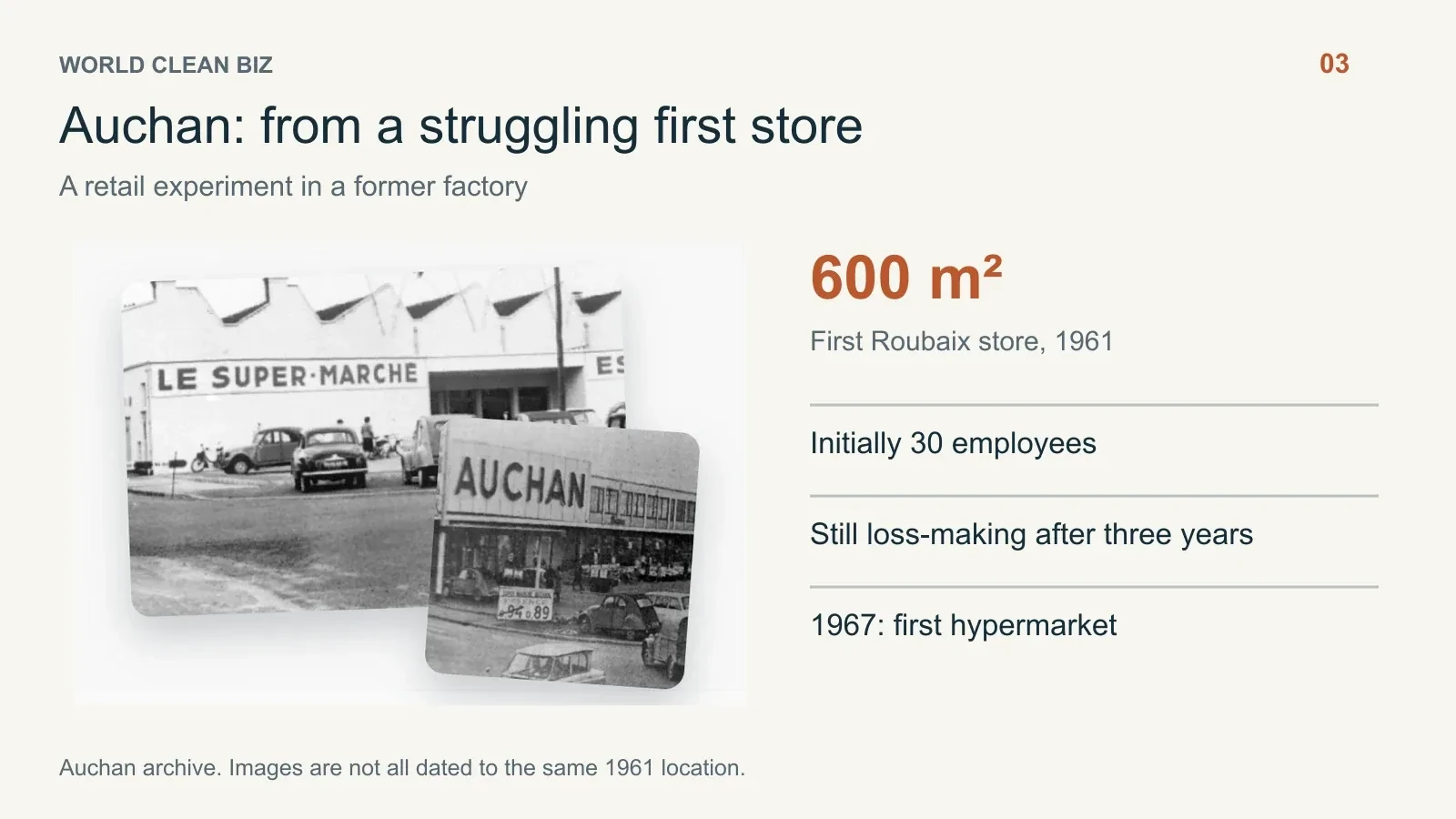
In a later interview, Gérard recalled being summoned to his father's office. His father presented two possibilities: either Gérard was not up to the job, or the business itself was no good. He gave his son another three years.
The conversation shook him. Gérard and his colleagues decided to spend less time debating around a table and more time testing their ideas in the store.
He also sought advice. Édouard Leclerc, founder of E.Leclerc, showed him purchasing invoices to help him understand what goods should cost. Marcel Fournier, a founder of Carrefour, helped him grasp the possibilities of selling larger quantities at smaller margins.
Gérard experimented with whisky, cutting the profit on each bottle. In his recollection, men came for the inexpensive drink and took home the impression that Auchan was a cheap place to shop. By 1967, he had opened his first hypermarket. The store that had worried his father for years had given the family a new business. He described these early lessons in a 2004 interview with Linéaires.
Inside his own company, he also shed the status of Gérard junior. School friends and relatives who worked with him used his first name, and other employees followed. He preferred that people tell him when he was wrong rather than defer to his position.
Auchan's success did not persuade every relative to spend a career opening supermarkets.
His cousin Michel Leclercq had worked at Auchan. In 1976, he opened a sports shop in Englos, in northern France, bringing equipment for different sports under one roof. He called it Decathlon.
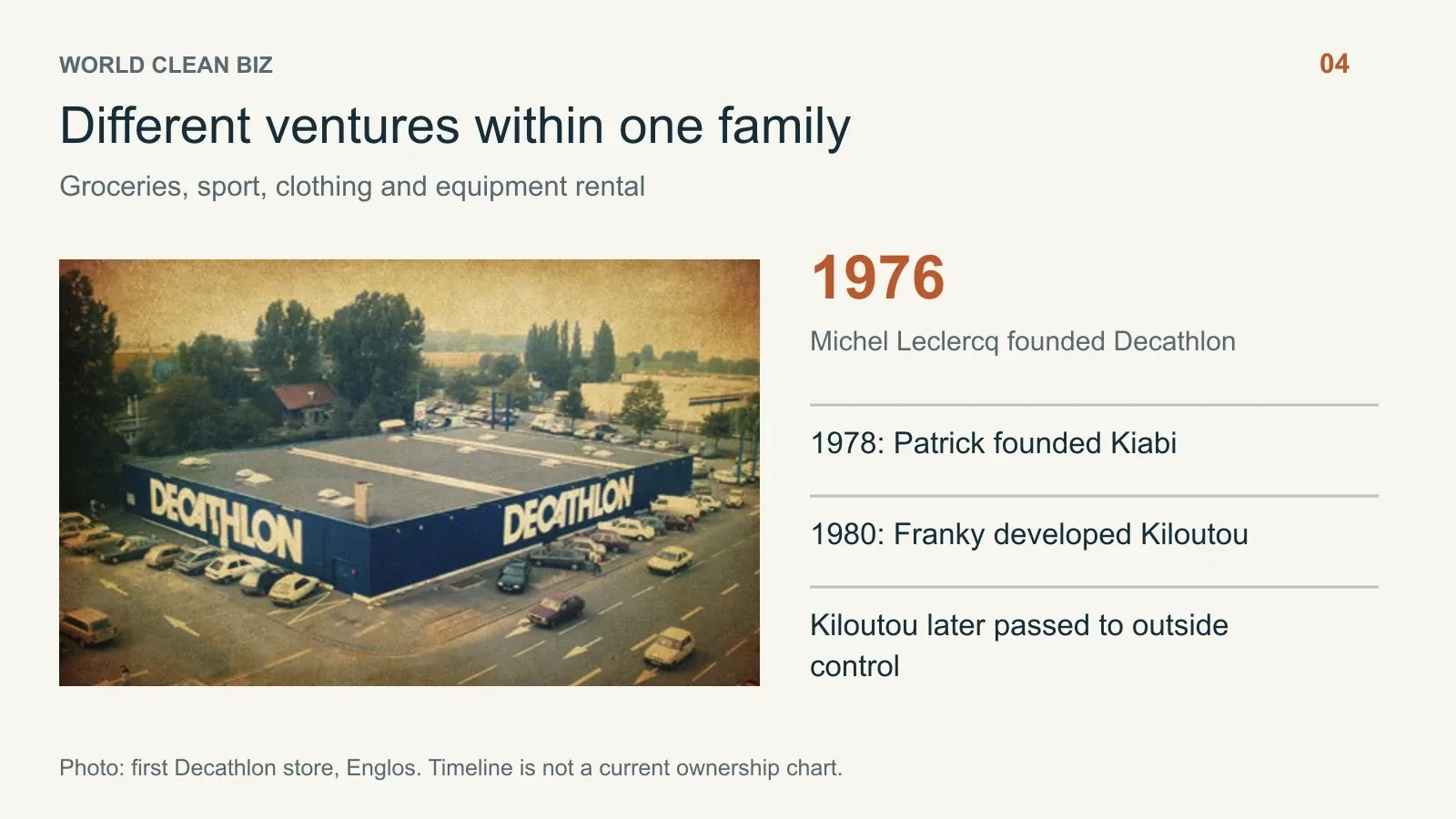
Family connections did not solve the new shop's supply problems. Some major brands resisted its low-margin approach, and bicycles were a particular difficulty. Stéphane Delesalle, who ran the bicycle department, approached the nearby manufacturer Leleu. Bicycles bearing the Decathlon name began appearing in the shop. The development of products under its own name, now one of Decathlon's defining strengths, was partly a response to suppliers who would not play along. Decathlon's anniversary archive preserves the story.
Two years after Decathlon opened, Gérard's younger brother Patrick founded Kiabi, selling inexpensive clothing for ordinary households. One brother sold groceries, another sold clothes, and their cousin sold sporting goods.
Franky Mulliez wondered whether some things needed to be sold at all.
In 1980, he brought an equipment-rental idea back from the United States and developed Kiloutou. Its first assortment was extraordinarily broad: more than 700 items, including tools, surfboards, candyfloss machines and mirrored party balls.
After a few years, he could see that some of those items barely rented. The business narrowed its range and concentrated on tools and equipment. It later brought in outside investors. Sagard became the controlling shareholder in 2005, and Franky gradually stepped back. Kiloutou's history records both the early experimentation and the subsequent changes in ownership.
Businesses founded by a Mulliez could change direction and eventually leave the family's control.
Seen together decades later, these companies can look like the execution of a carefully coordinated expansion plan. At the time, different people were trying different ideas. Some flourished; others had to change. The family's accumulated capital gave them more choices, and more time, than most entrepreneurs could count on.
Succession proved harder. The same founders who had been given room to experiment could doubt whether their own children were capable of taking over.
During the generational transition of the late 1980s and 1990s, some older members grew anxious about the next generation. Antoine Mayaud later said the family had seriously considered selling its businesses. As the companies grew, the founders found it harder to hand them over. The longer they held on, the fewer opportunities younger relatives had to prove themselves.
Some younger members argued for keeping the companies and continuing to back new ventures. Mayaud took on a task that looked far removed from running a retailer: he began visiting relatives.
He spoke with hundreds of family members about how they wanted to participate. Some could manage a company. Others wanted to start one. Still others could serve on boards or help with family affairs. His concern was that, for the descendants, the only remaining connection with the businesses might be a dividend arriving in an account. His work is described in IMD's account of the family's entrepreneurial system.
Training, company visits and trips together became ways of involving younger members. As the family grew, holiday meals could no longer be expected to keep everyone acquainted with one another, let alone with the businesses.
By 2025, the family reported more than 1,650 members and nearly 1,000 shareholders. Many would never manage a shop. They would still have to make choices about investment, dividends and the companies' future.
Even a founder had to live with the constraints of shared ownership.
In 2006, Gérard prepared to leave Auchan's highest leadership position after 45 years. The family had already extended the relevant age limit from 70 to 75. His son Arnaud had worked his way through department and store management, the Italian business, and the chairmanship of Auchan France's supervisory board. Another candidate, Vianney, came from a different family branch. An HEC graduate, he had worked in group development and led the property business, Immochan.
The family chose Vianney. Le Monde reported the succession at the time.
Arnaud's experience had not made his father's position an inheritance. Gérard had founded Auchan, but its capital and interests now belonged to a much wider circle. The succession gave shared ownership a concrete meaning: a father could pass his shares to his son; appointing the company's leader was a separate decision.
Decathlon later had its own disagreements over succession and strategy. Michel's son Matthieu served as chairman before leaving in 2018 amid strategic differences with shareholders. In 2025, Michel's younger son Julien took the chair. He had worked in Spain, Belgium and Singapore. The appointment put another member of the founding family in charge of governance, though his brother's departure showed how differently such a role could end. Le Monde's reporting sets out that earlier disagreement.
Entrepreneurial opportunities also increasingly went to people without the Mulliez surname.
In 2003, managers at Boulanger backed Pascal Roche's idea for a discount electrical retailer. The first Electro Dépôt opened the following year. Boulanger already sold appliances, but the new format would spend less on fittings, offer a narrower assortment and push costs and prices down. Roche had been given room to pursue a different version of appliance retail.
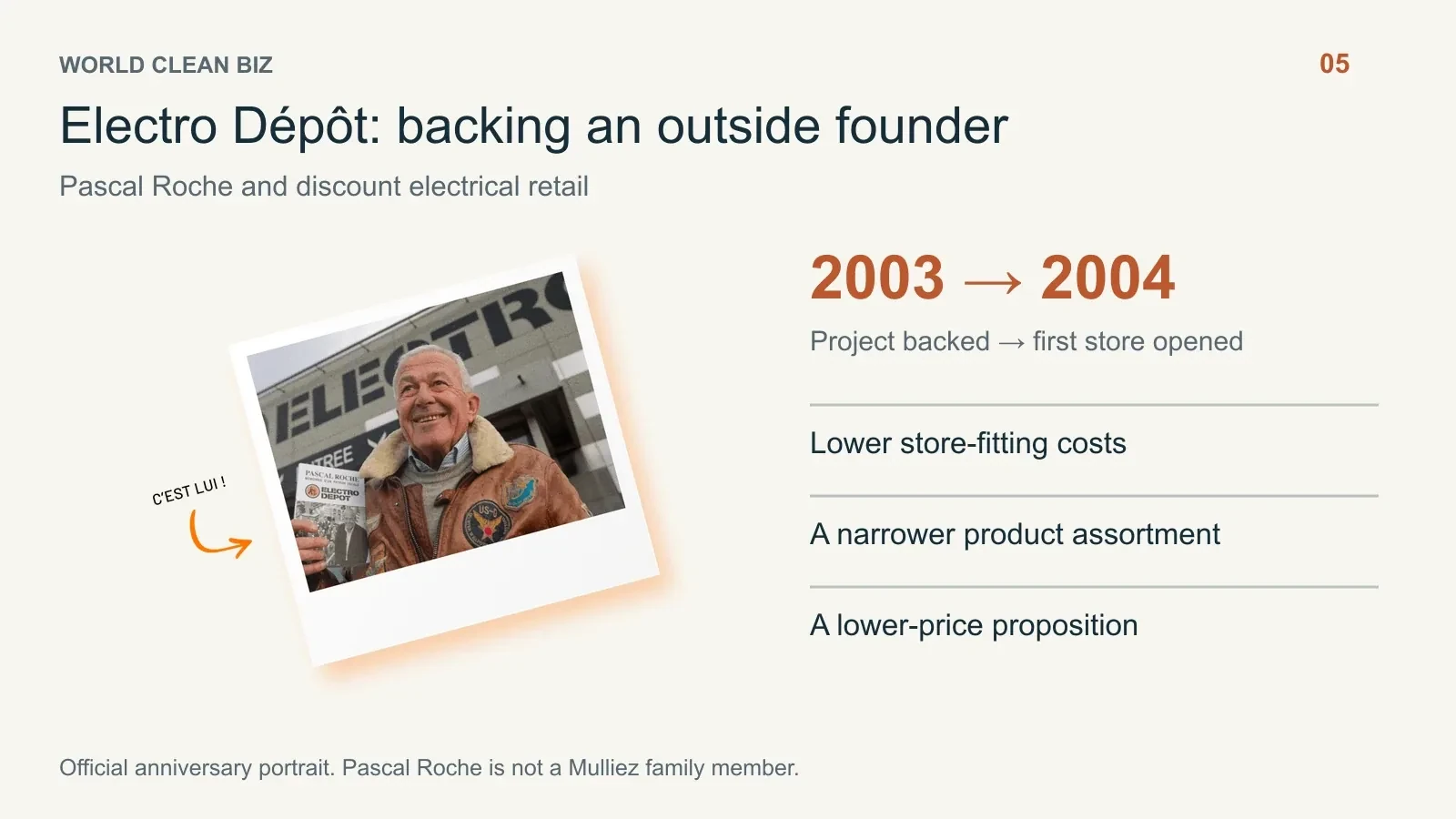
The two retailers could attract different customers, or compete for the same one. Both ultimately had to make their own operations work. The origins of the project are covered in a profile of Roche and Electro Dépôt's anniversary history.
Over time, these ventures formed an extensive business network. AFM describes an ecosystem of about 150 companies in 62 countries, employing roughly 615,000 people. Ownership stakes and control differ from one business to another; founding branches, employees and other shareholders also participate. This is not a list of wholly owned subsidiaries under a single operating company.
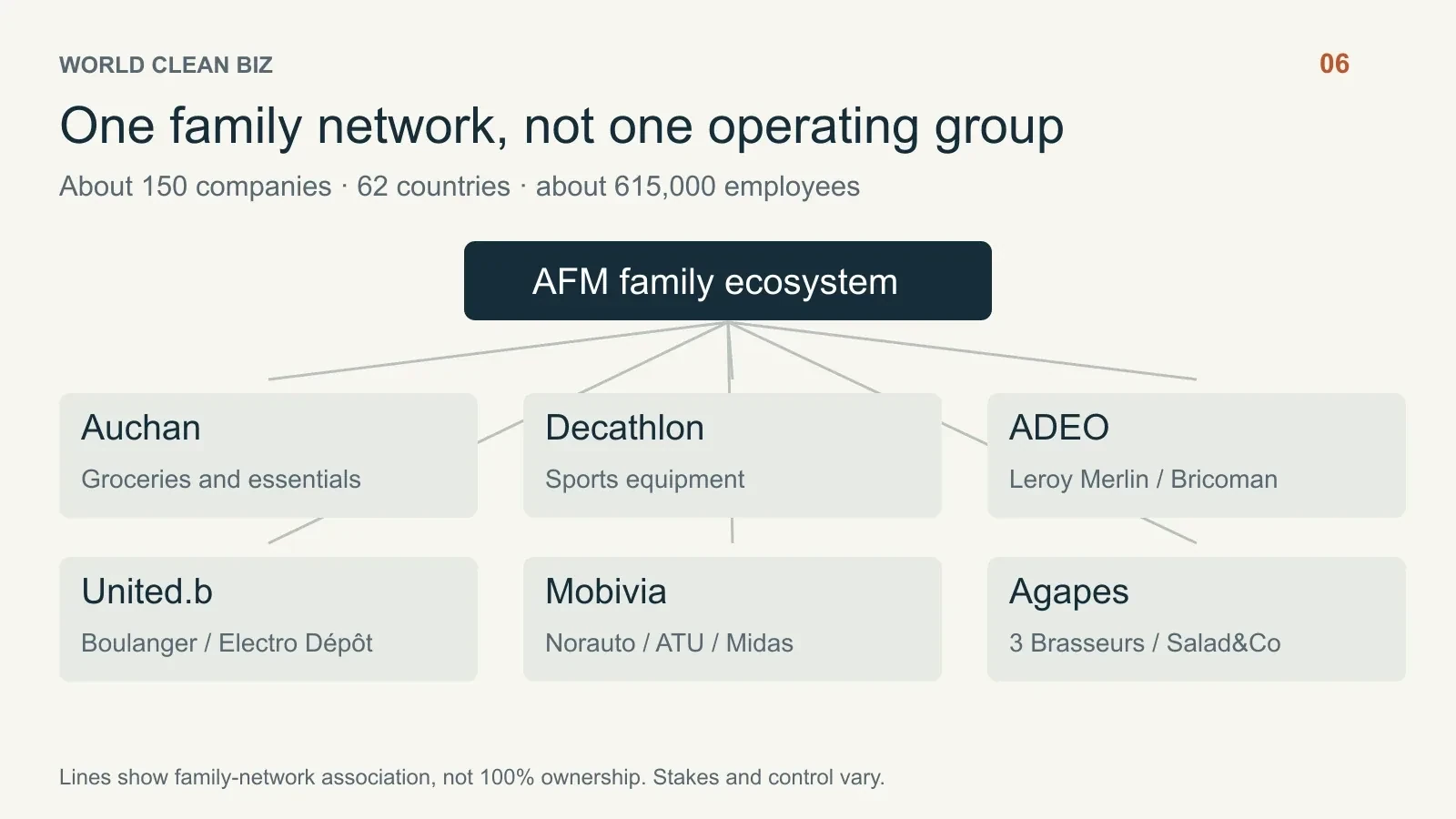
Auchan handles groceries and everyday household goods. Decathlon combines sports-product development with its store network and reported €16.8 billion in net sales in 2025. Another substantial business is ADEO, the group behind Leroy Merlin. It covers building materials, renovation, tools and gardening, while brands including Bricoman and Obramat serve professional construction customers. Buying groceries, taking up a sport or renovating a house can all bring a consumer into a family-linked store. ADEO's corporate presentation shows the breadth of that home-improvement business.
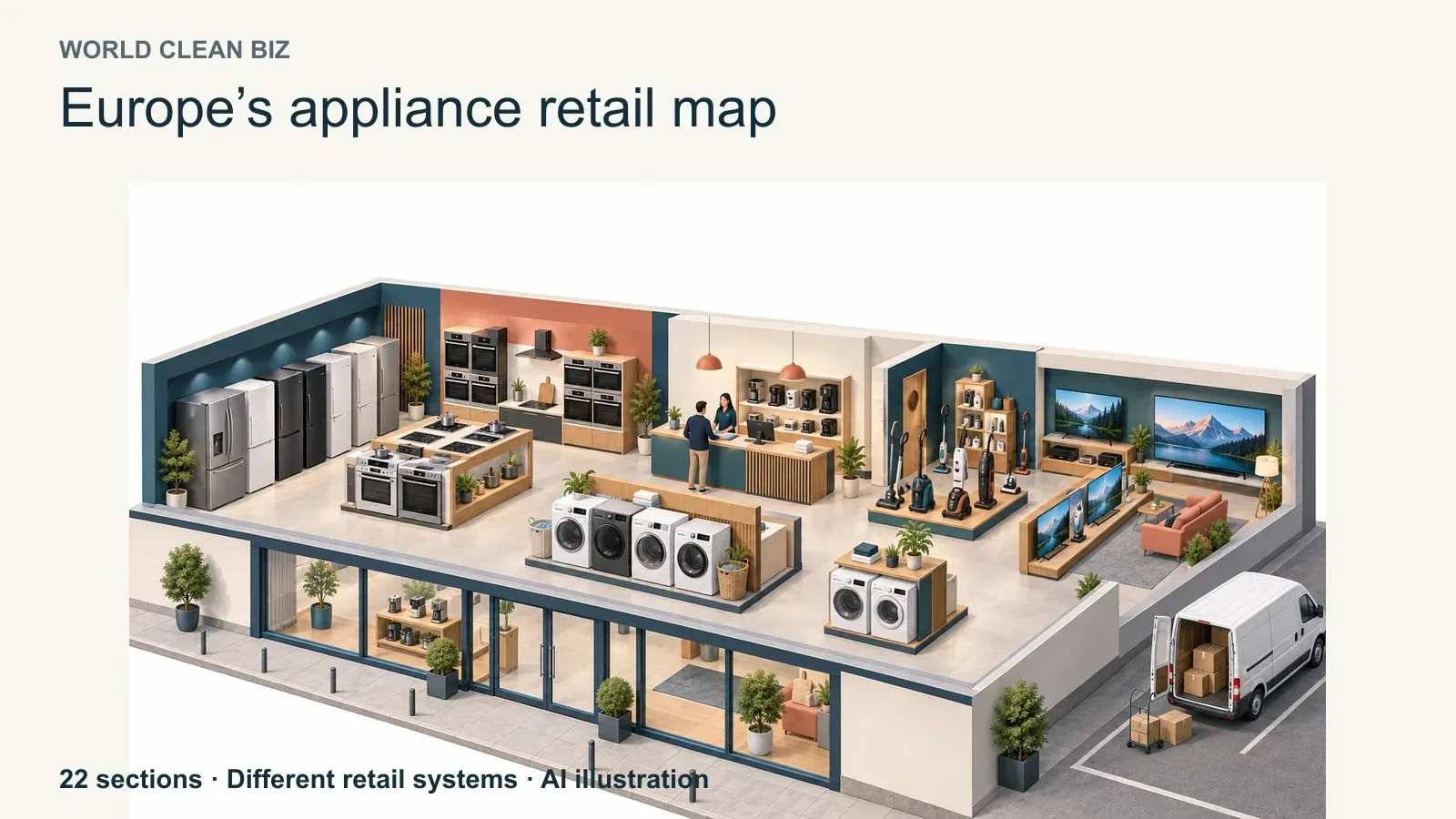
Appliances and consumer electronics sit largely within United.b, whose businesses include Boulanger and Electro Dépôt in France, Krëfel in Belgium and Hifi International in Luxembourg. Through companies such as Recommerce, its interests extend into collecting, refurbishing and reselling used devices. Kiabi supplies clothing. Mobivia's businesses include Norauto, Auto5, ATU and Midas, alongside the tire and parts retailer Carter-Cash. Agapes extends the network into restaurants through brands such as 3 Brasseurs, Salad&Co and Il Ristorante. Some of these companies make a sale and see the customer leave; others build years of repeat business through servicing and repair. Their current activities are described by United.b, Mobivia and Agapes.
Beyond the shops lies commercial property. Ceetrus owns and manages property assets, while Nhood provides operating, development and redevelopment services. Historically, a hypermarket drew customers to the surrounding shops. Today, some of those retail districts need to be rethought. The family faces decisions about the land and buildings as well as the stores' profits. These assets are less conspicuous than Decathlon tents or Auchan shelves, but they form another part of the family's wealth. Nhood describes the changing economics of these properties.
Creadev, the investment firm established in 2002, takes family capital into health, food and climate-related businesses in Europe, Africa and the United States. Its entrepreneurs need not be relatives, or retailers. While descendants participate in businesses left by earlier generations, family money also looks for ventures outside that inheritance. Creadev outlines those investment areas.
The network keeps changing. A sign that appeared in its history cannot automatically be counted among today's holdings. Kiloutou came under outside control long ago; Flunch separated from Agapes' operating perimeter in 2024, and Pizza Paï was sold in 2025.
The companies' fortunes differ too. Decathlon and Kiabi continued growing in 2025, while Auchan remained under pressure. In the first half of 2025, Auchan's parent, ELO, reported a net loss of €602 million, with like-for-like sales declining in France. ELO's first-half report set out the continuing difficulties.
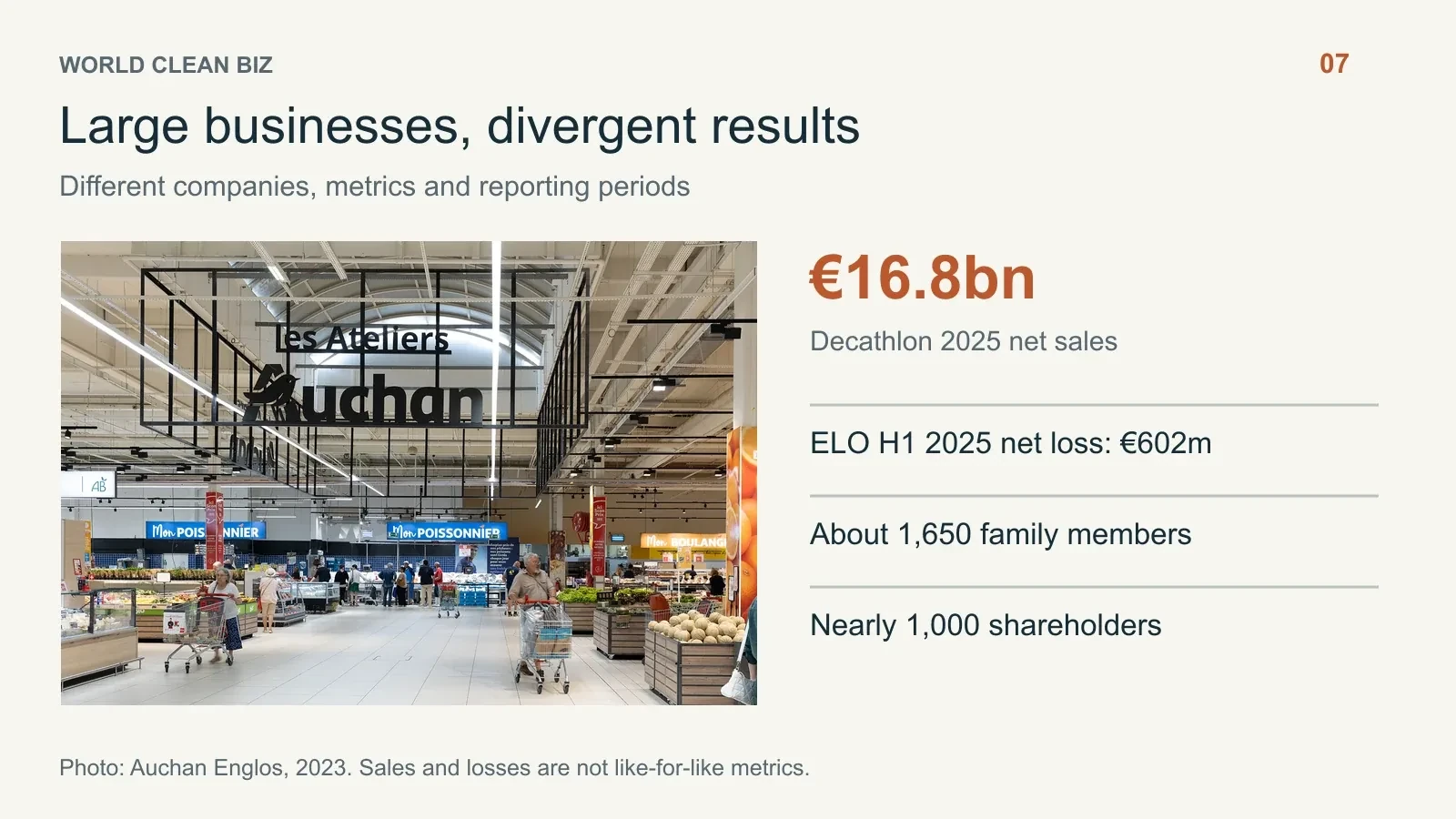
Decades of entrepreneurship mean the family has not staked everything on Auchan. But money earned elsewhere cannot, by itself, bring customers back to its hypermarkets.
Gérard once had to persuade his father to give his supermarket more time. The decisions confronting the family today are harder: which companies deserve patience, which businesses must change, and which should be sold or closed?
Founders remember their own loss-making years. Managers need capital. Some shareholders work in the businesses; others rely more heavily on dividends. Nearly 1,000 shareholders cannot resolve these competing interests as a father and son once did in an office.
Nor does every member of the next generation want to become an executive.
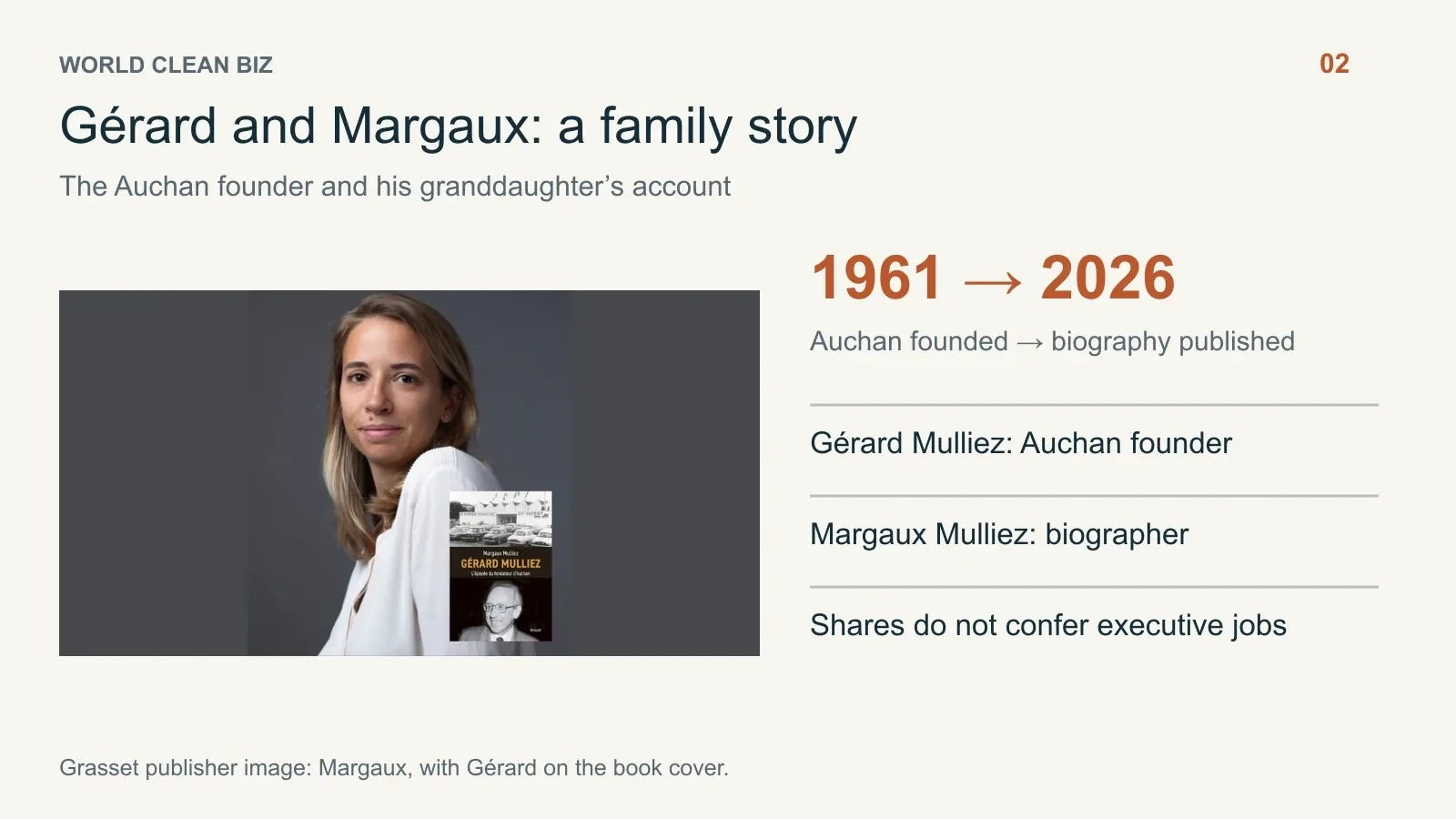
Margaux chose to write about her grandfather.
In 2021, she put the idea to Gérard. For the next year, they spent one full day each month talking. She then sought out people who had worked with him to fill the gaps in his recollections.
Her account also gives a place to her grandmother, Bernadette, who cared for the family, raised the children and supported her husband's business career. Bernadette died in the summer of 2025 after more than 60 years together, leaving a large absence in Gérard's life.
Margaux's book was published in February 2026. She had given him a copy as a Christmas present. In her account of the exchange, he opened it and cried. Then he noticed his photograph on the cover and worried that he would no longer be able to go out undisturbed.
The man who had put signs above so many shops was still uncomfortable putting his own face on display.
*Visuals combine a labeled AI concept cover, official archive photographs and editorial information graphics. Related reading in this family-business series: the family behind Kärcher. For the retail-channel context, see our European appliance retail map.*