- Automower offers a broad residential and professional range with wired or EPOS configurations and a dealer-led installation and service path.
- LUBA emphasizes wire-free multi-sensor navigation, wide-area AWD capability and user-managed mapping, but exact positioning hardware and service terms vary by SKU and market.
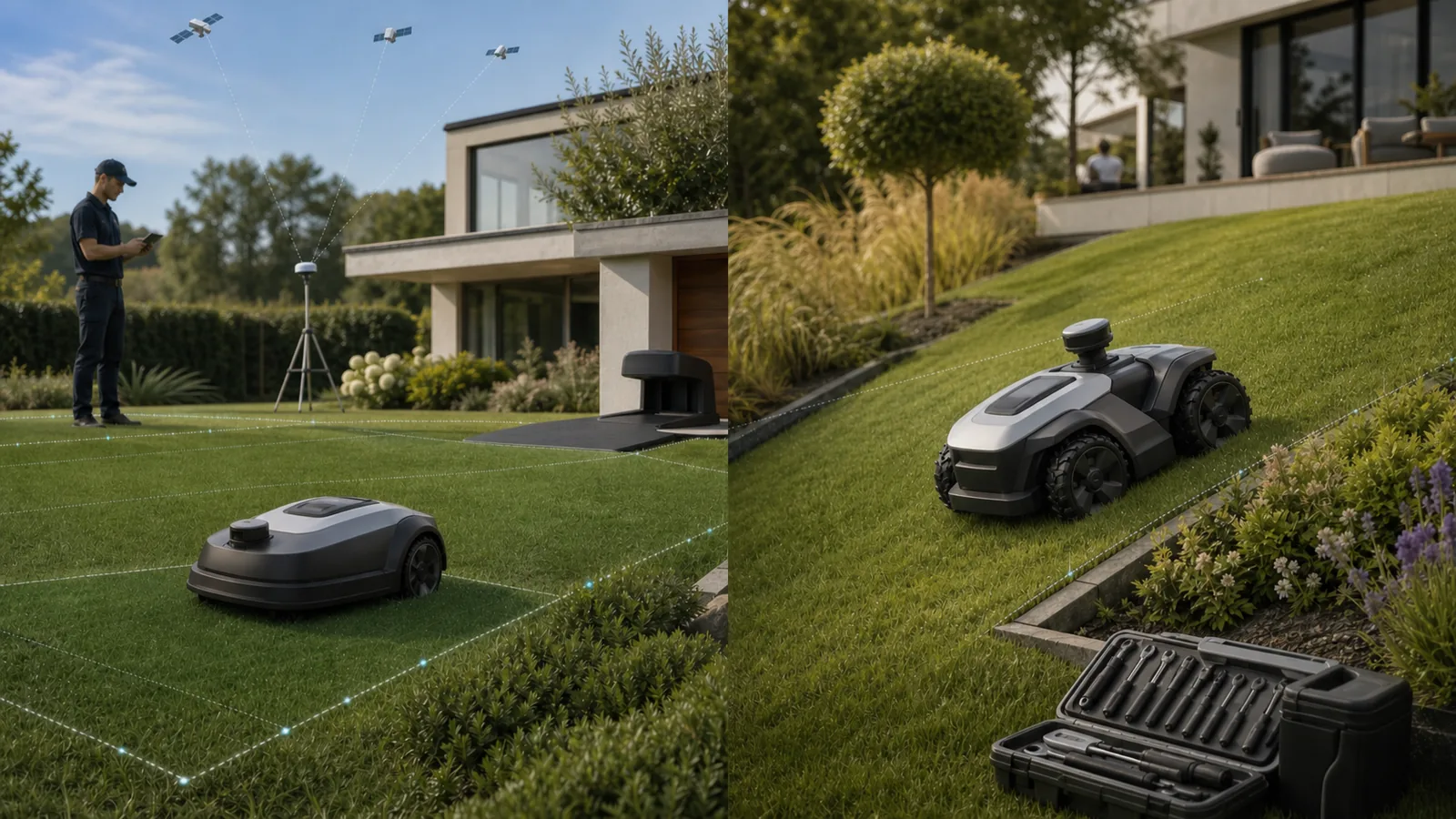
- Slope percentage, lawn capacity and navigation claims only become useful after a site survey checks boundaries, signal, wet traction, passages, drop-offs and repair access.
In this article 13 sections
Choose Husqvarna Automower when the property benefits from a broad residential or professional model range, a wired or EPOS installation option, and an established dealer-led service process. Choose Mammotion LUBA when all-wheel drive, wire-free mapping and a multi-sensor navigation platform fit a steep or complex lawn—and a practical local or depot service route is available. Neither brand wins every property.
The comparison must be made between exact models. Husqvarna’s current US range includes 410 iQ, 420 iQ, 435 iQ AWD and professional EPOS products. Mammotion’s current flagship is LUBA 3 AWD in several lawn-capacity and cutting-height variants; LUBA 2 remains relevant to existing owners but is no longer the newest platform.
Automower vs LUBA: The Short Answer
| Decision | Husqvarna Automower | Mammotion LUBA |
|---|---|---|
| Product range | Residential and professional models; standard and AWD roles | AWD-focused LUBA 3 family for compact to large, complex lawns |
| Boundary system | Physical wire or virtual EPOS, depending on model and configuration | Virtual mapping; no perimeter wire |
| Positioning | EPOS satellite positioning using cloud or reference-station options on supported products | LUBA 3 combines LiDAR, NetRTK and dual-camera vision on selected SKUs |
| Maximum published slope examples | Up to 45% on 410/420 iQ; up to 70% on 435 iQ AWD and selected AWD professional models | LUBA 3 family publishes up to 80% / 38.6° |
| Boundary-slope treatment | Publishes a separate, lower boundary limit | Maximum hill claim should not be assumed at every edge; site risk controls are still required |
| Installation route | DIY or professional Automower dealer; formal installation scope is published | Primarily app mapping with direct or dealer sales; exact local commissioning offer varies |
| Service route | Automower support center, parts pages and servicing dealers; warranty work is dealer examined | Dealer or direct support, proof of purchase and serial number; service-center shipping may be required |
| Best fit | Buyers who value model choice, installation support and local service accountability | Buyers who prioritize AWD terrain ability and a newer wire-free multi-sensor platform |
This is a platform comparison, not a laboratory performance test. Lawn size, grass growth, moisture, satellite visibility, shade, obstacles and allowed operating hours can change the result.
Compare Exact Models, Not Brand Maximums
Representative US specifications checked on July 26, 2026 show how wide the product range is.
| Model | Published area role | Published slope inside / boundary | Boundary and navigation role |
|---|---|---|---|
| Automower 410 iQ | 0.5 acre systematic; 0.25 acre irregular | 45% / 15% | Physical or virtual in the specification; current FAQ emphasizes wire-free EPOS |
| Automower 420 iQ | 1 acre systematic; 0.5 acre irregular | 45% / 15% | EPOS virtual mapping with systematic patterns; verify purchased configuration |
| Automower 435 iQ AWD | 1.25 acres systematic; 0.9 acre irregular | 70% / 50% | AWD, articulated chassis and virtual EPOS role |
| Automower 550H EPOS | 1.25 acres at 24-hour sports schedule; 2.5 acres at 48-hour standard schedule | 45% / 15% | Professional high-cut EPOS and Fleet Services; reference-station configuration must be checked |
| Automower 535 AWD EPOS | Professional one-acre sports role | 70% / 50% | Professional AWD; official US page requires EPOS RS5 reference station |
| LUBA 3 AWD 1500/1500H | Up to 0.37 acre | LUBA 3 family publishes up to 80% | LiDAR and dual-camera vision role; product page says this SKU does not include the RTK reference-station kit |
| LUBA 3 AWD 3000/3000H | Up to 0.75 acre | Up to 80% family maximum | LiDAR, NetRTK and dual-camera vision |
| LUBA 3 AWD 5000/5000H | Up to 1.25 acres | Up to 80% family maximum | Tri-fusion positioning and up to 50 zones on the current US page |
Husqvarna separates systematic and irregular capacity because route pattern changes throughput. Professional capacity can also be expressed by how many hours per day the mower is allowed to operate. Mammotion separates LUBA models by maximum mapped area. Those numbers are not directly equivalent.
Capacity is best evaluated as a workload:
`required weekly mowing area ÷ productive area per hour + charging + travel + weather reserve`
The robot lawn mower buying guide provides a full site-survey framework.
Navigation: EPOS vs Tri-Fusion
Husqvarna EPOS
Husqvarna EPOS creates virtual boundaries using high-precision satellite positioning. Depending on the model and market, positioning may use an EPOS reference station or a cloud-enabled configuration. The app can define work areas, transport paths and stay-out zones.
The installation still needs a suitable site:
- the charging station needs power and a reliable docking path;
- the mower and positioning system need the required communication;
- tall buildings, dense trees and narrow side yards should be tested;
- boundaries near roads, water and drops need physical risk controls;
- the exact reference-station or subscription configuration must be documented.
Husqvarna also retains physical-wire capability on selected products and in its support system. That can be an advantage where satellite geometry is poor or an existing wired installation already works. It can also add installation and wire-repair work.
Mammotion LUBA 3
LUBA 3 uses a multi-sensor approach. The current US page describes a combination of 360-degree LiDAR, NetRTK and dual-camera AI vision on larger variants, with the 1500 variant positioned differently in the comparison table. The goal is to maintain localization when one signal source becomes weak.
Mammotion’s page says LUBA 3 can use NetRTK without a physical base-station installation, while the same page’s box-content section lists reference-station hardware for variants other than 1500. That makes exact SKU verification essential:
- Is NetRTK available at the property address?
- Is a reference station included, optional or unnecessary?
- Which features depend on 4G or iNavi service?
- What happens when cloud, cellular or positioning services are unavailable?
- How does the model operate under trees, beside walls and in narrow corridors?
LiDAR and vision can improve local perception, but they do not remove the need to define safe boundaries. The RTK vs LiDAR robot mower guide explains why sensor fusion is usually more useful than treating either technology as a universal winner.
Slopes: Compare the Work Area and the Edge
Slope marketing often presents one maximum number. Installation engineering needs at least four:
- maximum uphill or downhill grade;
- cross-slope grade;
- boundary grade;
- wet-turf traction.
Husqvarna’s support material publishes separate work-area and boundary limits. Automower 410 iQ and 420 iQ list 45% inside the installation but 15% at the boundary. Automower 435 iQ AWD lists 70% inside and 50% at the boundary.
Mammotion publishes up to 80% / 38.6 degrees for LUBA 3 AWD. That is a high maximum, but it should not be used as permission to place a virtual edge beside a pond, road, retaining wall or drop. A mower can have enough traction to climb a grade and still lack an acceptable stopping margin on wet grass.
Survey each slope by measuring rise over horizontal run:
`slope % = vertical rise ÷ horizontal run × 100`
Then record:
- grass type and soil firmness;
- irrigation and drainage;
- direction of travel;
- roots, holes and wheel ruts;
- the turning zone at the top and bottom;
- distance to hazards;
- whether the mower must cross rather than climb the slope.
Where a slope ends at a hazard, add a physical barrier or move the boundary onto flatter ground. Maximum drive capability is not a safety design.
Installation: Product Setup vs Site Commissioning
A wire-free mower still needs installation. The work shifts from burying wire to surveying signal, mapping and validating routes.
Husqvarna dealer installation
Husqvarna publishes a professional Automower installation scope that can include:
- pre-installation consultation and property walk-through;
- charging-station placement;
- physical boundary and guide wires or wireless yard mapping;
- obstacles and stay-out zones;
- reference-station placement where applicable;
- firmware updates and app pairing;
- cutting-height setup, training and maintenance guidance;
- post-installation follow-up that varies by dealer.
This creates a clear accountability path for a buyer who does not want to engineer the site alone. Quality still depends on the local dealer’s robotics experience and documented scope.
Mammotion setup
LUBA emphasizes app-based manual or automatic mapping. For a straightforward open lawn, this can reduce installation labor. For a complex property, the owner or installer must still:
- choose a stable, powered charging location;
- validate the docking approach;
- define each work zone and connecting path;
- map obstacles and no-mow areas;
- test positioning under trees and beside structures;
- set edge behavior and pattern direction;
- confirm safe operation at roads, pools, steps and drop-offs.
Ask the seller whether commissioning is included, available for a fee or entirely owner-managed. A remote support session is not the same as an on-site survey.
Cutting System, Height and Lawn Finish
Model choice should follow the grass and desired cut height.
LUBA 3 offers standard and H versions on the current US page. The standard range is listed at 1.0–2.7 inches, while H variants are listed at 2.2–4.0 inches. Selecting the wrong height range cannot be fixed with software.
Husqvarna also sells standard and high-cut products. Automower 550H EPOS, for example, is positioned around a 2.0–3.6-inch range for turf that needs a higher cut.
Both platforms use frequent mowing and small clippings rather than collecting a week of tall grass. The practical comparison should include:
- cutting-height range;
- cutting width and number of discs;
- blade type and replacement interval;
- edge distance and required trimming strip;
- pattern quality on open areas;
- behavior in thick or wet growth;
- scalp risk on crowns and transitions;
- time needed to keep the whole area within the target height.
A wide cutting system can improve open-area throughput but may need more turning space. A narrower articulated mower may fit complex passages better. Measure the tightest gate and corridor before purchase.
Apps, Connectivity and Fleet Use
Both platforms use apps for mapping, schedules, zones and status. The comparison should include what remains functional without cloud or cellular access.
Husqvarna’s residential app and professional Fleet Services are different operating environments. Fleet Services is relevant when a contractor, municipality, school or facility manages multiple machines and needs centralized supervision.
Mammotion’s app supports mapping, patterns, zones and remote status. Current LUBA 3 pages also describe 4G and iNavi services. Record:
- included free-service period;
- renewal cost and market availability;
- account ownership when a property changes hands;
- ability to transfer the mower between dealer, installer and customer;
- data and camera privacy settings;
- firmware rollback or recovery process;
- operation during an internet outage.
For a dealer, account handover must be part of commissioning. The customer—not the installer’s personal account—should control the production lawn.
Safety, Security and Supervision
Robot mowers use small blades, but they are not zero-risk devices. Keep children, pets and wildlife away during operation, follow the manual and use physical barriers at serious hazards.
Compare:
- lift and tilt shutoff;
- object detection and bumper behavior;
- geofence, PIN and theft tracking;
- night and wildlife modes;
- remote stop and local stop;
- maximum boundary overshoot;
- visibility near shared paths;
- response to a lost positioning signal.
Camera and vision claims should be evaluated together with privacy controls and low-light behavior. Object recognition does not replace pre-mow removal of wire, toys, branches, hoses and small objects.
Maintenance, Parts and Repair
Routine ownership includes:
- cleaning grass from the deck and wheels;
- replacing blades and screws;
- checking cutting discs and guards;
- inspecting charging contacts;
- correcting ruts and worn docking paths;
- updating firmware;
- winter storage and battery care;
- repairing physical wire where used.
Husqvarna provides an Automower Support Center with manuals, installation guidance, parts and dealer access. Its warranty process says a defective product must be examined by a dealer or authorized service center.
Mammotion’s LUBA repair FAQ says warranty customers can contact the purchasing dealer or submit a form for direct purchases, using proof of purchase and the serial number. Out-of-warranty users may buy parts for self-maintenance or ship the mower to a service center.
The service comparison is therefore local:
| Question | Automower | LUBA |
|---|---|---|
| Nearest trained technician | Confirm with Automower dealer locator | Confirm Mammotion dealer or service-center coverage |
| Warranty diagnosis | Dealer/authorized center examination | Dealer or direct case, depending on purchase |
| Heavy-unit transport | Ask whether dealer pickup is offered | Ask who pays two-way depot shipping |
| Parts | Dealer and product parts pages | Online parts and dealer/direct support; confirm stock |
| Installation knowledge | Dealer may know the original site | Preserve maps, screenshots and commissioning records |
| Seasonal downtime | Ask local turnaround | Ask regional service-center turnaround |
Do not assume a large brand means every local dealer services robots, or that direct online support means fast physical repair.
Which Platform Fits the Buyer?
Choose an Automower shortlist when:
- professional installation and local service accountability are important;
- the site may benefit from either physical wire or virtual EPOS;
- residential and professional capacity tiers need to be evaluated;
- a fleet-management environment is required;
- a high-cut or specialized commercial role is needed.
Choose a LUBA shortlist when:
- AWD traction and high published slope capability are central;
- the buyer wants a wire-free platform with LiDAR, NetRTK and vision options;
- a wide, multi-zone property fits the LUBA 3 area tiers;
- the owner is comfortable with app mapping and a faster-moving software platform;
- local dealer service or depot logistics have been confirmed.
Do not choose either until:
- the lawn has been measured;
- the steepest work and boundary slopes are known;
- charging and signal locations have been tested;
- hazards have physical controls;
- the exact cutting-height version is correct;
- warranty, parts and repair responsibility are written down.
The robot mower cost guide helps convert these requirements into total installed and lifecycle cost.
Dealer and Installer Fit
Automower can suit a dealer that wants a structured consultation, installation and service business. Revenue can include site survey, boundary or EPOS setup, seasonal service, blades, parts, storage and fleet support.
LUBA can suit a dealer targeting customers who want wire-free AWD and newer sensor fusion. The installer needs strong app, mapping, connectivity and terrain-diagnosis skills, plus a clear depot-repair process.
Before adding either line, a dealer should verify:
- territory and channel rules;
- demonstration-unit access;
- certification and training;
- diagnostic tools and firmware permissions;
- warranty labor reimbursement;
- mower and battery shipping rules;
- parts stocking and lead times;
- account transfer and data ownership;
- model refresh and old-platform support;
- escalation response during peak season.
The Husqvarna ownership guide and LUBA manufacturing guide provide company context without treating ownership as proof of field performance. For another wire-free comparison, see LUBA vs Navimow.
Frequently Asked Questions
Is LUBA better than Automower on steep slopes?
LUBA 3 publishes an 80% family maximum. Automower 435 iQ AWD and selected professional AWD models publish up to 70% inside the work area. That does not decide the site. Boundary grade, wet traction, cross-slope travel, turning space and hazards must be tested.
Does Automower need a boundary wire?
Not always. Current iQ and EPOS models support virtual boundaries, while selected products and legacy installations can use physical wire. Confirm the exact model and purchased positioning configuration.
Does LUBA need an RTK base station?
The current LUBA 3 page emphasizes NetRTK without base-station installation, but its box-content section is variant-specific and lists reference-station hardware for some SKUs. Confirm the exact order contents and the local NetRTK/iNavi service.
Which is easier to install?
LUBA’s app mapping may be quicker on a simple open lawn. Automower offers a published professional-installation route. Complex lawns require site engineering on either platform.
Which has better dealer support?
Husqvarna publishes a broad servicing-dealer and Automower support network. Mammotion supports dealer and direct-service routes. The only useful answer is the distance, capability and turnaround of the actual local service option.
Can either mower eliminate string trimming?
Usually not completely. Blade-disc position, wheel clearance, boundary offset, walls, fences and beds leave different edge distances. Design a mow-over strip or keep a trimming plan.
Is LUBA 2 still the current model?
Mammotion’s US site now presents LUBA 3 AWD as the new flagship and marks LUBA 2 pages as the prior generation or sold out. Existing LUBA 2 owners should use their exact model’s support and warranty documents.
The Bottom Line
Husqvarna Automower and Mammotion LUBA represent two strong but different purchase systems.
Automower’s advantage is the breadth of residential and professional configurations plus a formal dealer installation, parts and service path. LUBA’s advantage is an AWD-first, wire-free platform that combines multiple positioning sensors and publishes a high slope capability.
The final choice should be made by a property survey and a service audit. If the mower cannot navigate the actual boundaries, use the correct cut height, recharge reliably and return to a technician during peak season, the better specification sheet does not matter.