- Survey the yard before choosing boundary wire, RTK, LiDAR, vision or a hybrid navigation system.
- Size ratings and maximum slope claims do not describe passages, tree cover, boundary risk, edge quality or seasonal growth.
- Installation quality, local parts, dealer service and five-year ownership cost can matter more than one headline feature.
In this article 14 sections
Choose a robot lawn mower from the yard outward: map the grass area, slopes, passages, tree cover, edges and hazards before selecting boundary wire, RTK, LiDAR, vision or a hybrid system. Then verify cutting capacity, traction, installation, safety, theft protection, maintenance, dealer service and total ownership cost.
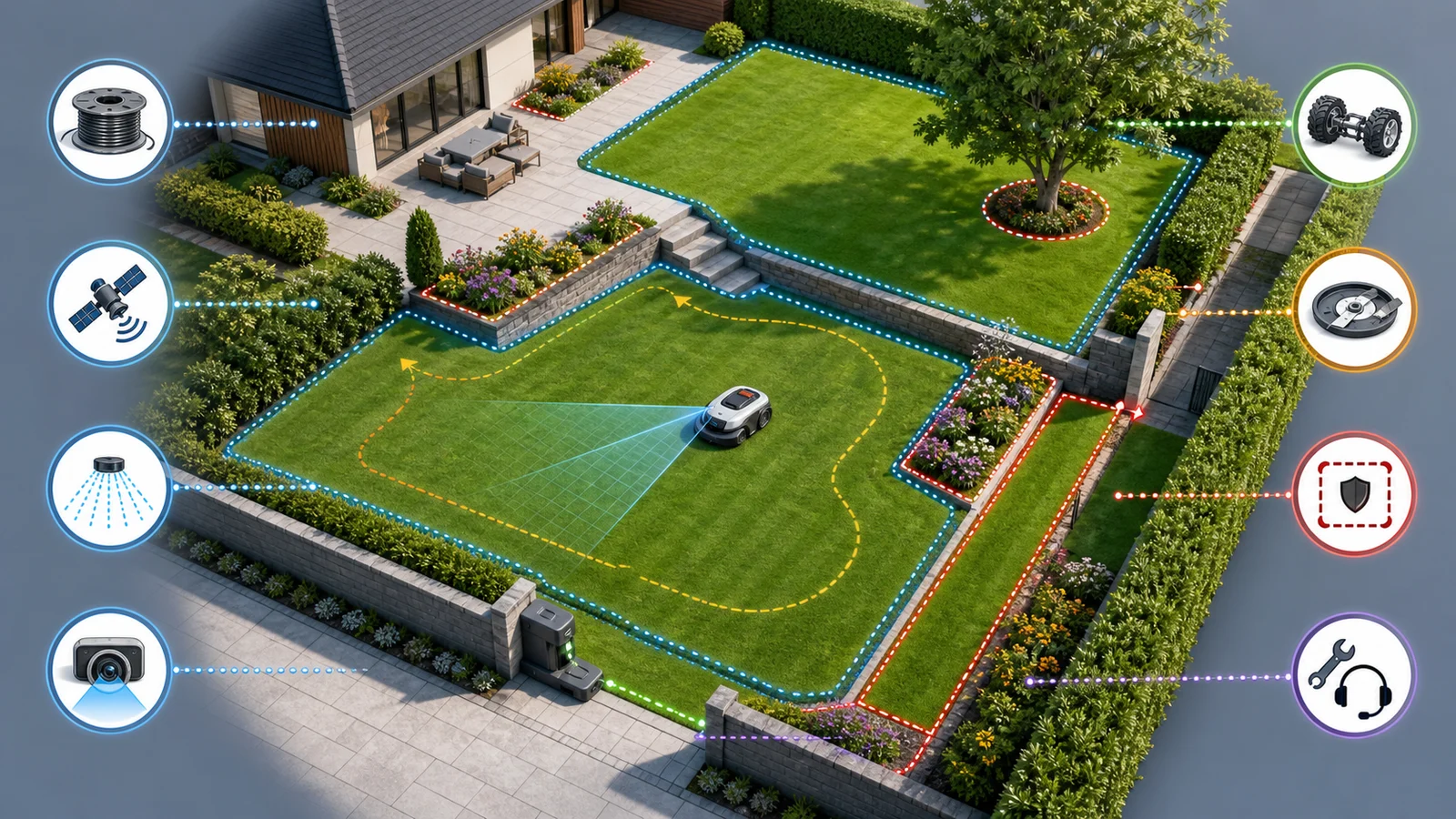
A mower rated for a large area can still fail in a smaller but complex garden. Satellite navigation can lose quality near buildings or dense trees; vision can struggle when boundaries are visually weak; LiDAR needs useful geometry; a boundary-wire system can be reliable but expensive to install and repair.
Robot Lawn Mower Buying Checklist
| Decision | Measure before buying | Do not rely on |
|---|---|---|
| Lawn | Mowable area, growth rate and separate zones | Property size alone |
| Navigation | Sky view, trees, walls, visual boundaries and network | “Wire-free” as a universal answer |
| Terrain | Maximum and boundary slope, holes and traction | One maximum slope number |
| Access | Narrowest passage, gates and paths | Marketing images of open lawns |
| Cutting | Height range, width, edge gap and blade cost | Area rating alone |
| Safety | Roads, water, drops, children, pets and loose objects | Obstacle avoidance as a safety guarantee |
| Ownership | Installation, blades, tires, battery, winter storage and repair | Checkout price |
| Service | Survey, setup, spare parts and peak-season turnaround | Brand reputation without local support |
Survey the Yard
Measure actual grass, not the entire plot. Exclude buildings, hardscape, dense planting and areas the mower cannot enter. Mark front and rear lawns, islands, narrow corridors, gates and any route that crosses paving.
Record:
- mowable area by zone;
- narrowest passage;
- steepest slope inside the lawn;
- slope at the boundary;
- drop-offs, ponds and public roads;
- walls, hedges and dense tree canopy;
- raised roots, holes and soft ground;
- edge type: flush paving, wall, gravel or flower bed;
- charging-station and power options;
- Wi-Fi or cellular coverage.
Husqvarna’s official materials treat lawn size, boundary type and maximum slope as separate specifications. That is the correct approach: no single capacity number represents the yard.
Boundary Wire, RTK, LiDAR or Vision?
Physical boundary wire
A buried or surface-staked wire defines the operating area. It does not depend on a clear satellite view and can be dependable in established gardens.
The trade-offs are installation labor, wire breaks and the difficulty of changing zones. Guide wires may also be required to reach remote areas or return efficiently. Official Husqvarna guidance specifies spacing, passage and slope rules by model; installation is part of performance.
Choose wire when the layout is stable, satellite conditions are poor and local installers can repair the loop.
RTK and satellite positioning
RTK-based systems create virtual boundaries and systematic paths. They can be effective in open lawns with suitable sky visibility and a correctly placed reference or network service.
Buildings, trees and terrain can block or reflect signals. Before buying, request a site survey or return policy. Confirm whether the system uses a local antenna, network RTK or another correction service, and what happens if connectivity ends.
LiDAR
LiDAR builds geometry from surrounding objects. It can help in structured, tree-covered or satellite-challenged yards, but a wide open lawn may provide fewer useful features. Dust, rain, foliage change and low obstacles also require validation.
Vision
Cameras can identify grass, edges and objects without a boundary wire. Performance depends on lighting, contrast, seasonal appearance and training. A visually weak border between grass and a planting bed is harder than a curb.
Hybrid navigation
Many current products combine satellite, cameras, inertial sensing, odometry or LiDAR. Hybrid hardware can improve resilience, but only if the software handles transitions and degraded signals well.
The RTK vs LiDAR robot mower guide provides a deeper technical comparison.
Lawn Size and Capacity
Area ratings assume conditions. Growth rate, cutting height, slope, route efficiency, charging and allowed mowing hours change the result.
For a demanding lawn, leave capacity headroom. Ask:
- stated area and test assumptions;
- daily mowing hours required;
- charge and mowing duration;
- behavior after rain delays;
- maximum number of zones;
- seasonal growth adjustment;
- whether the software or subscription limits area.
A larger battery does not solve a blocked passage or poor boundary.
Slopes and Traction
Slope is expressed as degrees or percent; they are not interchangeable. Also separate slope inside the lawn from slope at the boundary, where turning and slipping risk is higher.
Inspect:
- maximum sustained slope;
- wet-grass performance;
- side-slope stability;
- turning on the slope;
- wheel material and tread;
- two-wheel versus all-wheel drive;
- soil damage after repeated paths.
Official manuals set model-specific slope and boundary restrictions. Do not apply a flagship AWD claim to another mower from the same brand.
For steep yards, test the real route in damp conditions and confirm physical protection near roads, drops and water.
Passages, Zones and Crossings
Measure the full route, including gate posts, raised edges and turns. A mower may fit physically but fail to map or turn.
Check:
- minimum passage width;
- route between zones;
- whether it can cross paving;
- how no-mow islands are created;
- separate schedules and cutting heights;
- temporary exclusion zones;
- recovery when a gate is closed.
Wired installations may use guide wires through confined areas. Virtual systems require reliable localization throughout the corridor.
Cutting and Edge Performance
Robot mowers cut small amounts frequently. The lawn must first be reduced to a manageable height, and sticks, toys and stones should be removed.
Compare:
- cutting-height range;
- cutting width;
- floating deck or terrain following;
- blade type and replacement cost;
- motor protection;
- mowing pattern;
- edge-cutting design;
- uncut strip beside walls or beds.
“Edge cutting” usually reduces trimming; it does not eliminate every border task. Flush paving offers a better result than a vertical wall.
Obstacles, Children, Pets and Theft
Obstacle avoidance can reduce collisions, but it is not a safety guarantee. Follow the exact manual for operating hours, supervision, objects and access.
Verify:
- lift and tilt stop;
- blade stopping behavior;
- object-detection limits;
- emergency stop;
- PIN, alarm and location tracking;
- geofencing and account transfer;
- safe transport and storage.
Remove cords, toys, hoses and small objects. Keep the mower away from people and animals as required by the manufacturer.
Charging Station and Installation
The station needs power, drainage and a suitable approach. Satellite systems may also require an antenna or strong correction signal.
A professional survey should record:
- station location and level base;
- cable or antenna route;
- sky view and radio coverage;
- approach space;
- flood and irrigation exposure;
- power outlet and surge protection;
- map creation and exclusion zones;
- acceptance test.
The robot lawn mower installation guide explains the work behind a reliable deployment.
Maintenance and Winter Storage
Routine ownership includes:
- blade inspection and replacement;
- wheel and deck cleaning;
- checking sensors and charging contacts;
- removing packed grass;
- software and map maintenance;
- battery care;
- wire repair, if applicable;
- dry winter storage.
Ask whether battery, wheel motors, cutting motor, sensor modules, charger and station boards are available locally. A seasonal product loses value when repair consumes the mowing season.
See the robot lawn mower maintenance and winter storage guide.
Service and Total Cost
Calculate five-year cost:
- mower and required kit;
- survey and installation;
- antenna, connectivity or subscription;
- blades and tires;
- annual service and winter storage;
- battery allowance;
- wire repairs;
- pickup, freight and downtime;
- remaining manual trimming.
The robot lawn mower cost guide provides a detailed model.
Dealers should define who owns mapping, failed installations, theft setup, field diagnostics and warranty labor.
Yard Acceptance Test
Before the return period ends, verify:
- all boundaries and exclusion zones;
- every passage and zone;
- charging and return;
- slope and wet-traction behavior;
- edges and remaining trim;
- obstacle response;
- schedule recovery after interruption;
- app access and ownership transfer;
- theft functions;
- blade and maintenance access.
Run multiple cycles. A successful demonstration on a dry open lawn is not a seasonal acceptance test.
Frequently Asked Questions
Is a wire-free robot mower better?
It is easier to reconfigure, but depends on the navigation environment. Physical wire can remain the better fit where satellite, visual or LiDAR conditions are poor.
Is RTK better than LiDAR?
RTK often suits open yards with clear sky; LiDAR can suit structured or tree-covered spaces. Hybrid systems can help, but the real site should decide.
How much capacity headroom is needed?
There is no universal percentage. Allow more headroom for rapid growth, slopes, multiple zones, limited mowing hours and weather interruptions.
Can a robot mower handle steep slopes?
Selected models can, especially AWD products. Check both internal and boundary slope limits and reproduce the real surface.
Will it cut right to the edge?
Not always. Edge hardware can reduce the uncut strip, while walls, gravel and raised beds often require trimming.
Does it work without Wi-Fi?
Basic mowing may continue on some models, but mapping, remote control, correction services or updates can depend on Wi-Fi, cellular or cloud access. Check the exact model.
How long does a robot mower battery last?
Life depends on chemistry, cycles, heat, storage and replacement support. Ask for battery warranty, price and service route rather than one universal lifespan.
The Bottom Line
The best robot mower is the one that completes the real yard safely and can be serviced locally. Survey the site, choose navigation from the environment, leave capacity headroom and test the difficult zones.
The mower is only part of the system. Installation, maps, station, connectivity, blades, battery and dealer response determine whether autonomous mowing remains autonomous.