- Robot mower prices span entry-level small-lawn models to premium all-wheel-drive and commercial systems, but lawn complexity and the required installation can matter more than headline area capacity.
- Budget for the complete system: mower, dock, boundary or positioning hardware, installation, connectivity, blades, wheels, battery, service, winter storage and downtime.
- Payback is defensible only when avoided mowing cost is adjusted for edging, trimming, cleanup, seasonal work and owner support that the robot does not replace.
In this article 16 sections
A residential robot lawn mower can cost less than $1,000 for a compact lawn, roughly $1,000 to $3,000 for many current wireless and all-terrain models, and substantially more for large-property or commercial systems. Those are equipment-price bands, not installed total cost.
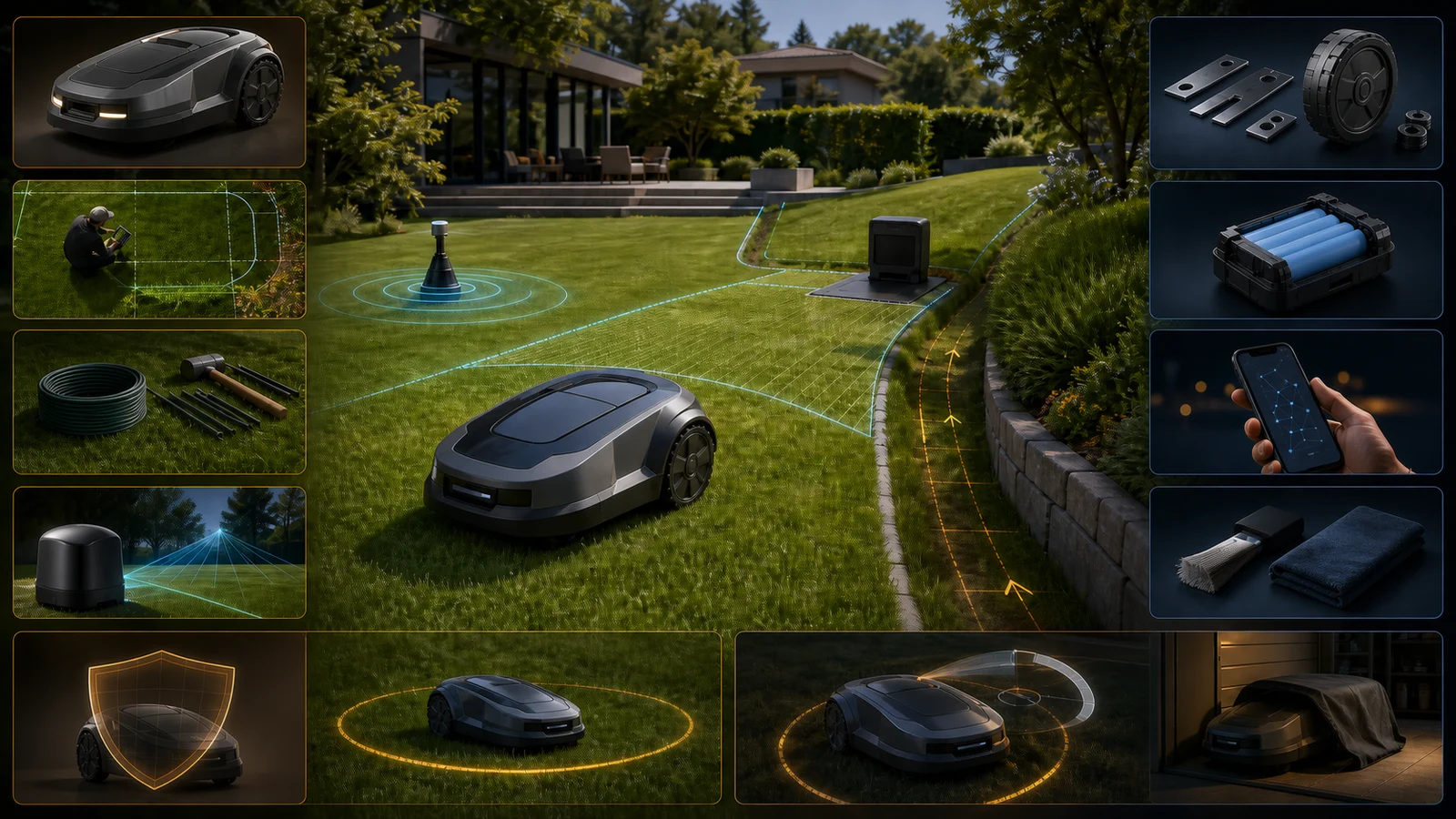
The real budget includes the mower, charging dock, boundary wire or positioning system, site setup, dealer labor, connectivity, blades, wheels, battery, annual service, winter storage and downtime. Lawn size is only one driver. Slopes, trees, narrow passages, separated zones, retaining walls, road crossings and weak satellite or Wi-Fi coverage can change both the required platform and the installation cost.
Prices in this guide are U.S. official-site examples checked on July 25, 2026. Promotions, taxes, stock and regional packages change, so use them to understand tiers—not as permanent market prices.
Robot Lawn Mower Cost at a Glance
| Cost layer | What to include |
|---|---|
| Machine | Mower, battery, charging station, power supply and included navigation hardware |
| Site system | Boundary wire and connectors, RTK reference station, network correction, LiDAR/vision setup or signal accessories |
| Installation | Survey, power, dock base, wire laying or mapping, zones, paths, no-go areas and training |
| Routine ownership | Blades, cleaning, wheel wear, connectivity, electricity and software services |
| Lifecycle | Battery, charging contacts, motors, electronics, dock and weather exposure |
| Seasonal | Winter cleaning, dry storage, battery care, spring recommissioning |
| Risk | Recovery visits, theft, storm damage, warranty exclusions, freight, downtime and backup mowing |
The cheapest machine can become the expensive choice if it cannot navigate the lawn reliably. A premium mower can also be poor value when its capacity and terrain features are unnecessary.
Current Price Tiers
Official U.S. product pages show the spread:
- Compact entry tier: Mammotion's YUKA mini comparison listed a 600H variant at $749 sale versus $1,099 regular, while Segway Navimow listed the i206 AWD for $999. Both target small lawns.
- Small-to-medium wireless tier: Mammotion listed the YUKA mini 2 1000H at $1,399 sale versus $1,559 regular for up to 0.25 acre.
- Premium large-lawn and all-terrain tier: Segway Navimow listed its X4 at $2,499, and Mammotion listed the LUBA 3 AWD starting variant at $2,499 sale versus $2,799 regular on the checked pages.
- Dealer and commercial tier: large-property, sports-turf and fleet machines are often sold through dealers or quotations. The mower can require separate reference stations, fleet software, installation and service.
These examples are not like-for-like comparisons. They differ in lawn capacity, drive system, navigation, included accessories, warranty, support and availability. Some checked variants were sold out, and sale prices can disappear.
Build a quote from the exact variant and package. “Starting at” may refer to the smallest area version, while the lawn requires a larger battery, different cutting height or AWD model.
Lawn Size Is Not Enough
Manufacturers usually state a maximum recommended area. Treat it as a screening value.
Cost rises when the lawn has:
- steep or cross slopes;
- ruts, soft ground or poor traction;
- many trees and buildings that obstruct satellite view;
- narrow passages;
- separate front, side and rear zones;
- fences without a mower gate;
- public sidewalks or driveways to cross;
- ponds, pools, steps or unprotected drops;
- complex edges and retaining walls;
- dense or fast-growing grass;
- strict mowing-hour or noise limits;
- unreliable Wi-Fi or cellular coverage.
A smaller AWD or LiDAR mower can be better value than a larger nominal-capacity machine that repeatedly becomes stuck. Conversely, a simple open lawn may not need premium sensing.
Map mowing area separately from gross parcel size. Remove the house, hardscape, beds, woodland and other non-mown surfaces before matching capacity.
Boundary Wire, RTK, LiDAR and Vision Change Cost
Physical boundary wire
A wired mower uses a buried or surface-laid perimeter loop and may use guide wires.
The mower can be less dependent on satellite coverage, but budget for:
- wire, stakes, connectors and surge protection;
- trenching or machine-laid installation;
- driveway and path crossings;
- cable breaks and tracing;
- changes after landscaping;
- guide-wire tuning and difficult passages.
DIY installation saves labor but transfers layout, repair and documentation work to the owner.
RTK or network-RTK
RTK systems use satellite positioning plus correction data. Some packages include a reference station; others use network correction or combine both.
Check:
- whether the station is included;
- mounting hardware and clear-sky location;
- power and cable route;
- ongoing correction or cellular service;
- operation under tree canopy and beside buildings;
- fallback behavior when correction is lost.
Husqvarna's 420 iQ page, for example, lists an EPOS plug-in and reference station as included for the specified U.S. package. That inclusion cannot be assumed for another model or market.
LiDAR and vision
LiDAR or camera-led systems can reduce reliance on a physical wire or local RTK station. They may still need careful mapping, lighting validation, clean sensor windows and safe treatment of drops or ambiguous grass boundaries.
The cost moves from buried infrastructure toward sensing, compute and software. The buyer should test the exact lawn rather than infer performance from the navigation label.
Hybrid navigation
Premium products increasingly combine satellite, camera, LiDAR, inertial sensing or radar. Hybrid systems can improve coverage across conditions, but more sensors do not remove the need for service, updates and field validation.
For a technical comparison, see RTK vs LiDAR robot lawn mowers.
Machine Price and Included Equipment
Before comparing prices, create an included-items table:
- mower and installed battery;
- charging station and power supply;
- low-voltage extension cable;
- boundary wire, stakes and connectors;
- RTK station, pole, mount and extension cable;
- garage or weather cover;
- spare blades and screws;
- cellular module or SIM period;
- installation tools;
- warranty duration for mower, battery and accessories.
The current Husqvarna 420 iQ page lists the charging station, power supply, low-voltage cable, stakes, EPOS plug-in, reference station and six extra blades for the named package, while saying loop wire is not included. Mammotion's current YUKA mini pages show packages and optional 4G modules that can change the checkout total.
Never compare a complete kit with a mower-only listing.
Installation Cost
There is no defensible universal installation price because the work scope varies.
Ask for separate lines:
- site survey and signal check;
- lawn-area measurement;
- dock location and base preparation;
- outdoor power work by a qualified provider where required;
- boundary-wire length, crossings and repair access;
- RTK station mount and cable route;
- mapping, zones, transport paths and no-go areas;
- fence gate or landscape changes;
- test mowing and edge adjustment;
- owner training and documentation;
- return visit after the first growth cycle.
Wireless does not mean zero installation. It often removes trenching but adds surveying, station placement, mapping and software configuration.
Husqvarna's U.S. support center separates wired installation, wireless installation and professional installation resources. That is a useful commercial boundary: identify who performs the setup and who must return if the route fails.
Blades, Wheels and Cleaning
Robot mowers cut frequently with small pivoting blades or another defined cutting system. Blade life depends on hours, soil, twigs, stones, sand, grass condition and cutting height.
Budget for:
- blades and correct fasteners;
- cutting-disc inspection;
- wheel and tread wear;
- removal of packed grass;
- dock-contact cleaning;
- sensor-window cleaning;
- underside inspection;
- damage from roots, stones and landscape edging.
Husqvarna's current iQ materials describe a free blade supply based on a recommended 500–1,000 mowing hours per blade set, while warning that lawn size, grass type and terrain affect performance. This is a maintenance interval reference for that package, not a universal blade-life guarantee.
Use the blade manufacturer's instructions and replace damaged or unbalanced parts as a set where required.
Battery Cost
The battery is a lifecycle cost, even when it is covered separately during part of the warranty.
Ask:
- battery capacity and chemistry;
- whether it is owner-, dealer- or depot-replaceable;
- battery warranty period and capacity threshold;
- replacement part price and availability;
- diagnostic process;
- storage state of charge and temperature;
- shipping restrictions;
- expected support period for the pack.
The Husqvarna 420 iQ page states a four-year U.S./Canada mower warranty for the iQ Series and a separate three-year battery warranty, subject to the policy. Other brands and products differ.
Do not divide battery price by a claimed number of years without considering cycles, heat, cold, storage and calendar aging.
Apps, Connectivity and Subscriptions
Some functions work over Bluetooth or Wi-Fi. Remote tracking, network RTK, cellular control or fleet management may use mobile data or a paid service.
Record:
- free service period;
- renewal price after the included period;
- functions lost if service is not renewed;
- map and account dependence;
- multi-user and dealer access;
- theft tracking;
- server-region and privacy terms;
- software support and end-of-life policy.
Segway's X4 page said network RTK and required cellular data were included at no extra cost on the checked date. Mammotion described three years of free 4G service with defined modules or variants. Those offers are product- and time-specific.
A lifetime ownership model must not assume a temporary free-service period continues forever.
Annual Service, Winter Storage and Repair
In cold or off-season markets, the mower may spend months out of operation.
An annual service can include:
- cleaning and inspection;
- blade replacement;
- seals and charging contacts;
- wheel, motor and bearing checks;
- battery diagnostic;
- firmware update;
- dock and cable test;
- boundary-loop measurement;
- spring recommissioning.
Winter cost depends on whether the owner cleans and stores the mower, pays a dealer, or uses pickup and storage. Follow the model manual for temperature, charging and storage position. Do not leave a battery unmaintained because the mower is out of sight.
The full maintenance workflow is covered in the robot lawn mower maintenance and winter storage checklist.
Warranty, Downtime and Backup Mowing
Warranty length is only one part of service value.
Verify:
- mower, battery, charger and accessory coverage;
- labor, freight and pickup;
- accidental, water, lightning and animal damage exclusions;
- authorized-seller requirement;
- turnaround time;
- advance replacement or loaner;
- local parts stock;
- who restores maps and settings;
- commercial-use limits.
During peak growth, a mower waiting for parts can create an immediate need for a contractor or conventional mower. Add a downtime reserve or backup plan.
The right comparison is not “four-year warranty versus three-year warranty.” It is the expected time and cost to restore the lawn to the required service level.
Compare Robot Mowing with the Alternatives
Versus a conventional mower
Include the existing mower's purchase or depreciation, fuel or electricity, maintenance, storage and the operator's time. A robot usually does not remove edging, trimming, cleanup, seasonal renovation or repairs.
Versus a lawn service
Only count the share of invoice cost that can actually be removed. A landscaping contract may bundle mowing, trimming, blowing, bed work, fertilization and seasonal service.
If the contractor still visits for edges and horticultural work, the avoided value may be lower than the full weekly charge.
Versus doing nothing differently
The owner may value time, mowing frequency, turf appearance, noise, emissions at point of use and schedule flexibility. Keep non-cash benefits separate from hard payback.
Robot Lawn Mower Payback Formula
Use:
`Initial installed cost = mower + required hardware + survey + installation + site changes + tax and delivery`
`Annual robot operating cost = blades + service + electricity + connectivity + repair reserve + battery reserve + owner support + backup mowing`
`Annual avoidable mowing cost = current annual cost that will actually stop after deployment`
`Annual net cash benefit = annual avoidable mowing cost - annual robot operating cost`
`Simple payback years = initial installed cost / annual net cash benefit`
If annual net cash benefit is zero or negative, the mower has no simple cash payback. It may still be a lifestyle or service-quality purchase.
For a multi-year comparison:
`Annualized ownership cost = (initial installed cost - expected residual value) / analysis years + annual operating cost`
Use a low residual value unless there is evidence for the exact model. Software support, battery condition and parts availability can affect used value.
Quote Checklist
Ask the dealer or seller to confirm:
- exact model and area variant;
- current price, tax, shipping and promotion expiry;
- all included hardware;
- measured mowing area and terrain assumptions;
- boundary and navigation method;
- dock, power and signal plan;
- mapping, zones, passages and crossings;
- installation exclusions and return visits;
- blades, wheels and consumables;
- connectivity term and renewal cost;
- mower, battery, dock and accessory warranty;
- service location, parts and turnaround;
- winter storage and spring startup;
- backup solution during repair;
- refund, exchange and failed-installation policy.
For buyers comparing channel support, see robot mower dealer networks. Brand teams assessing the factory side should use the separate robot lawn mower manufacturing cost model.
Frequently Asked Questions
How much does a robot lawn mower cost?
Current U.S. official-site examples checked in July 2026 ranged from sale prices below $1,000 for compact models to about $2,500 and above for premium AWD models. Larger variants, commercial systems, installation and accessories can raise the total substantially.
How much does robot mower installation cost?
It depends on boundary method, lawn size, wire length, station placement, power, crossings, mapping, terrain and site changes. Request a surveyed fixed-scope quote instead of relying on a national average.
Are wire-free robot mowers cheaper to install?
They can avoid perimeter-wire trenching and future wire repairs, but may require signal assessment, a reference station, mapping, network service and return visits. Compare the complete installed system.
How often do robot mower blades need replacement?
There is no universal interval. Hours, grass, soil, stones, twigs and blade design matter. Follow the model instructions, inspect frequently and budget by operating hours.
How long does a robot mower battery last?
Battery life depends on chemistry, cycles, heat, cold, charging and storage. Ask for the battery warranty, replacement price, diagnostic standard and part availability for the exact model.
Does a robot mower replace a lawn service?
It replaces frequent grass cutting on the areas it can reach. Edging, trimming, cleanup, beds, fertilization, seasonal work and repairs may remain, so do not count the entire service contract as avoided cost without changing its scope.
Is a robot lawn mower worth it?
It can be worth it when the lawn fits the platform, installation is reliable, service is available and the value of avoided mowing or owner time justifies total cost. Complex lawns require a site test.
Final Decision
Buy the system that fits the lawn, not the machine with the lowest advertised price or largest nominal area.
Document the complete first-year and lifecycle cost. Test navigation under trees, beside buildings, across slopes and through passages. Confirm what the package includes, what connectivity costs later, how the battery is replaced and who restores service during peak growth.
Then calculate payback from costs that genuinely disappear. If trimming, edges and contractor visits remain, keep them in the model. That produces a realistic answer to the robot lawn mower cost question—and a purchase that is less likely to become an expensive experiment.
Explore 2026 new models