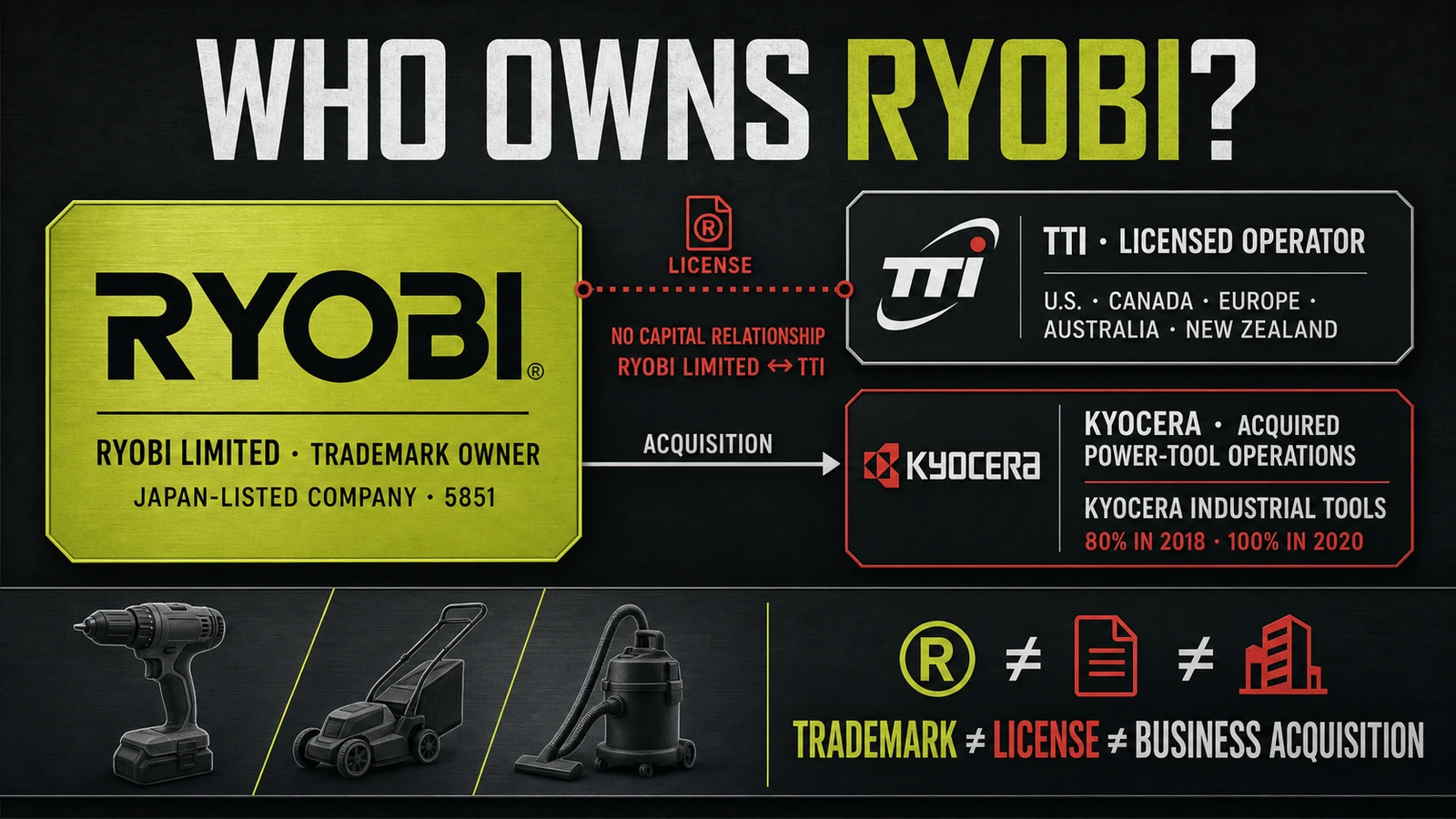
- Pudwill built TTI's manufacturing capabilities before acquiring the brands and distribution that shaped its expansion.
- His partnership with Joseph Galli combined a founder's commitment to cordless tools with a larger professional management organization.
- Financing strains during the financial crisis exposed the cost of rapid expansion, even as TTI continued investing in product development.
*Cover: AI-assisted editorial montage based on separate official TTI photographs; not a single documentary scene.*
On December 13, 2001, in Cleveland, Horst Julius Pudwill heard something he would rather not have heard.
His customer, Royal Appliance, said another supplier was offering more competitive prices and wanted a larger share of its orders. That supplier was even willing to discuss an acquisition. Royal owned Dirt Devil, a familiar vacuum-cleaner brand in American homes. Pudwill's company, Techtronic Industries, was one of its important suppliers.
Pudwill agreed to make his pricing more competitive. He was interested in an acquisition too, but could not do one immediately. TTI was still digesting several purchases and did not have the financial capacity for another deal.
The meeting would later appear in Royal's filings with the U.S. Securities and Exchange Commission. By then, Pudwill had been running TTI for more than a decade, and the company had long been listed in Hong Kong. Across the table from a customer, he still had to negotiate for the next order.
Today, Milwaukee, RYOBI and a collection of American and European tool and cleaning brands belong to TTI's business portfolio. Pudwill built the world's largest power tool company. He once had to persuade such brands to accept his products. Eventually, he would help decide what products they made.
Pudwill grew up in postwar Germany. He never knew his biological father; his mother later married a civil servant in Hanover. He studied engineering and went to work for Volkswagen. In 1971, he arrived in Hong Kong with his Canadian wife to look after the carmaker's local business.
He liked the city. Years later, when reporters asked why he had stayed, he still spoke about its speed: things got done, and businesses he wanted to build had a chance of succeeding. He never moved back to Germany.
In 1978, Pudwill started a trading company with six people. One was Roy Chi Ping Chung, who would later co-found TTI with him. They sourced tools from Taiwan, Japan and South Korea and sold them to Western customers. Pudwill handled the market; Chung handled production. Their partnership would last decades.
They agreed on ownership from the beginning: Pudwill held two-thirds. He later told Forbes that being clear about the division of shares had helped them remain partners—and friends—for 30 years.
The trading business grew, but Pudwill became dissatisfied with simply buying from other manufacturers. If quality or delivery went wrong, he had to answer to the customer without necessarily being able to fix the underlying problem. In 1985, the partners started manufacturing themselves. TTI was born.
With an engineering background and a personal interest in tools, Pudwill chose cordless products, a field with plenty of room for improvement. An early 3.6-volt rechargeable screwdriver won orders for Craftsman, the Sears brand. It was a small machine. Winning the business of that American retail giant was a much larger task.
Sears was used to buying from North America and Japan and had reservations about Chinese manufacturing. Pudwill recalled two layers of inspection: TTI checked the products, and Sears checked them again. It took more than three years for the customer to gradually increase its purchases.
The orders did not vindicate every part of his plan at once. They gave the factory a chance to keep going. Looking back, Pudwill said that he had started with small tools and had needed patience.
The partners also made money in Hong Kong property. According to Forbes, they bought a floor in an industrial building and sold it 18 months later for a 100% gain. The money went into expanding their manufacturing in China. In 1988, TTI opened its first production facility in Dongguan.
That year, Japan's RYOBI was looking for a tool-manufacturing partner. It became a customer and took a 20% stake in TTI, bringing orders and closer technical and manufacturing ties. In 1990, TTI listed in Hong Kong.
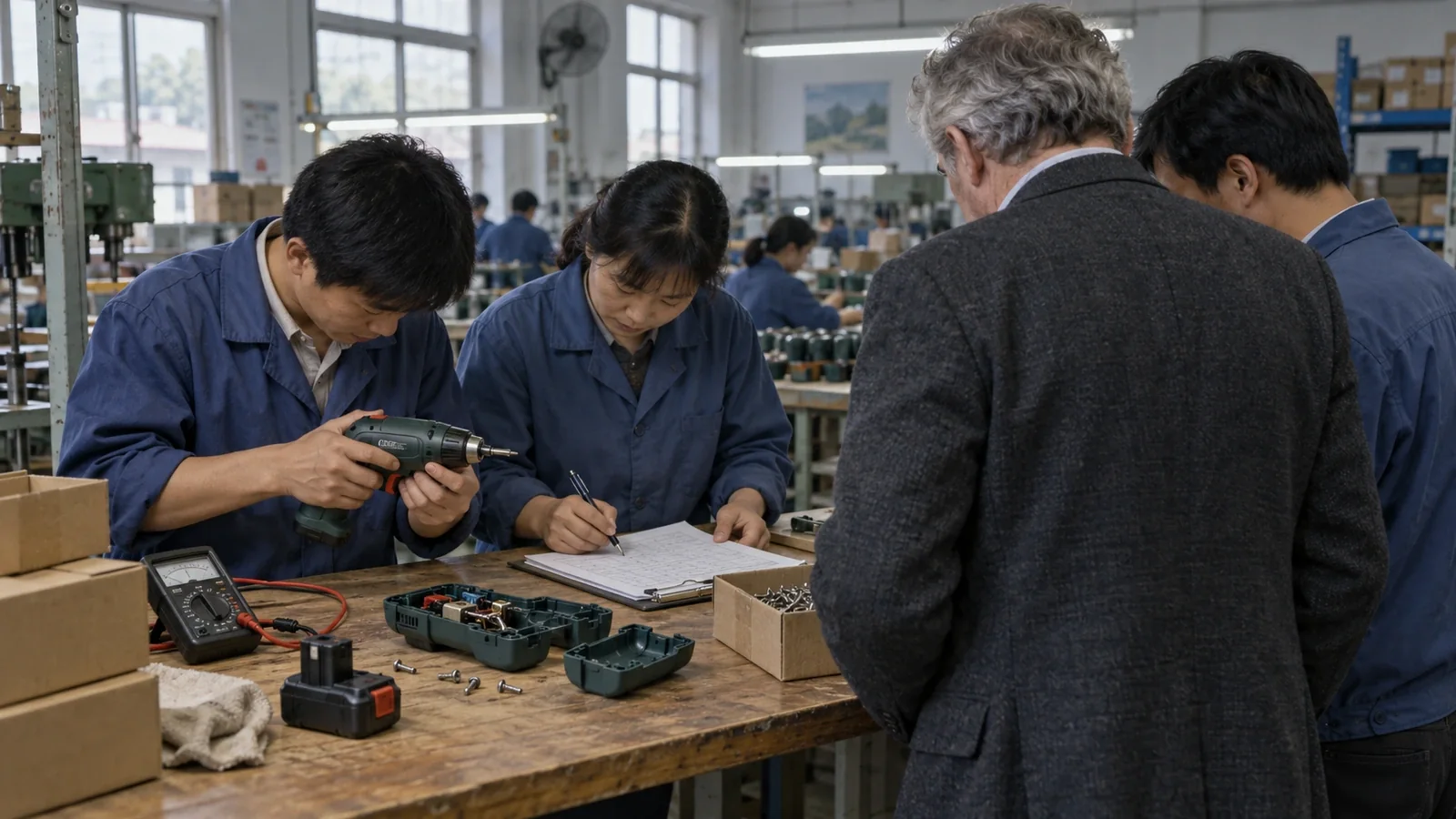
*AI-generated scene illustration accompanying the story of manufacturing and quality checks. The people, workshop and tool are illustrative, not archival records of TTI or Sears.*
For a business that had started with six people, this was already a considerable achievement: bigger factories, more customers and a founder with shares in a listed company. Yet Pudwill still depended on those customers to decide what the next product would be, who would buy it and at what price.
He wanted those decisions too.
In 1999, TTI acquired the relevant VAX business in Britain and began building its own brand portfolio. That same year, Pudwill recruited industrial designer Alex Chunn, who had worked for RYOBI in South Carolina. Chunn established a concept center that brought product engineers, industrial designers and graphic designers together.
Owning a brand would require a continuing supply of products that consumers wanted to buy. Pudwill had begun putting the people in place to develop them. His approach to those design centers was later described in a DFA profile.
A larger opportunity arrived in 2000, when RYOBI sold its North American power-tool-related business. TTI was the buyer. A supplier that had grown on RYOBI orders and accepted RYOBI investment was taking over part of its customer's business.
In the announcement, Pudwill said the transaction would double TTI's size. Over the following years, the group expanded its RYOBI business and brand licenses into additional regions and categories.
Years later, when the South China Morning Post asked him about his smartest business move, he still pointed to RYOBI.
With the brand in hand, he went to Home Depot. They reached an agreement in 2001. In his 2016 interview, Pudwill did not remember it as an easy handshake: the negotiations were tough, and Home Depot was a shrewd, demanding counterpart.
TTI now had a more direct route to consumers. Americans could walk into a home-improvement store and buy RYOBI tools whose development and supply were increasingly controlled by a company in Hong Kong.
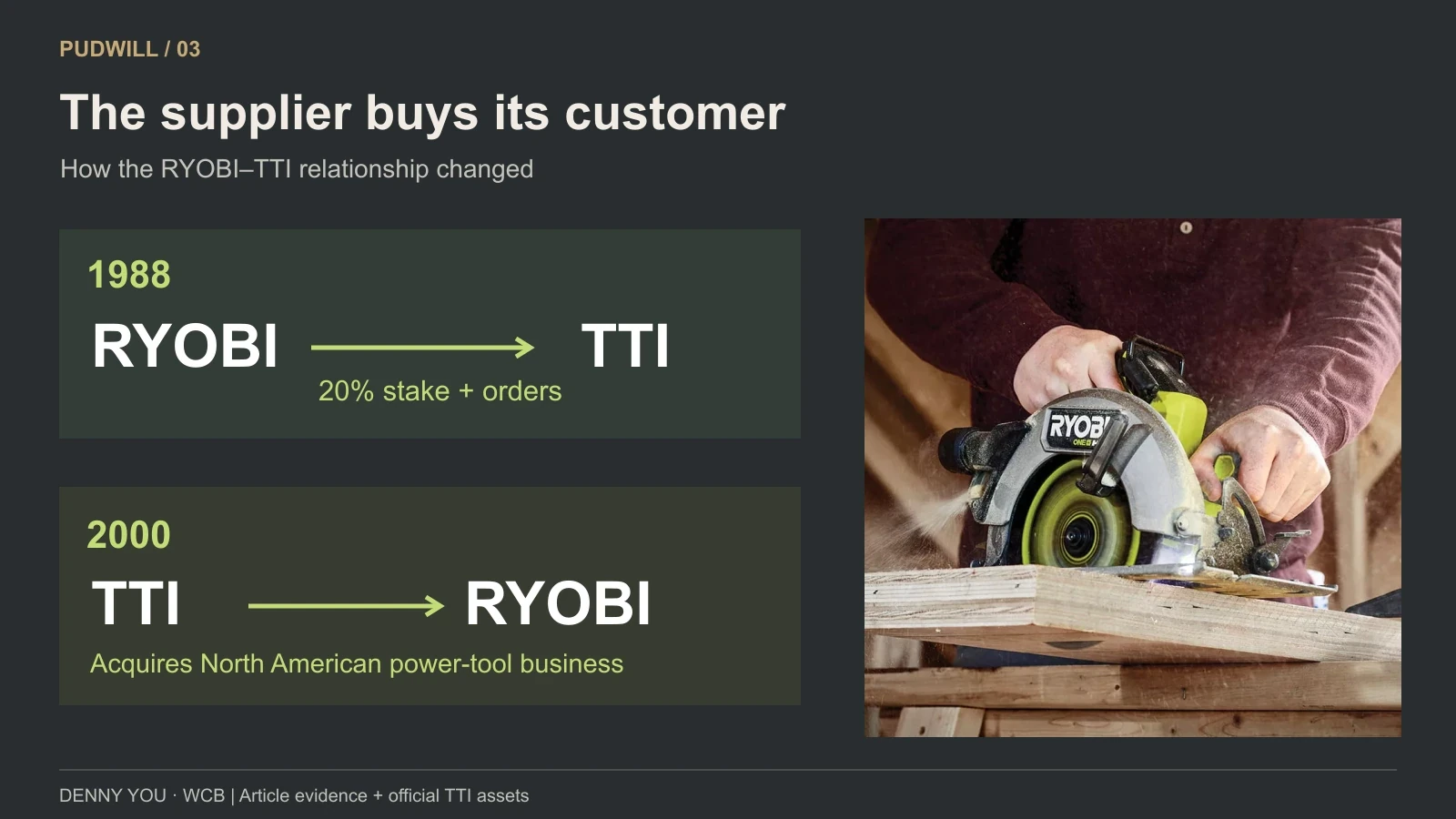
*A reversal in the business relationship, not a purchase of the entire Japanese RYOBI group. Contemporary tool photograph: TTI.*
Then Pudwill returned to the negotiating table with Royal.
By 2002, TTI had raised money and could discuss a purchase. Royal had approached other potential buyers, but some lacked financing and others preferred to wait. A workable transaction remained elusive.
The discussions moved from supply arrangements to cooperation in manufacturing, research and logistics, then to price. TTI initially offered roughly $92.8 million for Royal's equity. Royal wanted more. TTI raised its offer; the seller continued negotiating.
Pudwill was willing to pay more, but he had conditions of his own. He wanted changes to executive employment and severance arrangements. The eventual package included one-time payments, shorter future severance periods for some executives and additional incentives linked to performance. A change-of-control compensation plan for ordinary employees was not cut back as initially contemplated.
In December 2002, the companies signed an agreement with an equity purchase price of approximately $105.5 million.
The transaction record has fewer declarations of entrepreneurial ambition than the later profiles. When a customer used another supplier to press him on price, Pudwill first protected his competitive position. When he could not afford a purchase, he waited for the financing to improve. Once a deal became possible, he still negotiated the price and personnel arrangements item by item. Royal eventually became part of TTI.
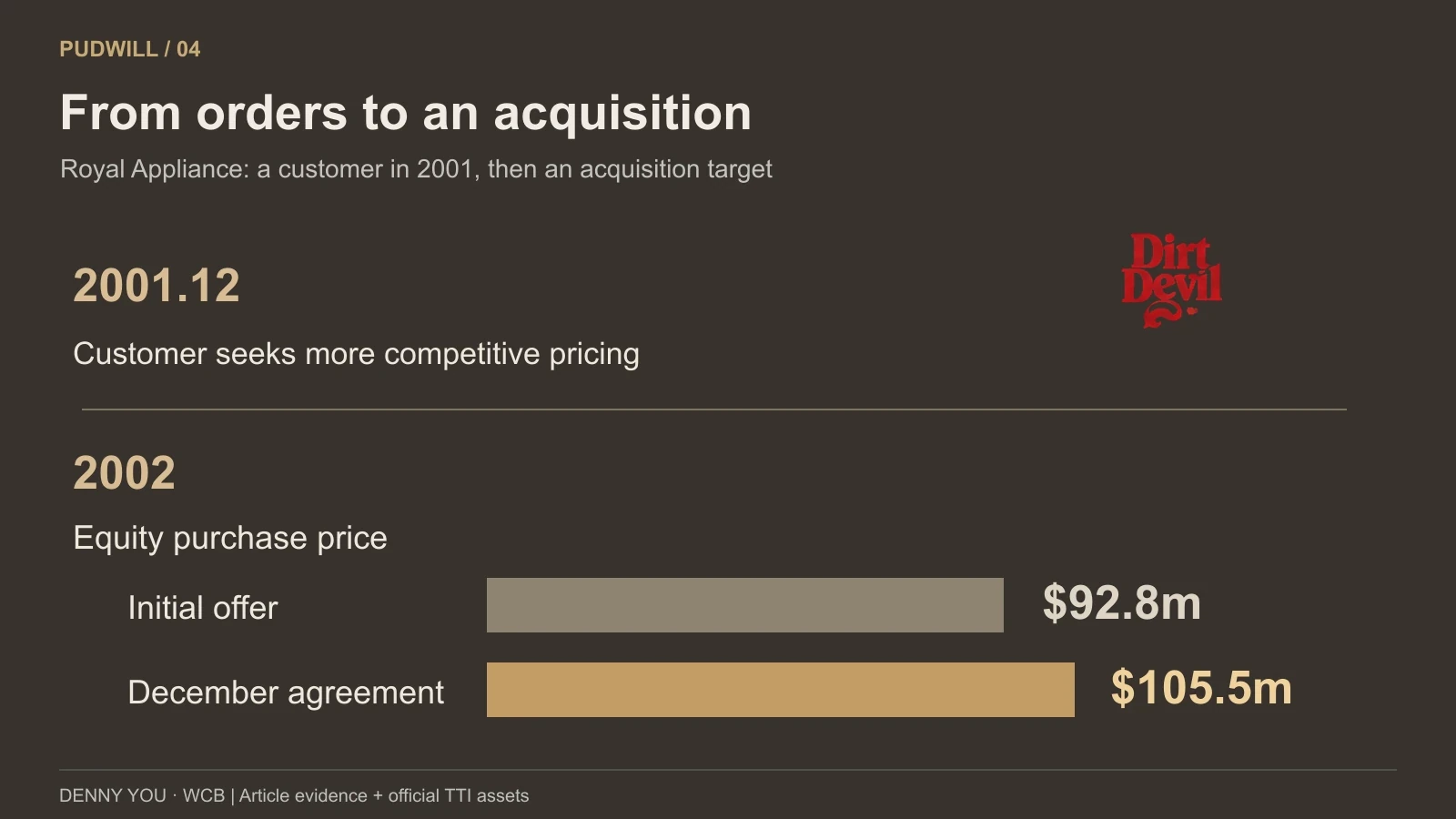
*The Royal negotiations, reconstructed from its SEC filing. Equity purchase prices; contemporary Dirt Devil logo.*
A bigger purchase followed.
In 2004, TTI announced that it would acquire Atlas Copco's electric power-tool and accessories businesses, including Milwaukee, the relevant AEG business and DreBo. The deal closed in early 2005. The announcement put the net cash consideration at approximately $627 million.
Milwaukee already had a strong reputation among professional tool users. Its lithium-ion technology was attractive too, although Pudwill thought other parts of the business looked old-fashioned.
RYOBI had taken TTI into home repair and DIY. Milwaukee brought it closer to people who earned their living with tools. These customers used their equipment every day; downtime cost them money. Better products could command higher prices, but serving that market also required sustained investment in development.
Pudwill was willing to pay for the opportunity. He had long believed that batteries would improve and more work could be done without a power cord. A friend once dismissed cordless tools as a gimmick. Pudwill did not change direction.

*The $627 million figure covers the announced transaction, not Milwaukee alone. Contemporary application photograph: TTI.*
As the acquisitions accumulated, however, the company became harder for one founder to manage. Alongside the factories were research teams, sales organizations and dealer networks in different countries.
Joseph Galli joined TTI in November 2006.
He had spent 19 years at Black & Decker, helping develop its DeWalt heavy-duty tool brand. He later became president and chief operating officer of Amazon and then CEO of Newell Rubbermaid. His departure from Newell Rubbermaid in 2005 had been a setback in his career.
Pudwill initially put him in charge of the floorcare business. Fifteen months later, in February 2008, Galli became group CEO. Pudwill handed over the job he had held for years and remained chairman.
The handover came before the financial crisis erupted in full. Pudwill was arranging the management of a larger company.
He did not withdraw from the business. The appointment announcement specified that Galli reported to him and that Pudwill retained oversight. Galli's package included a $1.2 million base salary, performance-related bonuses and share awards.
Galli later liked to compare TTI with the large companies he knew. He said a new product had taken 20 to 28 months to develop at Black & Decker, against roughly nine months at TTI. He credited Pudwill's entrepreneurial approach: the company did not require nine signatures to get something approved.
Pudwill had strong views about the company's direction while leaving managers room to act. Milwaukee retained its product-development and sales organizations; TTI supplied manufacturing, purchasing and financial support. Galli recruited managers and graduates and built a broader management structure. By 2016, he said more than 100 former Black & Decker employees had joined TTI.
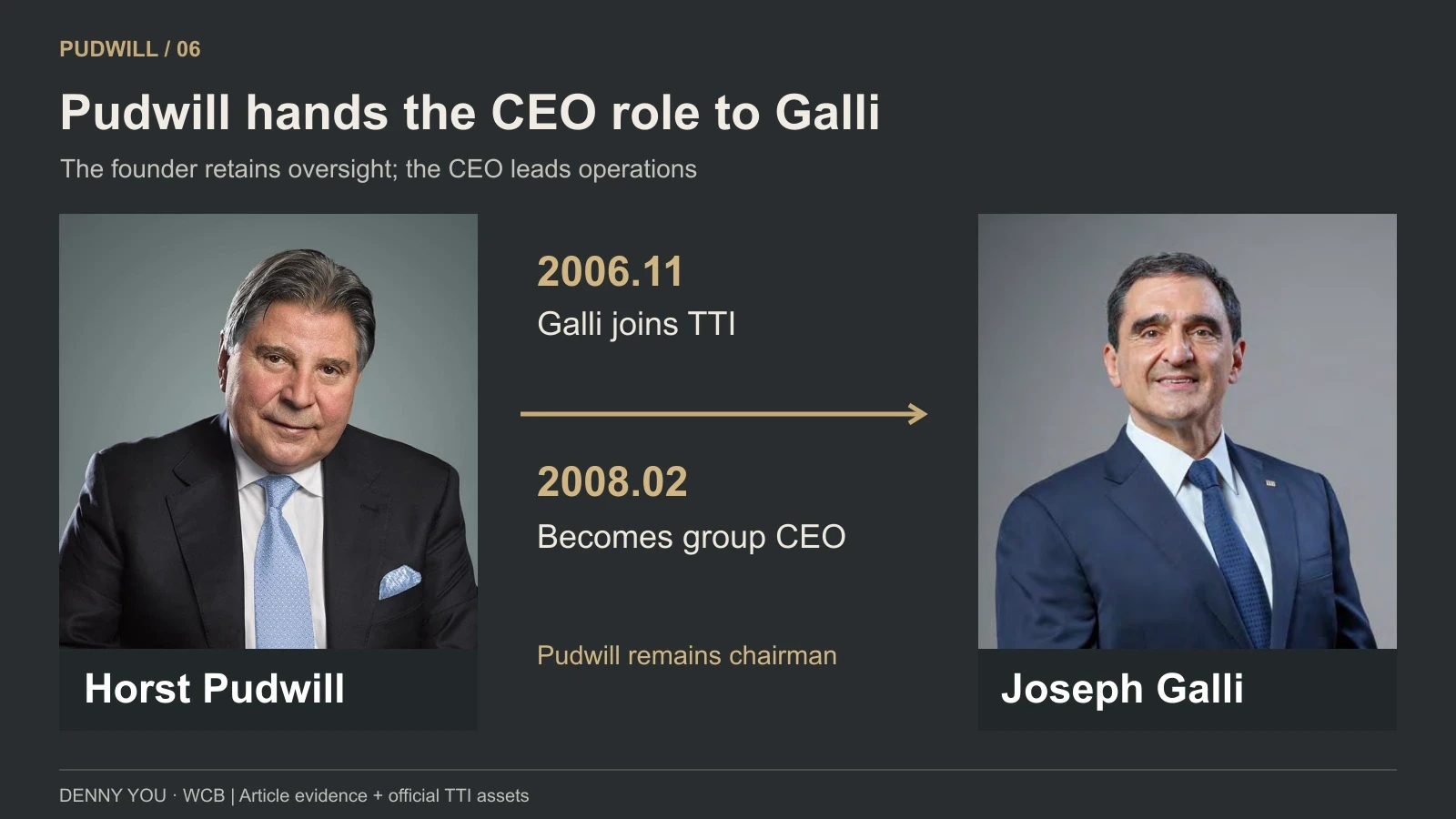
*Pudwill retained the chairmanship as Galli became CEO. Separate official portraits, not a photograph of the handover.*
Just as the partnership entered that new phase, the financial crisis arrived.
The American housing market was falling, tool demand was under pressure, and debt accumulated through acquisitions became a burden. The business needed funding as financial markets tightened. In 2009, TTI raised approximately $229 million through arrangements including a share placement and convertible bonds.
Pudwill later acknowledged a cost he did not want to pay again. Asked by the German newspaper Handelsblatt about his biggest mistake, he pointed to the dilution caused by that financing.
As he put it, they were engineers, not financial experts.
He had wanted to expand quickly and had underestimated the difficulty of funding that growth. After the crisis, TTI built a larger cash cushion. In the Handelsblatt interview, Pudwill said he did not want to find himself in the same position again.
The company kept developing cordless tools. Better batteries, motors and controls allowed Milwaukee to enter more professional applications and RYOBI to offer household users a wider range. Batteries that had once powered small screwdrivers gradually took on work previously done with power cords or other sources of energy.
Pudwill used the tools himself. He told the German magazine €uro that he had a tool cellar at home, where he tested products, and did repairs around the house. Painting was the exception. He disliked it and hired a painter.

*AI-generated scene illustration inspired by Pudwill's account of testing tools at home. This is not his portrait or a photograph of his actual house.*
Even after relinquishing the CEO role, he spent substantial time with customers. A 2016 profile reported that he traveled for about five months of the year, meeting customers and visiting stores to see how the products were selling.
Asked that year about his next ambition, he said he wanted to build a $10 billion company. TTI was then roughly half that size. He did not think doubling it would be especially difficult.
His son Stephan added that they would take it step by step.
Stephan had attended company dinners and traveled with his father from childhood. He later left Hong Kong to study and work before returning to the family business. Pudwill wanted his son to join, but recognized that establishing himself as the founder's son would not be easy.
Father, son and Galli developed a long working relationship. Stephan was based in Hong Kong, Galli mainly in the United States, and Pudwill continued to work on strategy and customer relationships. Stephan said their discussions could be intense, but they wanted to leave the room having reached agreement.
In 2020, all three faced another abrupt change. The Dongguan factories shut down, Home Depot restricted store traffic and customers adjusted orders. In early April, they met senior executives on Zoom and decided to keep investing for the long term, maintain research spending and allow inventories to rise.
Orders followed as households spent more on repairs and improvements. TTI reached approximately $9.8 billion in revenue in 2020. In 2021, it crossed the $10 billion threshold Pudwill had repeatedly discussed. Forbes's account of the pandemic decisions described the investment choice made before the strength of that demand was clear.
Galli left TTI in 2024, and Steve Richman, Milwaukee's longtime leader, succeeded him as group CEO. In 2025, TTI reported $15.26 billion in revenue and approximately $1.2 billion in profit attributable to shareholders. The business its founder had once hoped to double had kept growing.
Pudwill's influence cannot be measured only by a handful of successful acquisitions. Starting as a supplier, he gradually won control over brands, product decisions and routes to market, then gave capable managers room to build businesses within that organization. Chinese manufacturing helped sustain the growth of those brands in Western markets.
In one interview, he said he was proud of having become an important participant in the American market early on. His appearance on a rich list was something his son had told him about.
David Butts once asked why he did not sell the company and retire. The business was already substantial. In Butts's recollection, Pudwill turned and put a hand on his shoulder.
“David, my customers need me.”
 Milwaukee
 RYOBI
RYOBI