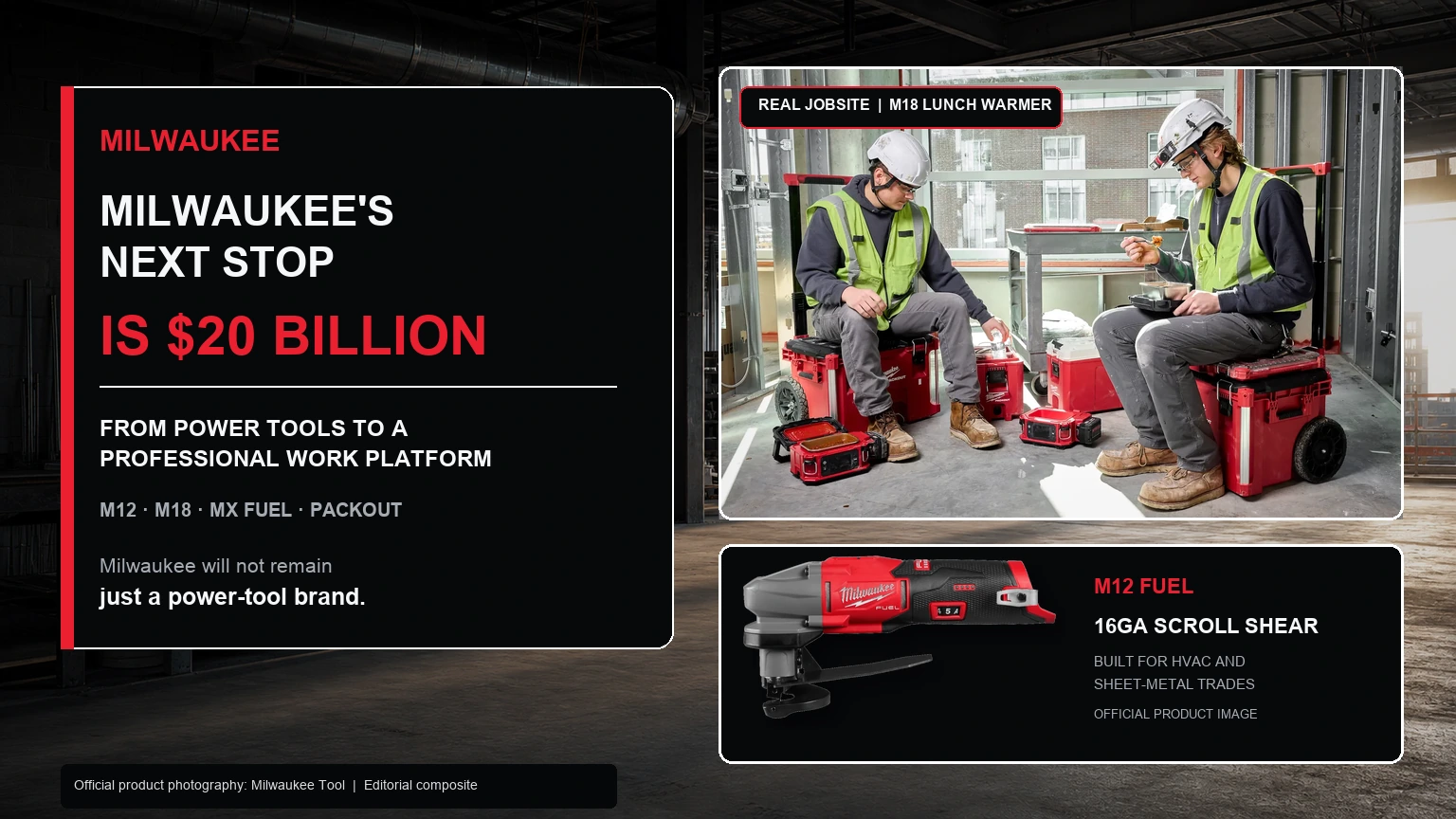
- Milwaukee expanded by developing tools around specific professional trades and tasks.
- Richman's contribution included faster product development, commercial execution and the expansion of teams with decision-making responsibility.
- Milwaukee's engineering heritage and TTI's resources were essential alongside Richman's leadership.

In early 2009, Steve Richman would not promise a reporter that Milwaukee would keep growing.
The American housing market was collapsing. Sales of the company's traditional tools used in home construction had fallen by double digits the previous year, and Milwaukee had cut jobs in Brookfield. Speaking to the Milwaukee Journal Sentinel, he said it would be imprudent to predict growth in 2009. The company would fight for market share.
Richman had taken charge of Milwaukee in January 2007. Founded in 1924, the company had built a professional reputation with products such as the Sawzall reciprocating saw, used by generations of American tradespeople. He later recalled a business with less than $500 million in annual revenue and an identity associated with their grandfathers.
He inherited substantial assets. TTI had acquired Milwaukee in 2005, the same year Milwaukee introduced lithium-ion tools. The brand, engineers and new technology were already there. The question was how to turn them into a much bigger business.
Richman had spent more than two decades in the tool industry. He began his career at Black & Decker in 1982, moving through sales, marketing and product management before eventually joining Skil and Bosch. There, he led a 200-person direct-sales force serving retail and industrial channels, and later became president.
In late 2004, ladder manufacturer Werner announced his appointment as CEO. Its announcement singled out two capabilities: expanding distribution and bringing new products to market faster. Both would become central to his work at Milwaukee.
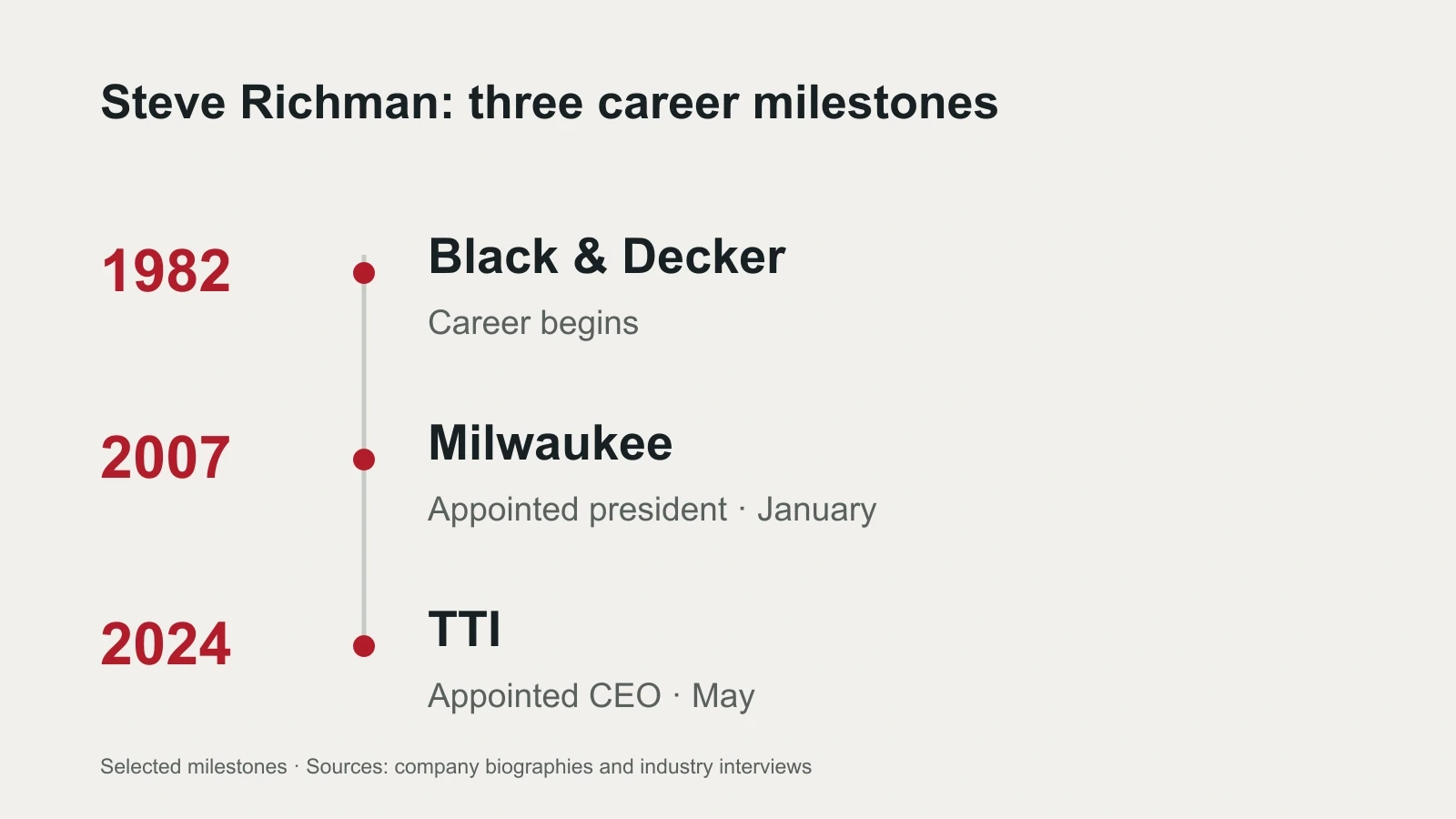
*Selected career milestones. Sources: Richman's industry interviews, Werner's appointment announcement and TTI's executive biography.*
Richman believed Milwaukee's pace of product innovation had slowed. Changes after his arrival addressed the development process: engineers in Brookfield developed concepts and designs, working with engineering teams in China to bring products into production. TTI's manufacturing system gave the American tool company the capacity to increase output and reach the market faster.
A range of products using newer battery technology arrived in 2008. In Richman's account to the reporter at the time, demand for the launches helped Milwaukee gain share while its traditional business contracted. He wanted tools with new applications that would generate additional purchases, beyond replacing worn-out machines.
The shift coincided with a technological opening. Lithium-ion batteries made tools lighter and more portable, but competitors had access to batteries too. Milwaukee needed specific jobs where the technology would give users a reason to buy.
Richman and his team concentrated on plumbers, electricians and mechanical installers. These professionals earned their living with tools, yet much of their work still involved manual operations. Beyond drilling, a plumber had to cut tubing, expand it and connect fittings. Each operation could support a specialized tool.
In 2010, Milwaukee partnered with piping-system company Uponor to develop M12 and M18 expansion tools for its ProPEX connection system. An auto-rotating expansion head enabled one-handed operation, and the tools used batteries from Milwaukee's existing platforms.
Uponor already had an established piping system and a customer base of installers. The partnership gave Milwaukee a place in an existing construction method. Plumbers using ProPEX could see the tool's value in the installation process; Milwaukee gained access to a market that a general-purpose drill could not serve.
A single category might look modest. Across more trades and more tasks, however, Milwaukee could earn a larger share of each professional's spending. Its growth opportunity extended beyond the replacement cycle for traditional power tools.
In a 2016 interview, Shane Moll, then president of Milwaukee's power-tool business, linked the company's focus on core professional users to Richman's leadership. After years serving mechanical, electrical and plumbing trades, he explained, improvements in technology were allowing Milwaukee to expand further into residential construction with products such as nailers and miter saws.
The team also sold more hand tools and accessories. These products did not necessarily contain motors, but the same customers needed them in their daily work. Understanding a trade increasingly determined which products Milwaukee would develop.
Richman wanted direct relationships with users. Field teams and product developers visited jobsites; the company engaged with trade-training institutions and professional organizations. Development teams could observe difficulties in actual work, while sales teams had opportunities to demonstrate new tools on site.
For professional products, a demonstration can be more persuasive than specifications on a shelf. A specialized tool that materially shortens an operation gives a tradesperson a reason to reconsider its price. Milwaukee's distributors and retail channels could then turn interest generated in the field into purchases.
M12 and M18 extended those relationships. Once a user owned batteries and chargers, adding another compatible tool cost less. Each new professional application gave existing customers another reason to buy.
The PACKOUT storage system, launched in 2017, extended the connections between products to toolboxes and bags. Users could configure equipment for their own work. Milwaukee's presence on the jobsite expanded from individual machines into how tools were carried, organized and stored.
That continuing expansion helps explain Milwaukee's development into a brand with an unusually strong following. Users could keep finding relevant new products that worked with what they already owned. The distinctive red equipment made those connections visible, while practical usefulness supported the purchases.
As the company grew, Richman's early management approach began to create problems.
In a later management interview, he recalled how he and his senior team had been deeply involved in almost every part of the business during the initial turnaround. One evening, two senior executives came into his office with a warning: the approach was not sustainable. Some talented employees were leaving, and new arrivals wanted more room to make decisions.
He began changing how authority was delegated. People close to users needed the ability to propose and advance products, while taking responsibility for results and seeking help when costs overran or other problems arose. Senior management could no longer support an expanding business by intervening personally in every detail.
That adjustment explains more about Richman's contribution than a general statement about valuing talent. As Milwaukee entered more professional markets, there was a limit to what its president could understand and handle himself. More teams needed the capacity to identify needs, develop products and drive sales independently.
Discussing expansion in 2019, Richman described a concrete principle: entry into a new trade would come with additional resources, without pulling sales and development teams away from existing trades. Established businesses retained their attention, and new businesses received dedicated people.
The approach required sustained spending. TTI's capital, manufacturing capacity and group resources allowed Milwaukee to expand its engineering and commercial teams. Richman's job was to organize those investments into businesses serving specific users. In 2019, Milwaukee's revenue grew 21.7% in local currency. Its growth had extended well beyond the life cycle of any single hit product.
Assigning all of Milwaukee's success to one person would overlook its existing technical capabilities and the contributions of TTI's management and operating teams. Richman's most substantial achievement over seventeen years was helping turn professional users' needs into a repeatable way of launching products and expanding markets.
He had not founded Milwaukee, but he remained at its operating center as it reset its direction, established a development cadence and expanded its organization. One measure of a professional manager's influence is whether the team can sustain that approach after the manager leaves the role.
In May 2024, Richman succeeded Joseph Galli as TTI's CEO. The executive who had run one brand took responsibility for a multibrand group. Galli's career and subsequent move are covered in our profile of the executive who helped build DeWalt and Milwaukee.
Milwaukee had demonstrated Richman's ability to take a long-established company to a new scale. His next test was whether, without concentrating his attention on a single brand, he could choose the right leaders for more businesses and give them enough resources and room to operate.
*Cover photograph: TTI, Annual Report 2025. It is a contemporary executive portrait, not a photograph from the 2009 events described in the opening.*