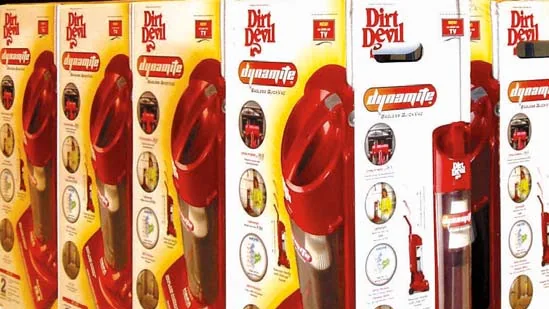
- TTI had supplied Royal since 1995, but lacked the financial capacity to acquire it in late 2001.
- The negotiations linked a higher purchase price to revised executive employment and severance arrangements.
- The acquisition turned a long-standing supply relationship into a platform for shared products, engineering and manufacturing.
In November 2002, Michael Merriman needed to ask a supplier for more money.
He ran Royal Appliance, the company behind Dirt Devil, a familiar name in American vacuum cleaners. For years, he had pressed Hong Kong-based Techtronic Industries—TTI—for more competitive supply prices. Now TTI wanted to buy Royal, and the bargaining had moved to the price of the entire company.
TTI had already raised its offer to about $100.8 million. Royal's board thought it was still too low and asked Merriman to call the man running TTI, Horst Pudwill.
They spoke on November 21. Pudwill was willing to consider paying more, provided Royal's executives accepted new employment agreements with shorter severance provisions. For Merriman, securing a better deal for shareholders had become entangled with negotiating his own future.
Years later, Royal would usually appear as a line in accounts of TTI's expansion: 2003, about $105.5 million, Dirt Devil and Royal added to the group. But the seller's filings with the U.S. Securities and Exchange Commission preserve a more complicated story. Prospective buyers came and went. Shareholders adjusted their expectations. A supplier that had once lacked the money to buy its customer eventually found an opening.
Merriman had not arrived at Royal to wind down a failed business.
When he became chief executive in 1995, the Ohio company was almost 90 years old. Its red Dirt Devil hand vacuum, introduced in 1984, had brought it a level of recognition it had never enjoyed before. Royal went public and expanded. As the hand-vacuum market matured, however, the company encountered stronger competition in upright cleaners.
Merriman had spent 14 years at Arthur Andersen before joining Royal in finance in 1992. Taking charge three years later, he tried to revive growth through faster product development and a different approach to selling.

*Michael Merriman. A later portrait from Resilience Capital Partners, not a photograph from the 2002 negotiations.*
In a 2001 interview, he compared Royal to Chrysler. Unlike competitors such as Hoover and Eureka, Royal did not make as much in-house. It purchased many components and handled final assembly itself. Merriman thought that could work in its favor, freeing the company to concentrate on products and bring them to market faster.
He organized cross-functional development teams and held regular meetings to move projects along. Before a new product reached chain stores, Royal demonstrated it in two-minute television commercials and took orders by telephone. Once it arrived in stores, the commercials grew shorter and the advertising broader. Revenue from the phone orders helped pay for the campaign.
Royal's sales rose from $270 million in 1995 to $408 million in 2000. Merriman had shown that he could grow the business.
One of the suppliers helping him do that was TTI.
The companies began working together in 1995 and later collaborated on new products and quality improvements. To Royal, TTI was part of its overseas supply chain. To Pudwill, orders from American brands were helping build manufacturing and development capabilities that could support a larger business.
TTI was changing during those years. Through transactions involving Vax, RYOBI operations and Homelite, Pudwill was assembling his own brand portfolio. He no longer had to confine the conversation to a customer's next purchase order. He could begin discussing what the customer's company was worth.
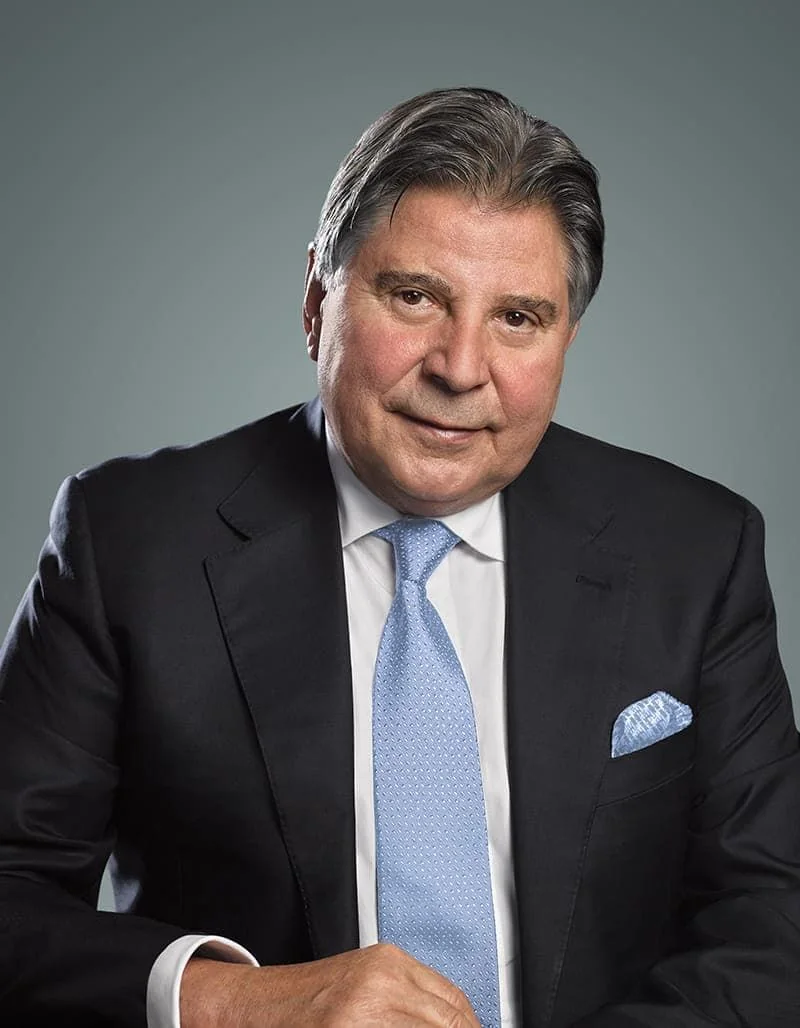
*Horst Julius Pudwill, in a later official TTI portrait. His company had supplied Royal for years before buying it.*
Royal had explored a sale as early as 1999. The board hired an investment adviser and approached strategic and financial buyers, including TTI. TTI did not participate in acquisition discussions at that point. After several months, Royal ended the process without an adequately priced, financed offer.
Shareholders still had higher expectations. In 2000, Richmont Capital, a major shareholder, indicated that it would not consider selling its stake below the low teens per share. Royal continued talking to possible buyers over the following years. Some conducted due diligence. None produced an offer that led to a deal.
Royal insisted on cash without a financing contingency. It did not want a buyer to sign first and find the money later. In a tight credit market, expressing interest was considerably easier than meeting that condition.
Late in 2001, another global supplier told Merriman it wanted more orders and a relationship that might lead to a merger. Merriman asked it to improve cost and quality, then raised the approach in a meeting with TTI.
Royal wanted competition among its suppliers. For Pudwill, the prospect represented both a threat to orders and an opportunity to make an acquisition. He offered to improve TTI's competitiveness and expressed a longer-term interest in buying Royal. But TTI was still absorbing its RYOBI and Homelite transactions and could not afford another acquisition immediately. A meeting between the companies' finance executives a few days later confirmed the borrowing constraint.
The other supplier got no further. It, too, was busy restructuring businesses it had bought and lacked the financial resources.
Another consumer-products company approached Royal in the summer of 2002, discussing both supply and a merger. In August, Merriman again told Pudwill about a potential competitor. This time the response was different: TTI had completed a financing and could seriously investigate a purchase.
A few months earlier, Pudwill and Roy Chi Ping Chung had participated in a placement and subsequent subscription for new shares that brought TTI about HK$376.5 million. The improved funding position allowed it to reconsider Royal. Meanwhile, the latest consumer-products suitor withdrew from acquisition discussions, retaining only an interest in supplying the company.
By the time Merriman met Pudwill in Hong Kong in October, the conversation had advanced to how the combined businesses would operate. Royal could use TTI's manufacturing capacity and engineering resources. Transportation and logistics could be shared with other product lines. After years of working together, neither side had to start by getting to know the other. They could discuss the effects of ownership in terms of factories, development projects and distribution networks.
Royal remained profitable, but the composition of those profits was becoming a problem.
In 2002, sales fell 7.5% to about $389.7 million. Floor care, responsible for roughly nine-tenths of revenue, produced operating profit of $6.97 million, down from $15.88 million the year before. Other businesses, including the Telezapper device for blocking telemarketing calls, accounted for just 9.3% of revenue but generated about $6.38 million in operating profit.
A company known for vacuum cleaners was earning almost half its operating profit outside cleaning.
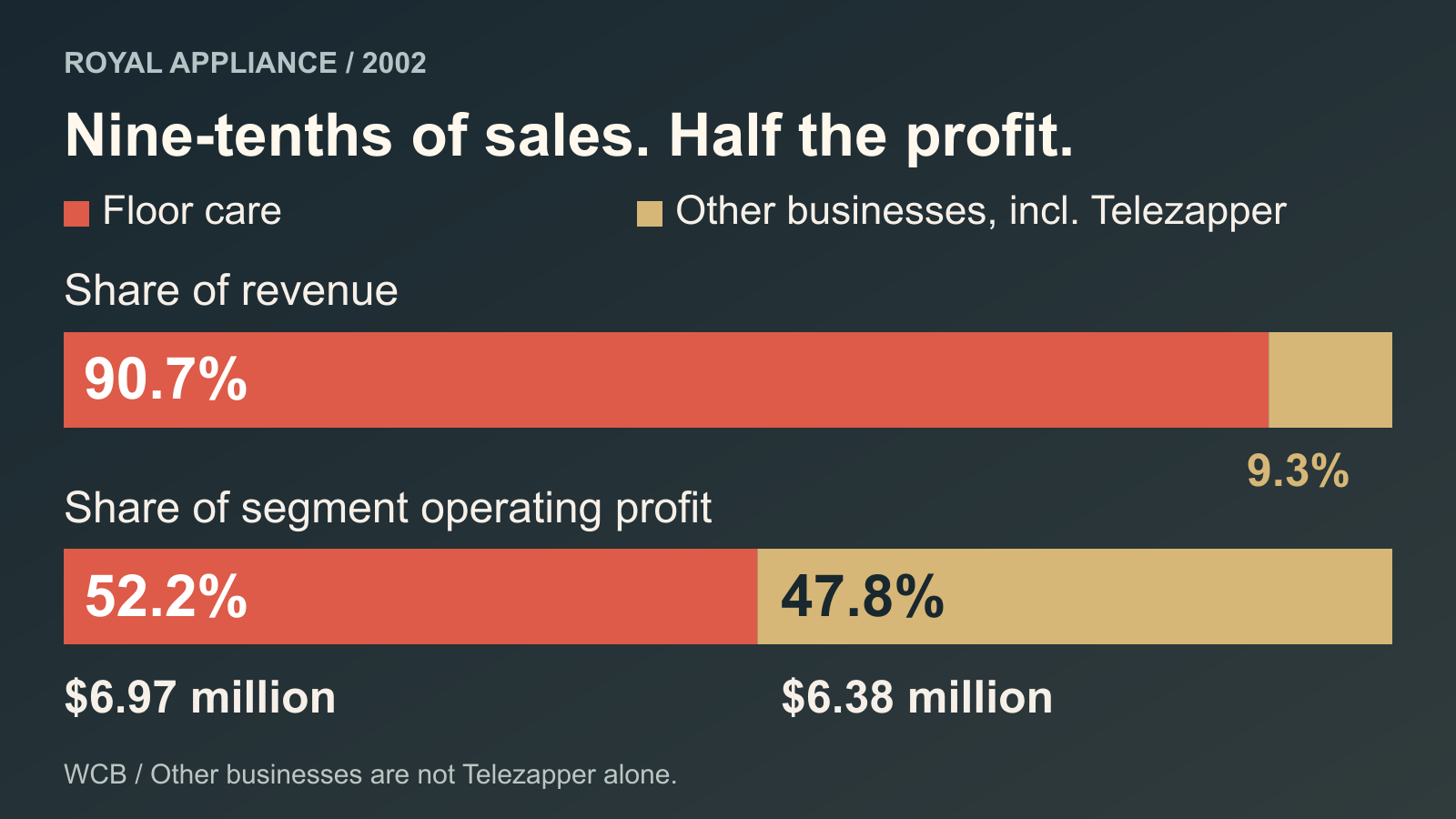
*Other businesses included Telezapper; the figures are not Telezapper-only results. Profit shares compare the two reported segment operating-profit amounts. Source: Royal Appliance's 2002 financial disclosures.*
Dependence on large retailers constrained Royal further. Walmart and Sam's Club, Kmart and Target were important customers. Its five largest customers accounted for about two-thirds of revenue. Kmart's bankruptcy filing that year forced Royal to provide for receivables risk and consider what might happen to future orders.
In the subsequent deal announcement, Merriman pointed to consolidation among retailers and increasingly limited shelf space. Suppliers needed scale through multiple brands and categories, supported by an efficient global supply chain. His assessment captured Royal's predicament: developing more products and selling more vacuums did not free it from competing for space at a handful of powerful customers.
TTI's broader business was beginning to look more attractive than Royal's prospects on its own.
On November 18, TTI offered $92.8 million for the equity, equivalent to about $6.56 a share after accounting for the relevant options and phantom stock. Royal's financial adviser considered it insufficient. The next day, TTI added $8 million, lifting the offer to approximately $100.8 million, or $7.07 a share.
The board still wanted more. That led to Merriman's November 21 call with Pudwill.
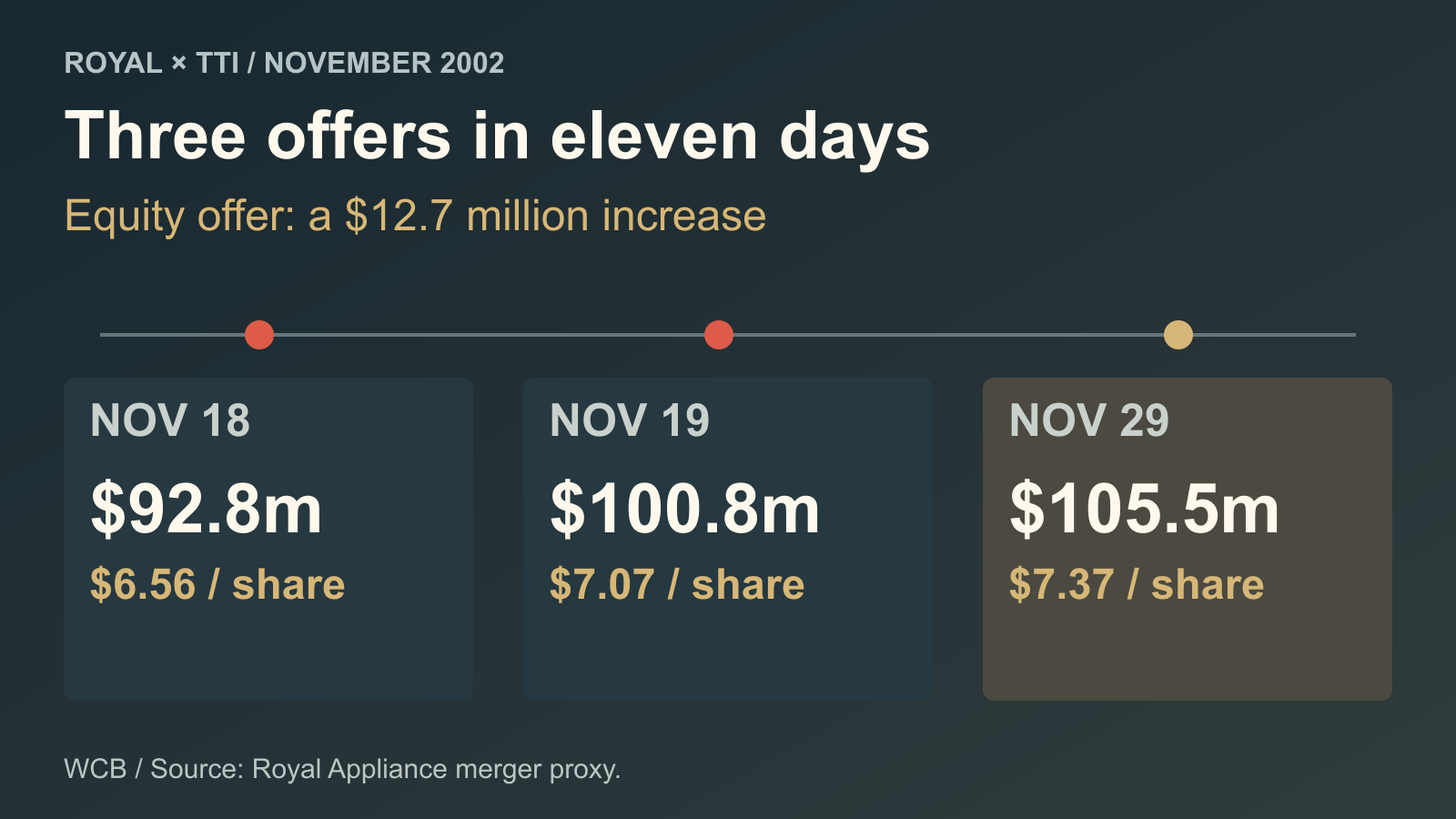
*The equity purchase price increased by about $12.7 million between the first and final proposals. Source: Royal's merger proxy.*
As the price moved within reach, the executives' existing contracts became an obstacle. Some Royal executives had lengthy severance protections. TTI wanted to replace them with one-time payments at closing and shorter severance periods thereafter. It was willing to spend more to obtain the business, but was also calculating what it would cost to run it.
Royal's board required the executives to hire independent counsel for their personal agreements. Representing shareholders in a sale had to be separated from negotiating their own compensation.
Over the following days, Merriman continued negotiating with TTI's adviser. Management was prepared to accept revised terms, but he also said that the change-of-control compensation plan covering ordinary employees could not be cut back as part of the arrangement.
On November 29, TTI proposed $7.37 a share, valuing the equity at about $105.5 million. It would pay 14 executives approximately $2.4 million in total in exchange for new employment arrangements, with a further performance-bonus pool of up to $3.5 million.
The bonus terms contained a revealing condition. Alongside an overall EBITDA threshold, the business excluding Telezapper also had to meet a specified target. Strong results from the call-blocking device alone would not earn management the reward. TTI had written its expectations for the underlying business into the compensation package.
Agreement on price did not end the bargaining.
TTI sought a $10 million termination fee. Royal's board rejected it. The final provision was $5.3 million, plus up to $700,000 in expense reimbursement under specified circumstances. Royal wanted room to accept a better offer. It also sought to prevent general economic changes or the effects of announcing the transaction from becoming easy grounds for TTI to walk away.
Even then, the seller was looking for alternatives. One director contacted the chief executive of another consumer-products company without making progress. A financial buyer involved in earlier discussions chose to wait for Royal's year-end results.
The possibilities that might have delivered a higher price did not become another agreement ready to sign.
On December 9, the board considered remaining independent, pursuing another transaction and selling to TTI. It unanimously approved the acquisition, subject to agreement on management's employment terms. Merriman and several other executives subsequently traveled to South Carolina to finish negotiating with Pudwill and the TTI team.
The merger agreement was signed on December 16. The next morning, the parties exchanged signature pages and announced the transaction after Hong Kong's stock market had closed and before New York's opened.
At $7.37 a share, the price fell short of a major shareholder's expectations a few years earlier. It was nevertheless about 23% above the previous trading day's close. For Royal's shareholders, years of exploratory discussions had finally produced a cash deal. For TTI, years of supplying the business were about to become ownership.
Completion took longer than expected. The SEC's review of the proxy statement required additional time, and the parties extended their deadline. Royal's shareholders finally approved the acquisition at a special meeting in Cleveland on April 22, 2003.
The merger took effect the next day. In the Form 15 Royal subsequently filed, its number of holders of record had fallen to one.
TTI began fitting Royal into its wider operations. Dirt Devil product platforms helped expand the European Vax range, while engineering and manufacturing activities progressively shifted toward Asia. What had been purchasing arrangements between separate companies became decisions about resources within one group.
Merriman left Royal in the spring of 2004.
He had used a global supply chain to put an American company's products into more consumers' hands. The eventual buyer came from that same supply chain. Dirt Devil's name stayed on the shelf. Control of the business behind it had traveled back along the route its products once took, to the other end.
 Dirt Devil