- TTI built manufacturing capabilities before expanding through brand acquisitions and licensing.
- Trade-specific product development and battery platforms created repeat purchasing opportunities at Milwaukee and RYOBI.
- Brand concentration, major retail customers and a changing manufacturing network shape TTI's next stage.
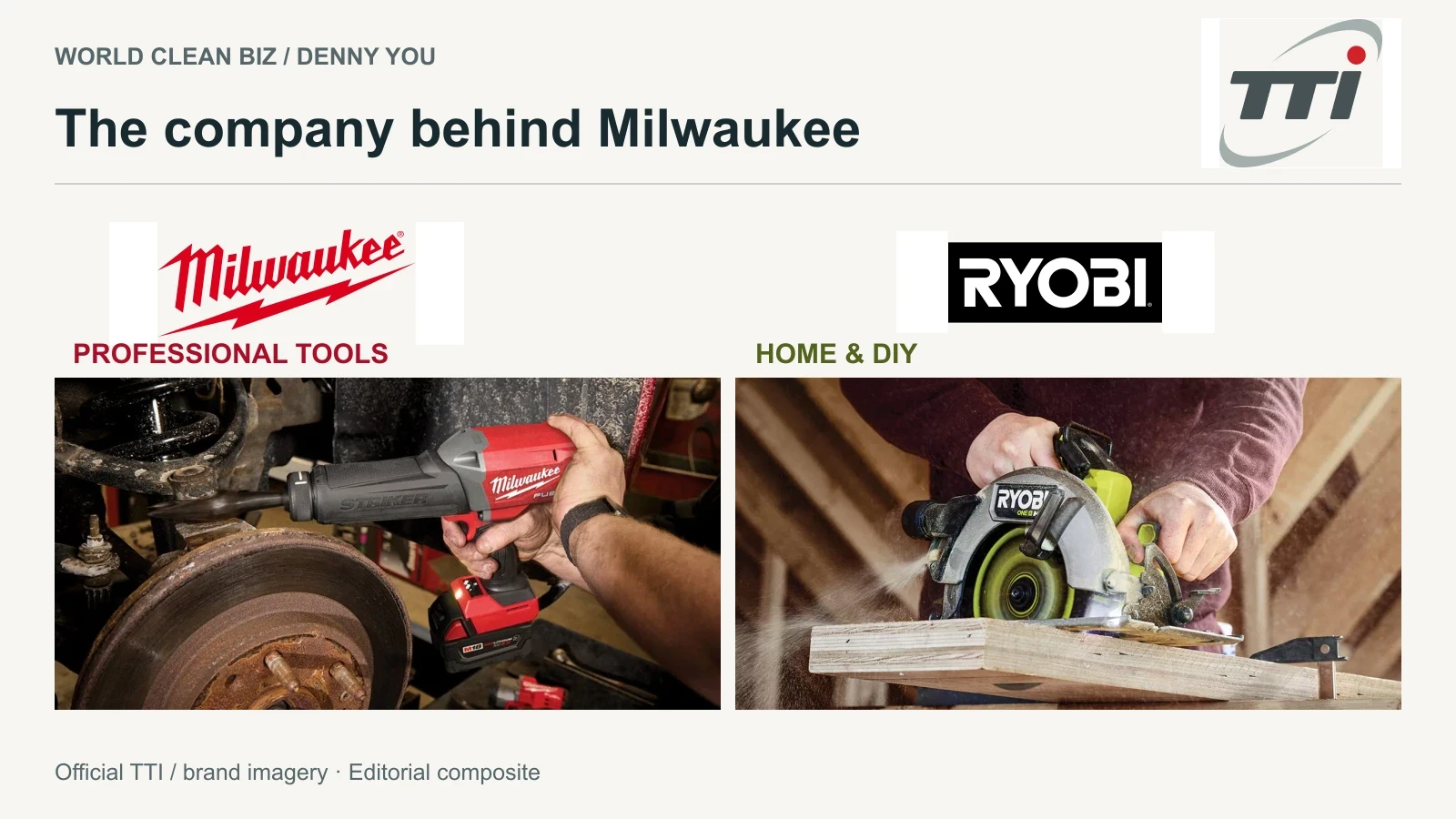
On American construction sites, Milwaukee's red tools have become a distinctive brand presence. In home garages, RYOBI serves DIY users with a different range of products and prices. Behind these names, with their American and Japanese brand histories, stands the same Hong Kong-listed company: Techtronic Industries, or TTI.
In 2025, TTI generated $15.26 billion in revenue and $1.198 billion in profit attributable to shareholders, with a gross margin of 41.2 percent. Milwaukee and RYOBI accounted for approximately 91 percent of group sales. After years of acquisitions, TTI has a long brand list, but the businesses supporting its scale are highly concentrated. These figures come from its 2025 results presentation.
For Chinese manufacturers, TTI is a company worth studying closely. It began in Hong Kong, established manufacturing capabilities in Dongguan, took over Western brands and grew them far beyond their size at acquisition. China's supply chain played an important role. Manufacturing costs alone, however, cannot explain the company's profitability or market position today.
Horst Julius Pudwill and Roy Chi Ping Chung founded TTI in Hong Kong in 1985. The early business principally supplied cordless power tools. Three years later, it opened its first factory in Dongguan, gradually building capabilities in tooling, injection molding, motors and assembly. TTI listed in Hong Kong in 1990.
Many Western tool companies already had brands and distribution and were looking for more competitive production locations. TTI entered the industry as a supplier. It first learned to manufacture products reliably, then gradually sought a larger role in determining the products and reaching their markets.
From 1999 onward, acquisitions and brand licenses expanded the business. Tools and floorcare appliances entered the portfolio. The acquisition of Milwaukee in 2005 gave TTI an asset that would keep growing in value.
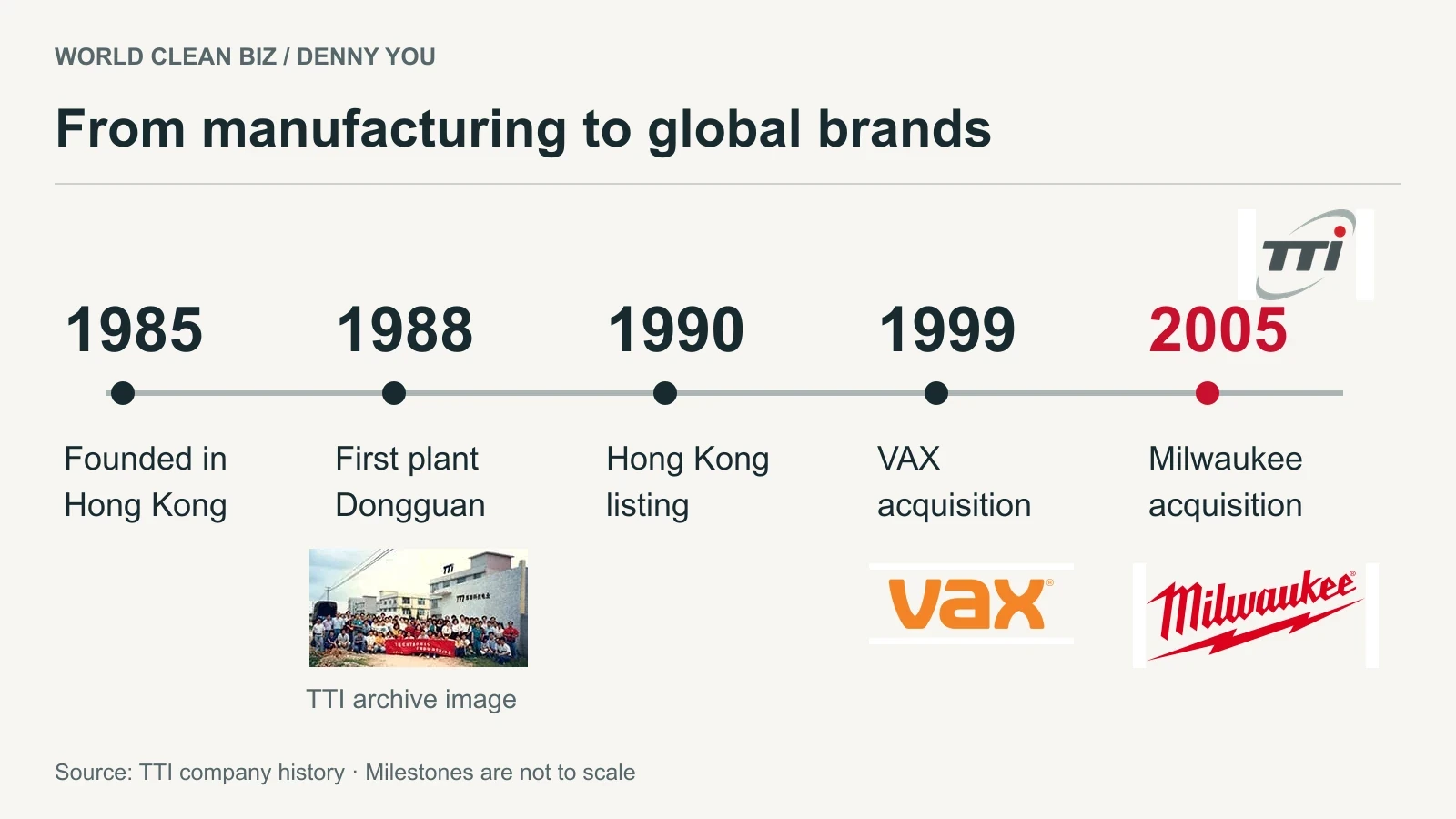
*Selected milestones and archival image from TTI's company history. Spacing is not a time scale.*
Founded in 1924, Milwaukee had built a professional reputation with products such as the Sawzall reciprocating saw. TTI acquired a business with history, engineering expertise and an established customer base. Yet when Steve Richman began leading Milwaukee in 2007, annual revenue was still below $500 million.
Tradespeople already respected the brand. There was considerable room to expand the business.
Richman and his team focused product development more closely on individual trades. Plumbers needed to cut and expand pipe and make connections. Automotive technicians needed to remove fasteners. Mechanical and electrical installers moved repeatedly between work locations. Many of these operations still depended on manual tools, cords or air compressors.
Advances in lithium-ion batteries made it possible to convert some of that work to cordless tools. Milwaukee's task was to identify the applications and turn the technology into products people would pay to use.
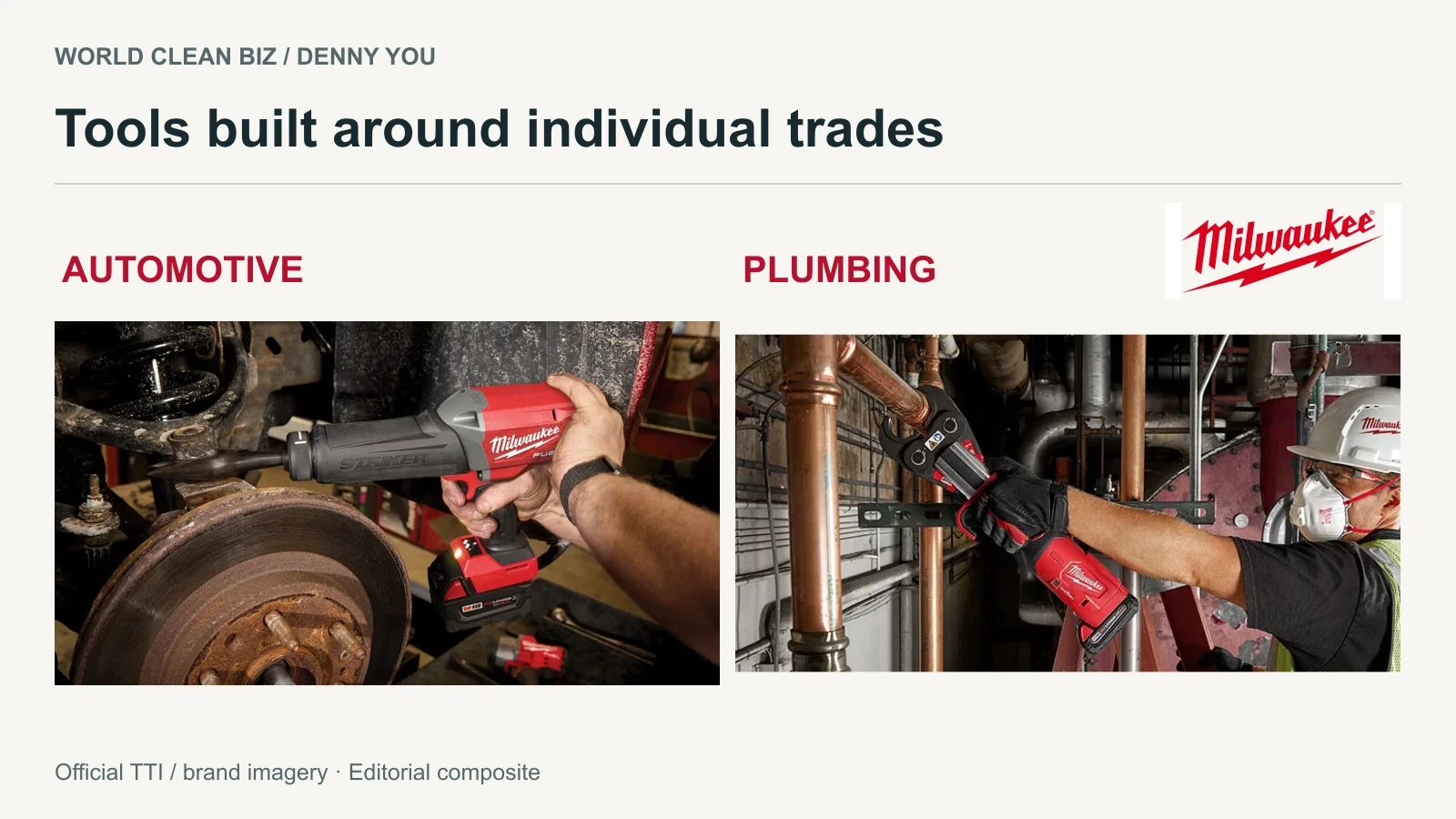
*Two separate applications, assembled from official TTI/Milwaukee imagery.*
Professionals calculate the value of a tool differently from household consumers. A product that shortens installation time or reduces the equipment they have to carry can recover its cost through daily work. Its price can be weighed against labor productivity, rather than simply against the price of a similar machine.
That opened a long path for product development. Beyond general-purpose drills and saws, each trade offered potential demand for specialized tools. Growth no longer depended entirely on replacing machines that had worn out.
Battery platforms amplified the value of this approach.
Milwaukee uses M12 for compact tools, M18 for a broad range of core applications and MX FUEL for larger equipment and demanding work. Their batteries are not interchangeable across platforms, but each supports a growing range of products.
When customers buy their first tool kit, they also need batteries and a charger. Later, they can buy compatible tools as bare units. Every new application Milwaukee develops creates another opportunity to sell to existing users.
This is a more durable business than competing one product at a time. A rival trying to enter the same tradesperson's toolbox needs more than a good machine. It must also persuade the customer to buy and manage another battery system.
PACKOUT extends those connections into storage. Toolboxes and bags need no motors, but they serve the same people and travel to the same jobsites. Milwaukee gradually came to address more of a professional user's purchasing needs.
The most instructive part of Milwaukee's development is how it grounds product expansion in a continuing understanding of the trades. Batteries provide compatibility. What keeps people adding equipment is the work that the new tools let them do. Without that, connecting more products to a platform does not necessarily create repeat purchases.
RYOBI follows a similar commercial logic for a different customer.
Home repairs and DIY do not require every tool to withstand professional construction use. Users still want to keep using the batteries they already own. RYOBI's 18V ONE+ platform covers drills, lighting, vacuums and many household tools, while its 40V platform serves some higher-power outdoor applications.
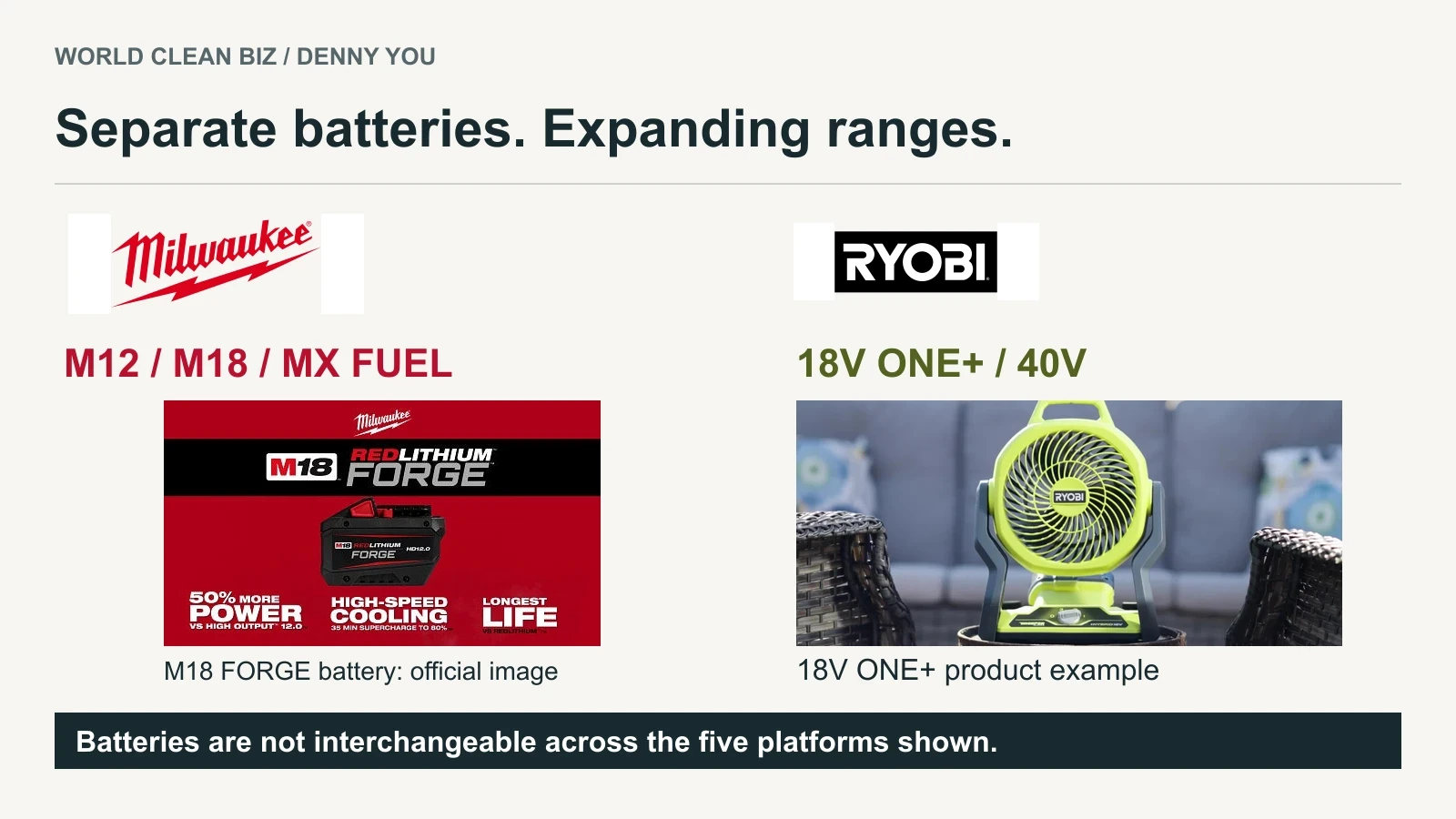
*Official Milwaukee and RYOBI imagery. The five platforms are not interchangeable. Performance wording inside the battery promotional image is the manufacturer's claim, not an independent test.*
TTI has kept RYOBI and Milwaukee distinct in positioning. They differ in price, product requirements and distribution, and they do not share batteries. Household users can gradually build a tool collection, while professionals pay more for productivity and capability on the job.
By the first half of 2026, Professional represented 71 percent of TTI revenue and Consumer 29 percent. Milwaukee had become its most important growth driver; RYOBI retained a large base of household users.
Not every brand in TTI's portfolio has reproduced that growth.
The group also operates Hoover, VAX, Oreck and Dirt Devil. In North America, Hoover covers vacuums and carpet and upholstery cleaning. VAX principally serves the UK. Oreck retains lightweight bagged uprights, and Dirt Devil addresses more basic household needs at lower prices. Each has a history and a market position, but their weight in group revenue is now much smaller than that of the two main tool brands.
The brand portfolio also has clear legal boundaries. TTI operates licensed RYOBI tool businesses; AEG power tools are distinct from AEG's wider appliance businesses; and Hoover's US and European brand rights should not be conflated.
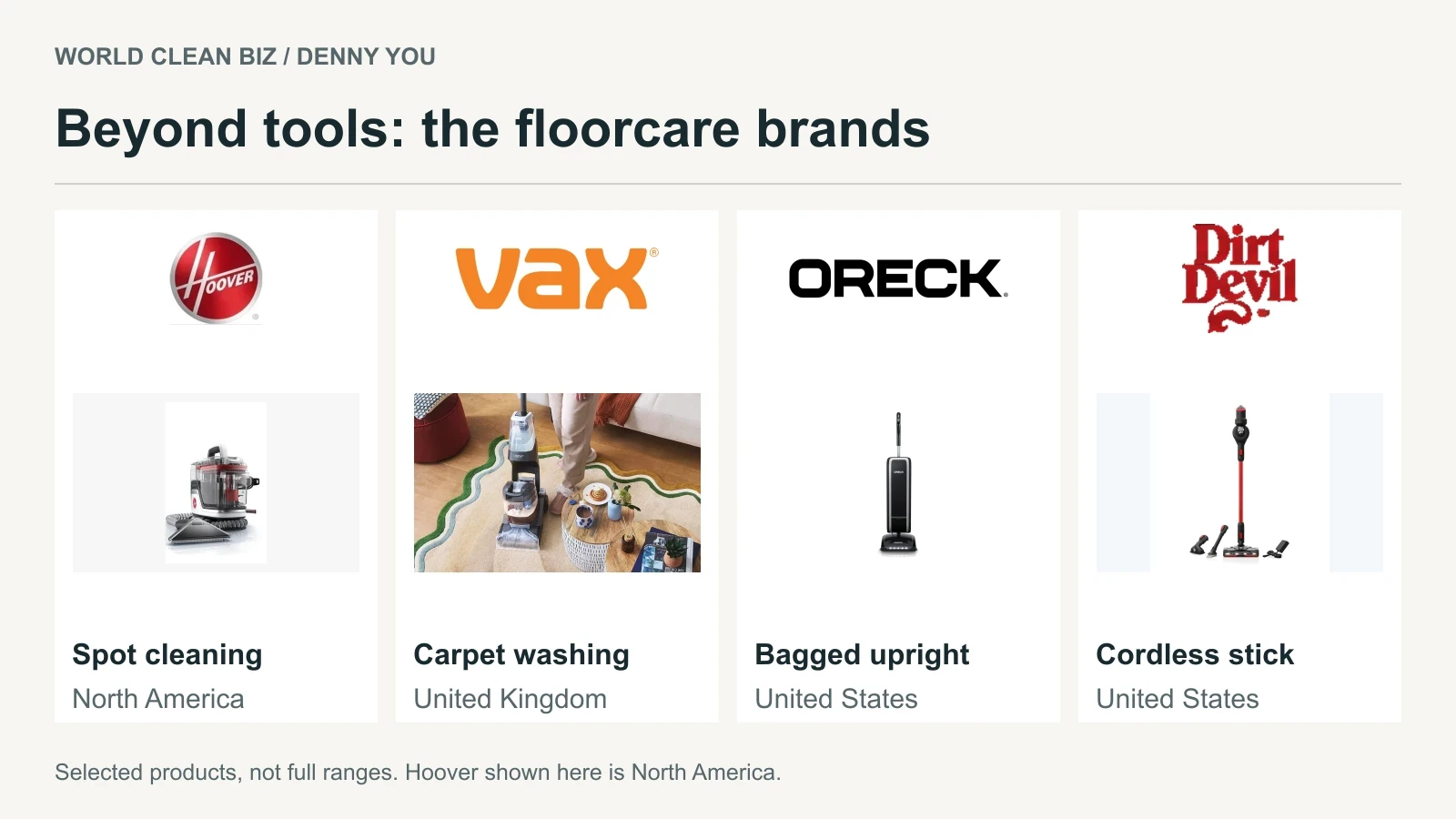
*Official brand imagery: Hoover CleanSlate, VAX ONEPWR compact carpet cleaner, Oreck Elevate Command and Dirt Devil cordless standing stick vacuum. Selected products and markets, not complete ranges. Hoover here refers to North America.*
TTI's exit from HART in 2025 also shows that the group will not sustain investment in every brand indefinitely. Acquisitions and licenses create opportunities. Subsequent capital still has to be directed toward businesses capable of earning returns.
For Chinese companies, this matters more than the number of overseas brands acquired. A transaction can secure a brand. New product capabilities and operating results must be built year after year afterward.
TTI continues to spend on research and development. Reported R&D expenses reached $757 million in 2025, up 16.8 percent. Across such a large portfolio, development must address both new applications and the coordination of batteries, motors and electronic controls. Any tool entering a professional's daily routine has to withstand sustained use.
Manufacturing has changed as the business has expanded. Dongguan supplied important early capabilities. TTI subsequently extended production to Vietnam, Mexico and the United States. Operating closer to customers can shorten parts of the supply chain and help respond to tariff changes, but new factories need time to build efficiency.
Even for a company with a gross margin above 40 percent, manufacturing remains central to the economics. A brand's pricing advantage will not preserve profits if inefficient production, rework and delivery problems consume it.
TTI's sales scale is also closely connected to major retailers.
North America accounted for approximately 75 percent of group revenue in 2025. The Home Depot and Bunnings in Australia and New Zealand are among its disclosed major retail partners. Its largest single customer generated 45.4 percent of revenue that year, although the annual report did not name the customer in that disclosure.
Large retailers help products reach extensive store networks. They also allow TTI to plan development and production around substantial volumes. Concentration brings constraints: when a major customer changes inventories or promotions, the effect can travel through orders to factories.
Despite building strong branded businesses, TTI must still manage channel demand alongside supply-chain efficiency. Coordinating the two becomes more important as the company grows.
In the first half of 2026, revenue reached $8.292 billion, up 5.9 percent, while profit attributable to shareholders rose 17.5 percent to $738 million. Free cash flow reached $753 million. Inventory days fell to 100, three days below the year-earlier period.
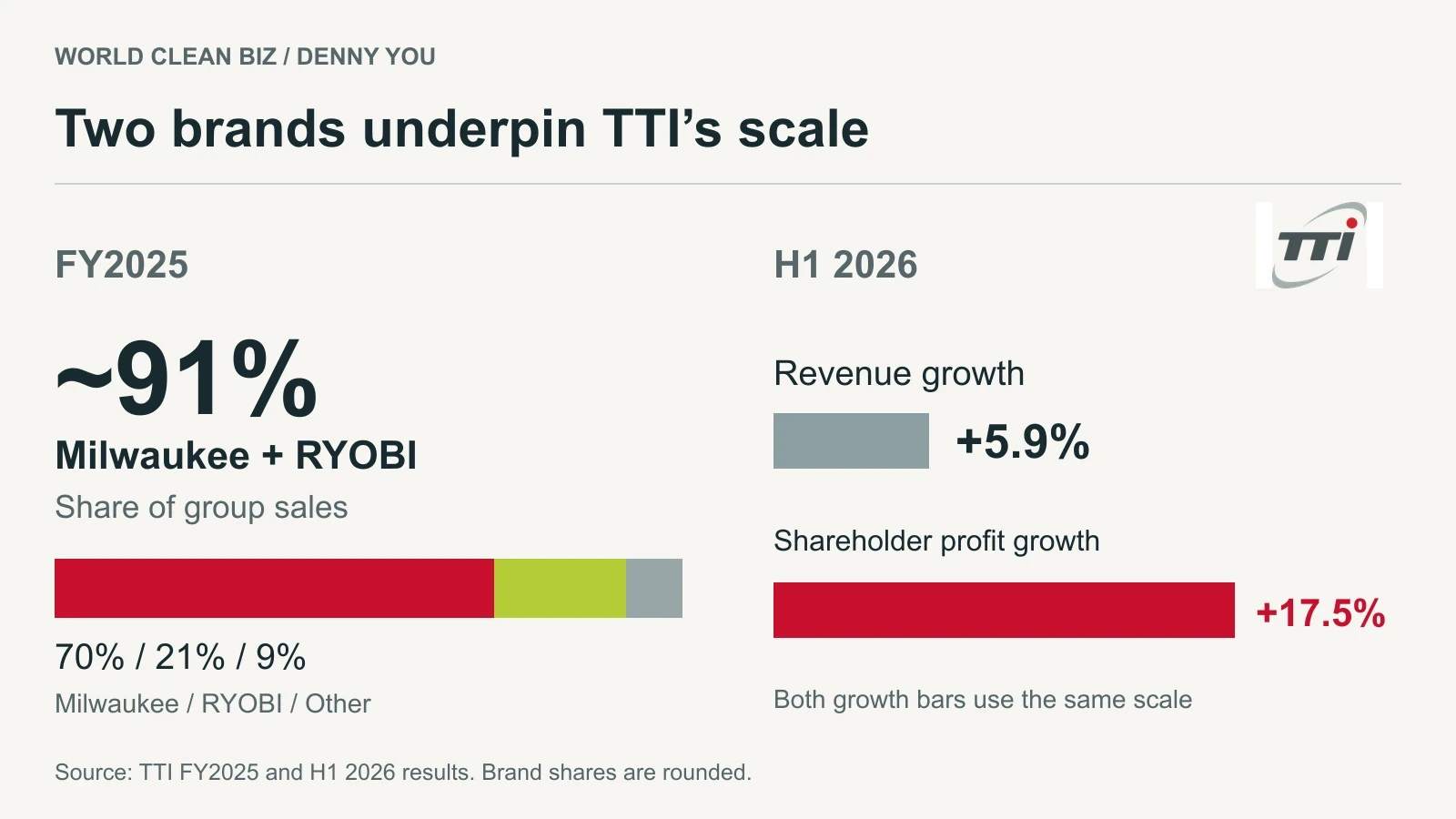
*FY2025 brand shares are rounded; growth figures cover the six months ended June 30, 2026. Both growth bars use the same percentage scale. Sources: TTI annual and interim results.*
Profit and cash flow reveal more about operating quality than the number of new products. TTI adds products every year while allocating capacity across countries. If additional inventory keeps tying up cash, expansion becomes a burden. New products on its platforms have to sell through to support the next round of development.
In 2024, Richman succeeded Joseph Galli as TTI's chief executive after years leading Milwaukee. He had managed a fast-expanding professional tool brand. He now decides where the entire group directs its resources.
Milwaukee and RYOBI together account for more than nine-tenths of revenue, showing how concentrated TTI's success has become. Improving floorcare profitability and maintaining the efficiency of overseas factories compete with the core tool business for management attention and capital.
TTI's strongest lesson for Chinese manufacturers is that factory capabilities can be the starting point for operating global brands. It entered the industry through the supply chain, increased brand value through continuing product development and built reasons for users to buy repeatedly over many years.
At its present scale, TTI cannot keep growing solely on the strength of names acquired in the past. Richman must demonstrate that, with Milwaukee now the group's dominant business, the company can still find new operations worth sustained investment, rather than asking the same brand to carry an ever-larger share of its growth.