- SEB expanded through acquisitions while retaining distinct brand identities.
- Supor provides a Chinese consumer business as well as development, manufacturing and export capacity.
- New floorcare products are generating revenue, but restoring profitability across the group remains the larger task.
Supor, Tefal and WMF look like brands from different countries serving different consumers. Behind them stands the same French company: Groupe SEB.
In 2025, the group generated €8.169 billion in sales. From a nonstick pan or vacuum cleaner at home to a professional coffee machine serving drinks in a hotel, SEB is already part of many people's daily routines. Consumers recognize its products without necessarily knowing how the brands are connected.
Over nearly 170 years, the company has grown from a metalworking shop into a global appliance group. It is still acquiring brands and has begun working with Chinese cleaning companies on new products. Yet more brands and a larger business have not made profits easier to earn.
Antoine Lescure founded the original metalworking shop in France in 1857. SEB launched its pressure cooker in 1953, moving from traditional metalworking toward household consumer products. The acquisition of Tefal in 1968 took it into nonstick cookware and small appliances.
Over the following decades, SEB kept bringing other brands into the group. France's garment-care brand Calor and Germany's Rowenta joined, followed by the takeover of Moulinex and Krups operations in 2001, expanding its position in kitchen appliances and coffee products.
SEB did not put its own name on everything it acquired. Rowenta continued in cleaning and home care, Moulinex retained its kitchen-appliance identity, and Krups focused mainly on household coffee equipment. Consumers kept buying the brands they knew, while the group organized development, manufacturing and sales behind the scenes.
The same company could reach different countries and price points through different brands. Acquisitions brought established consumer recognition and distribution relationships alongside the products themselves.
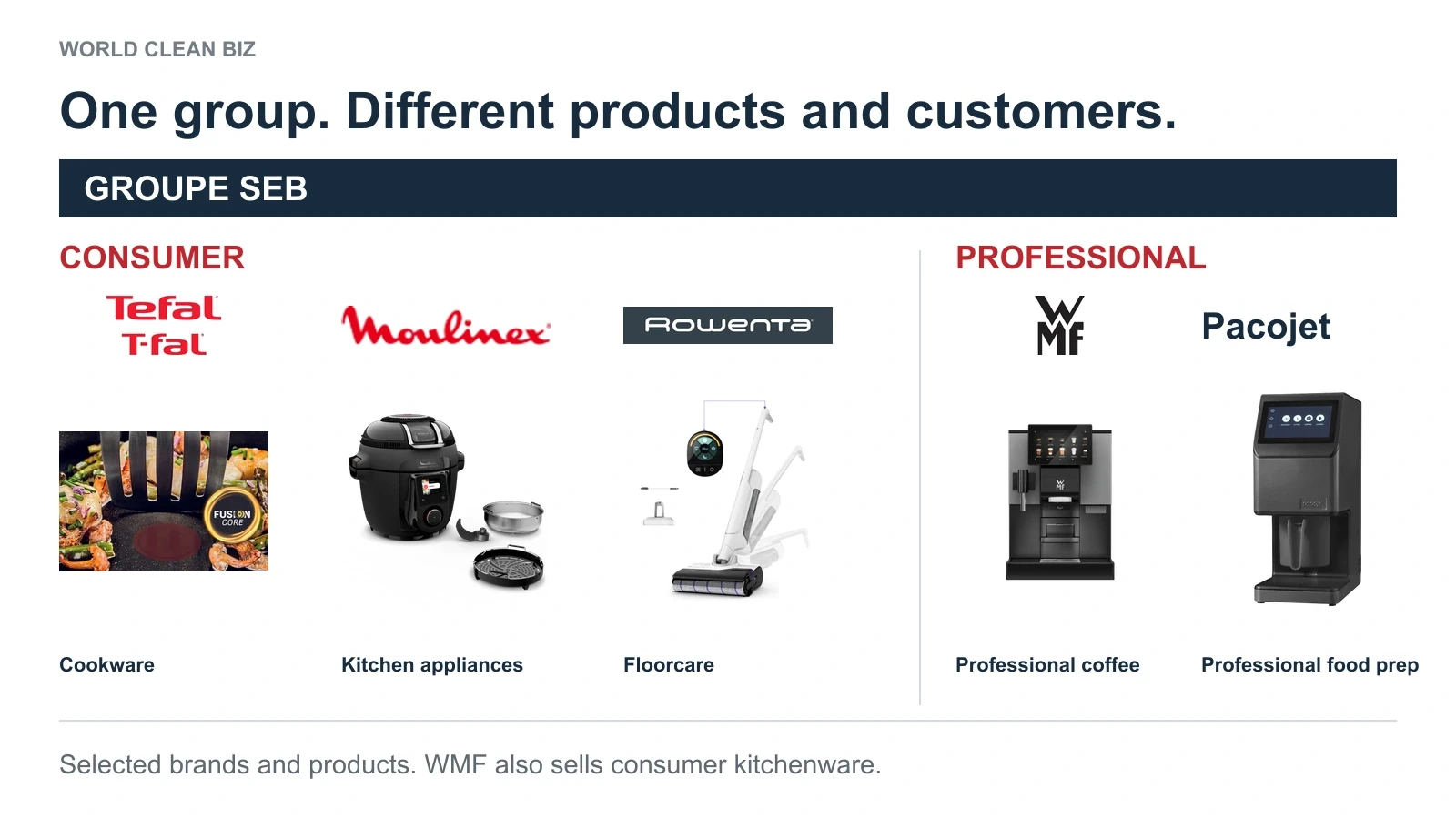
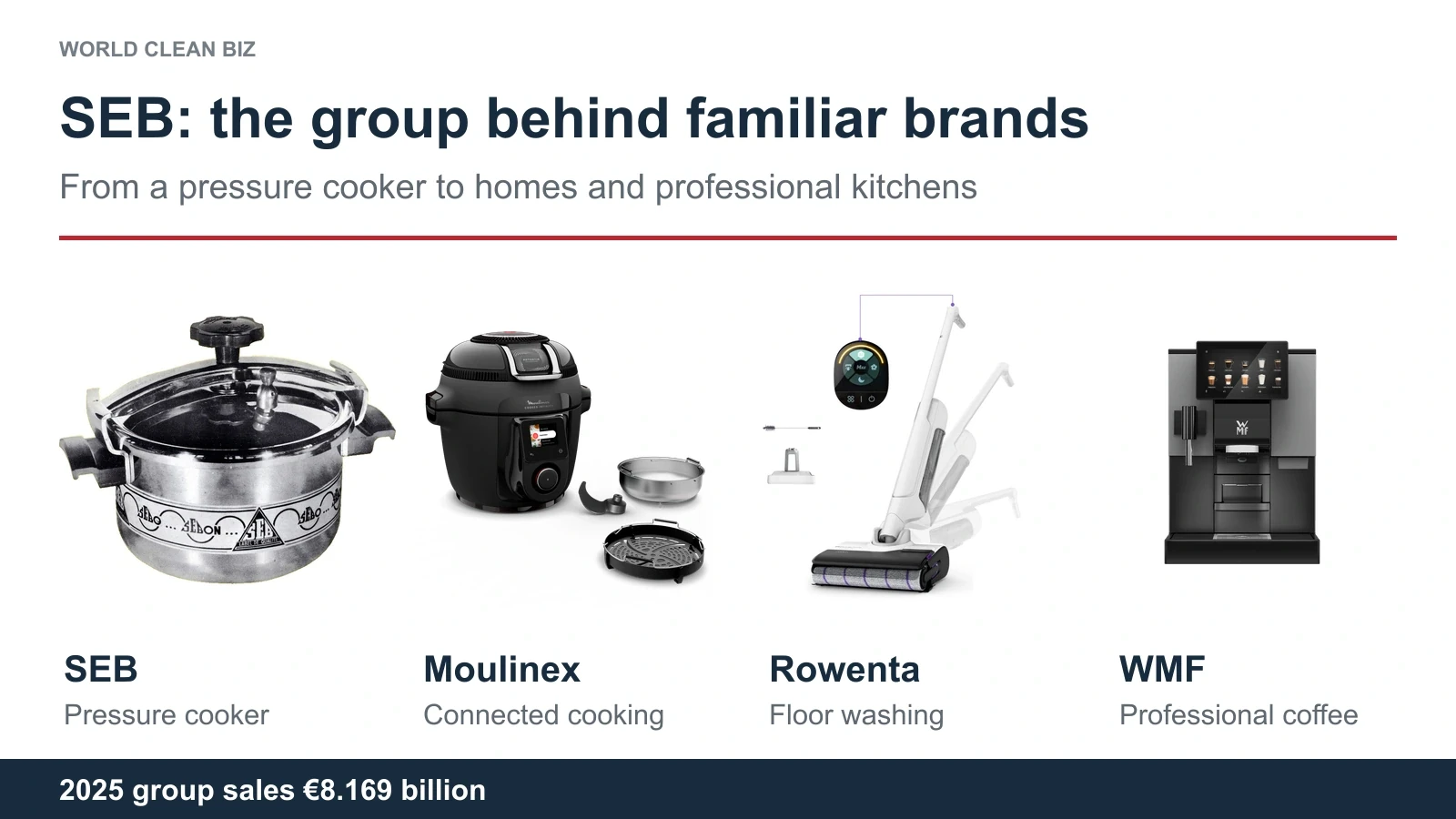
*Official brand and product images: Groupe SEB, Tefal, Moulinex, Rowenta, WMF and Pacojet. Selected examples, not the full portfolio; WMF also sells consumer kitchenware.*
Thierry de La Tour d'Artaise, who began leading the group in 2000, drove its continued international expansion. In 2022, Stanislas de Gramont became chief executive while Thierry remained chairman. China was a crucial part of that expansion.
SEB acquired Supor in 2007. By the end of 2025, SEB International held 83.16% of its shares.
The transaction gave SEB an established Chinese consumer brand and a mature product-development and manufacturing operation. Supor serves Chinese households while acting as an important export platform for the wider group.
In 2025, Supor recorded RMB 22.772 billion in revenue and RMB 2.097 billion in net profit attributable to shareholders. Its development and manufacturing sites span Zhejiang, Hubei and Vietnam, and annual R&D spending reached RMB 476 million. For SEB, Supor has become far more than an overseas equity investment.
The acquisition of WMF in 2016 took the group into a different kind of business.
Once a household coffee machine has been sold, future business depends largely on its reputation and eventual replacement. When a professional machine goes into a hotel, restaurant or office, the equipment sale begins a relationship. Installation, maintenance and repairs continue throughout its working life.
In the first half of 2026, services accounted for approximately 35% of SEB's Professional business revenue. A coffee machine that stops working costs its customer that day's drink sales, so the supplier needs to resolve problems promptly. Through its professional subsidiaries and around 200 distributors, SEB supplies equipment and services in more than 100 countries.
Since 2023, professional-equipment and premium-kitchen brands including Pacojet have continued to join the group. Professional operations account for around 12% of revenue, still much smaller than Consumer operations, but they bring customer relationships and revenue streams that differ from household retail. SEB's 2025 annual report
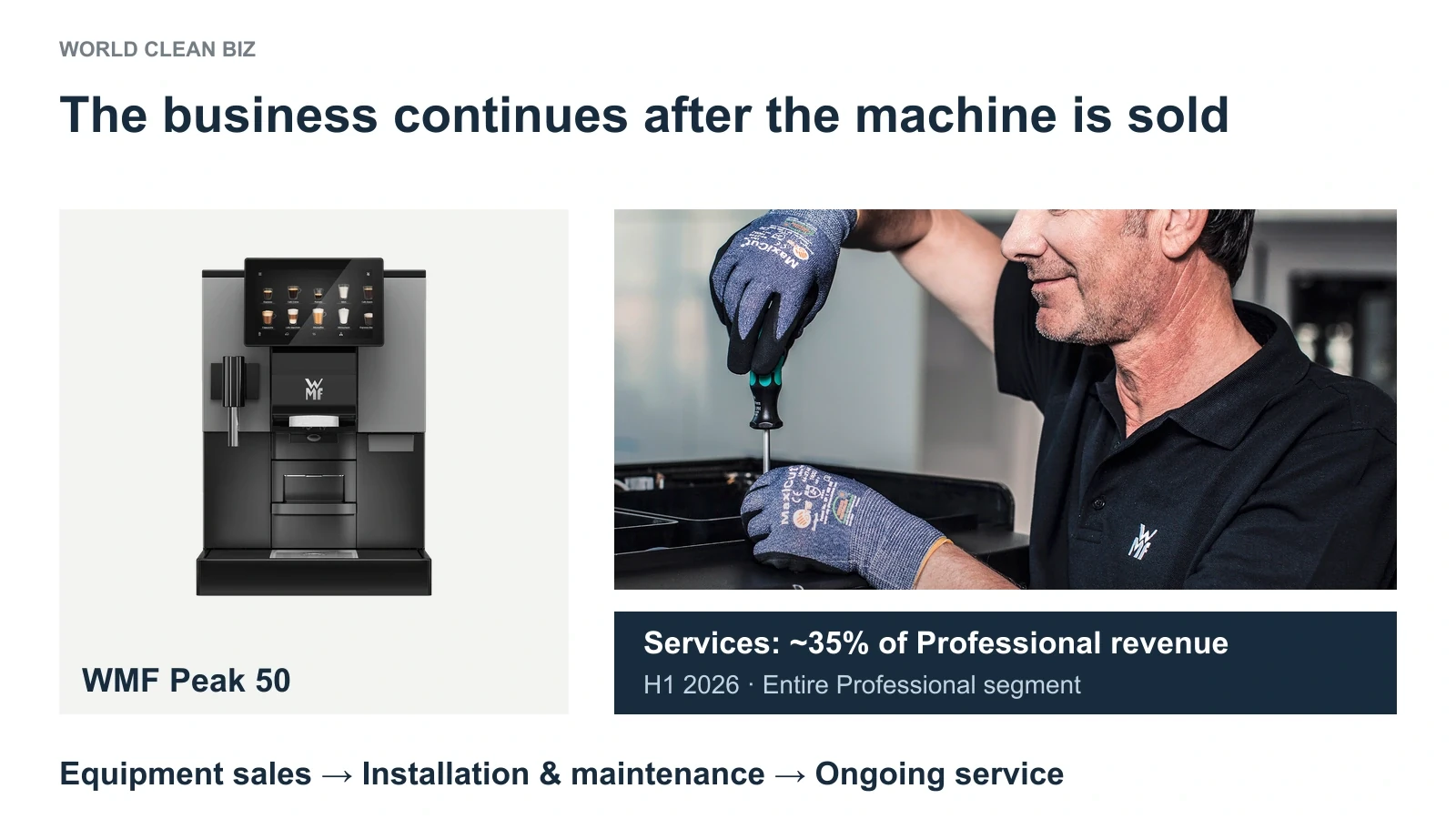
*Photos: WMF. The approximately 35% services share refers to SEB's entire Professional segment in H1 2026, not coffee machines alone. The service photograph is illustrative of WMF's service operations, not a Peak 50 repair.*
A substantial manufacturing operation supports these brands.
Compared with companies such as SharkNinja, which rely mainly on outside manufacturing partners, SEB retains considerable production capacity of its own. In 2025, it had 47 manufacturing sites in 14 countries and annual output of approximately 240 million products. More than 60% of the products it sold, measured by units, came from its own manufacturing system.
France still houses development and manufacturing for products including vacuum cleaners, coffee machines and garment-care equipment. Supor's Chinese and Vietnamese sites handle another part of production and exports. In 2026, SEB's professional-equipment center in Shaoxing began operating, with an initial investment of approximately €40 million, serving Asian markets and new customer groups such as offices.
Owning factories allows SEB to retain important process expertise and share capacity among brands. But factories need investment and orders, while a large product portfolio brings inventory and management demands. When market growth slows, those accumulated assets can also make adjustment more difficult.
SEB continues to invest in innovation. In 2025, its innovation investment was approximately €320 million, with around 3,000 dedicated innovation personnel. In faster-moving new categories, however, it is also drawing on external partners.
Rowenta's X-Clean 10 floor washer is a publicly disclosed example of joint development between SEB and Narwal.
Rowenta brings a brand and distribution network familiar to European consumers; Narwal brings cleaning technology and product experience. The collaboration helped SEB enter floor washing more quickly. The disclosed partnership concerns the X-Clean 10 and should not be taken as evidence that Narwal developed the entire range.
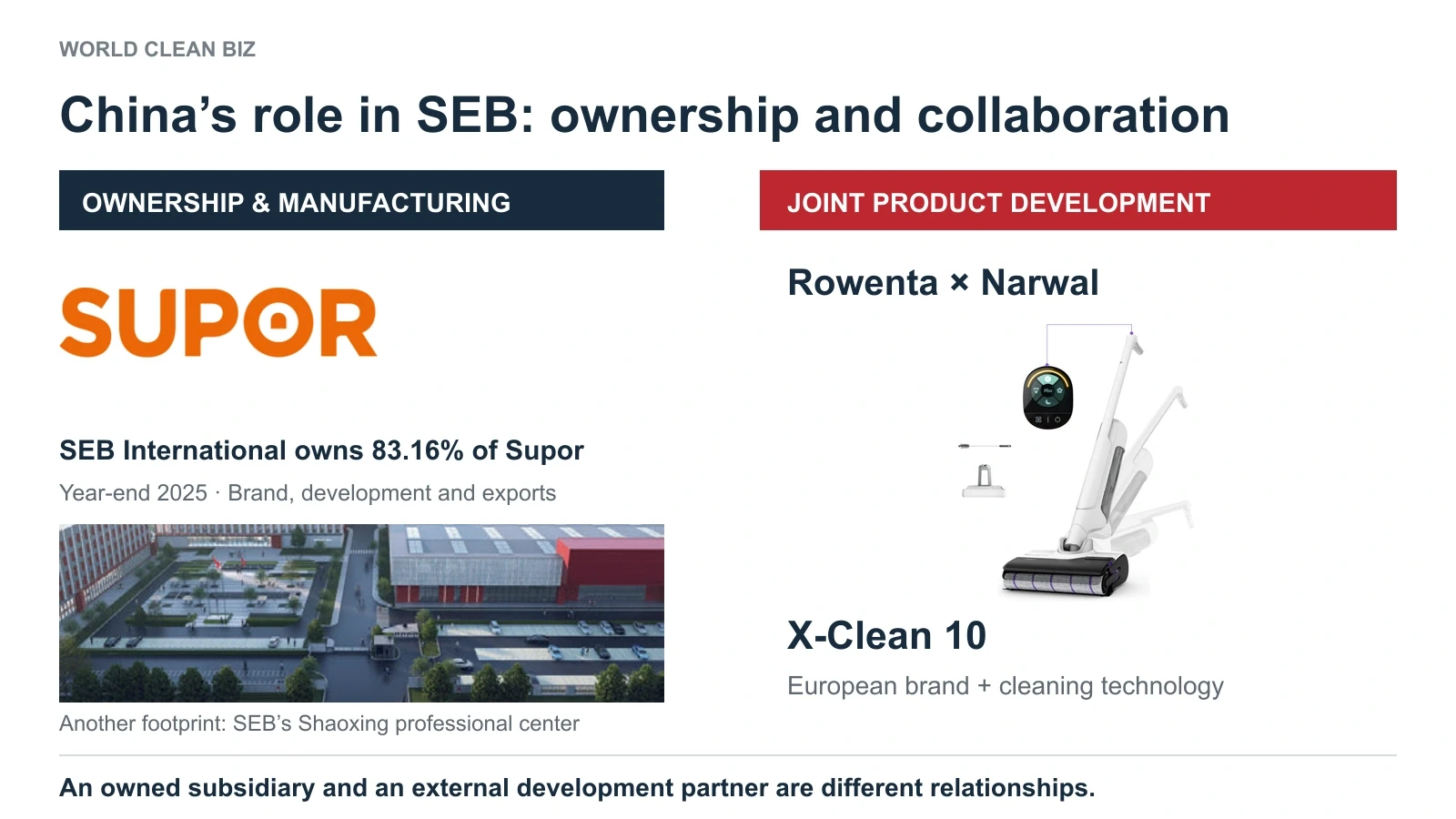
*Images: Supor, Groupe SEB and Rowenta. The factory photograph shows SEB's Shaoxing professional-equipment center, not a Supor factory. The disclosed Narwal collaboration concerns X-Clean 10.*
After entering the market in late 2024, the X-Clean range generated nearly €100 million in 2025 sales. Fabric spot-cleaning products generated approximately €25 million over the same period.
These businesses are not yet large enough to change the scale of a group with more than €8.1 billion in annual revenue. But they show that established European brands do not have to watch Chinese companies take every new category. Where brand recognition and distribution remain effective, joint development can bring products to market and generate sales relatively quickly.
SEB's floorcare business has not simply followed China's product cycle.
Rowenta sells floor washers and robot vacuums while continuing to offer bagged vacuum cleaners. Traditional corded products still have a market among European users who are accustomed to them and care about noise and ease of repair.
Some products carry a repairability commitment of up to 15 years, subject to the particular brand, model and market. That is not a 15-year free warranty. It requires the business to maintain the relevant spare parts and repair capabilities over time. In 2025, SEB also launched new refurbishment operations in France to extend products' useful lives.
This model requires sustained investment and consumers willing to pay for familiar brands and service. As product cycles shorten and price competition intensifies, how much advantage it retains will depend on buyers' choices.
Changes in distribution are already forcing SEB to adapt.
In 2025, e-commerce accounted for approximately 45% of Consumer revenue, including third-party platforms, retailer websites and direct sales. The group operated around 100 transactional brand websites, and online direct-to-consumer revenue grew 19% organically.
In China, Supor ran more than 25,000 livestreams during the year and worked with around 3,000 creators. A company long experienced in factories, distributors and department-store retail must also learn how to sell on a phone screen. A brand's history can help get it onto a shop floor without guaranteeing attention in a short video.
All these changes eventually have to show up in earnings.
SEB's 2025 sales fell 1.2% on a reported basis. Stripping out currency and changes in the scope of the business, organic growth was just 0.3%. Profitability came under greater pressure: Operating Result from Activity fell approximately 25%, with the corresponding margin declining from 9.7% to 7.4%. 2025 results
Operating performance improved in the first half of 2026, but €178 million in exceptional charges associated with the Rebound restructuring plan weighed on reported earnings. Through measures including purchasing and production-efficiency improvements, SEB aims to achieve approximately €200 million in recurring annual savings by the end of 2027. First-half 2026 results
For China's cleaning-appliance industry, SEB's changes point to a potential avenue for collaboration. These international brands retain market access and distribution, but they may no longer insist on developing every new product internally. X-Clean 10 demonstrates that cooperation can begin at the product-development stage.
The first WCB International Cleaning Appliances Expo will take place at Suzhou Shishan Convention Center on November 18–20, with nearly 200 cleaning-industry companies expected to exhibit, alongside industry forums. We want to bring brands, contract manufacturers and component suppliers together to discuss specific products and partnerships. Exhibitor and visitor information is available through World Clean Expo and our contact page.
SEB grew by bringing many familiar consumer brands into one group. Its next task is to demonstrate that these brands and factories can generate better returns together than they could separately.
Floor washers are already adding revenue, professional equipment creates ongoing service demand, and online direct sales are growing. Whether those businesses can offset pressure on traditional categories and restore profitability will determine the French group's next phase.