- LG-branded home appliances are operated by LG Electronics through its Home Appliance Solution Company and regional subsidiaries, not by a separate universal manufacturer called LG Appliances.
- LG manufactures appliances through a global network that includes the Changwon LG Smart Park in South Korea and a washing-machine plant in Tennessee, but the factory and country of origin remain model-specific.
- LG's ThinQ AI platform and expanding vacuum lineup connect major appliances with floor care, while buyers still need to verify the local seller, importer, software terms, parts and warranty provider.
In this article 13 sections
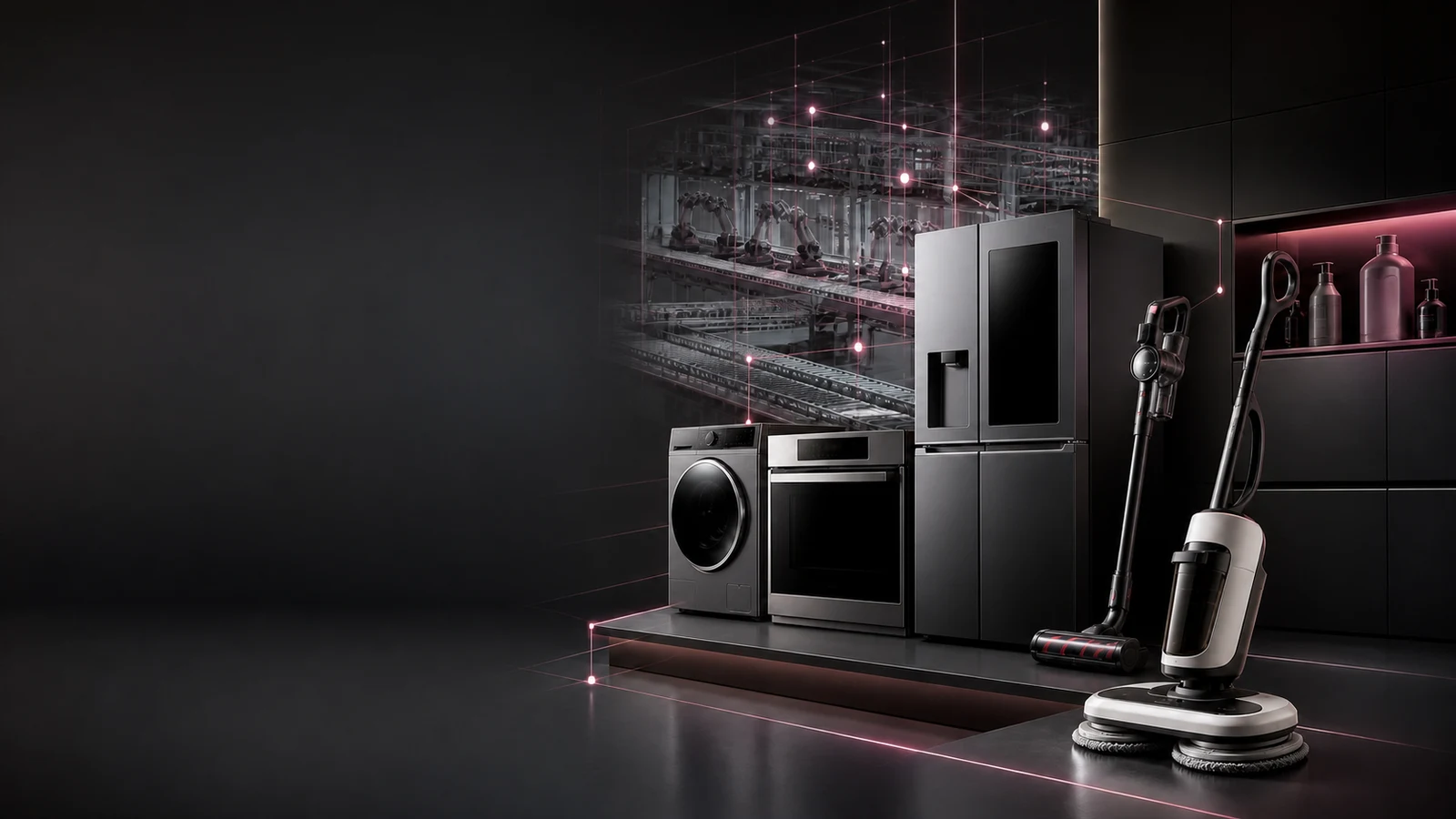
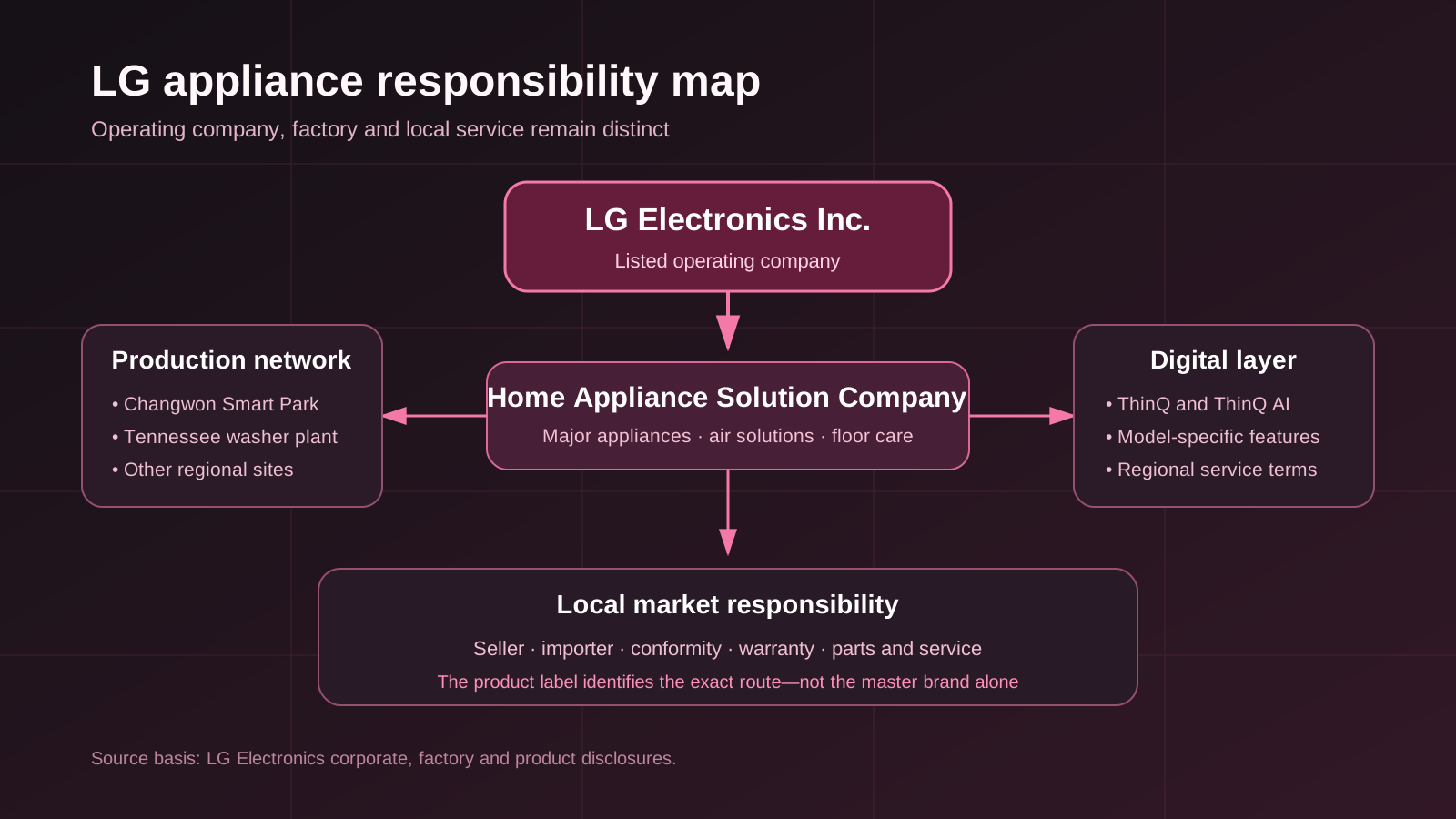
LG-branded home appliances are made and marketed by LG Electronics Inc. through its Home Appliance Solution business and regional operating network. LG Electronics designs and manufactures major appliances, operates factories in several countries and uses local subsidiaries to sell and service products. There is no separate global company called “LG Appliances” that makes every LG product.
The LG logo alone does not identify one factory, importer or warranty provider. A refrigerator sold in Europe, a washer assembled in the United States and a cordless vacuum offered in Asia can sit under the same brand while following different production and service routes.
LG Appliances at a Glance
| Question | Evidence-based answer | Important boundary |
|---|---|---|
| Who makes LG appliances? | LG Electronics and its regional manufacturing network | The exact plant can vary by model and destination |
| What business runs them? | LG Electronics' Home Appliance Solution, or HS, Company | It is an operating business, not a separate public company |
| Where are LG appliances made? | LG uses factories across South Korea and other regional markets | Country of origin must be checked on the unit and documents |
| Does LG make appliances in the United States? | Yes. LG's Tennessee facility produces washing machines | It does not establish the origin of every U.S. LG appliance |
| What is LG Smart Park? | LG's digitally transformed appliance production complex in Changwon, South Korea | It is a major production base, not LG's only factory |
| Does LG make vacuum cleaners? | Yes. LG offers cordless, robot and wet-dry floor-care products in selected markets | Product availability and manufacturing routes differ by region |
What Company Actually Makes LG Home Appliances?
The company-level answer is LG Electronics Inc. LG Electronics is the South Korean listed company behind LG televisions, home appliances, air solutions and several business-to-business technology operations.
Within LG Electronics, the relevant organization is the Home Appliance Solution Company, commonly shortened to the HS Company. LG reorganized its reporting structure around this name as it expanded beyond traditional hardware into connected-home services, subscriptions and appliance solutions.
This distinction matters because “LG” also appears across other companies in the wider LG corporate group. An LG-branded refrigerator or vacuum belongs to LG Electronics' product system; it should not be attributed broadly to every company with LG in its name.
The usual responsibility chain is:
- LG Electronics controls the brand, product platform and appliance business.
- A regional LG Electronics subsidiary or distributor places the model on a local market.
- A designated factory assembles the product or major module.
- The invoice, importer label and local warranty identify the entities responsible to the buyer.
Those entities may be related, but they are not automatically interchangeable.
Where Are LG Appliances Manufactured?
LG operates a global manufacturing network designed to serve major regional markets. Two well-documented examples show why buyers should connect a factory to a product rather than to the entire brand.
In Changwon, South Korea, LG transformed an established appliance production base into LG Smart Park. The World Economic Forum recognized the facility as a Lighthouse Factory after LG introduced digital-twin systems, intelligent automation, logistics improvements and flexible production methods. LG's disclosures describe Changwon as a central home-appliance manufacturing and innovation site.
In Clarksville, Tennessee, LG built a washing-machine factory to serve the U.S. market. LG announced the facility as its first U.S. home-appliance manufacturing plant, with production focused on front- and top-load washing machines.
Neither example proves that every LG appliance sold in Korea or the United States comes from those locations. Refrigerators, laundry products, cooking appliances, dishwashers, air-care products and vacuums can use different factories and supply chains. Production assignments can also change between model generations.
For an exact answer, inspect the rating plate, carton, country-of-origin marking, model code and conformity documents. A retailer's general “made by LG” description is not enough for customs, compliance or supplier qualification.
Does LG Manufacture Every Component It Uses?
LG Electronics is a large appliance manufacturer, but final assembly and component origin are different questions.
A modern appliance combines cabinets, motors, compressors, pumps, batteries, electronics, displays, sensors, software and accessories. LG may design and manufacture important systems while purchasing other parts from approved suppliers. A replacement filter, brush roll or battery can also follow a different supply route from the finished appliance.
This is normal industrial practice. The procurement question is not whether every screw came from LG. It is which company controls the specification, which site assembles the exact model, which suppliers are approved, and which legal entity accepts quality and warranty responsibility.
What Are LG ThinQ and ThinQ AI?
LG ThinQ is LG Electronics' connected-device platform for compatible appliances. It can link products, deliver notifications, support remote functions and provide maintenance or energy-related information, depending on the model and country.
LG uses ThinQ AI for a broader connected-home proposition. Its recent European announcements describe ThinQ AI services, ThinQ UP software updates and ThinQ Care diagnostics across selected appliances. LG's AI Home demonstrations also connect appliances through hubs and sensors to automate household routines.
ThinQ should not be treated as one fixed specification. A washer that downloads cycles, a refrigerator that manages food information and a robot vacuum that maps rooms use different hardware and permissions. Features can depend on a supported market, account, app version, network connection and software policy.
Commercial buyers should therefore verify:
- whether core operation remains available without an account or cloud service;
- which company provides the digital service in the destination country;
- whether remote functions are enabled for the exact model;
- how security updates, stored data and end-of-service notices are handled;
- whether connected features affect installation, privacy or after-sales obligations.
Does LG Make Vacuum Cleaners and Floor-Care Products?
Yes. LG is directly active in cleaning appliances as well as major home appliances.
At IFA 2025, LG introduced a new European vacuum lineup that included a robot vacuum with a steam mop function, a built-in robot vacuum station, a cordless stick vacuum and a wet-dry stick vacuum. LG said the range combined cleaning hardware with AI-assisted functions and designs intended to integrate into the home.
LG has also sold CordZero cordless and robotic floor-care products in multiple markets. The precise naming and range vary by country, so a product shown in a global announcement may not be available through every local LG company.
For cleaning-industry buyers, LG's relevance is broader than a single vacuum SKU. The company can connect laundry, kitchens, air care and floor care through one consumer brand and software ecosystem. That creates cross-category retail opportunities, but it does not remove category-specific checks for motors, batteries, filters, docking stations, spare parts and service capability.
Is LG's Appliance Business the Same Everywhere?
No. LG Electronics controls the global brand and product system, while local execution differs.
A regional LG subsidiary may choose a different catalogue, source designated models from a different plant, use local certification and appoint its own service network. Voltage, plugs, radio approvals, energy labels, language support and connected features can all be market-specific.
This is why parallel imports deserve extra attention. A genuine LG product intended for another country may have incompatible electrical specifications, unsupported ThinQ features or no local warranty coverage. Authenticity does not guarantee local suitability.
How Does LG Appliance Warranty Work?
LG warranties are issued under local terms. Coverage periods, parts-only extensions, labor, registration requirements, commercial-use exclusions and repair procedures vary by product and jurisdiction.
A compressor or motor warranty advertised for one category may cover only the named component and not labor or the whole appliance. A national promotion may also be separate from the standard manufacturer's warranty.
Before purchasing, match the model number and serial information to the local warranty document. Confirm the warranty provider, authorized service route, spare-parts policy and whether the seller is recognized by LG in that market.
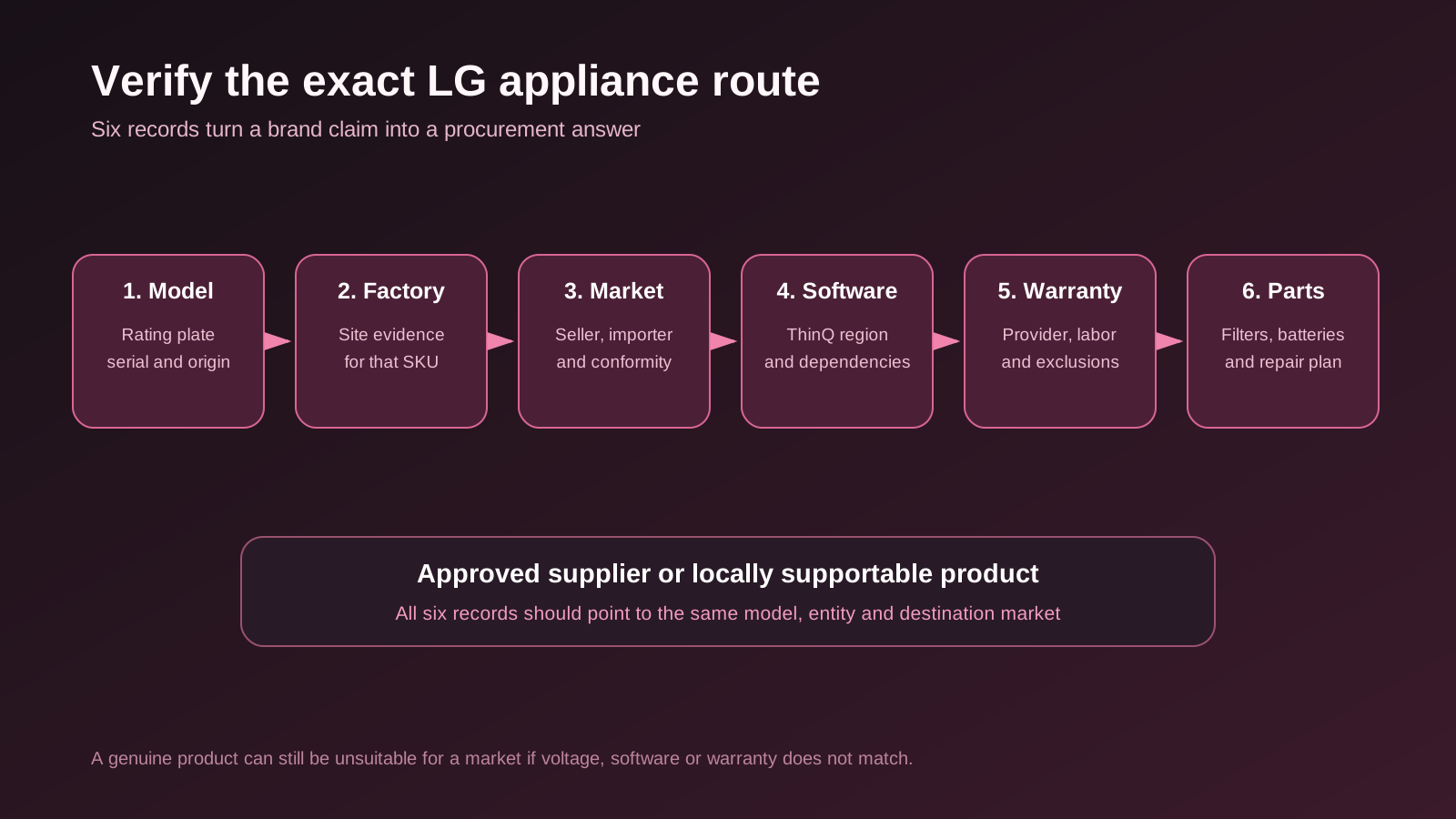
What Buyers and Suppliers Should Verify
| Document or check | What it should establish |
|---|---|
| Rating plate and model code | Exact product identity, electrical specification and production code |
| Country-of-origin marking | Origin stated for the individual unit |
| Manufacturer or responsible-company line | Company identified for product compliance |
| Importer and seller records | Entity placing and selling the product in the destination market |
| Declaration of conformity | Model, applicable standards and responsible signatory |
| Factory evidence | Production site for the specified model or program |
| Warranty terms | Provider, period, exclusions, labor and service route |
| ThinQ terms | Account provider, feature region, data and software dependencies |
| Parts plan | Filters, bags, batteries, brushes, motors and repair availability |
Suppliers should also verify the legal name on any request for quotation. A message using an LG logo is not proof that it comes from LG Electronics or an authorized procurement partner. Match the email domain, purchasing entity, plant, delivery address and banking details before committing capacity or sharing sensitive specifications.
Frequently Asked Questions
Who makes LG appliances?
LG Electronics makes and markets LG appliances through its Home Appliance Solution Company, regional subsidiaries and global manufacturing network.
Is LG Appliances a separate company?
No. “LG Appliances” is a convenient product description. The relevant operating company is LG Electronics Inc.
Are LG appliances made in South Korea?
Some are. LG's Changwon Smart Park is a major South Korean appliance production site, but LG also manufactures in other countries. Check the exact model label.
Are LG washing machines made in the USA?
LG operates a washing-machine factory in Clarksville, Tennessee. Not every LG washer or appliance sold in the United States necessarily comes from that plant.
Who makes LG vacuum cleaners?
LG Electronics operates LG's floor-care business, including CordZero and selected robot, cordless and wet-dry products. The factory and seller vary by model and market.
Is ThinQ a separate appliance brand?
No. ThinQ is LG Electronics' connected-device and smart-home platform used with compatible products.
Does one LG warranty apply worldwide?
No. Warranty coverage is regional and model-specific. Use the local terms for the country where the appliance is sold and installed.
Final Answer
LG appliances are made and marketed by LG Electronics through its Home Appliance Solution business and a global manufacturing network. Changwon Smart Park in South Korea and the washing-machine factory in Tennessee are important verified sites, but neither represents the origin of LG's entire catalogue.
LG also competes directly in floor care, with cordless, robot and wet-dry cleaning products connected to its wider ThinQ AI strategy. Buyers should use the exact model documents—not the LG logo alone—to verify the factory, country of origin, local seller and importer, connected-service terms, parts support and warranty provider.
Official and Primary Sources
- LG Electronics 2025 full-year financial results and business structure
- LG vacuum lineup introduced at IFA 2025
- LG Smart Park manufacturing transformation
- LG Smart Park named a Lighthouse Factory
- LG Tennessee home-appliance factory announcement
- LG ThinQ AI smart-home services in Europe
- LG AI Home at IFA 2025
Related World Clean Biz Articles
- Who Makes Samsung Appliances? Samsung Electronics, Global Manufacturing and Bespoke AI Explained
- Who Owns Bosch Appliances? BSH, Siemens Licensing and the Brand Portfolio Explained
- Who Owns Miele? The Families, Company Structure and Global Manufacturing Network
- Who Owns Dyson? James Dyson, Its UK–Singapore Structure and Manufacturing Network Explained
- Who Owns Tineco? ECOVACS Group, TEK Electrical and Its Manufacturing Network Explained