- USTR proposes up to 20% on Chinese goods, net of the 12.5% forced-labor Section 301 duty, with a 40% fallback; nothing is in effect yet.
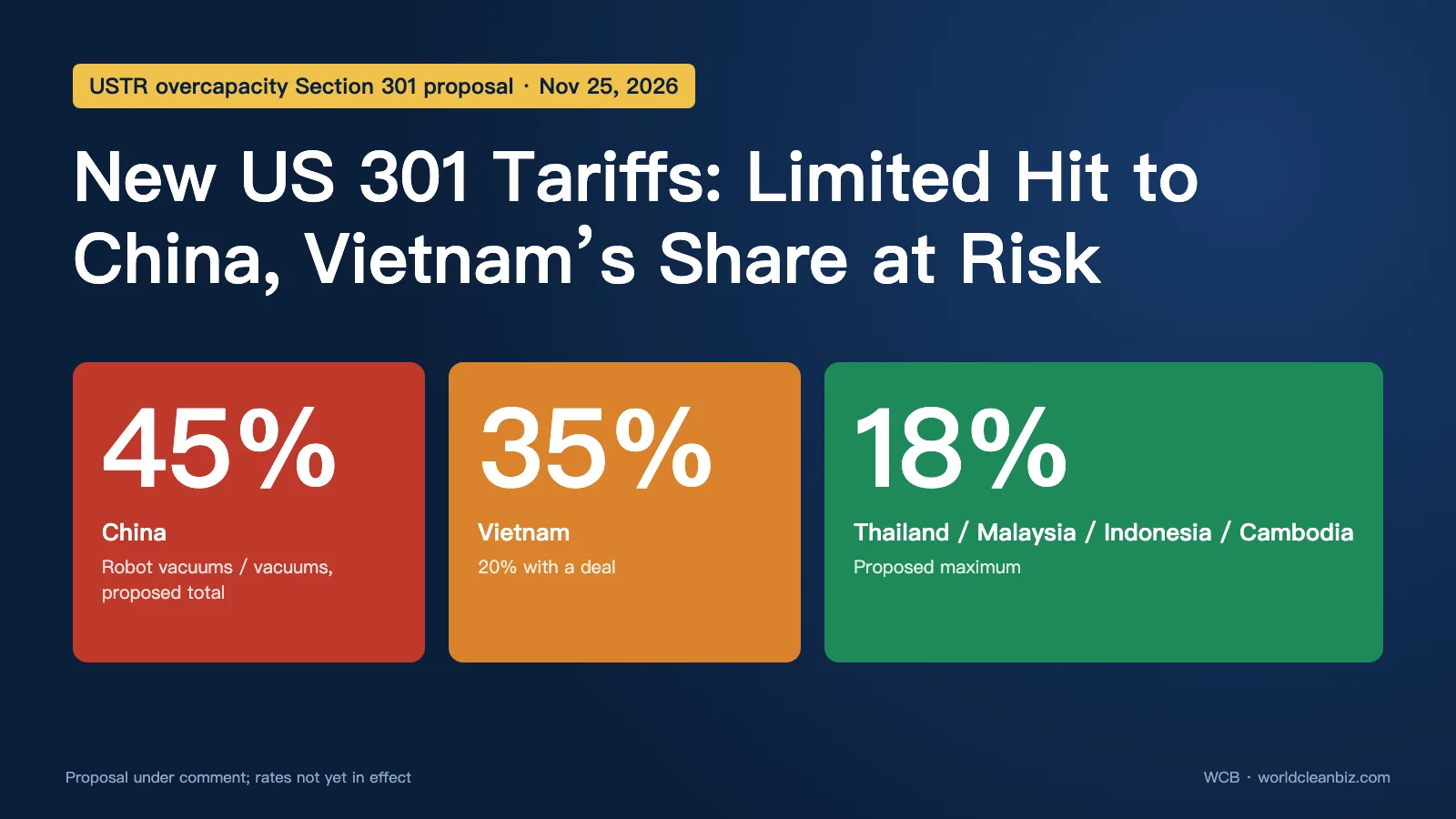
- Robot vacuums and vacuums from China would reach 45% because of the 25% List 3 duty from 2018; robotic mowers and pool robots would be around 30%.
- North American cleaning appliance orders are already made mostly in Southeast Asia, so the direct impact on China is limited.
- At 35%, Vietnam would sit 17 points above Thailand, Malaysia, Indonesia and Cambodia; I expect orders to move there rather than back to China.
On November 25, the Office of the US Trade Representative (USTR) published the findings of its Section 301 investigation into industrial overcapacity and proposed new tariffs on Chinese goods. Chinese products not listed in either annex would face up to 20%, net of the 12.5% forced-labor Section 301 duty already being collected, so the actual increase is 7.5 points. If Washington decides negotiations are not making progress, the fallback is up to 40%. These are proposals open for comment; none of the rates are in effect yet.
USTR proposed rates for several Southeast Asian countries on the same day. After reading them, my view is that the direct impact on China's cleaning appliance exports will be limited, and the bigger effect will be inside Southeast Asia. Over the past few years, almost every company making vacuums, robot vacuums and other cleaning appliances for North America has already built factories in Southeast Asia, and the volume still shipped from China to the US is small. A higher China rate only touches what is left. The spread between Southeast Asian countries is what will decide where North American orders go next. To work this out, start with where China's 20% comes from.
The proposal is explicit: the rate corresponds to the arrangement Trump and Xi reached in Kuala Lumpur on October 30 last year. In February, the US Supreme Court ruled the IEEPA tariffs unlawful, which removed the legal basis for the 20% fentanyl and reciprocal duties. Washington first imposed a temporary 10% under Section 122, and when that expired after 150 days it was replaced on July 24 by the 12.5% forced-labor Section 301 duty. This round uses the overcapacity Section 301 case to bring China back up to 20%.
In legal terms, this round mainly puts the Kuala Lumpur 20% on firmer ground. The IEEPA tariffs have already been struck down once. Section 301 is an administrative process, and once it has gone through investigation, comments and hearings, the chance of a court throwing it out wholesale is much smaller. I expect this 20% to become a long-term floor for Chinese goods entering the US.
I see the 40% fallback mainly as negotiating leverage. The Kuala Lumpur arrangement reportedly expires on January 10, comments are due January 5, and the hearing is on January 25. The dates are tightly packed, and I read Washington's message as: 20% if talks go well, 40% if they don't.
For cleaning products, the proposal has three tiers: 20% for goods not in an annex, 10% for Annex A, and an exemption for Annex B. I went through the two thousand-plus HS codes in both annexes one by one. Annex A is mostly beef and agricultural products, plus tariff lines limited to civil aircraft and pharmaceutical use. Annex B has only 77 lines, taken from the U.S.-China Board of Trade's "30-for-30" list, mainly tableware, bedding, fireworks and small kitchen appliances. Nearly all cleaning appliances fall into the 20% tier, and the differences between categories come from the Section 301 duties already in place since 2018 (the figures below use common classifications; customs rulings prevail).
Robot vacuums and vacuums (8508.11.00 / 8508.19.00) were on List 3 in 2018 and already carry a 25% Section 301 duty. Add the 12.5% forced-labor duty and they are at 37.5% today. Under the proposal they would reach 45%, and 65% under the fallback. Handheld vacuums are also classified under 8508 and are in the same position. Vacuum parts (8508.70.00) are on List 3 too, so parts shipped from China to the US go up as well. At 37.5% these products were already hard to make work from China, which is why North American orders moved to Southeast Asia early.
Most wet-dry floor cleaners are declared under 8508.11.00 and would also reach 45%. A smaller number are declared under 8509.80.50, the catch-all code for domestic electromechanical appliances. That code is on the Annex B exemption list: today it carries only the 4.2% MFN duty plus 12.5%, 16.7% in total, and that would not change under the proposal. Window-cleaning robots and similar small appliances are also commonly classified under 8509.80.50. Classification is decided by customs; companies should check their codes, but should not push products into 8509 just to save duty.
Robotic mowers (8433.11.00) are on List 4A, with a Section 301 duty of only 7.5%. With the 12.5% they are at 20% today, 27.5% under the proposal and 47.5% under the fallback. Pool robots (8479.89.65) are also on List 4A, with a 2.8% MFN duty, 22.8% in total today and 30.3% under the proposal. The code appears in Annex A, but only for civil aircraft, so ordinary products stay in the 20% tier. The same applies to lithium batteries and motors (8507.60.00 and the codes under 8501): Annex A covers only aircraft use, and consumer products fall in the 20% tier.
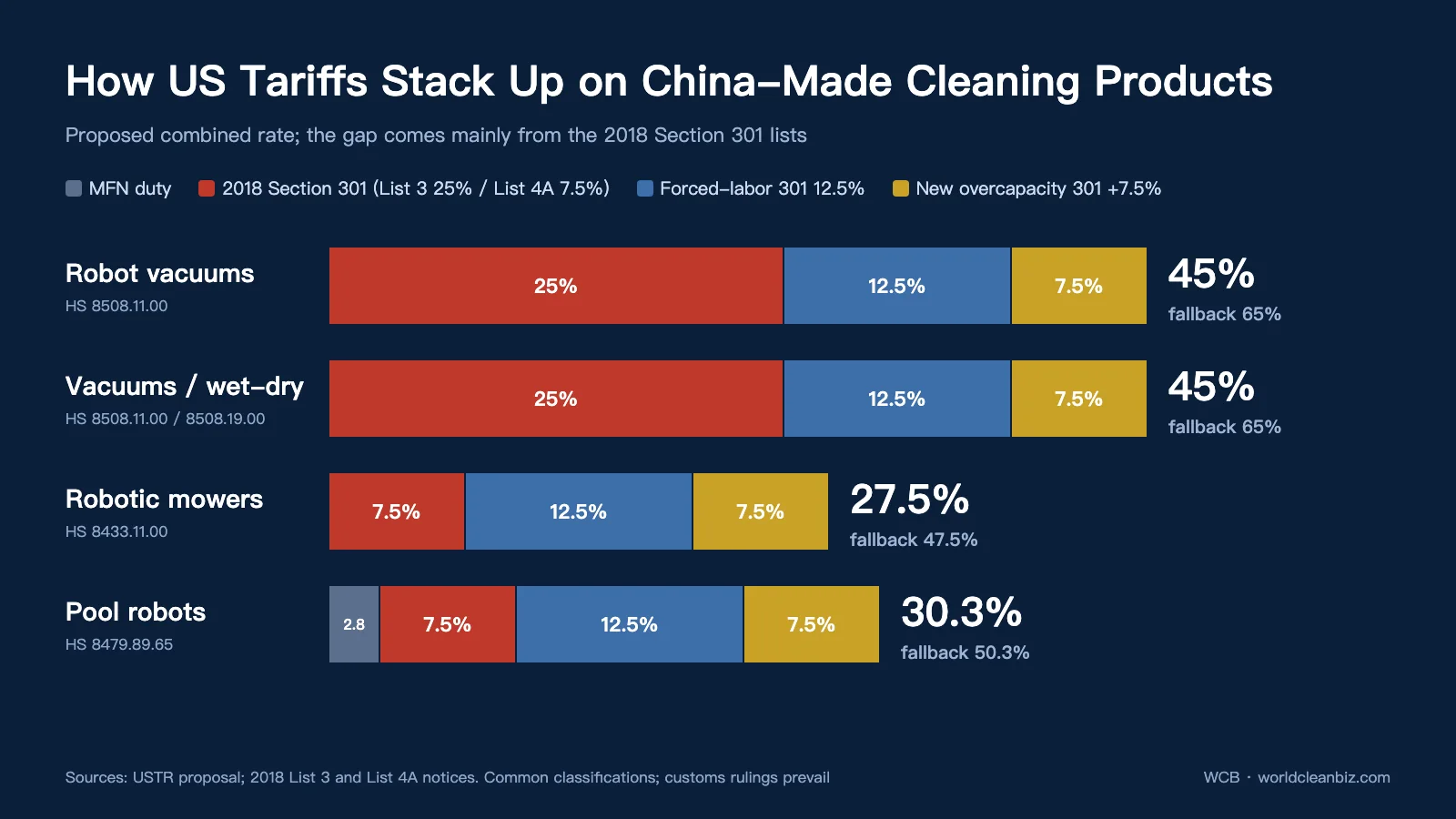
For goods still shipped directly from China, then, robot vacuums, vacuums and most wet-dry cleaners would reach 45%, while robotic mowers and pool robots would be around 30%. Orders still shipped from China to North America, mainly some robotic mowers, pool robots and parts, will get more expensive again. The main products, which have already moved to Southeast Asia, are not much affected.
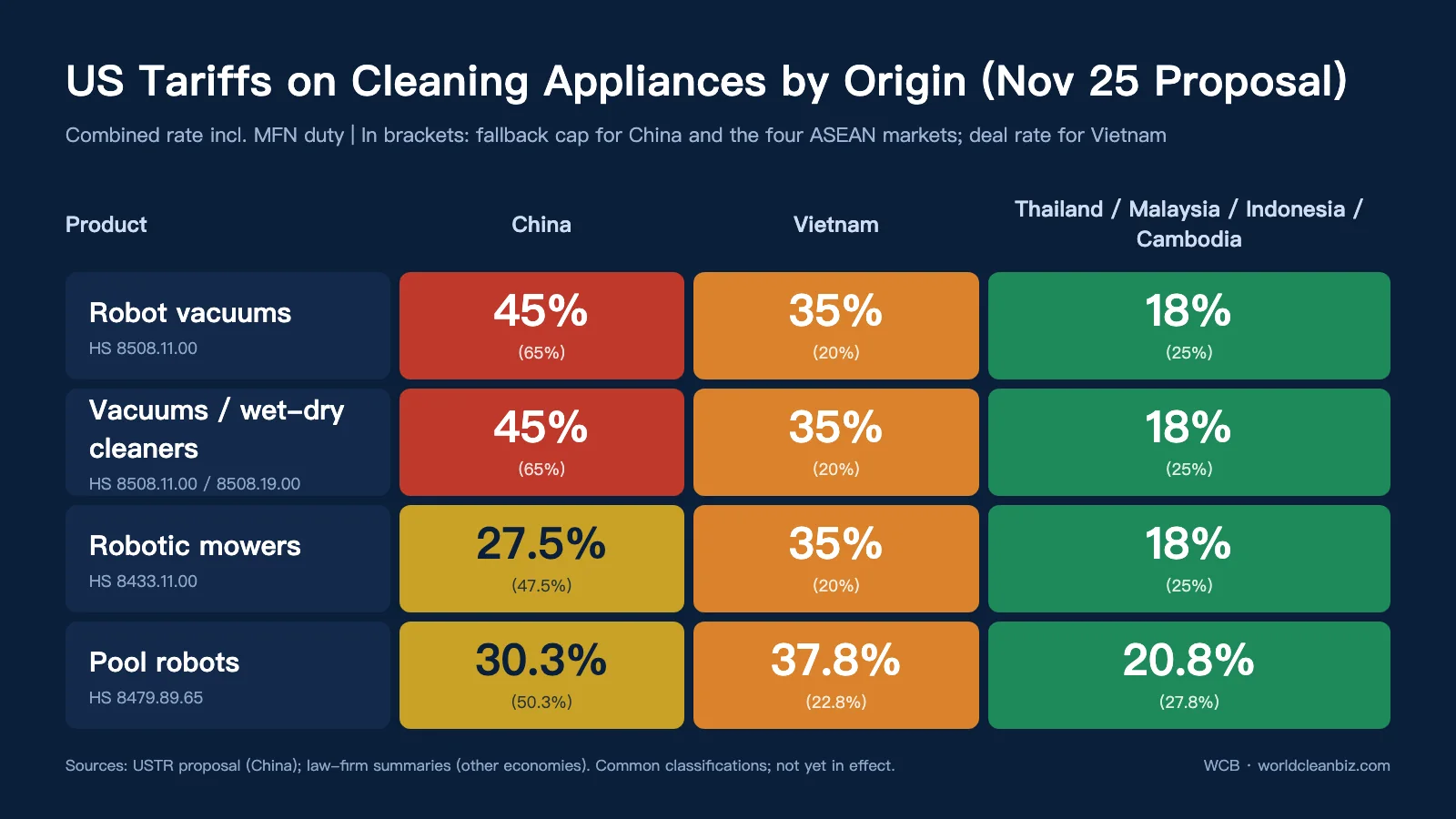
On the Southeast Asian side, the proposed maximum for Thailand, Malaysia, Indonesia and Cambodia is 18%, or up to 25% if talks fail. Vietnam faces up to 35%, which could come down to 20% with an agreement. Korea, Japan, the EU and Taiwan are capped at 15%. These rates are also net of each country's existing Section 301 duties, so they are combined figures. The 2018 Section 301 lists apply only to China, so Southeast Asian products do not carry that layer.
Putting the four main categories and the main origins together, the proposed combined US duty looks like this (MFN included; in brackets, the fallback cap for China and the four ASEAN markets, and the deal rate for Vietnam):
| Product | HS code | China | Vietnam | Thailand / Malaysia / Indonesia / Cambodia |
|---|---|---|---|---|
| Robot vacuums | 8508.11.00 | 45% (65%) | 35% (20%) | 18% (25%) |
| Vacuums, wet-dry cleaners | 8508.11.00 / 8508.19.00 | 45% (65%) | 35% (20%) | 18% (25%) |
| Robotic mowers | 8433.11.00 | 27.5% (47.5%) | 35% (20%) | 18% (25%) |
| Pool robots | 8479.89.65 | 30.3% (50.3%) | 37.8% (22.8%) | 20.8% (27.8%) |
The table gives three conclusions. First, Thailand, Malaysia, Indonesia and Cambodia are the lowest-duty origins in all four categories, and North American orders will keep concentrating there. Second, robot vacuums and vacuums from China face 45%, 27 points above those countries. On a robot vacuum with a $200 landed value, that is $54 more in duty, so North American orders are very unlikely to return to China. Third, if Vietnam does not reach a deal, its 35% is 17 points above Thailand and Malaysia in all four categories, and for robotic mowers and pool robots it is even higher than China.
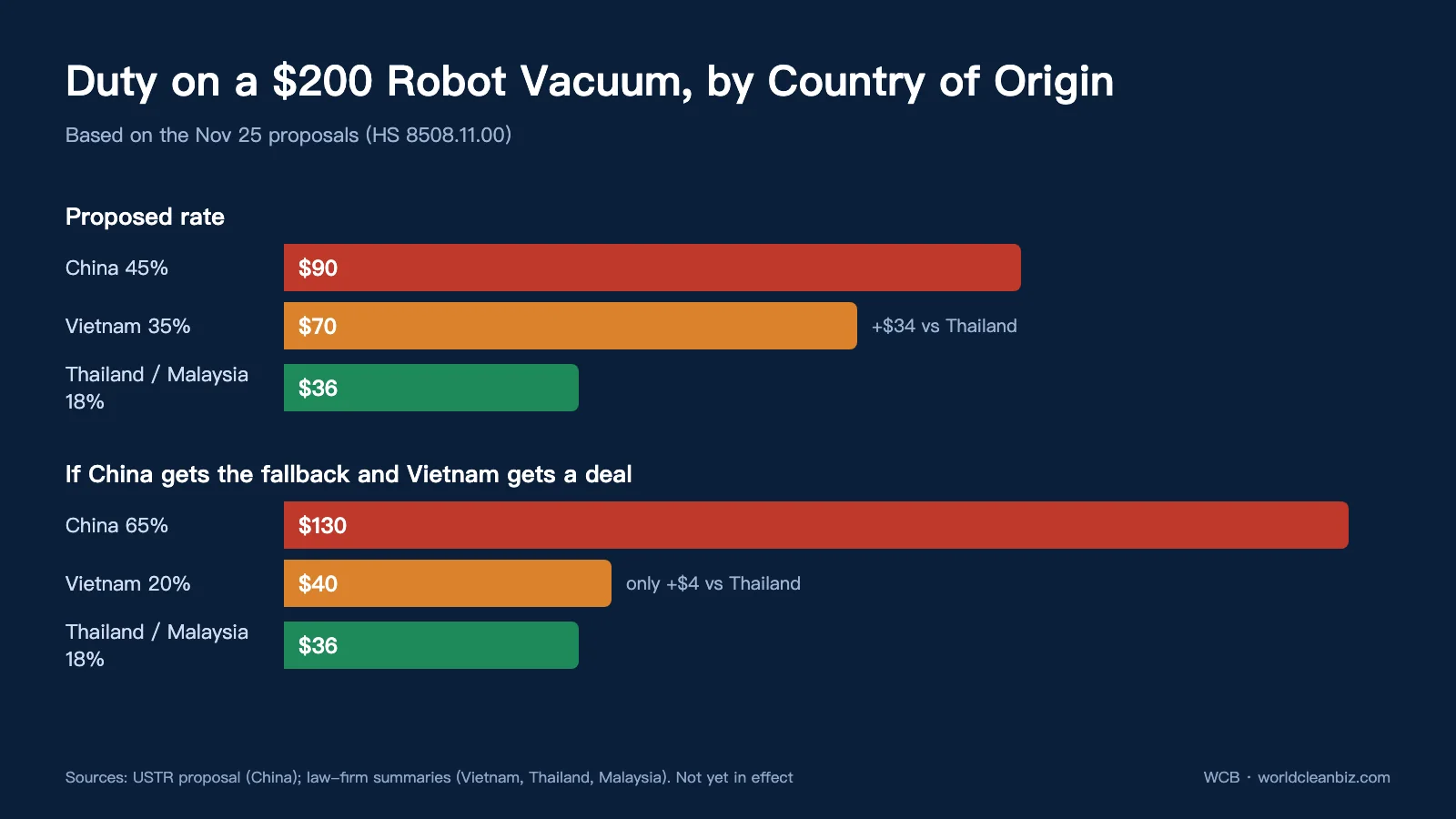
That is why I am watching Vietnam most closely. Vietnam has taken a large share of North American cleaning appliance orders in recent years. On the same $200 robot vacuum, shipping from Vietnam under the proposal costs $34 more in duty than shipping from Thailand. If Vietnam cannot reach a deal, I expect brands and ODMs to shift North American orders toward Thailand, Malaysia and Indonesia at 18%, and Vietnam will lose part of its share. Robot vacuums and vacuums from China are at 45%, 10 points above Vietnam, so those orders will not go back to China. Robotic mowers and pool robots from China are 7.5 points below Vietnam, but still 9.5 points above Thailand and Malaysia, so those orders are more likely to go straight to Thailand or Malaysia, and there is little room for a return to China either.
If Vietnam gets 20%, it is only 2 points above Thailand and Malaysia, and the current pattern will mostly stay as it is. US officials have reportedly said some agreements could be finalized as early as the G20 summit in Miami on December 14–15. Whether Vietnam ends up at 20% or 35% is the biggest variable in this round for the cleaning appliance industry. Companies that already have factories in Vietnam, or plan to build there, should prepare for both outcomes now and keep backup capacity in Thailand, Malaysia or Indonesia.
Moving to Southeast Asia also carries origin risk. Motors, batteries and mainboards are still mostly shipped in from China. If the work in Southeast Asia is only simple assembly, US Customs may still treat the product as Chinese origin and apply the China rate. Only products substantially transformed locally can clear at Southeast Asian rates.
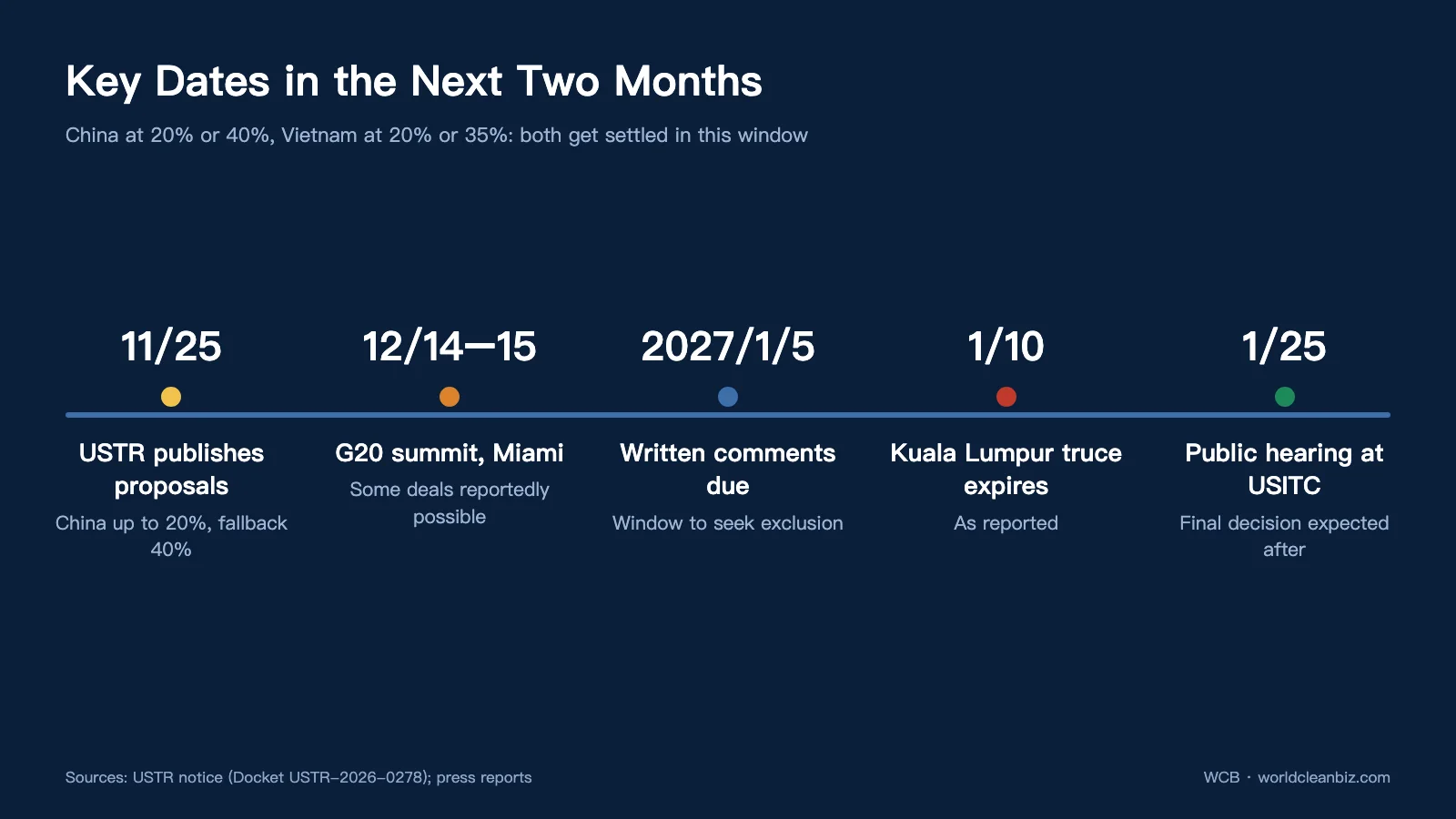
On timing, companies can file written comments through USTR's portal until January 5. The "30-for-30" list in Annex B is itself open for comment, which makes this the window to seek an exemption. I expect the final decision to come after the January 25 hearing. Until then, 20% or 40% for China and 20% or 35% for Vietnam are all still possible.
These tariffs will keep changing, and I will keep following them.