- Two days ago, I wrote a batch of articles "With Trump coming to power, the end of the trade war?" Some friends strongly agreed with my point of view, while others said it was.
- In order to facilitate the deduction, we introduced two protagonists, Company A and Company B, respectively.
- Once tariffs begin to be lowered, it means that the entire trade war is showing signs of loosening.
Two days ago, I wrote a batch of articles "With Trump coming to power, the end of the trade war?" Some friends strongly agreed with my point of view, while others said it was too optimistic. If the situation is not as good as I imagined, how should everyone in the industry respond?
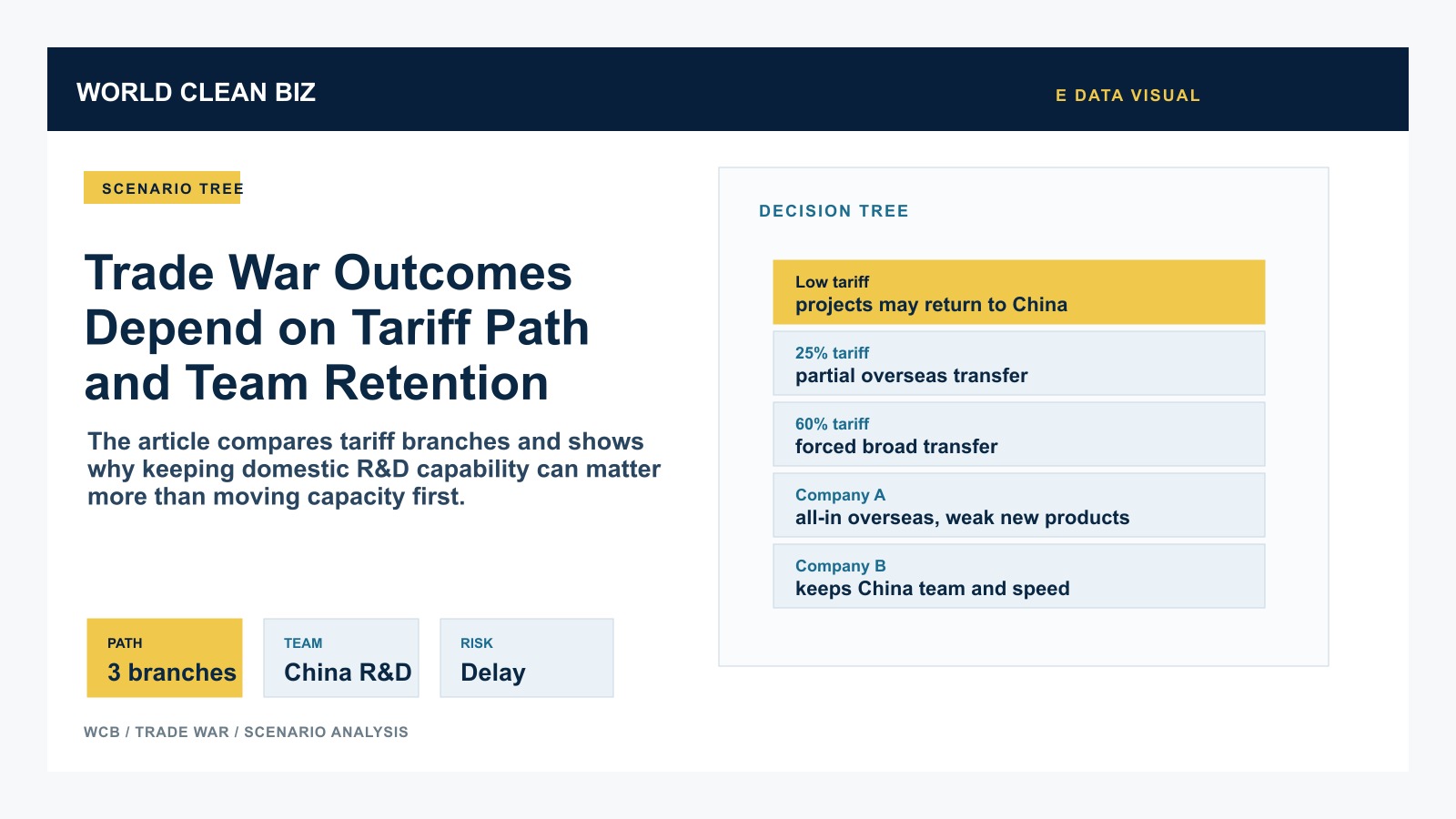
In order to facilitate the deduction, we introduced two protagonists, Company A and Company B, respectively. These two companies are North Midea cleaning appliance giants. They also have some other competitors. We will make a deduction based on the different choices of Company A and B to see who benefits and who is unlucky.
Trump’s first year in office:
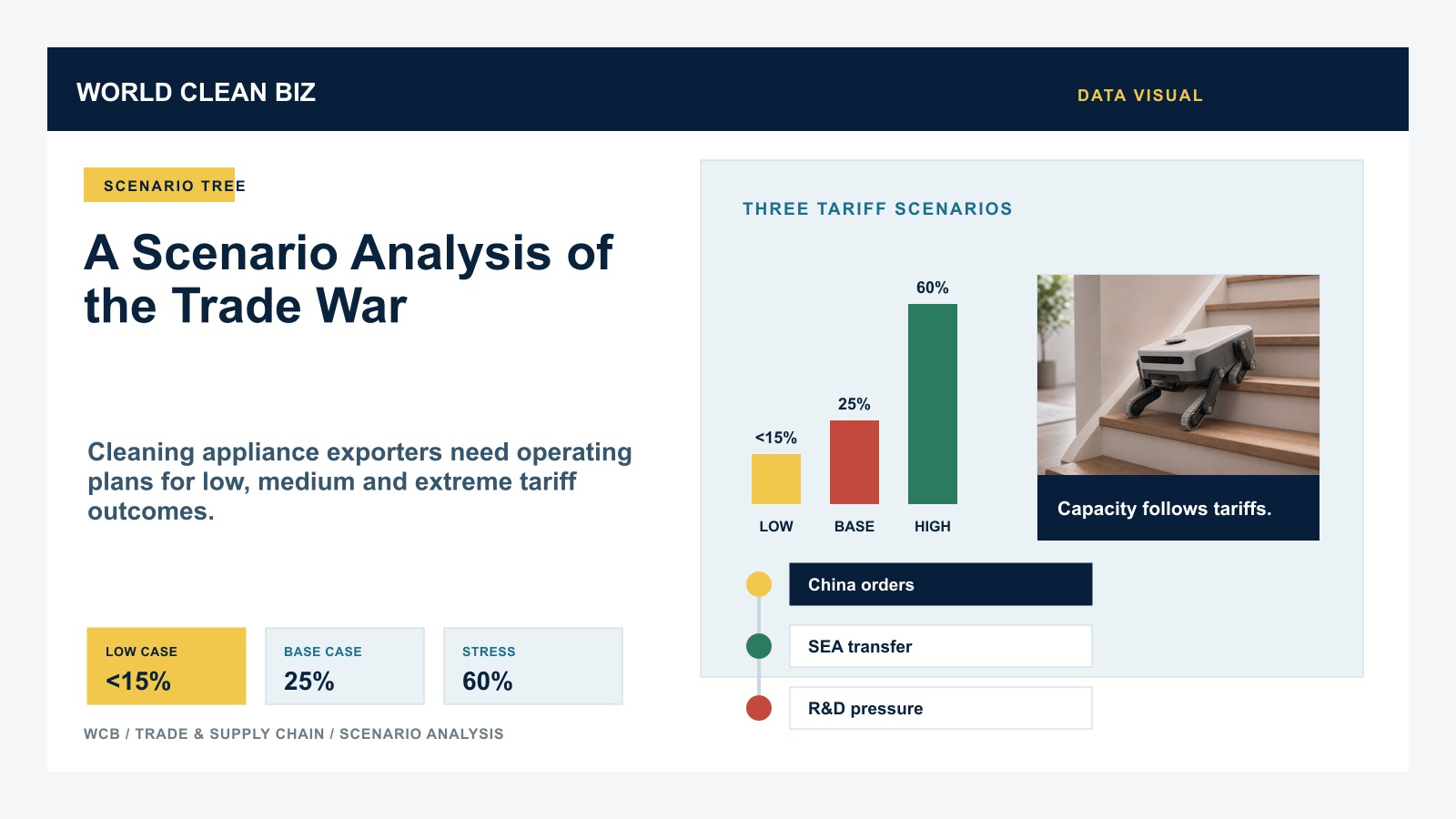
Branch 1: Reduce tariff to 15% and below:
Once tariffs begin to be lowered, it means that the entire trade war is showing signs of loosening. At the same time, overseas production bases have no price advantage. Therefore, brands will tend to keep the existing structure unchanged, and projects that have not been transferred will remain unchanged. Once tariffs are reduced to a lower level, it may be a trend of projects returning to China. At present, many of these big brands have opened backup models, so just talking about where the order is placed will not have much impact.
This is the optimal solution for these domestic leading factories. They do not need to spend too much money and energy on transferring projects. So once the situation of branch line 1 occurs, the entire trade war is basically over, and the follow-up is how to end it. Then we will not consider this situation in the subsequent deduction.
Branch 2: Maintain tariff at 25%.
Brand side: Large companies such as Company A and Company B continue to transfer projects, which may cause the order volume of the same company's overseas base to exceed its domestic base.
For foundries, most of which also carry out overseas professional work, they may need to consider renting more venues to cope with production capacity.
Cross-border e-commerce customers: This group of customers will also consider the impact of tariffs and may go online. However, since the number of cross-border e-commerce orders is relatively small compared to large North American customers, there will not be many substantive actions in the short term.
Branch 3: Increase tariff to 60%.
Once it is determined to increase to 60%, there is no doubt that all orders will face transfer. At this time, the problems that large overseas customers will face are as follows:
- Because all industries are facing a surge in tariffs, all overseas factories have insufficient production capacity and cannot deliver so many projects and orders in a short period of time. Moreover, there are not so many engineers and project managers in Southeast Asia to coordinate these resources, requiring domestic teams to travel frequently.
At this time, the domestic R&D/project teams of big brands will also have an idea in their minds. After I have worked hard to transfer these projects overseas, will I still have a job in Suzhou/Ningbo/Shenzhen in the future? Once people's hearts are dispersed, it will be difficult to lead the team.
Considering that both Branch Line 2 and Branch Line 3 will lead to professionalism in the industry, we will continue the analysis for the next year on the basis of Branch Line 2 and Branch 3.
Trump’s second year in office:
Branch 1, reduced to less than 15% in the second year:
After friendly communication between the two governments, the two sides reached greater trade cooperation. At the same time, the relationship was further reduced to less than 15%. The transfer of the clean electrical appliance industry ended and began to return. (Analysis as above)
Branch 2/3, the tariff will continue to be maintained at 25% (or increased to more than 60%) in the second year.
After getting the news that the tariff will remain at 25% (or even higher), Company A and Company B should move 80-90% to Southeast Asia according to their respective plans. At the same time, several suppliers have also spent more money to expand the production capacity of overseas factories to ensure the delivery of customer orders.
Several old models have been successfully transferred to mass production as planned. At the same time, due to tariff issues, they have a greater price advantage than some competitors that have not gone overseas. At this time, the bosses of Company A and Company B should be thankful that they have made arrangements in advance and have achieved a 30% increase in performance in a few years.
At the same time, how to deal with the huge domestic R&D team has become a problem?
Company A: The boss of Company A firmly believes that the increase (at least not reduction) of tariffs is a high probability event. Currently, All in Southeast Asia will fully enjoy this wave of dividends just like coming to China 30 years ago. Therefore, the only task of the Chinese team is to cooperate with the transfer to Southeast Asia and train the local engineering team, and use lower labor costs to occupy the market in the future to achieve growth in the next 20 years.
Company B: The boss of Company B is relatively less radical. He is a real businessman, and all considerations are based on actual ROI. There is no difference between "Made in VN" and "Made in CN". Currently, the domestic team of hundreds of people is also facing a problem, whether to directly lay off employees like Company A, or to retain the current team to prevent any changes in the future.
Because Company B is not a listed company, there is no pressure on performance. For risk control, it has chosen to temporarily retain the current domestic team for the research and development of new products and the early introduction of new products to ensure that there are enough manpower for the research and development of new products.
The way both parties selected and handled the domestic team that year was also reflected in the year-end performance of Company A and Company B. Company B's net profit hit a record high.
Trump’s third year in office:
Branch 2/3, the tariff will continue to be maintained at 25% (or increased to more than 60%) in the second year.
Since the tariff level remains unchanged and as the level increases in Southeast Asia, the same price at home and abroad has been basically achieved.
However, due to the rise of Amazon in China and the popularity of products such as hard floor washers, wireless steamers, and base station robot vacuums overseas, the market has begun to see changes in demand.
Company A: Company A currently retains a small team of several people in China to deal with some daily chores. All projects are produced in Southeast Asia. However, Company A does not have the technical reserves for new products that are currently hot on the market. For customer development projects, the time cycle has also been delayed from 8 months to 1 year in China to 1 and a half years. They began to delay the development progress of new products and were unable to meet customer needs.
Local engineers were never able to meet customer needs. After the project continued to be delayed, Company A's boss visited the factory in person and asked, "Why don't you work overtime until dawn like Company XXX?" After losing their temper several times, Company A desperately discovered that they no longer had the technology to guide the current foundry. They originally Most of the technologies it is proud of come from foundries. At the end of the third year, after experiencing a series of project setbacks, Company A urgently hired headhunters to recruit a new team in China. However, talents in the industry had great doubts about whether Company A could stick to its domestic development strategy in the future, so no capable talent was willing to go.
Company B: The hot-selling machines on the market also brought new challenges. Because it maintained a complete team, Company B ensured the same efficiency in product development as before. At the same time, many customers of Company A also came to the door, asking to deliver new projects in a short time. Stimulated by the bonus, the team of Company B quickly completed multiple projects.
In the third year, due to changes in the external environment, Company B's performance began to be on par with Company A's.
Trump’s fourth year in office
As Sino-US relations returned to normal levels, negotiations with China began in the fourth year. Tariffs on clean appliances were reduced to 5-10% (or even eliminated). After experiencing inefficient project research and development cycles in Southeast Asia, Company A and Company B were respectively preparing to transfer most of their production capacity to China.
Company A: Company A did not have a suitable domestic team to undertake the project transfer, and the project transfer was stumbling. At the same time, the newly recruited team was also delayed due to running-in and other reasons. At this time, due to poor performance, the original CEO of All in was also replaced by a new candidate by the board of directors. The company was in a state of confusion internally, and did not know what to do in the future?
Company B: Due to the stable domestic team and supply chain, project transfer and new product mold opening are now very smooth. Also because it is ahead of its old rival Company A in the launch of new products, Company B has overtaken Company A in shipment volume for the first time in many years, becoming No. 1 in North America.
Of course, the above stories are all made up by me, but the industry specialization of cleaning appliances is very different from other industries since the trade war. This time the product specialization is mainly due to political factors, unlike many previous industries that were caused by cost reasons, which makes it very embarrassing for the industry that has been transferred to the past after this external political factor does not exist.
The following factors are fundamental to industrial transfer:
- Manufacturing costs. At present, the manufacturing costs in Southeast Asia are still trying to be on par with those in China. After the localization of the supply chain, it is very likely that some large-volume products will be realistically the same in the future. In the next few years, we will at most see the cost being flat and it will be difficult to see the cost leading domestically.
- Tariff factors. Tariffs are the fundamental factor in this industrial transfer. The launch of this trade war was also very accidental and arbitrary. It was initiated by Trump and then inherited by Biden. The trade war does not have a strong strategic intention and logical basis. Judging from the implementation in recent years, there has been no return of manufacturing to the United States. Based on this status quo, it is also a high probability that tariffs will be canceled and reduced in the future. It just depends on how the Chinese government negotiates with Trump and what conditions it offers.
- Technical strength. One of the core reasons why industrial expertise cannot be maintained is that foreign brand companies are technically dependent on domestic foundries, rather than being significantly ahead of the foundries as everyone imagines. Once separated from the R&D power of Chinese foundries/suppliers, it is already very difficult to rely on American companies to independently complete the research and development of some products. Once they are no longer leading in products, the death of the brand will only happen in an instant.
- External environment. In recent years, there have been so many changes in the cleaning appliance industry that even some old masters in the cleaning appliance industry cannot understand it. Bases in Southeast Asia can only achieve simple production without the support of the parts supply chain, and cannot keep up with the pace of the market in the development of new products. And store customers have no loyalty. Once they cannot keep up with new products, it will only take a moment for store customers to abandon the brand.
So no matter how the trade war/product transfer proceeds, for those in the industry, only by doing their own thing and responding quickly can they have the last laugh.