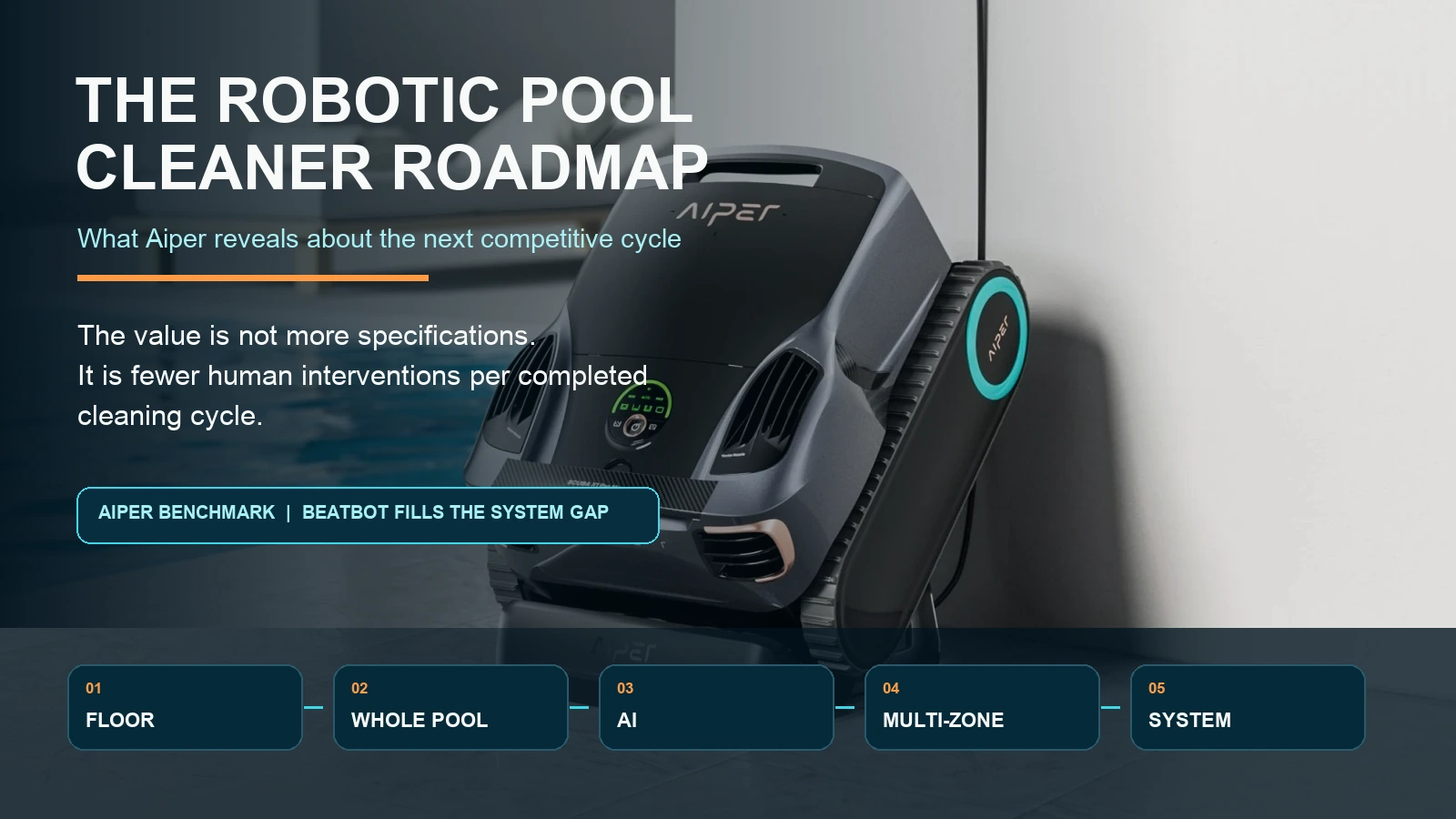
- Competition is shifting from suction, runtime and cleaning zones toward task completion and fewer human interventions.
- Aiper's product ladder shows the route from floor-only cleaning through wall and waterline coverage and AI vision to multi-zone systems.
- Beatbot AquaSense X highlights the next maintenance-system frontier: docking, filter cleaning, debris transfer and readiness for the next task.
In this article 6 sections
Robotic pool cleaners are going through the same kind of product expansion seen in robot vacuums and robotic mowers. Cordless operation has moved from a selling point to a basic feature, while tracked chassis, lateral waterline cleaning, 3-micron filtration, AI vision, shallow-platform cleaning and surface skimming are appearing rapidly in new products. Competition is no longer about whether a robot can remove debris from the pool floor. It is about which parts of the pool it can cover and how often a person must intervene along the way.
Aiper is one of the more useful brands for observing this shift. Its portfolio begins with the floor-only Scuba SE and E1, extends to the S1 and S3 for floors, walls and waterlines, and then moves into the camera- and sensor-equipped V3 and X1 families. Above them are the X1 Pro Max and V3 Ultra, which also cover the water surface, as well as the dedicated EcoSurfer S2 surface skimmer and the two-robot Experts Duo package. Aiper cites Euromonitor International data on its website to describe itself as the world's No. 1 smart robotic pool cleaner brand by manufacturer sales volume in 2025. That claim helps explain the brand's market relevance, but it does not mean every product line has solved its users' problems.
The Scuba S1 and Scuba V3 both target medium-to-large residential pools, and both clean the floor, walls and waterline. The S1 had a US list price of $699.99 and a promotional price of $499.99 on July 22, 2026. The V3 listed at $1,099.99, while its official product page showed a promotional or member price of $799.99 at the time. The extra roughly $300 mainly pays for camera-based recognition, navigation in more complex pool shapes and the brand's promise of less wasted movement.
The same issue runs through the entire market. Pool area determines how much battery capacity and filter volume a robot needs, but it does not tell a buyer whether the machine can cross a main drain, climb a step or scrub the full waterline. Nor does it reveal how long the owner will still spend with a skimmer net and pool brush after the robot finishes.
Prices in this article are snapshots of the US market on July 22, 2026. Consumer discussions come from Aiper, Beatbot, WYBOT and pool-focused communities. The original comments are used only to show the environment, trigger and practical consequence of a problem. They are not evidence of a model's overall failure rate. New products and products with small review samples are identified separately.
Value Floor-Only Cleaners: Replacing Manual Vacuuming Comes First
Product Line and Competing Products
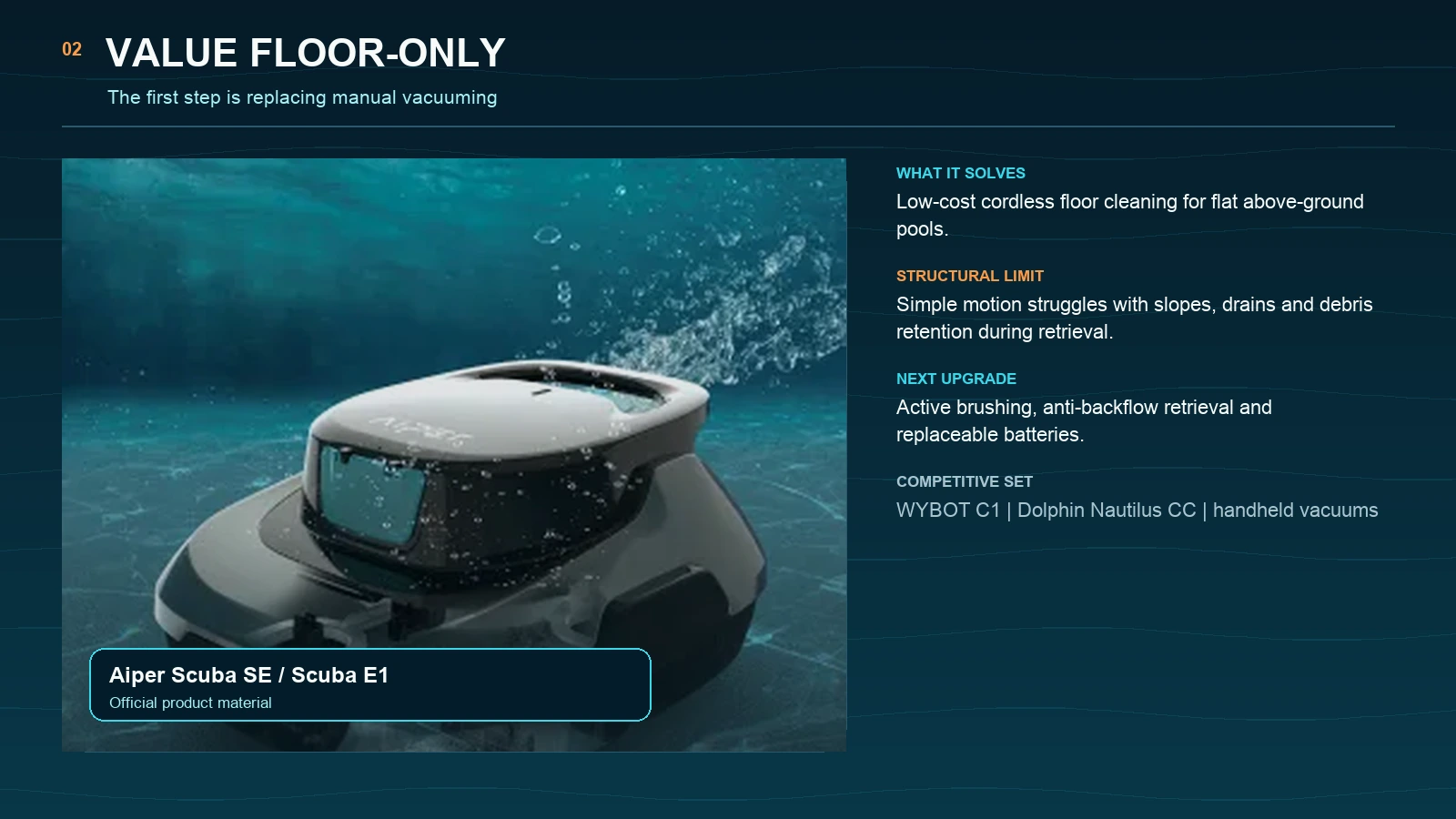
The Aiper Scuba SE is designed for above-ground pools with flat floors. It covers about 860 square feet, or pools up to roughly 30 feet long, and cleans the floor only. One drive motor and one pump provide about 1,200 GPH of filtration flow. Two fixed brushes on the underside work with the intake, and debris enters a 2-liter, 180-micron filter tray. Runtime is up to about 90 minutes and charging takes roughly three hours. Aiper's current US product page does not publish the machine's dimensions or weight, so this article does not fill those gaps with reseller listings or visual estimates.
The Scuba SE uses a low, streamlined shell to reduce drag. Without tracks or an active roller brush, it relies on water flow, friction against the floor and simple steering to stay in contact with the surface. The structure is lighter and less expensive, and it is easier to remove from an above-ground pool. On slopes, walls and complicated main drains, however, the simple chassis struggles to maintain stable motion. Fast drainage and low-battery parking near the pool edge make retrieval easier, but the owner still needs a hook to lift the robot out.
The Scuba E1 steps up to three motors, 3,600 GPH of flow, a 3.6-liter basket and an underside roller brush. It also adds dual-layer 180-micron and 3-micron filtration. The machine covers about 1,100 square feet in flat-floor above-ground pools and runs for around 100 minutes, but still does not clean walls or the waterline. The E1 shows that entry products are gaining active brushing and finer filtration without changing their basic role: they remain automated floor vacuums.
Core competitors in this tier include cordless floor-cleaning robots such as the WYBOT C1. The corded Dolphin Nautilus CC trades cordless convenience for continuous power, a mature chassis and more predictable repeat operation. Handheld pool vacuums offer no automated coverage but can attack steps, corners and localized heavy debris directly. The first battle in the entry market is therefore straightforward: replace the owner's most frequent floor-vacuuming work at a lower purchase price and with a shorter learning curve.
What Consumers Complain About Most
Battery degradation directly reduces the robot's task radius. Entry-level robots generally cannot recharge themselves. Once runtime falls, a job that previously took one cycle must be split across several. After more than a year of use, one Seagull SE owner wrote:
“It only runs for about 15 minutes.” — Seagull SE owner replacing the battery
The owner eventually opened the machine, replaced the battery and resealed it. One case cannot establish the battery life of an entire product line, but it exposes a common weakness in sealed-battery products: once the battery deteriorates, the difficulty of repair may approach the cost and effort of replacing the machine.
Slopes and floor structures can interrupt coverage. In an independent test, the Scuba SE made it only halfway up a slope of roughly 45 degrees, leaving the upper section uncovered:
“It only made it halfway up the incline.” — Independent Scuba SE review
Specifications measured on a flat pool floor become a chassis problem as soon as the machine encounters the transition between shallow and deep water, a main drain or wrinkles in a pool liner.
Retrieval can release debris back into the pool. One Scuba SE owner found that the robot had to be lifted continuously once it left the water or collected material would spill back out:
“Debris dumps back unless lifted in one continuous motion.” — Scuba SE owner
If the owner must clean the same debris again because of the retrieval design, much of the automation value disappears.
How the Segment Should Evolve
Hardware must complete the basic cleaning loop first. An entry robot does not necessarily need a camera, but it does need a more reliable one-way anti-backflow structure, an active roller brush, the ability to clear low-profile drains and faster drainage when it leaves the water. Batteries, charge-port seals, filter baskets and underside brushes should be replaceable separately so that one wearing component does not determine the life of the whole machine.
Navigation should focus on knowing what remains unfinished. Low-cost inertial sensors and wheel-speed data can identify when a robot repeatedly follows the same line, becomes perched on a drain or slips at the bottom of a slope. Even if it cannot build a detailed map, it should tell the owner that coverage was abnormal instead of treating “ran for 90 minutes” as proof that the pool was cleaned.
The purchase flow should assess the pool floor, not just its area. A flat floor, bowl-shaped floor, shallow-to-deep transition, main-drain height and liner wrinkles determine suitability more directly than area alone. After the buyer uploads a photo or chooses a pool shape, the system should state clearly which areas will still require manual work.
After-sales support should be built around repairability. Brands should disclose whether the battery can be replaced, whether seals are supplied, what a basket and charger cost and whether repairing an entry robot after warranty is economical. A low price should not make the product disposable.
Evaluation should return to the floor-cleaning task. Coverage per cycle, debris retention during retrieval, monthly stranding events and runtime retained after a defined number of battery cycles are more useful than peak flow in judging whether the machine genuinely replaces manual vacuuming.
Mainstream Whole-Pool Cleaners: From the Floor to Walls and the Waterline
Product Line and Competing Products
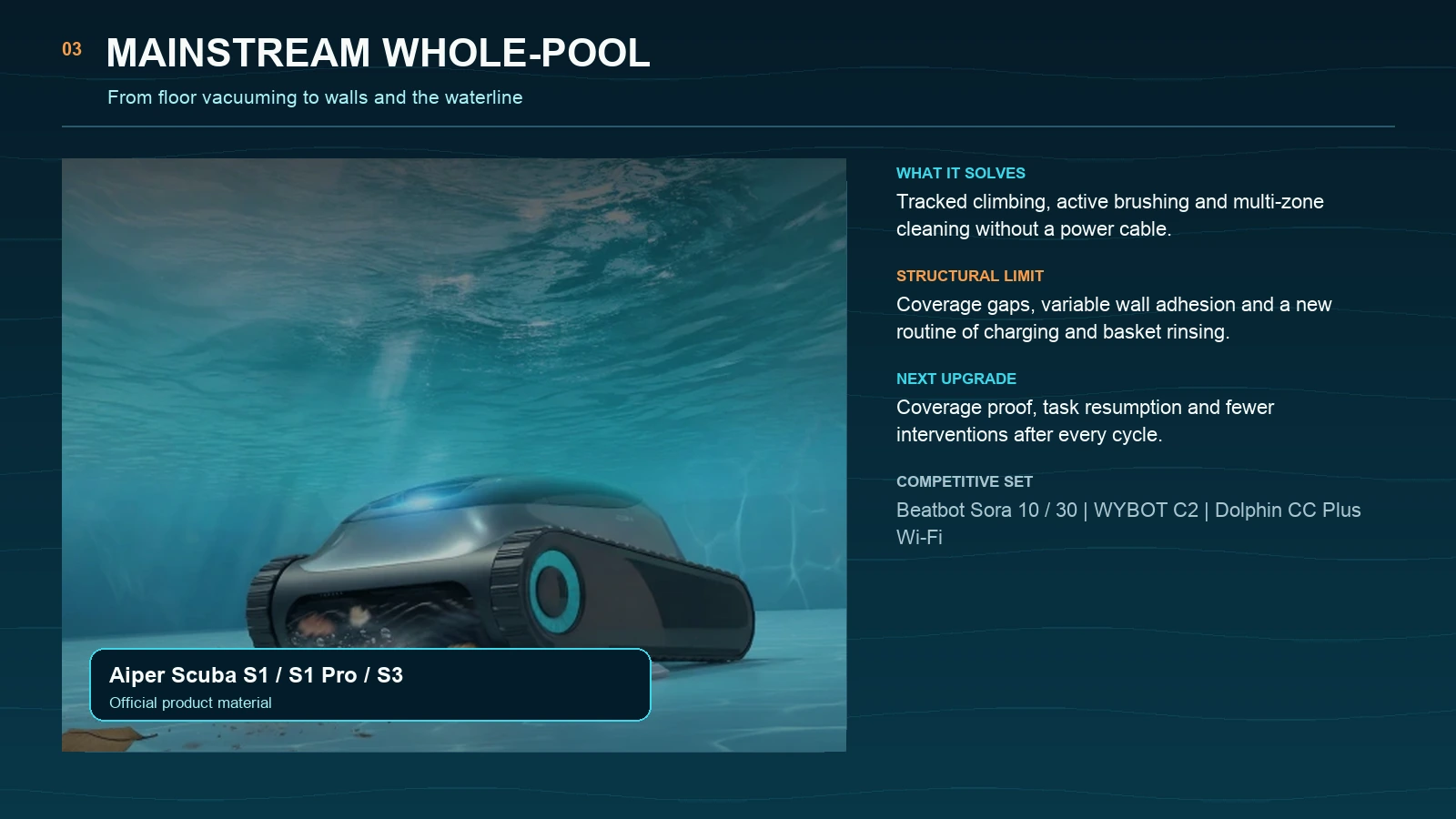
The Scuba S1 is the Aiper model that best represents the industry's mainstream route. It is designed for in-ground pools up to about 1,600 square feet or 50 feet long. Two drive motors, one brushless filtration motor and a tracked chassis provide about 4,200 GPH of flow. One active PVC roller loosens attached material. A 3.5-liter basket provides 180-micron filtration and accepts an optional 3-micron MicroMesh ultrafine filter. Standard cleaning runtime is up to roughly 180 minutes. Aiper also advertises up to about 270 minutes in Eco mode, so the two figures must be understood as different operating modes.
Tracks allow the S1 to climb from the pool floor onto the wall and maintain a larger contact patch near the waterline. WavePath 2.0 uses inertial and motion sensors to plan routes across the floor and walls without a camera. The body is thicker and more enclosed than the Scuba SE, and the top-loading basket is easy to remove and rinse. The tracks, roller and larger volume of trapped water also increase the load during retrieval. Aiper's current official page does not publish a complete set of dimensions or net weight for the S1, and this article does not estimate them.
The S1 Pro raises coverage to about 2,150 square feet and uses active rollers at the front and rear, two drive motors and two pumps. Flow rises to about 6,000 GPH, the basket grows to 5 liters and lateral waterline cleaning is strengthened. The S3 instead emphasizes a lighter 18-pound body, 4,800 GPH, dual rollers, dToF-assisted route planning and up to 240 minutes in Eco mode. Its US list price was $799.99, with a promotional price of $729.99 shown in July 2026.
The Beatbot Sora 10 and Sora 30 are the most direct competitors in this segment. The Sora 10 was promoted at $449 against a $699 list price. It weighs about 18.7 pounds, provides 6,800 GPH and a 5-liter basket, and covers the floor, walls, waterline and shallow areas meeting certain depth conditions. The Sora 30 was promoted at $689 against a $999 list price. It weighs around 19.6 pounds and adds a larger battery, a roughly 5.2-liter basket and cleaning on shallow platforms with at least about eight inches of water. The WYBOT C2 competes on price. The corded Dolphin Nautilus CC Plus Wi-Fi trades cordless operation for the ability to start at any time without waiting for a battery to charge.
The central trade-off is already clear. Cordless operation removes cable tangles and concerns about mains power near the pool, but it creates a new daily routine of charging, carrying, drying the charge port and rinsing the filter basket.
What Consumers Complain About Most
Wall climbing and waterline cleaning depend on surface material and curvature. One S1 Pro owner reported that the machine could not climb the walls reliably and moved only a short distance in waterline mode:
“It didn’t climb walls… and the waterline mode stopped after six inches.” — Scuba S1 Pro owner
If the robot reaches the waterline only intermittently, the owner must still use a pool brush regularly to remove oils and scale.
Repeated routes consume runtime in areas that are already clean. One owner watched the S1 repeat similar movements:
“It feels like it is stuck in a loop.” — Scuba S1 owner
Long runtime does not prove complete coverage. Freeform pools, shallow-to-deep transitions and curved walls widen the gap further.
App connection can break the smart experience during setup. An owner of the 2025 S1 tried QR-code, Bluetooth and Wi-Fi pairing, but the progress indicator remained at 90%:
“It got stuck on 90% and it gave up.” — Scuba S1 2025 owner
This does not prevent basic push-button operation, but it affects mode selection, cleaning records and over-the-air updates. The S1 received hardware and software changes across its 2024, 2025 and 2026 versions, so complaints about an older version should not be applied directly to the current product.
How the Segment Should Evolve
The chassis needs to be designed around real pool structures. Main drains, ladders, curved walls, smooth tile and shallow-to-deep slopes should be standard test environments. Tracks must do more than provide traction for wall climbing. The machine should identify when it is perched on an obstacle, lacks suction or has entered a narrow area, then choose an exit route.
The task system must advance from route planning to proof of coverage. The robot should record how much of the floor, walls and waterline it completed, and identify repeated routes and consistently missed areas. If the battery runs low, it should save progress and continue the unfinished area after charging instead of starting again.
The app should explain the limits of underwater communication. Radio signals do not travel easily through water. Brands should not let “app control” imply that a robot remains connected at depth when it can communicate only near or above the surface. The machine should cache its task before disconnecting, then synchronize the map, errors and completion data when it surfaces.
Maintenance design should reduce the work required after every cycle. A top-loading basket, fast drainage and a protected charging port are only the beginning. Basket-cleaning frequency, roller removal and battery health should be visible in the app. Frequently replaced parts need stable availability and transparent prices.
Success in the mainstream tier should mean less supervision. Brands should publish whole-pool task completion per cycle, average rescues per month, the length of waterline that still needs manual brushing, retrieval weight and the number of basket rinses required each week. These measures are closer to the household's real cost than another increase in GPH.
AI for Complex Pools: Can Cameras Actually Reduce Missed Areas?
Product Line and Competing Products
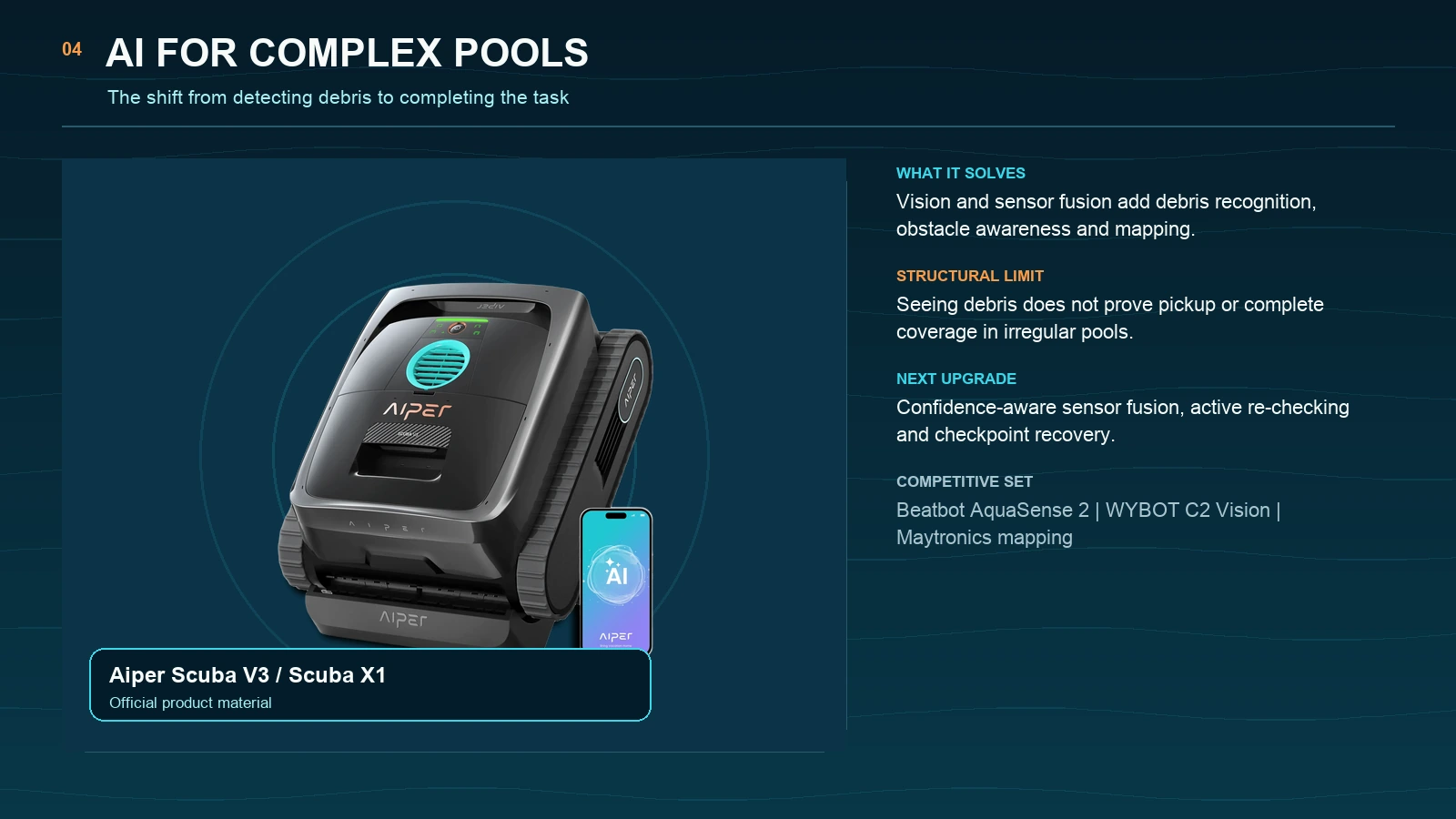
The Scuba V3 marks Aiper's shift from inertial route planning toward visual perception. It weighs about 18.2 pounds and uses four motors, dual rollers, up to roughly 4,800 GPH and a 3.5-liter multilayer filter basket. It cleans the floor, walls and waterline. Cognitive AI and VisionPath use a camera to identify debris and obstacles, while an LED supports visibility at night. Navium mode also combines pool history, weather and usage to create recurring schedules.
Traditional robots move along fixed routes or react to collisions. With a camera, the V3 can slow down and adjust direction when it detects debris, while attempting to reduce unproductive movement. The roughly 18-pound body limits the carrying penalty created by the additional sensors. The front camera and lighting components observe the scene, and the dual rollers direct material toward the intake. The product's value ultimately depends on whether “seeing debris” becomes “putting debris in the basket.”
The Scuba X1 uses 14 sensors, four motors, dual active rollers, 6,600 GPH and a 5-liter basket. It covers about 2,150 square feet and cleans the floor, walls and waterline. The X1 Pro raises the sensor count to 26 and adds mapping plus platform and slope adaptation. At about 24.25 pounds, the X1 is closer to a heavy platform that uses ultrasonic, dToF and motion sensing to establish spatial relationships. The V3 instead emphasizes camera-based understanding of debris and obstacles. Aiper is backing two routes at once: understanding what the robot sees and measuring the pool more precisely.
The Beatbot AquaSense 2 series, WYBOT C2 Vision and newer mapping products from Maytronics compete in this tier. Every brand using AI, maps and additional sensors must answer the same question: does more perception actually reduce missed areas and manual touch-up work in a complex pool?
What Consumers Complain About Most
AI recognition does not automatically produce complete coverage. A V3 reviewer on Aiper's official store described a 20-by-44-foot L-shaped pool:
“The robot misses at least 10–20% of my pool on every run.” — Scuba V3 reviewer on Aiper's store
The reviewer praised fine-dust filtration but found that the same parts of the pool remained unfinished on each cycle. Debris recognition and global coverage are still two different problems.
Mode or mapping errors can leave the robot circling. During a first run, one X1 owner watched the machine climb the walls repeatedly. After switching to floor mode, it began turning in circles:
“It seems to be just going in circles.” — Scuba X1 owner
Customer service suggested allowing the robot to keep “learning” the pool, but the consumer could not tell how many cycles this would require or whether the behavior already represented a fault.
Slopes can disrupt chassis attitude and navigation at the same time. An owner using a related Aiper platform described the front of the robot lifting as it travelled down the slope between shallow and deep water:
“It’s basically doing a wheelie all the way down.” — Owner of a pool with a complex slope
Once the front leaves the floor, the intake position and camera angle both change, interrupting the planned back-and-forth route.
The V3 is a 2026 product. Existing reviews are useful for showing which questions the AI route still needs to answer, but they are not sufficient to judge long-term reliability or establish a brand-level complaint rate.
How the Segment Should Evolve
A multisensor system needs to know when to trust each input. Cameras are useful for recognizing debris and obstacles. dToF and ultrasonic sensing are useful for distance, while wheel-speed and inertial data show movement state. The system should continuously calculate confidence for each input so that a sensor distorted by underwater reflections, cloudy water or slope-induced chassis attitude does not control the entire decision.
Recognition must be followed by active verification. After detecting a possible obstacle or debris, the machine should observe it from another angle and decide whether to avoid it, slow down and collect it, or return later. Avoided areas should enter a follow-up cleaning queue. After a stranding event, restart or manual relocation, the task should resume from a safe checkpoint.
The map should show task results, not just a path. Owners need to distinguish between “travelled across,” “scrubbed” and “collected debris.” They should also see which zones the robot could not enter because of water depth, platform size or slope. AI cannot be reduced to a visually complex route line.
Service diagnostics should read the task context directly. With the owner's authorization, support staff should be able to see camera confidence, wheel speed, mode, firmware and pool shape immediately before and after a fault. Consumers should not have to reset, remap and describe the same problem repeatedly.
The AI premium must be validated through outcomes. Consistently missed area, duplicate coverage, pickup rate after debris detection, successful task resumption and human takeovers per 100 tasks are the evidence that determines whether vision and mapping create value.
All-in-One Flagships: Do More Functions Actually Mean Less Work?
Product Line and Competing Products
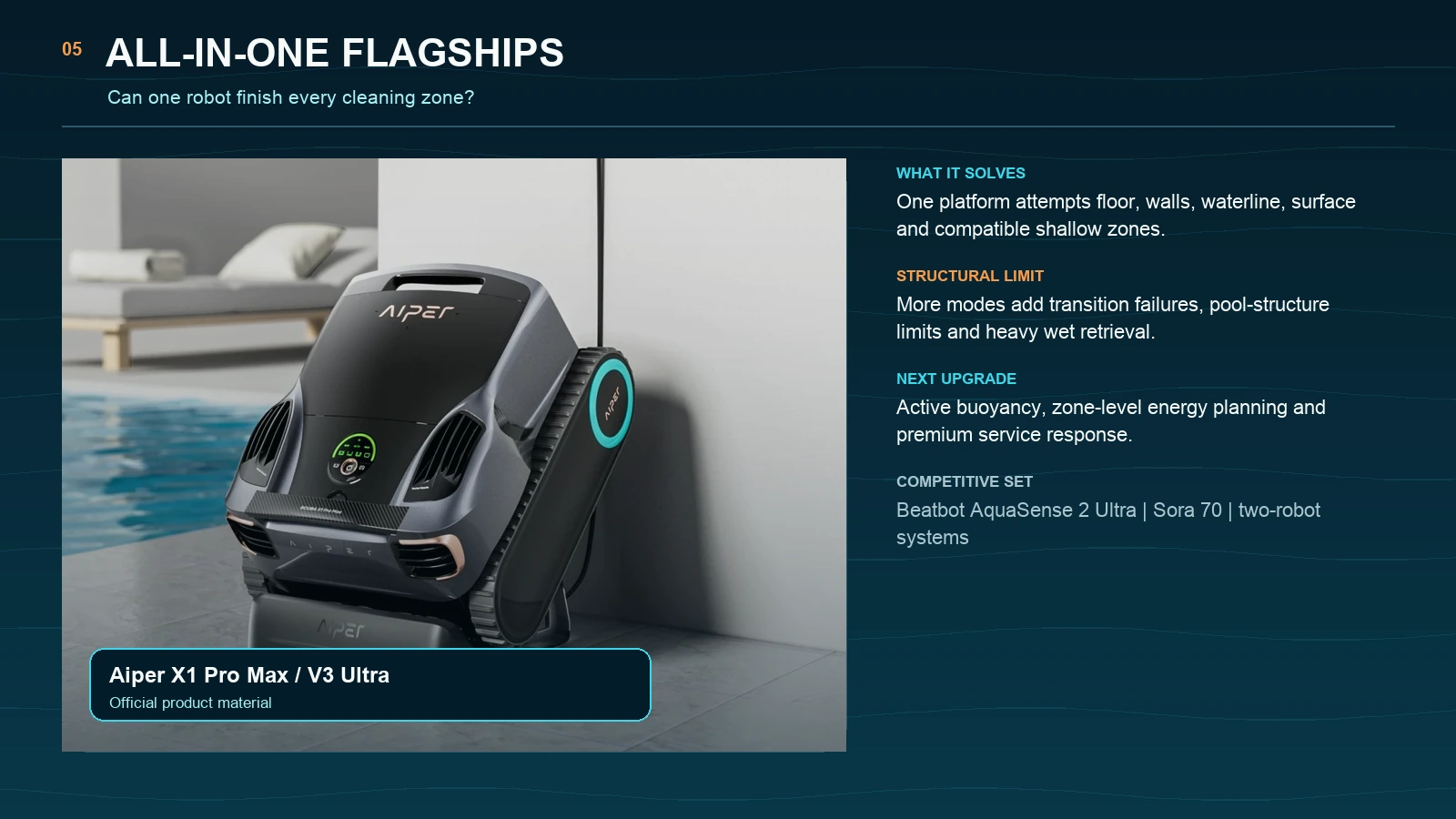
The Scuba X1 Pro Max is Aiper's clearest attempt to combine multiple cleaning zones in one machine. On July 22, 2026, its US promotional price was $1,699.99 against a $1,799.99 list price. It covers about 3,230 square feet. The robot weighs roughly 33.07 pounds and uses nine motors, 40 sensors, active rollers at the front and rear, 8,500 GPH and a 5-liter basket. It cleans the floor, walls, waterline and water surface, as well as compatible shallow platforms and slopes.
Runtime varies by task. Aiper lists up to about 210 minutes for floor cleaning, around 330 minutes in Eco mode and as much as roughly 720 minutes in surface mode, with charging taking about four hours. The robot can rise automatically to the surface and park near the edge. A wireless charging dock and rapid drainage make retrieval easier, but a 33-pound machine carrying residual water remains a substantial load. Aiper's current page does not publish a complete set of dimensions. One independent test measured about 16.9 by 19.7 by 11.7 inches, but this article treats that as third-party measurement rather than an official specification.
The V3 Ultra adds dual-camera AI, cleaning on platforms with water as shallow as roughly 7.9 inches, JellyFloat buoyancy recovery, surface cleaning and a chlorine-tablet compartment. It weighs about 28.8 pounds, covers roughly 3,875 square feet, provides 8,500 GPH and runs for up to about eight hours in surface mode. Its US list price was $2,299.99, with an early-bird price of $1,899.99. The lighter body and active buoyancy mechanism attempt to address the X1 Pro Max's carrying load and platform limitations.
The Beatbot AquaSense 2 Ultra and Sora 70 are direct competitors. Another route is a two-robot system: one underwater cleaner plus a surface robot that remains in the pool. An all-in-one flagship must transition reliably among three conflicting physical states—floor vacuuming, wall adhesion and surface flotation. A feature list alone cannot prove that it can.
What Consumers Complain About Most
More complex functions create more points at which the entire cycle can fail. One X1 Pro Max owner received two replacement machines and found that both sank without starting:
“It would float to the bottom of the pool and just stay there.” — Scuba X1 Pro Max owner
When the basic task cannot begin, every advanced cleaning zone becomes irrelevant.
Shallow platforms and steps still have strict structural requirements. An owner in South Texas reported that the X1 Pro Max would not enter the tanning ledge and could climb only the lowest step:
“It won’t go near the tanning ledge.” — X1 Pro Max owner
“Supports shallow platforms” must be accompanied by minimum water depth, platform dimensions, step width and approach-angle requirements. It cannot become a promise that applies to every pool.
Retrieval weight can cancel some of the convenience of cordless operation. An independent tester found that removing and moving the X1 Pro Max required noticeable effort:
“It can be a bit of a struggle to carry.” — Independent X1 Pro Max test
Automatic surfacing and edge parking remove the need for a long retrieval pole, but they do not eliminate the work of moving a heavy, wet machine to its charging area.
How the Segment Should Evolve
The next flagship is first a chassis that can manage buoyancy and center of gravity. Floor cleaning requires firm contact, wall cleaning requires stable adhesion and surface travel requires enough buoyancy and propulsion efficiency. Controllable buoyancy chambers, rapid drainage and center-of-gravity adjustment between tasks may improve multi-zone performance more than adding still more motors.
Route planning must allocate battery capacity across zones. The system should decide which task comes first based on surface leaf load, fine sand on the floor, attached material on the walls and battery state. Progress in one zone cannot be discarded simply because the robot changes modes.
Platforms and waterlines need local strategies. Owners should be able to mark a section of waterline with heavy oils, a platform with insufficient depth or a step that requires a low-speed attempt. The robot should record where entry succeeded and where it had to retreat, then adjust on the next cycle instead of forcing the user to switch global modes repeatedly.
A premium price must include stronger service. A three-year warranty is only the minimum. Remote diagnosis, replacement of critical modules, clear repair deadlines, peak-season exchange and collection of heavy equipment should become part of the flagship offer.
The flagship scorecard is full-cycle task integrity. Actual completion by zone, mode-switch failures in one cycle, weight the owner must carry, length of waterline requiring touch-up, successful platform entry and faults per 100 tasks show whether one machine genuinely reduces manual work.
The Pool Maintenance System: Consumers Are Buying Unattended Time
Product Line and Competing Products
The EcoSurfer S2 cleans only the water surface. It weighs about 12.6 pounds and uses two brushless propellers plus one brushless impeller. A top-loading 4-liter basket provides 150-micron filtration. Optical sensors handle obstacle avoidance, the DebrisGuard structure reduces debris backflow during reversing and an integrated compartment holds chlorine tablets. Aiper's official page lists roughly 35 hours of operation on adapter charging, and the US price was about $399.99.
Aiper's current US pages conflict on the EcoSurfer S2's solar configuration. The official product page describes SolarSeeker and solar-assisted operation, while an official troubleshooting page says the EcoSurfer S2 has no solar panel and relies on cable charging. Until Aiper clarifies the actual US hardware version, specifications from different pages, regions or production batches should not be combined.
The Experts Duo combines a Scuba V3 with an EcoSurfer S2. The underwater robot handles the floor, walls and waterline, while the surface robot continuously collects leaves and insects. The July 2026 US promotional price was about $1,249.99 against a $1,499.98 list price. HydroComm adds water-quality monitoring and communication. This system acknowledges a product reality: asking one machine to cover every zone creates structural compromises. Two specialized robots can work in parallel, but the consumer must maintain two batteries, two propulsion systems and two filter baskets.
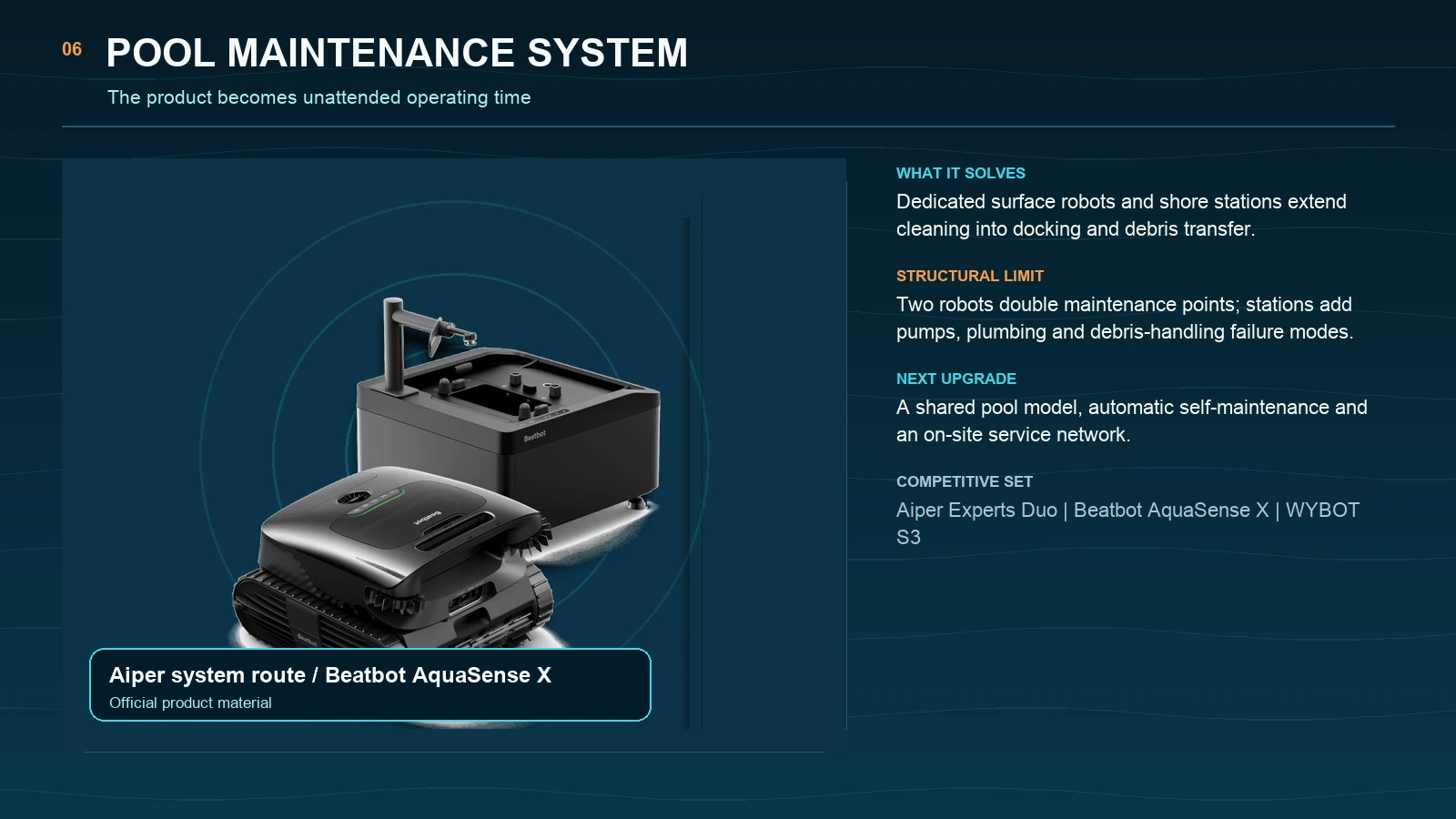
Aiper does not yet offer a complete system for automatic recharging, filter-basket cleaning and shore-based debris storage. Beatbot's AquaSense X fills that gap in the roadmap. Its official US price is $4,250. The AstroRinse shore station rinses the filter basket in about three minutes and transfers debris into a 22-liter bin. Beatbot says that under typical conditions the bin may need emptying only about once every two months. The WYBOT S3 offers automatic docking, charging, self-cleaning and a 10-liter shore bin at a promotional price of $2,499.99 against a $2,999.99 list price.
The cleaning task is moving onto land. After the robot finishes in the pool, the station takes over drainage, basket rinsing, debris transfer and charging. Consumers are paying for the number of consecutive days they can avoid carrying a robot, washing a filter and restarting a task.
What Consumers Complain About Most
Obstacles at the surface are less stable than those on the floor. One EcoSurfer S2 owner repeatedly found the robot stranded near the edge, a projecting finger ledge and a vacuum hose:
“It constantly gets stuck, breached like a whale.” — EcoSurfer S2 owner
Wind, return jets, floating hoses and water-level changes continually alter the surface environment. A static map cannot describe all these temporary conditions.
Propellers may become a long-term reliability weakness under continuous immersion. Several owners in one discussion reported one-sided propulsion failure, leaving the robot able only to circle or reverse:
“The right-hand motor just stopped working correctly.” — EcoSurfer S2 owner
Leaves, hair, salt crystallization and bearing wear can create similar symptoms. Consumers need to know whether to clean a propeller, update firmware or request service.
Self-cleaning stations still need validation under heavy debris loads. An early AquaSense X tester said the station worked under ordinary daily debris, but struggled with water flow and splashing during a winter test with a large volume of leaves:
“The station struggled with water flow and splashed/leaked.” — Early AquaSense X test
The AquaSense X and WYBOT S3 have been on the market for only a short time and have limited real-user samples. These comments show why self-cleaning stations need testing across different debris loads, but they do not support a mature reliability conclusion.
How the Segment Should Evolve
The system needs a stable interface between pool and shore. Automatic approach, fast drainage, charging and debris transfer must work through changing water levels, wind and different coping structures. The station also needs to distinguish leaves, fine sand and wet sludge instead of forcing every material through one disposal path.
Multiple robots should share one pool model. If the surface robot detects a concentration of leaves, it can adjust the underwater robot's task. If water-quality monitoring detects cloudiness or rainfall, the system can increase filtration and fine-particle cleaning without making the owner open three separate apps.
Task planning must include maintenance of the robots themselves. The system should schedule pool cleaning while predicting when a basket will fill, when a propeller needs cleaning, when filter performance is declining and when a battery requires service. If it cannot continue, it should create a clear action recommendation or service ticket automatically.
Service will become part of the system. Shore stations add pumps, pipes and debris-handling structures, which also add failure points. Brands need to offer on-site installation, winter storage, periodic maintenance, spare parts and a defined service radius. The mail-in repair model used for small consumer electronics is no longer enough.
The final metric is unattended time. Consecutive operating days, bin-emptying events per month, automatic docking success, debris remaining after basket self-cleaning, remote recovery success and total cost over three to five years are more meaningful than a single “up to two months without emptying” claim.
From Specification Competition to Task Completion
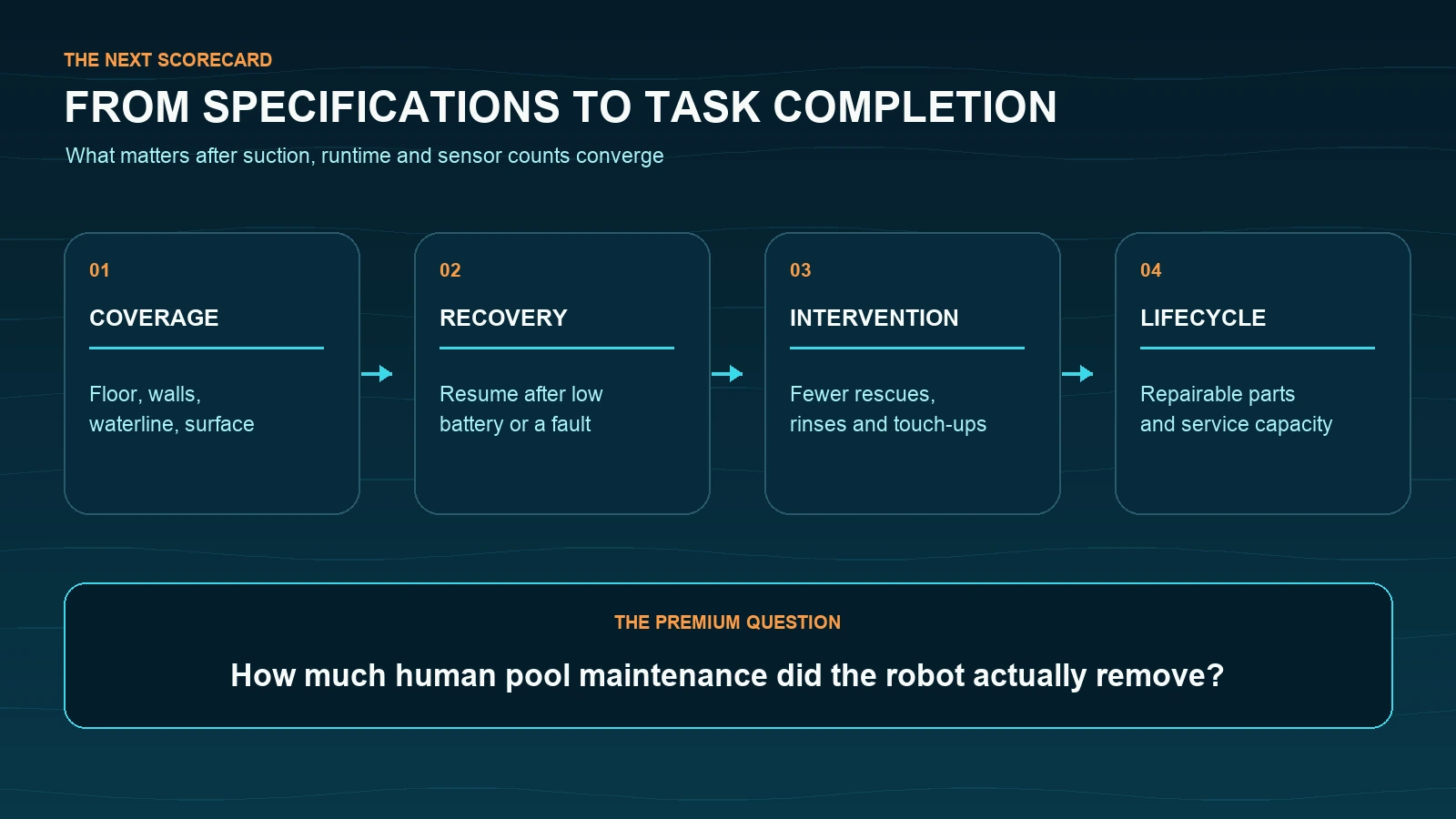
Aiper's portfolio from the Scuba SE to the V3 Ultra and Experts Duo traces the industry's route from floor vacuuming to whole-pool cleaning, AI vision and the pool maintenance system. Beatbot's AquaSense X and the WYBOT S3 extend the roadmap toward automatic docking, self-cleaning and shore-based debris storage. Each upgrade expands the tasks the machine can handle, but the final objective remains the same: reduce human intervention.
Suction, runtime, filtration precision and sensor count remain necessary hardware thresholds. As brands converge on these specifications, households will care more about how many rescues are required each month, whether the waterline still needs manual brushing, how often the basket must be cleaned and whether one cycle finishes the full task. Premium buyers are not purchasing additional modes alone. They are paying for a machine that can recover from a fault—or for fast support when it cannot.
Task completion will support the next round of product premiums more effectively than a new GPH record. For a robotic pool cleaner, completion does not mean running underwater for several hours. It means reporting how much of the floor, walls, waterline and surface was actually finished, and what work the owner still had to do.
Robotic pool cleaners have learned to clean pools by themselves. The next phase of growth depends on whether owners can stop taking care of the robots.
Explore 2026 new models