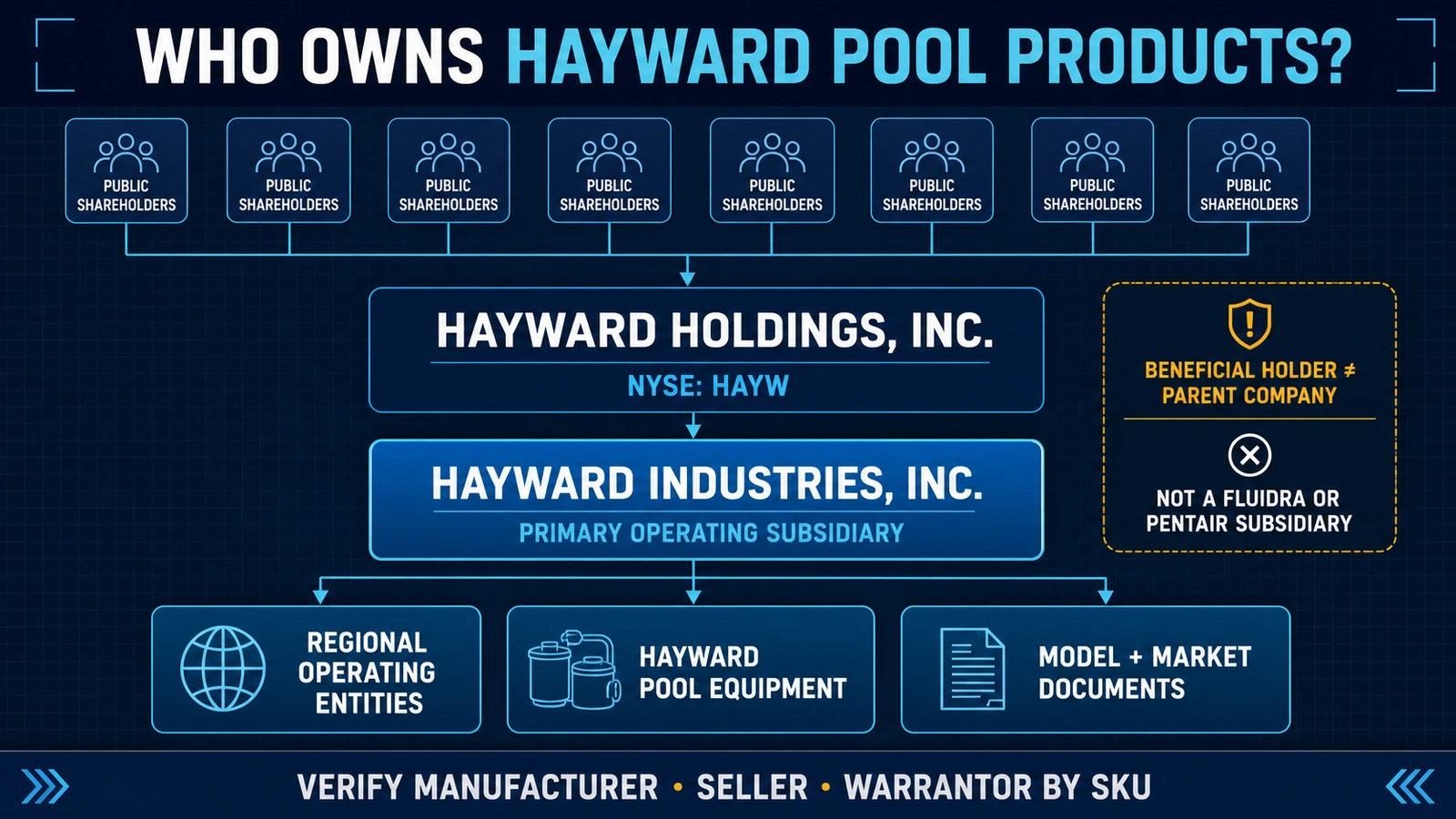
- Hayward Pool Products belongs to the Hayward group, whose ultimate public parent is Hayward Holdings, Inc. (NYSE: HAYW).
- Institutional shareholders such as BlackRock, Vanguard and JPMorgan are disclosed beneficial holders, not a separate parent company for the Hayward brand.
- For a specific product, buyers must verify the legal manufacturer, country of origin, seller and warranty entity from the exact model and market documents.
In this article 14 sections
Hayward Pool Products is part of the Hayward group, whose ultimate publicly traded parent is Hayward Holdings, Inc. Hayward Holdings trades on the New York Stock Exchange under the ticker HAYW. It is owned by its shareholders; it is not a subsidiary of Fluidra, Pentair or Maytronics.
Who manufactures Hayward pool products? Hayward Holdings describes its consolidated business as a global designer and manufacturer and reported seven manufacturing facilities as of December 31, 2025: four in the United States, two in Spain and one in China. The filing does not map every pump, cleaner, heater, controller or replacement part to one legal manufacturer or factory, so buyers must verify those details from the exact SKU label, conformity documents and market records.
That short answer is correct, but it does not identify every company that may appear on a Hayward product, invoice or warranty document. Hayward Holdings is the public parent. Hayward Industries, Inc. is the primary operating subsidiary identified in Hayward’s IPO filing. Regional companies, distributors, dealers and service centers can take different roles in a transaction.
For buyers, the useful question is therefore not only “Who owns Hayward?” It is also: Which entity made, sold, imported and warranted the exact product in this market?
Hayward Ownership at a Glance
| Question | Answer |
|---|---|
| Who is the ultimate public parent? | Hayward Holdings, Inc. |
| Is Hayward publicly traded? | Yes. NYSE: HAYW |
| Who owns Hayward Holdings? | Its public shareholders |
| Is BlackRock the parent company? | No. It was a disclosed beneficial shareholder, not Hayward’s corporate parent |
| What is Hayward Industries, Inc.? | The primary operating subsidiary identified in Hayward’s IPO filing |
| Is “Hayward Pool Products” always one legal company? | No. The name can describe the product business and also appears in specific legal entities and documents |
| Who makes Hayward products? | The Hayward group designs and manufactures pool equipment, but the exact legal manufacturer and factory must be verified by SKU |
| Who sells the product? | Depending on the market, a distributor, dealer, retailer, builder, online reseller or regional Hayward entity |
| Who handles the warranty? | The warrantor and service route stated in the exact product and regional warranty documents |
What Does “Who Owns Hayward” Actually Mean?
Ownership searches often collapse several different relationships into one. That creates bad answers, especially for a listed manufacturer with regional companies and a large dealer network.
There are at least four separate layers:
- Corporate parent: the company at the top of the consolidated group.
- Shareholders: institutions and individuals that hold shares in the listed parent.
- Operating entities: subsidiaries that employ people, sign contracts, manufacture, distribute or support products.
- Transaction parties: the manufacturer, importer, seller and warrantor named for a particular model and country.
For Hayward, the first layer is straightforward: the SEC registrant and listed parent is Hayward Holdings, Inc.
The second layer changes over time because public-company shares trade. A fund manager can become a large beneficial holder without becoming the corporate parent. The third and fourth layers require document-level checks rather than a brand-level assumption.
Who Owns Hayward Holdings Today?
Hayward Holdings is a public company. Its 2025 Form 10-K identifies the common stock as listed on the New York Stock Exchange under HAYW. The company reported 217,207,659 shares outstanding on February 23, 2026.
Hayward’s 2026 proxy statement used 217,634,403 outstanding shares as of March 20, 2026. It listed three holders known to beneficially own more than 5%:
| Disclosed beneficial holder | Shares | Percentage in the 2026 proxy |
|---|---|---|
| BlackRock | 22,976,015 | 10.56% |
| The Vanguard Group | 19,305,043 | 8.87% |
| JPMorgan Chase & Company | 11,641,562 | 5.35% |
These figures need two qualifications.
First, this is a dated securities-ownership disclosure, not a permanent cap table. The percentages can change as shares are bought, sold, issued or repurchased.
Second, a beneficial shareholder is not the same as a parent company. Asset managers commonly report shares over which they have voting or investment authority. That does not turn BlackRock, Vanguard or JPMorgan into the Hayward brand owner in the corporate-structure sense.
The proxy also reported that Hayward’s 16 directors and executive officers as a group beneficially owned 4.73%. No single operating company is shown above Hayward Holdings in the public-company structure.
Was Hayward Previously Private-Equity Owned?
Yes, but the history should not be mistaken for the current answer.
Immediately before Hayward’s 2021 IPO, affiliates of CCMP, MSD Partners and AIMCo were major owners. The IPO prospectus said those affiliates were expected to hold about 78.7% of the combined voting power after the offering, or 76.0% if the underwriters fully exercised their option. Hayward therefore expected to qualify as a controlled company at that time.
Hayward priced its IPO in March 2021 and began trading on the NYSE on March 12, 2021. The offering included both newly issued shares and shares sold by existing stockholders.
By contrast, the 2026 proxy’s current 5%-plus table lists BlackRock, Vanguard and JPMorgan Chase. It does not list CCMP, MSD Partners or AIMCo in that table.
The accurate timeline is:
- Before and around the IPO: Hayward had concentrated sponsor ownership.
- Since March 2021: Hayward Holdings has been a publicly traded company.
- Current answer: public shareholders own Hayward Holdings; large disclosed holders should be described using a date, not as an eternal “owner.”
This distinction matters because many ownership pages remain online long after a private-equity exit or public listing has changed the capital structure.
Hayward Holdings, Hayward Industries and Hayward Pool Products
The three names are related, but they do not mean exactly the same thing.
Hayward Holdings, Inc.
This is the listed parent and SEC reporting company. Its filings consolidate the business and subsidiaries and present group-level sales, manufacturing, risks and governance.
Hayward Industries, Inc.
Hayward’s IPO filing identifies Hayward Industries as its primary operating subsidiary. The name continues to appear in current corporate materials and legal agreements. A current Hayward campaign page, for example, is copyrighted by Hayward Industries, Inc.
Hayward Pool Products
“Hayward Pool Products” is widely used as the customer-facing pool-equipment business name. It also appears inside specific legal names and warranty documents.
For example, current SEC exhibits reference Hayward Pool Products Canada, Inc. / Produits De Piscines Hayward Canada, Inc. A Hayward product manual available on the company’s website identifies Hayward Pool Products, Inc. as the warrantor for that equipment.
That does not prove one “Hayward Pool Products” entity is the manufacturer, seller and warrantor for every Hayward SKU worldwide. It proves why buyers should copy the exact legal name from the relevant document instead of shortening every party to “Hayward.”
What Does Hayward Manufacture?
Hayward describes itself as a global designer and manufacturer of pool equipment, outdoor-living products and industrial flow-control products.
Its pool portfolio includes:
- variable-speed pumps;
- filters;
- robotic, suction and pressure cleaners;
- gas heaters and heat pumps;
- LED pool, water-feature and landscape lighting;
- sanitizers and salt chlorine generators;
- safety equipment;
- in-floor automated cleaning systems; and
- connected controls and automation.
This is a broader platform than a pool-cleaner specialist. Automatic cleaners are one part of a system that also includes water circulation, filtration, heating, sanitization, lighting and controls.
The portfolio logic also helps explain why Hayward’s dealer relationships matter. A builder or service company may specify several interoperable equipment categories for one pool rather than buy a cleaner in isolation.
For the wider competitive context, see World Clean Biz’s analysis of the robotic pool cleaner market and the robotic pool cleaner product roadmap.
Where Are Hayward Pool Products Made?
The correct group-level answer is that Hayward manufactures in several countries.
As of December 31, 2025, Hayward reported seven manufacturing facilities:
- North Carolina;
- Georgia;
- Tennessee;
- Rhode Island;
- Spain, with two facilities; and
- China.
Hayward said it owned four of those seven facilities and leased the others. It also reported distribution, warehouse and corporate locations in the United States, Canada, France and Australia.
Hayward’s 2026 “Power of Us” page makes a more specific U.S. manufacturing claim: the company says more than 3.8 million products were manufactured in its U.S. facilities during 2025 and that U.S.-manufactured products represented 87% of total sales value that year.
Those facts support a strong U.S. manufacturing footprint. They do not support the claim that every Hayward product is made in the United States.
How to Verify the Origin of a Specific Hayward Product
For sourcing, customs or country-of-origin claims, check:
- the product rating plate or molded label;
- the retail carton and shipping carton;
- the declaration of conformity or regulatory certificate;
- the commercial invoice and packing list;
- the importer-of-record information;
- the product manual and model number; and
- a written supplier declaration tied to the exact SKU and production period.
A global factory list cannot tell a buyer which plant made a particular pump, cleaner, controller or replacement part. Even products sold under the same brand may have different manufacturing routes.
How Are Hayward Products Distributed?
Hayward uses a multi-channel model, with distributors playing a central role.
In North America, the company says its teams sell directly to specialized pool distributors, large retailers, major builders and specialized online resellers. U.S. trade shipments are fulfilled through East Coast or West Coast distribution centers, while Canadian trade customers are served through Oakville, Ontario.
For Europe and the rest of the world, Hayward describes sales structures in Europe and Australia as broadly similar to those in the United States. European shipments are fulfilled through distribution centers in France or Spain. Australia is served primarily through third-party distribution, while many other countries are supported through established distributors working with U.S.-based regional managers.
Hayward’s 2025 10-K estimates the U.S. residential pool-equipment channel as follows:
- approximately 80% through distributors;
- approximately 15% sold directly to retailers; and
- approximately 5% sold to builders.
It estimates European sales at approximately 77% through distributors and 23% through direct sales.
These are management estimates, not universal rules for every product. But they show why the business is often experienced through a dealer or distributor even though the brand belongs to Hayward.
Does a Hayward Dealer Own the Brand?
No. An authorized dealer or distributor may order, stock, train, deliver, install or service Hayward products. Those commercial roles do not transfer ownership of the Hayward brand or public parent.
A dealer’s responsibilities also depend on the contract. The seller named on the invoice may owe statutory or contractual duties to the buyer even when the manufacturer provides a separate limited warranty.
Who Is Responsible for a Hayward Warranty?
There is no safe one-line global answer without the model and market.
One Hayward pump manual currently available from the company’s website says that Hayward Pool Products, Inc. warrants the covered equipment for one year in specified residential use. It requires proof of purchase and directs the customer to contact the place of purchase or a Hayward Authorized Service Center.
That manual is useful as an example of the responsibility chain. It is not a universal current warranty schedule for every Hayward pump, cleaner, heater, controller, commercial product or country.
Warranty duration and coverage can vary with:
- product category and model;
- residential or commercial use;
- installation requirements;
- country or region;
- purchase date;
- authorized versus unauthorized sales channel;
- registration requirements;
- parts, labor and freight exclusions; and
- whether a component was manufactured by another company.
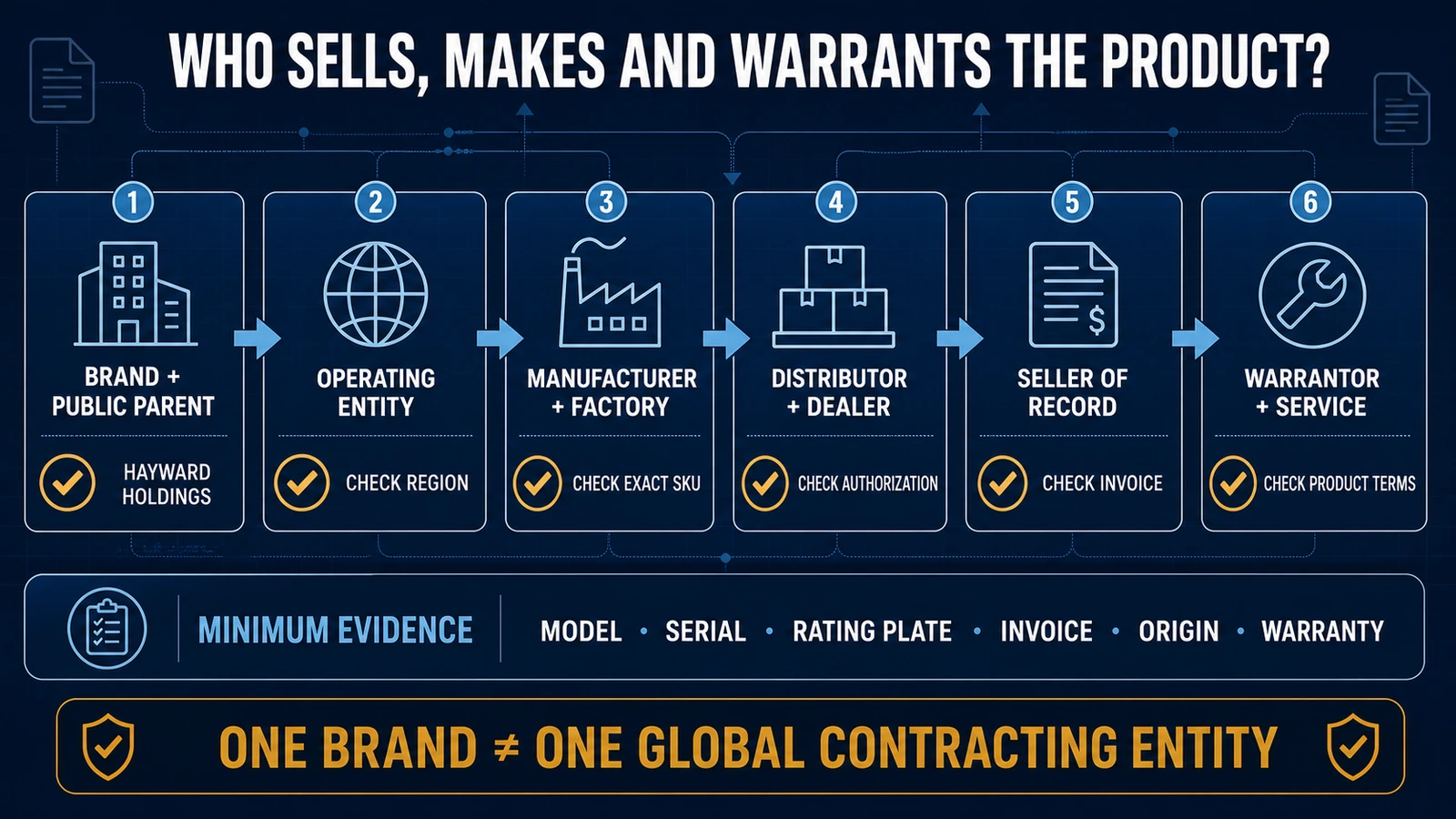
The Minimum Warranty Check
Before purchase, obtain:
- the complete warranty document for the exact model;
- the warrantor’s full legal name and address;
- confirmation that the seller is authorized for that territory and channel;
- the required proof of purchase and registration steps;
- parts, labor, freight and removal coverage;
- the service-center process;
- serial-number and installation requirements; and
- written treatment of cross-border sales.
For an importer or distributor, the agreement should also state who funds replacements, field labor, reverse logistics, defective-product testing and safety recalls.
A B2B Due-Diligence Checklist for Hayward Buyers
Use this checklist before treating “Hayward” as the answer to every responsibility question.
| Check | Evidence to request | Why it matters |
|---|---|---|
| Public parent | Current 10-K and exchange listing | Confirms group ownership |
| Contracting entity | Quotation, order confirmation and sales terms | Identifies who signs the deal |
| Legal manufacturer | Rating plate, declaration and test report | Connects compliance to a company |
| Factory and origin | Origin certificate and supplier declaration | Supports customs and origin claims |
| Importer of record | Import label and customs documents | Identifies local regulatory responsibility |
| Authorized channel | Territory and dealer authorization | Protects pricing, support and warranty eligibility |
| Seller of record | Commercial invoice | Identifies the buyer’s direct counterparty |
| Warranty entity | Model-specific warranty | Defines contractual product coverage |
| Service capacity | Service-center list, parts SLA and training records | Tests whether support exists in practice |
| Digital responsibility | App terms and privacy notice for connected products | Identifies account and data obligations |
The checklist is especially important for cross-border e-commerce, gray-market inventory, private projects and commercial installations. A genuine branded product can still arrive through a channel that changes the buyer’s warranty or service options.
Is Hayward Owned by Fluidra, Pentair or Maytronics?
No. Hayward Holdings is a separate listed company.
Fluidra is a Spanish-listed pool-equipment group with brands including Zodiac, Jandy and Polaris. See what brands Fluidra owns for that portfolio.
Pentair is another separate public pool-equipment company. Maytronics is the company behind Dolphin pool cleaners; World Clean Biz explains that structure in Who Makes Dolphin Pool Cleaners?.
These companies can compete in pumps, filtration, automation, heating or pool cleaning, but product-category overlap does not establish common ownership.
Frequently Asked Questions
Who owns Hayward Pool Products?
Hayward Pool Products is part of the Hayward group. The ultimate publicly traded parent is Hayward Holdings, Inc., listed on the NYSE under HAYW.
Is Hayward a publicly traded company?
Yes. Hayward Holdings began trading on the New York Stock Exchange on March 12, 2021.
Is BlackRock the owner of Hayward?
BlackRock was the largest disclosed beneficial holder in Hayward’s 2026 proxy at 10.56%. That does not make BlackRock the corporate parent or sole owner. Hayward Holdings is owned by its shareholders collectively.
Is Hayward still owned by private equity?
Hayward had concentrated sponsor ownership around its 2021 IPO. The 2026 proxy’s 5%-plus table instead lists BlackRock, Vanguard and JPMorgan Chase. Current ownership should therefore be described as public share ownership, with any large-holder percentage tied to a date.
What is the difference between Hayward Holdings and Hayward Industries?
Hayward Holdings, Inc. is the listed parent. Hayward’s IPO filing describes Hayward Industries, Inc. as its primary operating subsidiary.
Who manufactures Hayward pool products?
The Hayward group describes itself as a designer and manufacturer. It reported seven manufacturing facilities across the United States, Spain and China at the end of 2025. The legal manufacturer and factory for a specific product must be checked on that model’s documents.
Are all Hayward products made in the USA?
No such blanket claim is supported. Hayward has four reported U.S. manufacturing locations and says more than 3.8 million products were made in U.S. facilities in 2025, but it also reports factories in Spain and China.
Does Hayward own AquaVac?
Hayward’s 2021 IPO announcement listed AquaVac among its brands. For a current AquaVac product, buyers should still verify the exact model, regional seller, manufacturer and warranty documents rather than rely only on the brand relationship.
Who handles Hayward warranty claims?
Follow the exact product and market warranty. A Hayward manual may name a Hayward entity as warrantor while directing customers to the seller or an authorized service center. The responsible entity, coverage and process can vary.
Does buying from an authorized Hayward dealer change ownership?
No. Dealer authorization concerns the sales and service channel. It does not make the dealer the owner of Hayward Holdings or the Hayward brand.
Final Answer
Hayward Pool Products is owned within the Hayward group, with Hayward Holdings, Inc. as the ultimate publicly traded parent. Its shares trade on the NYSE under HAYW and are held by public investors.
For company research, that is the ownership answer. For product procurement, it is only the first layer. Buyers should separately verify the operating entity, legal manufacturer, factory, country of origin, distributor, seller of record and warranty party for the exact model and market.