- Choose LUBA when steep slopes, rough ground, AWD traction and large-lawn output are the primary requirements.
- Choose full-size YUKA when the lawn is moderate terrain and its optional sweeping and mapped dumping workflow replaces separate leaf collection.
- Match the exact generation, area, cutting-height version, navigation system, accessory box and warranty before comparing price.
In this article 14 sections
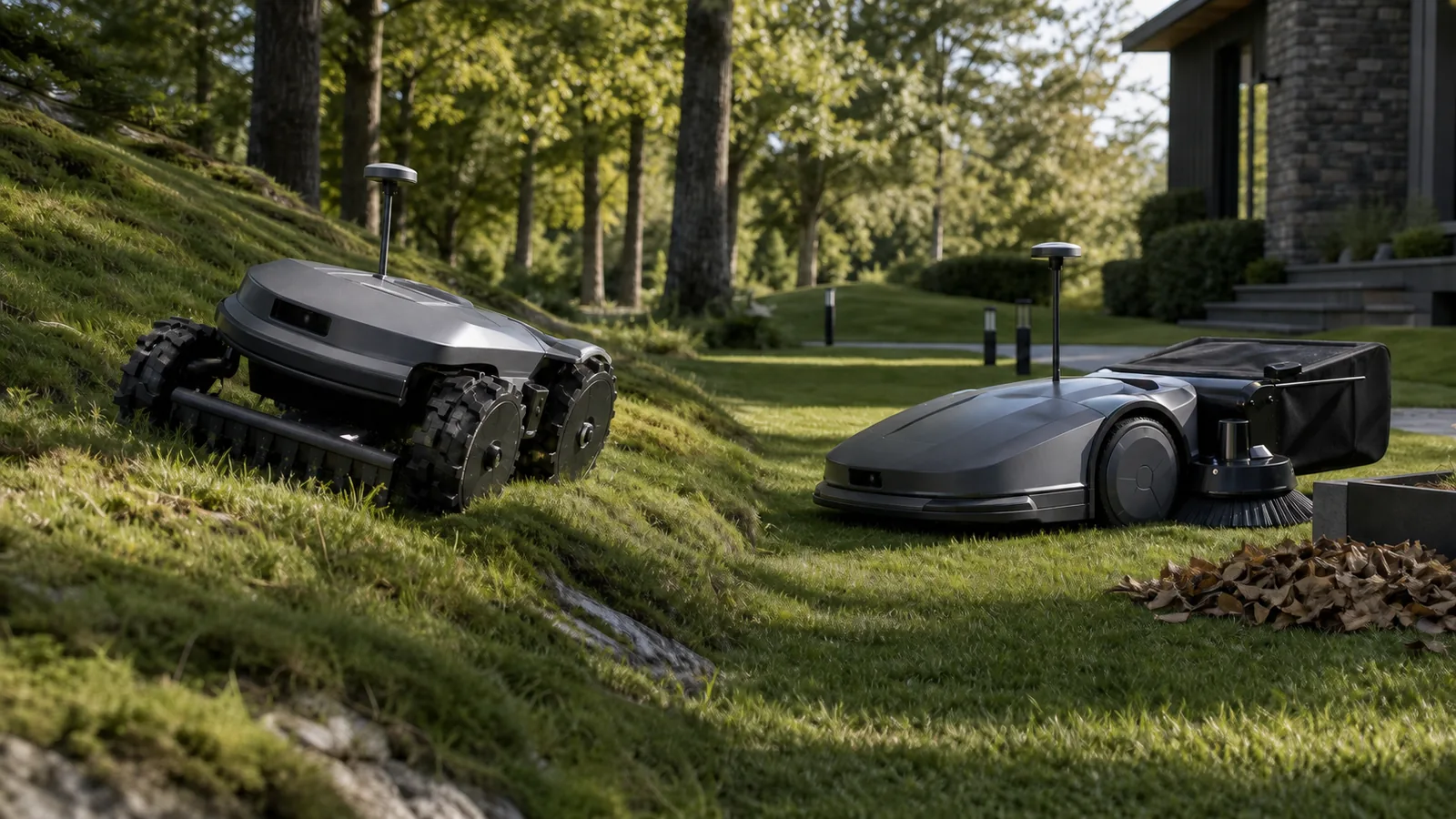
Choose Mammotion LUBA if the property has steep slopes, uneven ground or large multi-zone mowing demands. Choose the full-size YUKA if the lawn is less severe and you want the optional sweeper to collect leaves and grass debris, then unload at mapped points. LUBA is the terrain platform; YUKA is the mowing-plus-collection platform.
The names now cover several generations. LUBA 2 AWD, LUBA 3 AWD and LUBA mini are different products. Full-size YUKA 1000/2000/3000 is also different from YUKA mini and the newer YUKA mini 2. Compare the exact model year, area rating, cutting-height version and navigation hardware.
Quick Comparison
| Decision | Mammotion LUBA | Mammotion YUKA |
|---|---|---|
| Primary job | High-traction mowing on complex terrain | Mowing with optional lawn sweeping and mapped dumping |
| Drive | AWD across the main family | Rear/two-wheel drive on full-size YUKA |
| Headline slope | Up to 80% on current AWD platforms | About 45% on full-size YUKA |
| Cutting route | Wider dual-disc architecture on main large-lawn models | Mowing deck designed to work with optional rear sweeper |
| Navigation | Generation-dependent RTK + vision or LiDAR + NetRTK + vision | Full-size YUKA uses RTK + vision; newer mini products can use LiDAR/vision |
| Lawn fit | Rough, steep and large multi-zone properties | Moderate terrain where leaf/debris collection adds value |
| Ownership risk | Higher platform and tire/drive complexity | Sweeper brush, bag and unloading workflow add maintenance |
Do not compare the highest-capacity LUBA with YUKA mini. The useful comparison is full-size LUBA versus full-size YUKA at similar maintained area.
Current Product Families
LUBA
Mammotion’s 2026 portfolio places LUBA 3 AWD at the flagship end, with configurations spanning roughly 1,500 to 10,000 square metres across markets. It uses a tri-fusion positioning system combining LiDAR, network RTK and vision.
LUBA 2 AWD remains a proven large-lawn platform. The current US product page lists 3000HX, 5000HX and 10000HX variants at 0.75, 1.25 and 2.5 acres. LUBA mini brings AWD to smaller areas, while LUBA mini 2 adds newer vision or LiDAR routes.
YUKA
Full-size YUKA is sold in area-based versions such as 1000, 2000 and 3000 in relevant markets. Its defining option is the quick-attach Sweeper Kit, which collects lawn debris and can unload at user-defined locations.
YUKA mini is a compact mowing family. New YUKA mini 2 models use newer LiDAR or vision systems, but they do not automatically inherit the full-size YUKA sweeper architecture. Treat “YUKA” and “YUKA mini” as separate product decisions.
Lawn Size and Weekly Capacity
Area names are scheduling limits, not single-charge coverage. A mower rated for 3,000 square metres may need several mowing and charging cycles to maintain that area.
Size with:
- actual grass area rather than lot size;
- weekly growth and required cutting frequency;
- number of separated zones;
- travel paths that are not mowed;
- slope and obstacle density;
- rain recovery time;
- whether sweeping is added to the schedule.
LUBA’s wider cutting system and large-battery variants suit properties where output is the priority. YUKA can cover substantial residential lawns, but sweeping adds resistance, weight and extra trips to unloading points.
Reserve capacity instead of buying exactly at the maximum. A mower operating near its rating has less room to recover after rain, rapid spring growth or a firmware-delayed task.
Slopes, AWD and Ground Conditions
LUBA’s core advantage is four-wheel drive. Current LUBA platforms advertise up to an 80% grade, or about 38.6 degrees, under stated conditions. AWD and adaptive chassis hardware improve climbing and recovery on uneven terrain.
Full-size YUKA uses a two-wheel-drive layout and is positioned for less severe ground. Mammotion materials list about 45% slope capability. That is still substantial, but it is not the same terrain class as LUBA.
Maximum grade is not the only test. Inspect:
- lateral travel across a slope;
- turning near the top or bottom;
- wet turf and loose soil;
- holes, roots and low curbs;
- boundary run-out near a road, pool or retaining wall;
- the return route with an attached, partly filled sweeper.
The sweeper changes YUKA’s mass distribution and traction demand. A slope that is acceptable while mowing can behave differently while carrying wet leaves.
Choose a safety margin. A product’s maximum laboratory grade should not become the operating boundary beside a drop.
Cutting Systems and Lawn Finish
Large LUBA models use a broad dual-disc cutting route. The benefit is productive width and overlapping coverage, particularly on open areas. Current US LUBA 2 AWD H variants offer higher cutting settings for North American turf, while S versions cover lower ranges in other configurations.
YUKA’s mower is designed around a more compact body and the rear sweeper interface. Its strength is not maximum mowing width; it is combining routine cutting with debris pickup.
Compare:
- cutting width and blade count;
- minimum and maximum height;
- H versus S version;
- electronic height adjustment;
- edge offset;
- perimeter laps;
- turn style and turf scuffing;
- blade access and replacement cost.
Neither platform removes all string trimming. Walls and raised borders leave an uncut strip determined by blade offset and boundary placement. A flush paved edge produces a cleaner result than a vertical fence.
RTK, Vision and LiDAR
Mammotion’s navigation stack changes by generation.
LUBA 2 AWD uses RTK positioning with UltraSense vision as a complementary route. LUBA 3 adds a tri-fusion system that combines LiDAR, network RTK and vision. Selected LUBA mini products use either RTK/vision or LiDAR/vision.
Full-size YUKA uses RTK and UltraSense vision. The newer YUKA mini 2 can use 360-degree LiDAR and dual-camera vision without a local RTK antenna on the applicable model.
Before purchase, identify the actual positioning dependency:
- local RTK reference station;
- network RTK and its coverage;
- Wi-Fi or 4G route for remote operation;
- vision or LiDAR fallback under trees;
- charging-station and corridor requirements.
“Wire-free” removes buried perimeter wire. It does not remove site planning. Tree canopy, buildings, narrow passages and reference-station placement still determine reliability.
Mapping and Multiple Zones
Both families use the Mammotion app for virtual boundaries, no-go zones, channels, schedules and mowing patterns. The exact number of zones and saved maps varies by model.
LUBA is better suited to a property where zones are connected by rough paths or have different grades. YUKA is attractive when zones also need different sweeping or unloading instructions.
During commissioning:
- map a safe buffer around water and drops;
- test each channel in both directions;
- set separate heights only where the model supports them;
- verify docking after rain and at night;
- store a map backup if available;
- document the RTK or network configuration for future service.
Some 2026 map functions were announced for phased release. Confirm that the required editing or LiveMap feature is active in the installed firmware, not only shown on a product page.
YUKA Sweeper and Self-Emptying Limits
The optional YUKA Sweeper Kit can collect leaves, grass clippings and small twigs. Users can set dumping locations in the map so the mower unloads without returning to a fixed bin.
This does not make YUKA a universal lawn vacuum.
Performance changes with:
- wet versus dry leaves;
- twig length and stiffness;
- bag fill level;
- grass height;
- slope and wheel grip;
- brush wear;
- distance to unloading points.
Wet debris can clump and increase mass. Stones, wire, toys and hard branches should be removed before operation. The bag and roller brush need inspection and cleaning.
The self-emptying claim means the robot tips material at a mapped point. The owner still needs a suitable pile location and must move or process the dumped debris.
App, 4G and Firmware
The Mammotion app controls schedules, maps, remote status and updates. Bluetooth and Wi-Fi cover setup and local control; 4G supports selected remote functions and anti-theft features.
Included cellular terms depend on production year. Mammotion’s current guide distinguishes 2025 LUBA 2 AWD X/YUKA packages from 2026 LUBA 3 and other new models. Do not assume a lifetime data plan from the presence of a 4G module.
Check:
- included data period;
- renewal price;
- whether the module is built in or optional;
- live-video availability;
- operation when cellular service expires;
- app account transfer at resale;
- map restoration after repair.
Firmware remains an ownership factor. Mammotion’s 2026 release notes continue to address slope protection, remote connectivity, obstacle detection and docking. Keep the mower updated, but avoid a major update immediately before a critical mowing window.
Parts, Warranty and Repair
Mammotion’s US support route includes online chat, phone support, manuals and official accessories. Local service-partner availability varies by region.
The published warranty table is generation-specific. It lists LUBA 2 at two years, while LUBA 2 AWD X and YUKA 2025 are listed at three years. Batteries and stations have their own terms. Blades, tires, cutting discs, roller brushes and collection bags are consumables.
Before buying:
- confirm the authorized seller;
- save the invoice and serial number;
- price blades, tires and charging contacts;
- verify whether repair is local or mail-in;
- ask who pays freight outside warranty;
- check turnaround during peak mowing season;
- identify winter-storage instructions.
AWD adds motors, suspension and driven-wheel components. YUKA’s sweeper adds a brush, bag and attachment interface. Both create value, but both add parts that a basic two-wheel mower does not have.
Total Cost of Ownership
Use:
`mower + RTK/network hardware + 4G + blades + tires + battery + repairs + sweeper parts + downtime`
LUBA’s higher purchase price can be justified when it replaces manual mowing on steep or rough ground. Buying it for a flat, simple lawn can mean paying for traction that is rarely used.
YUKA’s sweeper can replace part of a separate leaf-collection routine. Its value is highest when debris is frequent, dry enough to collect and easy to unload. If the sweeper remains stored most of the year, a simpler mower plus occasional manual cleanup can cost less.
For dealers, quote commissioning, map changes, seasonal service and loaner availability separately from the hardware.
Which Should You Buy?
Choose LUBA if:
- the property has steep or uneven terrain;
- AWD traction is more important than debris collection;
- the lawn needs a large-capacity mowing platform;
- multiple zones include rough transport routes.
Choose full-size YUKA if:
- terrain is moderate;
- leaf and clipping pickup has recurring value;
- mapped unloading points are practical;
- the optional sweeper cost and maintenance fit the budget.
Consider a mini model if:
- the lawn is smaller;
- narrow passages matter more than maximum width;
- the newer LiDAR or vision navigation route better fits tree cover;
- sweeping is not a required full-size-platform feature.
For company and platform context, read who makes LUBA robot mowers. Use our robot mower guide for large lawns to size capacity, and the robot lawn mower buying guide for a broader shortlist.
FAQ
Is LUBA better than YUKA?
LUBA is better for steep, rough and large properties. YUKA is better when moderate-terrain mowing plus optional leaf and debris collection is the main requirement.
Can YUKA handle slopes?
Full-size YUKA is rated for meaningful grades, but its two-wheel-drive platform sits below LUBA’s AWD terrain capability. Leave extra margin with wet grass or a loaded sweeper.
Does every YUKA sweep leaves?
No. The full-size YUKA sweeping function depends on the compatible optional Sweeper Kit. YUKA mini specifications and accessories differ.
Does LUBA need an RTK antenna?
It depends on generation and model. LUBA 2 uses an RTK reference route; newer LUBA 3 and selected mini models add network RTK or LiDAR options.
Which is better for a large flat lawn?
Compare area, weekly output and price. LUBA offers width and capacity; YUKA adds sweeping. On flat ground, the decision is productivity versus debris collection rather than traction.
Which has lower maintenance?
Without the sweeper, YUKA has fewer driven-wheel components than an AWD platform. With the sweeper installed, brush and bag care add a separate maintenance route.
Bottom Line
LUBA and YUKA are not two cosmetic versions of the same mower. LUBA spends hardware on traction and terrain. YUKA spends system complexity on collecting what mowing leaves behind.
Choose the job first. For steep ground, buy the AWD margin. For recurring leaf collection on manageable terrain, price the complete YUKA sweeping workflow—not only the mower.
Explore 2026 new models
From brand to model
Specifications, versions & buying considerations
Robot mowersMammotion LUBA 3 AWD 1500 ↗Specifications, versions & buying considerations
Robot mowersMammotion YUKA mini 2 1000 ↗Specifications, versions & buying considerations
Robot mowersDreame A3 AWD Pro 2500 ↗Specifications, versions & buying considerations