- Choose capacity from effective weekly workload, not the largest acreage printed on a product page.
- Charging, transport, signal loss, weather, grass growth and maintenance all reduce productive mowing time.
- Large or operationally critical sites may need several zoned mowers and spare capacity instead of one machine operating at its limit.
In this article 15 sections
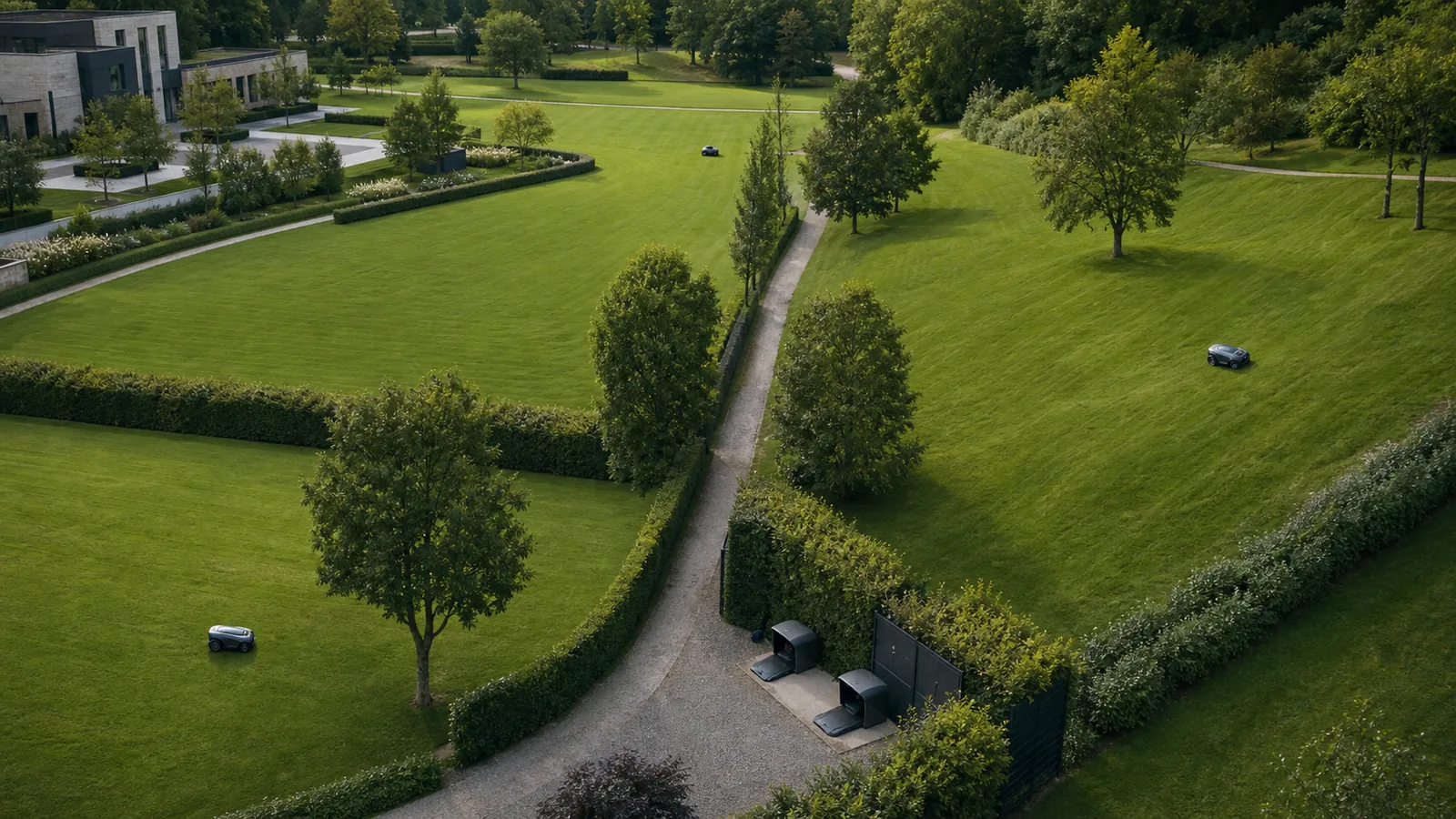
For a large lawn, buy against effective weekly capacity—not the biggest acreage printed on the box. Measure the actual mowable area, define how often it must be maintained, estimate productive time after charging and travel, then add capacity for grass-growth peaks, weather and downtime. A machine rated exactly at the site’s acreage may be undersized if the lawn is steep, fragmented, shaded, wet or unavailable for mowing during much of the day.
For a residential estate, one correctly sized robot may be the simplest answer. For a school, hotel, sports venue, municipality or landscape contractor, several smaller robots can provide better zoning and resilience than one machine running at its limit. The right choice depends on the service level the site must maintain.
The Short Answer
Use this sequence:
- Measure net mowable area, excluding buildings, ponds, beds, hardscape and permanently inaccessible ground.
- Define the required mowing window and turf standard.
- Convert published runtime and charge time into a provisional duty factor.
- Discount for travel, obstacles, signal conditions, slopes, wet grass, weather and maintenance.
- Size the machine or fleet against peak-season workload.
- Keep practical reserve capacity—especially where missed mowing affects customers, events or safety.
Do not treat two products with the same acreage rating as equivalent. One brand may express capacity on a 24-hour cycle, another on a 48-hour cycle, and another as a maximum mapped lawn size. Systematic and irregular mowing also produce different results.
What Counts as a Large Lawn?
There is no universal acreage threshold. A one-acre open rectangle can be easier than a half-acre garden divided by buildings, trees, narrow passages and fenced sections. In this guide, a “large lawn” means a site where capacity, charging, access or downtime can affect the purchasing decision.
The practical size is the workload, not the property boundary:
`net mowable area × required service frequency × site difficulty`
Start with a measured map. Separate:
- open turf from densely obstructed areas;
- primary presentation lawns from low-priority zones;
- slopes from flat ground;
- connected zones from areas that require gates or manual transport;
- safe autonomous routes from roads, water, drops and public circulation;
- areas with clear positioning conditions from tree or building shadow.
A dealer who quotes from the deeded acreage alone has not completed a capacity survey.
Headline Acreage Is a Conditional Number
Official specifications show why the label needs context.
| Current official example | Published area role | Mow / charge figures | Slope figures | Important interpretation |
|---|---|---|---|---|
| Husqvarna Automower 560 EPOS | 1.5 acres on Sports 24; 3 acres on Standard 48 | 150 / 55 minutes typical | 50% inside; 20% boundary | Capacity changes with the allowed mowing cycle |
| Husqvarna Automower 580 EPOS | 2 acres on Sports 24; 4 acres on Standard 48 | 120 / 55 minutes typical | 45% inside; 20% boundary | Commercial fleet product; RS5 reference station required |
| Segway Navimow X3 range | 0.5, 1.0, 1.5 and 2.5-acre recommended tiers | 120–240 / 60–100 minutes by tier | 50% inside; 25% boundary | Compare the exact SKU, not one family headline |
| Mammotion LUBA 3 AWD | 0.37, 0.75 and 1.25-acre tiers | Up to 215 minutes; up to 0.42 acre per charge | Up to 80% family claim | Positioning package and included hardware vary by model |
| Kress RTKn range | Official US page lists products from 0.25 to 7 acres and describes a range extending to 9 acres | Model-specific | Model-specific | Dealer survey, network availability and use case still need verification |
Husqvarna’s capacity support note says its work-area capacity assumes continuous operation seven days a week on flat ground. It also explains that operating time includes cutting, searching and charging, and that layout, grass growth and battery age affect the allocation.
That is a useful principle for every brand: a laboratory-style or standardized headline is a starting point, not a site guarantee.
Calculate Effective Capacity
1. Estimate the basic duty factor
Where a manufacturer publishes typical mowing and charging time, calculate:
`basic duty factor = mowing minutes ÷ (mowing minutes + charging minutes)`
Using official values only as examples:
- 560 EPOS: `150 ÷ (150 + 55) ≈ 73%`
- 580 EPOS: `120 ÷ (120 + 55) ≈ 69%`
- the 2.5-acre X3 tier: `240 ÷ (240 + 100) ≈ 71%`
These are not field-efficiency guarantees. They exclude some combination of route travel, docking attempts, obstacle handling, cleaning, weather, signal interruptions, battery ageing and repairs.
2. Apply a site factor
Use a conservative site factor for the conditions observed during a survey:
`effective productive hours = scheduled hours × basic duty factor × site factor`
The site factor should fall when:
- grass grows quickly or is routinely allowed to become tall;
- the mower crosses long transport paths;
- many trees, beds, furniture or play features increase turning;
- wet turf limits safe operating time;
- slopes cause wheel slip or slower routes;
- satellite, cellular or Wi-Fi conditions are inconsistent;
- gates are closed or public access restricts operating hours;
- staff frequently pause the mower for events or irrigation.
Do not invent one universal discount. Validate it in a commissioning period and adjust the schedule from actual operating logs.
3. Add reserve
For a private lawn, reserve may simply mean choosing the next capacity tier. For a customer-facing or commercial site, reserve should address failure and seasonal peaks.
`required fleet size = peak workload ÷ proven capacity per machine`
Round up, then ask whether one failed mower would make the service level unacceptable. If the answer is yes, add redundancy or maintain a service replacement plan.
An illustrative calculation
Suppose a site offers 84 scheduled hours per week. If the selected mower has a 70% basic duty factor and the surveyed site factor is 75%, the provisional productive window is:
`84 × 0.70 × 0.75 = 44.1 productive hours per week`
This does not tell you how many acres it will maintain. That final step requires a verified productive area rate for the exact mower, cutting pattern, grass and site. The installer should prove that rate during commissioning rather than borrowing it from an unrelated model.
Charging Can Decide the Project
Battery capacity alone does not determine throughput. Charging current, thermal management, docking reliability and the ratio of mow time to charge time matter more to daily capacity.
Check:
- typical mowing time and charging time for the exact SKU;
- whether the published runtime uses the same cutting load and speed expected on site;
- charging-station location, drainage and shade;
- cable length, electrical protection and surge risk;
- docking approach on wet or sloped ground;
- whether one station can be repositioned or is dedicated to a zone;
- battery replacement route, price and expected availability;
- performance after several seasons, not only when new.
A station placed far from the work area creates nonproductive transport. A station in a signal shadow can create repeated docking or departure failures. On a fleet site, power and station placement should be designed before the final mower count is approved.
Slopes: Separate Four Different Questions
A single maximum slope number is not enough. Ask separately about:
- Working-area slope: the grade the mower may traverse while cutting.
- Boundary slope: the grade permitted near the edge; official limits are often lower.
- Cross-slope behavior: side-hill tracking can differ from climbing directly up or down.
- Wet traction and stopping distance: a mower that climbs dry turf may slide on wet grass.
For example, the current 560 EPOS specifications publish 50% inside the installation but 20% at the boundary. Navimow’s X3 specifications publish 50% inside and 25% at the boundary. Those distinctions matter near ponds, retaining walls, roads and drop-offs.
An 80% family claim for an AWD product should not be copied into a site plan without confirming the exact model, direction of travel, surface, boundary setback and safety instructions. Measure the steepest repeatable route, not the average lawn grade.
Where a slope ends at a hazard, use physical risk controls. Obstacle detection and app mapping do not replace barriers, drainage and a safe setback.
Navigation and Signal Conditions
Large properties magnify navigation weaknesses because they contain more tree cover, buildings, courtyards and long transport paths.
RTK or satellite-led systems
Verify:
- sky visibility across every work and transport area;
- local reference-station placement or network RTK coverage;
- correction-service, cellular or subscription dependencies;
- operation beside tall walls, dense canopy and narrow passages;
- what happens when positioning confidence falls;
- whether the charging station and maintenance point remain reachable.
LiDAR and vision-assisted systems
Verify:
- detection range and usable reference features in open fields;
- low-light, glare, rain and dirty-sensor behavior;
- seasonal change when hedges, furniture or parked vehicles move;
- how the system transitions between sensor modes;
- camera-data and remote-view policies where privacy matters.
Hybrid sensing can improve continuity, but it does not remove the need for a mapped site test. Read the RTK vs LiDAR robot lawn mower guide before choosing the installation architecture.
Multiple Zones and Transport Paths
Count zones by operational separation, not by how many polygons the app can store.
A zone becomes operationally separate when:
- a locked gate can block access;
- the route crosses a driveway, public path or road;
- the mower must pass through gravel, steps or an unsuitable surface;
- irrigation or event schedules differ;
- grass type and cutting height differ;
- the positioning system changes quality between areas.
Virtual transport paths are useful, but travel time still consumes capacity. For a campus or estate, record each path’s distance, width, surface, slope and access control. Confirm whether the mower can travel the path autonomously and safely under the manufacturer’s instructions.
One Large Robot or Several Smaller Robots?
One larger robot is attractive when:
- the lawn is open and connected;
- one charging location serves it efficiently;
- the machine can operate for long windows;
- a brief outage is acceptable;
- the local service provider stocks critical parts or loan units.
Benefits include simpler mapping, fewer chargers and less fleet administration.
Several robots are stronger when:
- zones are physically separated;
- turf standards or schedules differ;
- the site must remain partly operational during service;
- transport paths are long or risky;
- the operator wants maintenance without stopping the whole property;
- seasonal workload can be redistributed between zones.
The drawbacks are more charging infrastructure, more devices to inspect, additional connectivity and potentially higher spare-parts inventory.
For commercial work, define an N+1 policy: can the remaining fleet absorb one machine’s workload during repair? If not, negotiate a loan mower, on-site spare or response-time commitment. The commercial robotic lawn mower guide covers fleet and ROI planning in more detail.
Installation and Commissioning
A large-lawn project should have a written acceptance test.
Before installation
- obtain an accurate net-area map;
- mark hazards, slopes, trees, shadow zones, gates and transport paths;
- confirm electrical and network requirements;
- document reference stations, antennas, subscriptions and included hardware;
- agree mowing hours, noise limits and public-access rules;
- define who maintains edges the robot cannot finish.
During commissioning
- test every zone and transport path;
- run in the worst credible signal area;
- check docking from multiple zones;
- record cutting and charging time over several cycles;
- test slope routes in realistic moisture conditions without creating a hazard;
- confirm stay-out zones and boundary setbacks;
- train staff on stops, alarms, cleaning, blade changes and recovery.
Acceptance evidence
Request:
- mapped area by zone;
- actual productive hours and completed area;
- exception and intervention log;
- firmware, app and account ownership;
- model, serial number and accessory list;
- spare-blade, wheel and battery availability;
- warranty use classification and service contact;
- recovery plan if positioning, connectivity or charging fails.
Do not sign off merely because the mower completed one dry-day demonstration.
Maintenance and Downtime
Large lawns accumulate blade hours, wheel contamination and charging cycles quickly. Include:
- blade inspection and replacement frequency;
- underside and wheel cleaning;
- sensor and charging-contact cleaning;
- station and cable inspection;
- winter storage or off-season battery care;
- firmware and map-change control;
- battery health monitoring;
- spare-part lead times;
- who diagnoses a fault and who pays transport.
Warranty terms may differ between residential and commercial use. Kress, for example, publishes different coverage by product segment and use on its US warranty page. Verify the exact country, model, sales channel and operating use in writing.
For total ownership cost, combine this capacity analysis with the robot lawn mower cost, installation and maintenance guide.
Dealer Site-Survey and RFQ Checklist
Ask every bidder to answer the same questions:
- What is the measured net mowable area by zone?
- Which exact model and capacity definition are quoted?
- What scheduled operating window is assumed?
- What mow/charge duty factor and site reduction are used?
- How are slopes, wet traction and hazardous boundaries controlled?
- Which areas have been checked for satellite, RTK, cellular, Wi-Fi, LiDAR or vision limits?
- How much non-cutting transport is included?
- Is the proposal one mower or a fleet, and what happens if one unit fails?
- Which charging, positioning and connectivity hardware is included?
- Who commissions, trains, repairs and supplies parts?
- Does the warranty cover the intended residential or commercial use?
- What measurable acceptance test proves capacity?
The quote should separate equipment, installation, mapping, electrical work, connectivity, accessories, subscriptions, training, maintenance and reserve equipment.
Common Sizing Mistakes
- Buying exactly to the headline maximum acreage.
- Measuring the property instead of the mowable turf.
- Ignoring charging and transport time.
- Comparing a 24-hour capacity with a 48-hour capacity.
- Applying an inside-slope maximum to a hazardous boundary.
- Assuming AWD solves wet traction, rutting or poor drainage.
- Assuming virtual boundaries remove every physical safety control.
- Expecting one robot to pass through gates that staff often close.
- Leaving no capacity for fast spring growth or rain delays.
- Treating residential warranty and commercial fleet use as identical.
- Buying from a seller without a credible repair and replacement route.
FAQ
How many acres can a robot lawn mower handle?
Current official product ranges include residential and commercial models from fractions of an acre to several acres. The usable figure depends on the exact model, capacity definition, mowing window and site. Do not choose from the family maximum alone.
Should I oversize a robot mower?
Usually, yes. Oversizing creates room for charging, weather, faster grass growth and restricted operating hours. The amount of reserve should reflect the site’s operational risk rather than a universal percentage.
Is one robot enough for two acres?
It can be if a current model’s verified capacity, signal conditions, slopes and allowed schedule fit the property. A fragmented two-acre site may need more capacity or multiple machines than an open two-acre field.
Are two small robot mowers better than one large mower?
They can be better for separated zones and uptime, but they require more chargers, administration and maintenance. Compare total installed capacity and failure resilience, not just purchase price.
Does a larger battery mean more acres?
Not by itself. Cutting width, route pattern, speed, grass load, docking, charge time and allowed operating hours all affect coverage.
Can a robot mower handle steep large lawns?
Some models publish high slope limits, but the inside-work-area limit may differ from the boundary limit. Cross-slopes, wet turf and nearby hazards need a site-specific test and conservative physical controls.
Do large lawns require RTK?
Not always, but virtual-boundary large-lawn systems commonly use RTK, network corrections, reference stations or multi-sensor positioning. The property must be checked for coverage, sky visibility and failure behavior.
What should a commercial buyer require before acceptance?
Require a zone map, measured operating results, charging and intervention logs, safety boundary checks, staff training, parts and service commitments, and a documented downtime plan.
Final Recommendation
The best robot lawn mower for a large lawn is the one that proves enough effective capacity on the actual site. Shortlist exact models by area and terrain, then make the installer show how charging, transport, signals, weather, service and reserve were included.
For a straightforward private estate, that may mean one oversized machine with a dependable service route. For a large or critical commercial property, it may mean several zoned robots, central fleet monitoring and a defined spare-capacity plan. In both cases, the purchasing decision should end with a measured commissioning test—not a headline acreage claim.