- Ready-to-fly drones opened DJI's market to people who wanted aerial footage without assembling an aircraft.
- Handheld cameras brought DJI customers who had no need for a drone.
- Reported 2025 sales above RMB 80 billion cover the whole company; its cleaning products must earn their place through everyday performance.
Frank Wang, known in Chinese as Wang Tao, began with a problem that had frustrated him since his teens: radio-controlled helicopters were too difficult to fly.
In a 2026 interview with LatePost, he recalled receiving one from his parents in high school, then spending a year or two struggling to get it flying properly because of assembly and component problems. Later, at the Hong Kong University of Science and Technology, he worked with classmates on a flight-control system. DJI was founded in 2006. He wanted to build an aircraft that could hover steadily and be easy to control. LatePost interview with Frank Wang
Twenty years later, many people buying DJI products have no need to make anything fly. They put a Pocket camera in a pocket and head out to record a trip, a visit to a restaurant or their children's everyday lives. Their relationship with DJI begins with a camera.
As its customers expanded from model-aircraft enthusiasts to ordinary filmmakers, and then to people with no interest in aerial photography, DJI's business took on new forms. LatePost reported in April 2026 that DJI's 2025 sales exceeded RMB 80 billion. That is a media-reported figure, rather than a publicly released, audited annual financial statement from the company. LatePost
The figure covers the whole company, including agricultural and enterprise applications; it cannot all be attributed to consumer imaging. But following the path from drones to handheld cameras reveals one way DJI grew: turning tasks that once required specialist skills into products more people could buy and use.
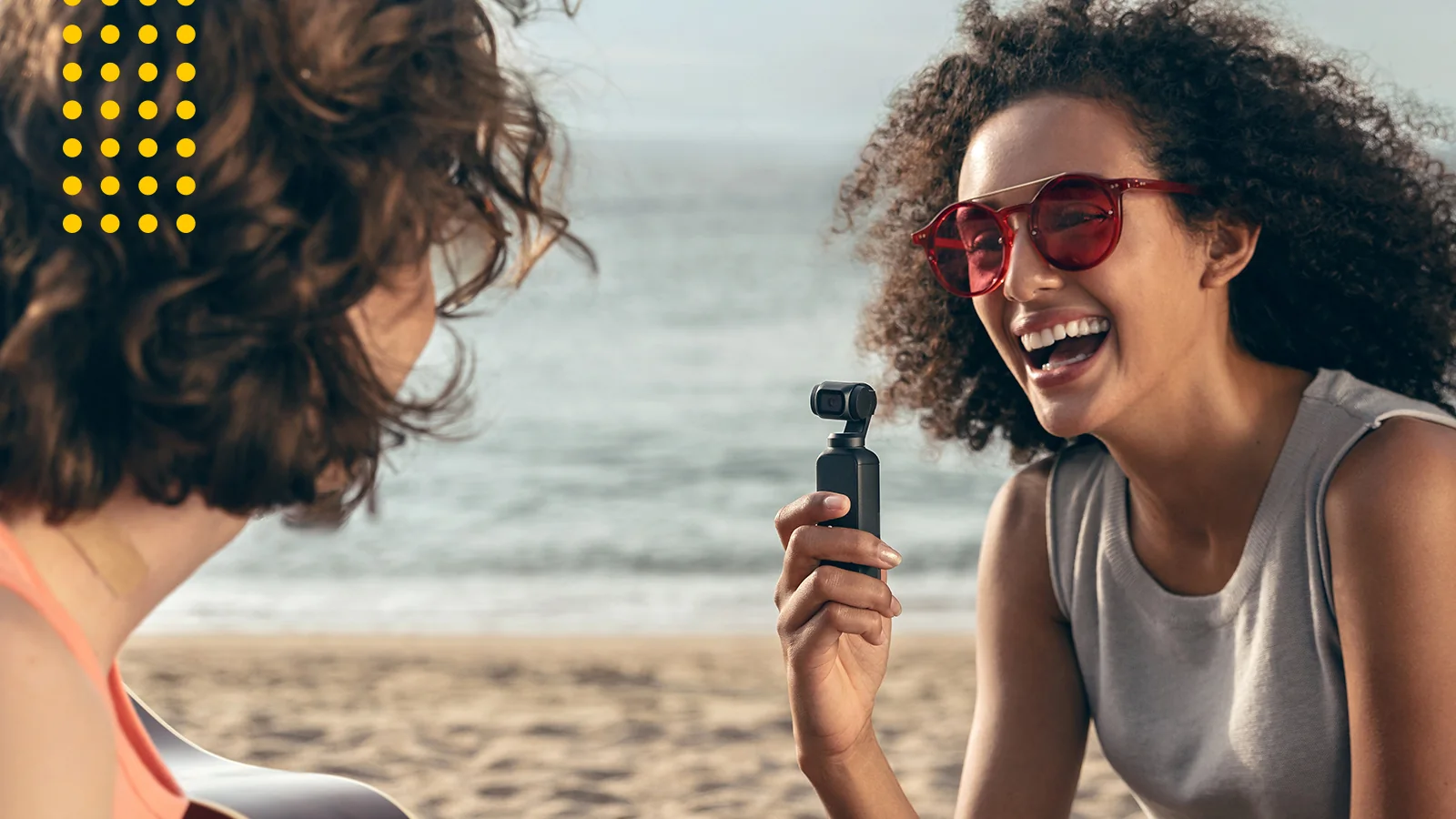
*Cover photograph: DJI. The original Osmo Pocket in everyday use; the camera pictured is not the later Pocket 3.*
Its early flight controllers were a long way from that kind of product.
A flight controller acts as an aircraft's brain, adjusting its flight in response to sensor readings and the operator's commands. Buying one still left users to assemble the frame, motors, battery and radio equipment, configure the system and learn to operate it. People willing to spend that time were usually enthusiasts already. The technology could find buyers, but they belonged to a specialist community. DJI's developers look back
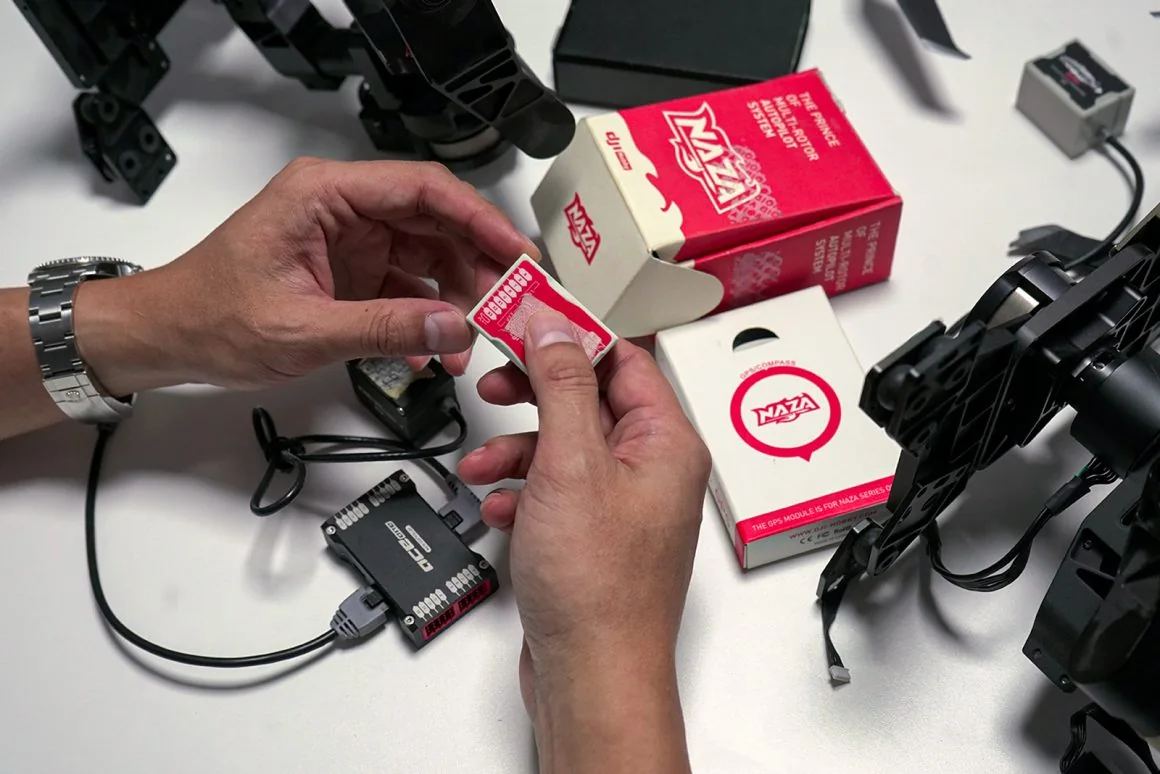
*DJI's retrospective shows NAZA flight-control components alongside an aircraft frame. Photograph: DJI. This is not a photograph of Wang's graduation project.*
Wang did not see the larger market immediately. He later recalled that DJI was initially skeptical of multirotor aircraft because of their limited payload and short flight time. Only when a partner in New Zealand told him that the vast majority of the gimbals it sold were being fitted to multirotors for aerial filming did he recognize the larger opportunity. LatePost interview
That discovery changed whom the product needed to serve. Model-aircraft enthusiasts enjoyed studying and flying their machines. Filmmakers wanted an aircraft to help them get a shot. For the latter group, assembly and setup were extra burdens to overcome before filming could begin.
In January 2013, DJI introduced the Phantom. Launched in the United States at $679, the quadcopter came with a preconfigured flight-control system, GPS positioning, a return-home function if the control signal was lost, and a mount for a GoPro camera. It brought much of the assembly work previously left to users into the factory, helping turn the drone into a more approachable consumer product. Phantom launch announcement
Someone could now buy a drone because they wanted to film buildings, weddings or a holiday. They did not first have to develop a deep interest in aircraft or become an enthusiast who assembled their own equipment. DJI gained new customers, but those customers brought a new requirement: once the aircraft was airborne, could it capture what they wanted?
The original Phantom provided somewhere to mount a camera without delivering the complete filming experience. Tilting and vibration affected the footage. Users of early externally mounted cameras might also have to start recording before takeoff and wait until the aircraft returned to discover what they had captured. To a filmmaker, stable flight, a clear image and the ability to see the framing in real time were inseparable parts of one task.
DJI gradually integrated the gimbal, camera and live image display. By the Phantom 2 Vision+, users had an onboard three-axis gimbal camera and could see its footage through a mobile app. Buying an aircraft increasingly meant buying an aerial-imaging tool that was ready to work. DJI's development history
To me, this was a decisive change: DJI began taking responsibility for the system integration that users had previously performed themselves. Consumers no longer had to select separate pieces of equipment and work out how to make them cooperate. The company had more problems to solve, and its products could reach a wider audience.
One capability developed for aerial filming then took it to another group of customers.
A gimbal stabilizes footage by controlling the camera's orientation. An aircraft needs that while moving; someone walking with a camera has a similar need. In 2015, DJI introduced the Osmo, mounting a stabilized gimbal and camera on a handle. Consumers could use DJI's imaging technology without having anything to do with a drone. Osmo launch announcement
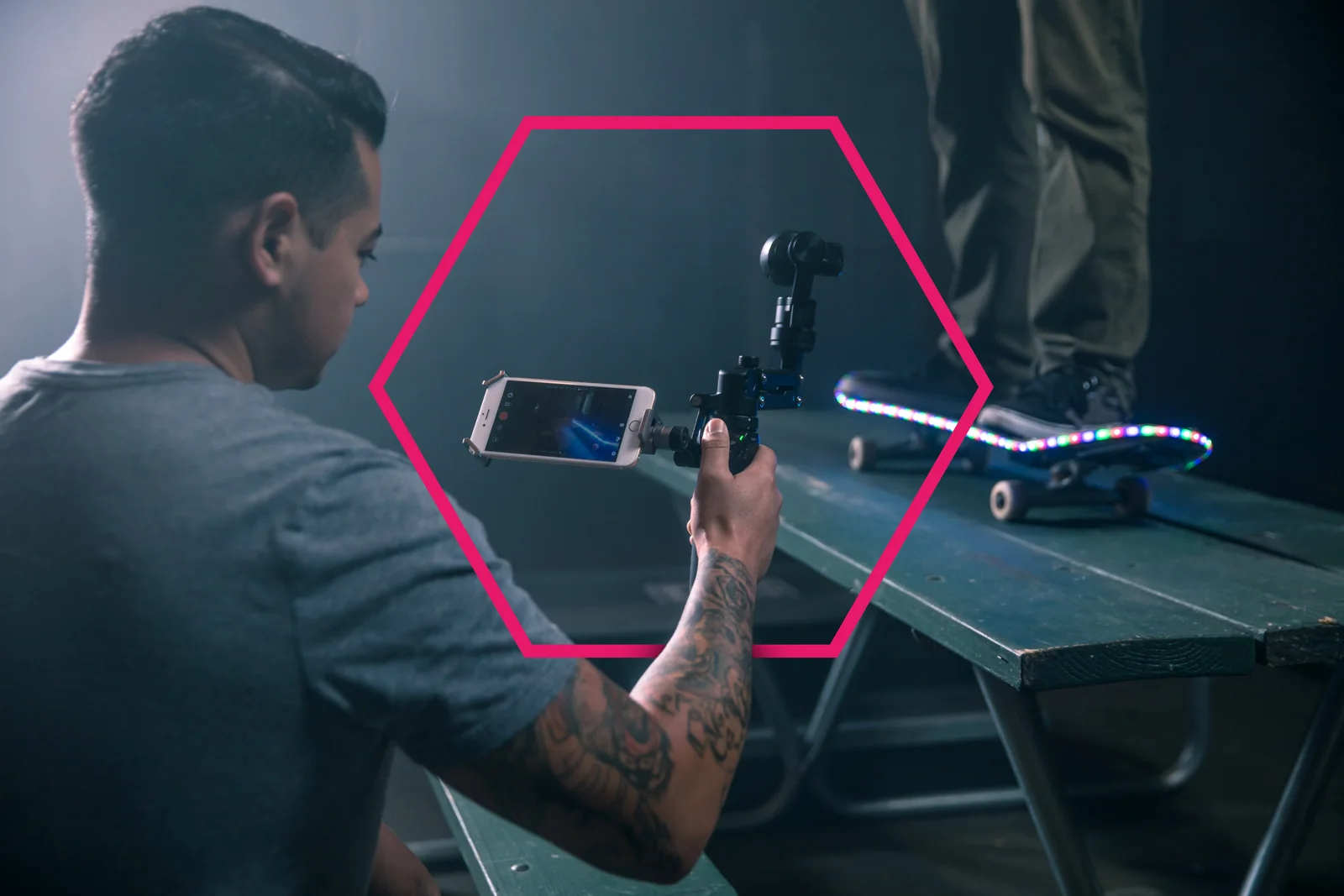
*The original Osmo brings gimbal stabilization to handheld filming. Official DJI image, including its original graphic treatment.*
Stable footage alone, however, was not enough to persuade ordinary people to carry the device every day. Professionals could take another piece of equipment to work; casual users could easily leave a camera at home because of its size, weight or the steps needed to get it ready. Reaching a larger handheld-imaging market required reducing the burden of carrying and using the equipment.
DJI's designers tried a box-shaped pocket-camera concept, but its size and usability were unsatisfactory. They continued making the product smaller and added a screen and buttons so it could work independently of a phone. The first Osmo Pocket arrived in 2018. It was competing for a place in a user's clothing pocket, beyond the camera bag. Interview with the Osmo Pocket design team
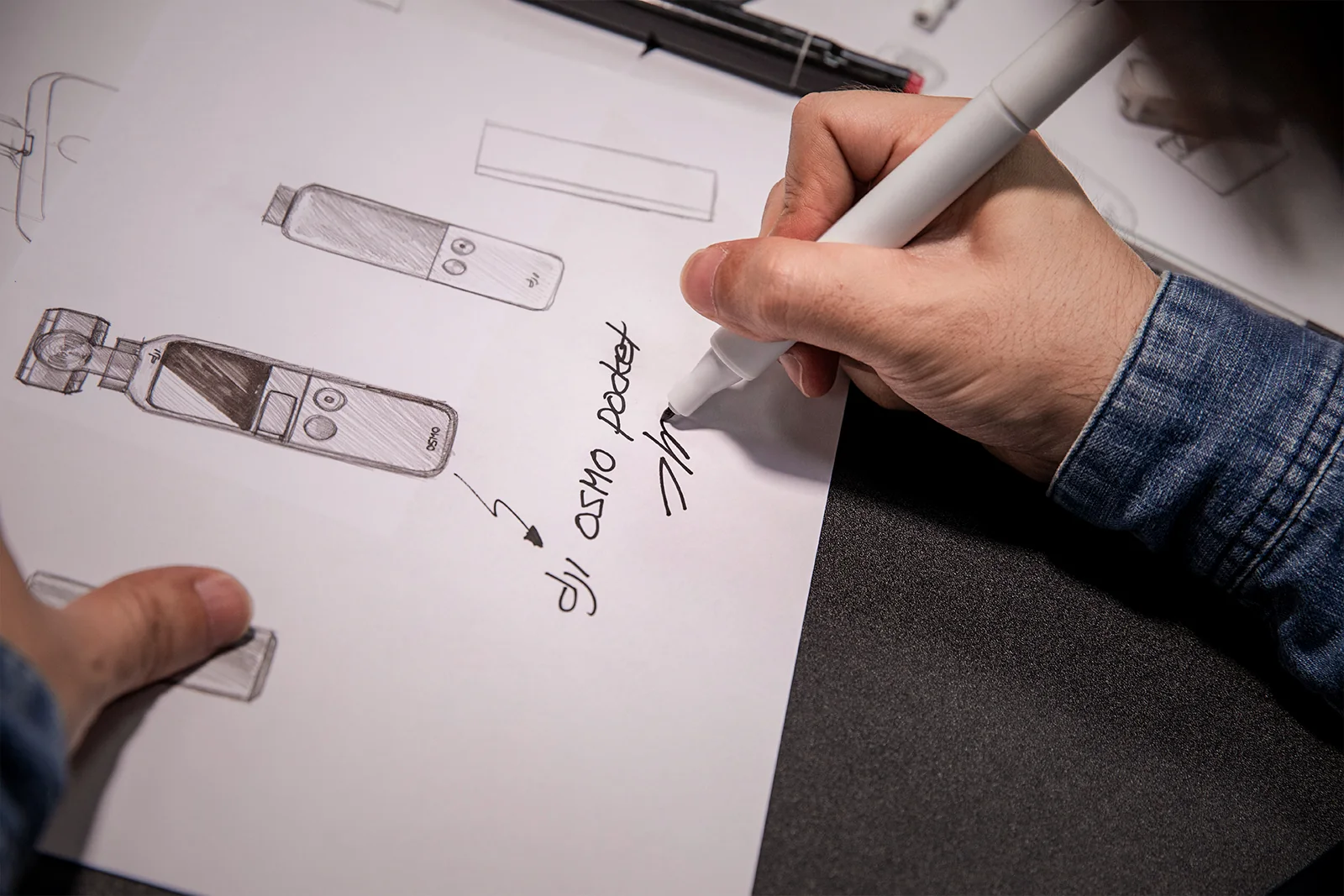
*Design sketches published with DJI's interview about the original Osmo Pocket. Photograph: DJI. These are not Pocket 3 designs.*
The commercial significance was practical: the easier a device was to carry, the more likely it was to be used for spontaneous, everyday filming. Consumers no longer needed to plan a photography outing to have a reason to take a camera with them.
The Pocket 3, introduced in 2023, continued improving around those situations. A one-inch sensor improved imaging capabilities, a rotating touchscreen made it easier to switch between horizontal and vertical shooting, and subject tracking helped solo users stay in frame. These features served someone traveling alone, walking and talking to the camera, or trying to film without another person behind it. Pocket 3 launch announcement
By this point, DJI no longer had to wait for consumers to develop a need for aerial footage. Someone who had never considered buying a drone could walk into its store because they wanted better everyday videos. Gimbal and imaging technologies found further uses, while the reason for buying the product had changed.
That does not mean one strong technology provides an endless route into new markets. Each expansion requires DJI to understand how much inconvenience its new users will tolerate: filmmakers do not want to assemble an aircraft, and ordinary users do not want to carry complicated equipment. What technology can solve and what consumers will pay to solve have to meet in a specific product.
ROMO now brings that question into home cleaning. When DJI launched the ROMO 2 globally in September 2026, it continued to emphasize drone-derived perception technology, while also giving prominence to its robotic arm, cleaning decisions and the base station's self-cleaning system. This move brings more unfamiliar user requirements than the transition from aerial to handheld filming did. Once the robot can see obstacles, it still has to deal properly with hair, stains and dirty water. DJI's ROMO 2 announcement
DJI's brand and technology can persuade consumers to try it. Months later, though, they will still open the base station, clean the roller brushes and check for dust along the edges of furniture. For these new customers, the value of the drone technology inside ultimately has to show up in how much housework the machine saves them.