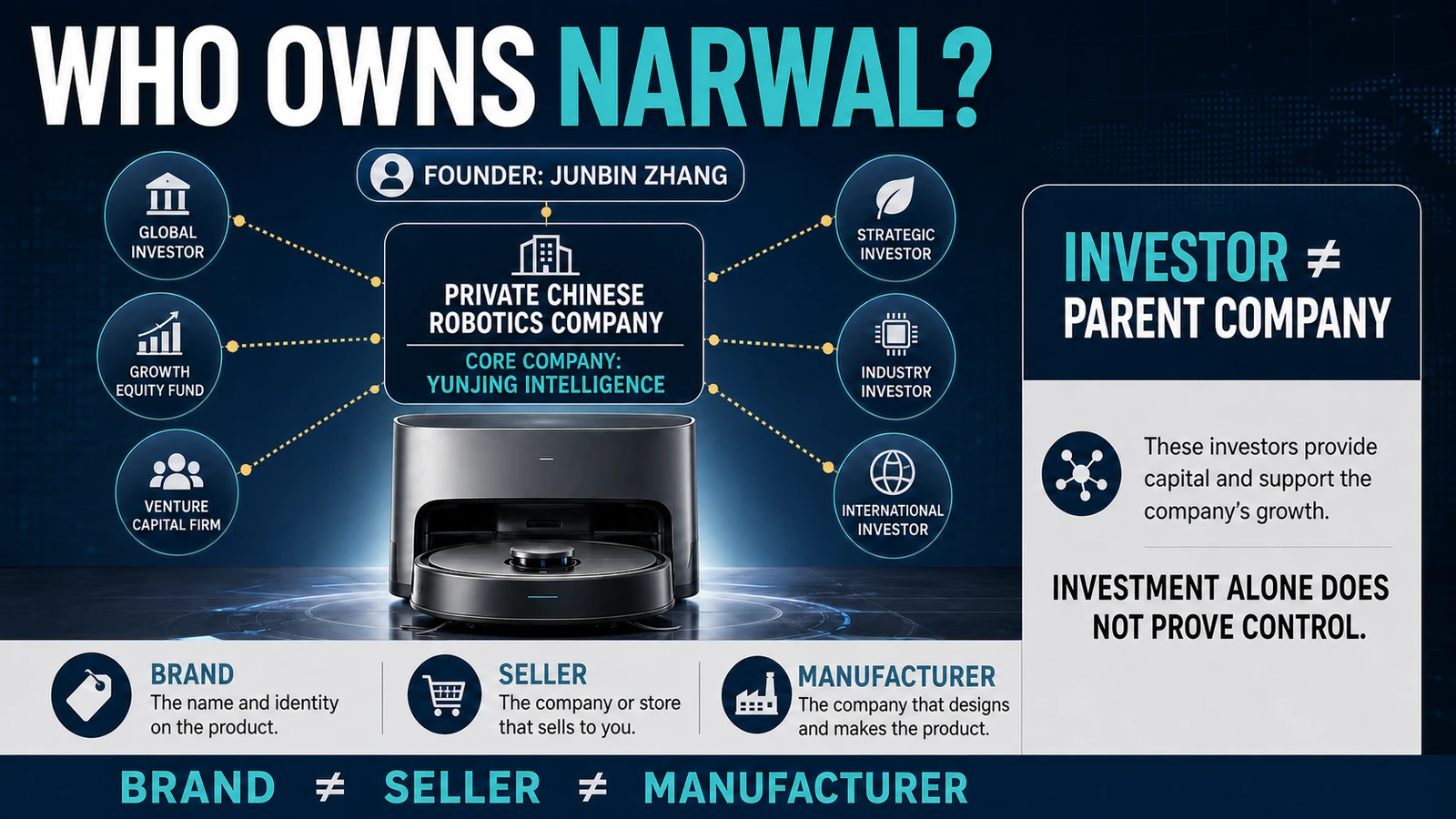
- Narwal is operated by a privately held Chinese robotics group built around Yunjing Intelligence, not by Xiaomi, Roborock or Ecovacs.
- Tencent, ByteDance, HongShan, Hillhouse and other funds have invested in Narwal, but an investment does not by itself identify a parent company or controlling owner.
- Narwal's brand operator, regional seller, legal manufacturer and physical factory can be different entities, so model documents remain essential.
In this article 15 sections
Narwal is a privately held Chinese home-robotics brand operated through the Yunjing Intelligence group. Its founder and CEO is Junbin Zhang, and the company has raised multiple private financing rounds. Publicly reported investors include Tencent, ByteDance, Source Code Capital, HongShan, Hillhouse and government-backed funds.
That does not make Narwal a Tencent brand, a ByteDance subsidiary or part of Xiaomi's ecosystem. It also does not mean every Narwal website, product label and warranty uses the same legal company. The group operates through several entities in Shenzhen, Dongguan, Hong Kong and the United States.
The most accurate answer is therefore not a single company name. Narwal ownership has to be separated into the private company's shareholders, the core operating company, regional sellers, trademark records and model-level manufacturing responsibility.
Narwal Ownership at a Glance
| Name or layer | Verified role | What it does not automatically mean |
|---|---|---|
| Narwal | Consumer brand for home-cleaning robots and appliances | A Xiaomi, Roborock or Ecovacs sub-brand |
| Yunjing Intelligence Innovation (Shenzhen) Co., Ltd. | Core company named in current website policies and product documents | The contract seller in every country |
| Junbin Zhang | Founder and CEO | Publicly disclosed sole owner of the company |
| Tencent, ByteDance, Source Code Capital, HongShan, Hillhouse and other funds | Current or historical outside investors reported in financing records | Each is Narwal's parent company |
| Narwal Robotics Corporation | Delaware company used in the US website's purchase terms | The disclosed ultimate parent of the global group |
| Narwal Trading (Hong Kong) and other affiliates | Parts of the international operating network | The manufacturer of every Narwal model |
| Product manufacturer and production enterprise | Entities named in manuals, labels and compliance documents | Proof that every component was made in one factory |
What Company Owns the Narwal Brand?
Narwal's current global policies and product manuals repeatedly identify Yunjing Intelligence Innovation (Shenzhen) Co., Ltd. as a central company behind the brand.
The company's global privacy policy says that the Shenzhen company and its affiliates operate Narwal's websites, applications and connected devices. Current user manuals identify the same Shenzhen company as the manufacturer and state that Narwal is its trademark. European regional terms also identify it as the website operator.
That makes Yunjing Intelligence Innovation (Shenzhen) the clearest current legal anchor for the brand. It is more precise than using the English marketing name “Narwal Robotics” as though that were one universal parent company.
The wider group contains several related entities. Narwal's official international pages have identified companies including:
- Yunjing Intelligence Innovation (Shenzhen) Co., Ltd.
- Yunjing Information Service (Shenzhen) Co., Ltd.
- Yunjing Intelligence Technology (Dongguan) Co., Ltd.
- Narwal Trading (Hong Kong) Co., Limited
- Narwal Robotics Corporation in Delaware
These names represent operating, data, trading, manufacturing or regional sales functions. A list of affiliates is not a complete ownership chart, and the company has not published a current group diagram showing every entity and percentage.
Who Founded Narwal?
Narwal was founded in 2016 by Junbin Zhang, also written as Zhang Junbin. He remains publicly identified as founder and CEO.
Narwal's early identity was built around a product problem rather than an established appliance group. Its first major breakthrough was a robot that could return to a base station and wash its own mop pads. That concept helped move premium robot vacuums toward automated dock maintenance.
The founder remains central to the company's public strategy. In 2025, Narwal said Zhang would personally lead development of a future home embodied-intelligence product intended to move beyond floor cleaning. Founder leadership, however, is not the same as a verified statement of current beneficial ownership.
Narwal is a private company with multiple financing rounds. Without a current prospectus or a complete official cap table, it would be unsafe to assign Zhang—or any investor—an exact ownership or voting-control percentage.
Is Narwal Owned by Tencent?
No public evidence identifies Tencent as Narwal's parent company. Tencent is a major investor.
In April 2025, Narwal completed a disclosed US$100 million financing led by Tencent Investment and the Beijing Robot Industry Development Investment Fund. Other participants included a science-fiction industry fund and Mingshi Capital. Public corporate-change reporting also identified a Tencent investment entity among Narwal's shareholders.
The distinction matters:
- A financing round confirms an investment.
- A direct shareholder record confirms equity ownership by a named entity.
- Neither fact, without voting and control information, proves that the investor controls the company.
- A “Tencent-backed company” is not automatically a Tencent subsidiary.
Narwal should therefore be described as Tencent-backed, not Tencent-owned.
Is Narwal Owned by ByteDance?
Narwal is not presented as a ByteDance subsidiary either.
A ByteDance investment unit participated in Narwal's earlier financing. Public reporting around Narwal's 2020 rounds also named Source Code Capital, HongShan, Hillhouse, Mingshi, Infore Capital and other investors.
Those rounds created a broad institutional shareholder base. They did not turn the Narwal brand into TikTok, Douyin or ByteDance hardware. The same boundary applies to HongShan and Hillhouse: participation in a private financing round is not equivalent to operating the brand.
Is Narwal Part of Xiaomi, Roborock or Ecovacs?
Narwal's official company materials and disclosed financing history do not identify Xiaomi, Roborock or Ecovacs as its parent.
The brands are often grouped together because they compete in the same Chinese-led robot-vacuum market. That commercial proximity creates three common mistakes:
- Treating every Chinese robot-vacuum startup as a Xiaomi ecosystem company.
- Assuming similar dock functions prove a corporate relationship.
- Confusing shared suppliers with shared ownership.
Roborock is a separately listed company with its own Xiaomi-related shareholder history. Ecovacs is another listed company and the parent behind Tineco. Narwal remains a separate private company.
The early involvement of robotics investors and advisers associated with China's hardware ecosystem also does not make Narwal a DJI subsidiary. Investment, mentoring, supplier overlap and corporate control are different relationships.
Is Narwal Publicly Traded?
Narwal has disclosed preparations for a future listing, but it should not yet be described as a publicly traded company.
The US$100 million round announced in 2025 was followed by reports that the company was starting a Pre-IPO financing process. “Pre-IPO” describes a financing stage or intention; it does not mean shares have begun trading.
As of this article's research cutoff, Narwal has no verified public stock ticker and no completed listing identified in the official sources reviewed. Consumers cannot buy “Narwal stock” through a public exchange in the same way they can buy shares in Roborock or Ecovacs.
That private-company status also explains why Narwal does not publish the same audited annual reports, segment revenue or shareholder tables as a listed competitor.
How Much Revenue Does Narwal Generate?
Narwal does not publish a complete audited financial report for public shareholders, so precise revenue claims require restraint.
Information released around its 2025 financing said that 2024 revenue grew by more than 130% and overseas business grew close to 700%. Those are growth rates attributed to the company and financing participants, not a public annual report with full accounting notes.
The company has disclosed meaningful operating progress. A Shenzhen government report citing IDC said Narwal held 7.5% of global robot-vacuum shipments in the first three quarters of 2025, ranking fifth. A later Shenzhen report said its products served more than five million households and that the company was active in more than 30 countries.
These figures help establish scale, but they do not reveal Narwal's current profit, cash flow or exact revenue. Valuation, funds raised, retail GMV and company revenue should not be treated as interchangeable numbers.
Who Manufactures Narwal Robot Vacuums?
Current official manuals for Narwal products identify Yunjing Intelligence Innovation (Shenzhen) Co., Ltd. as the manufacturer. An older Chinese J2 manual separately named the Shenzhen company's Dongguan branch as the production enterprise.
This is stronger evidence than guessing from the brand's headquarters. It is still not a universal factory answer.
In appliance compliance, several roles may be separated:
| Role | Typical evidence |
|---|---|
| Brand or trademark holder | Trademark register and brand statement |
| Legal manufacturer | User manual, declaration and rating label |
| Production enterprise or assembly plant | Model manual, factory record or audit |
| Importer | Local product label and customs documents |
| Contract seller | Website terms, invoice or marketplace seller page |
| Warranty provider | Regional warranty policy and service documentation |
A manual naming the Shenzhen company as manufacturer does not prove that every component was produced in Shenzhen. A Dongguan production reference for one generation does not prove that every current Narwal robot is assembled at the same site.
Distributors should check the exact model's label, declaration of conformity, importer information and service terms rather than repeating a group-level “made in” claim.
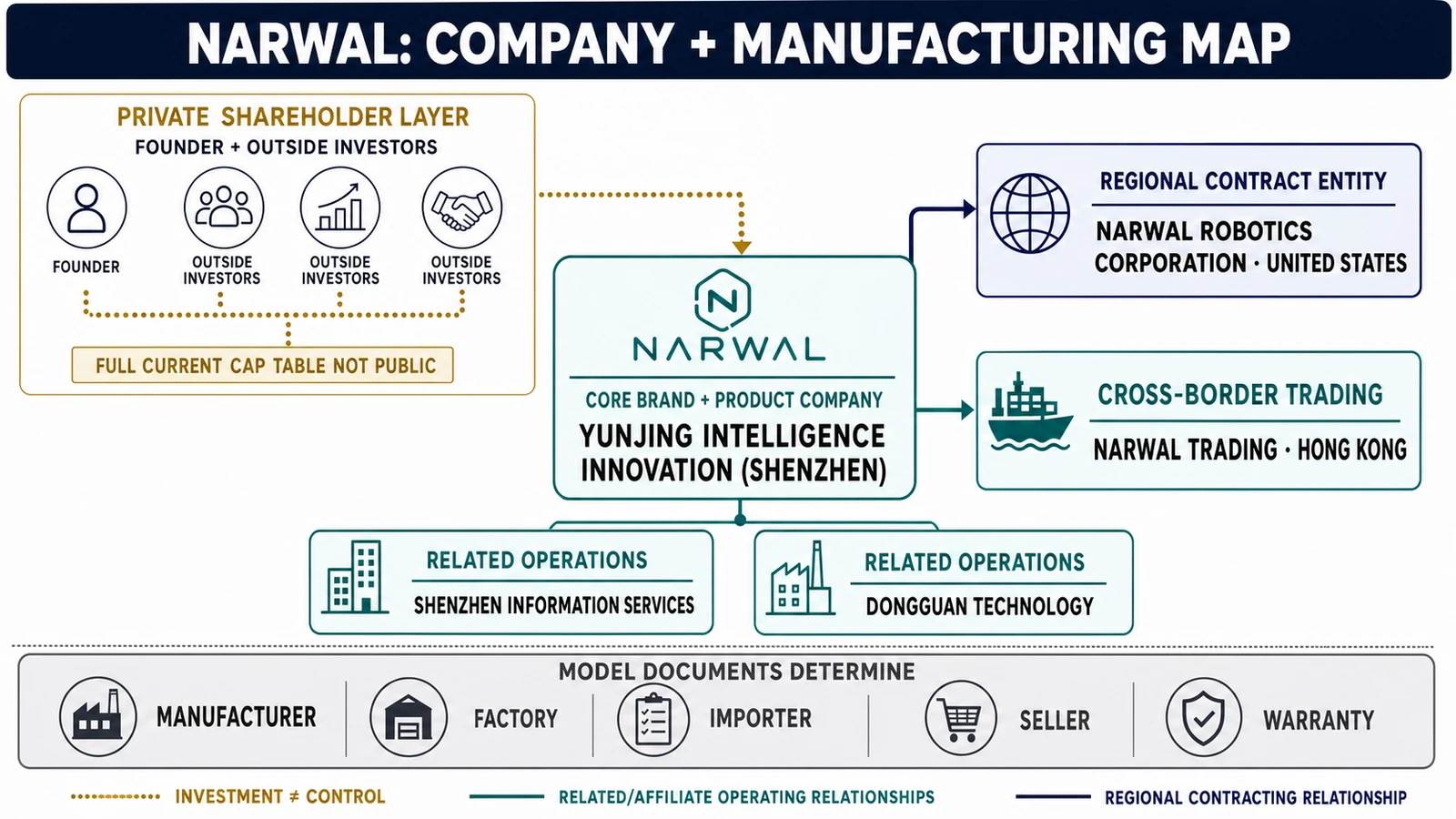
*Narwal's private shareholders, core company, regional entities and model-level manufacturing documents answer different questions.*
Why Does Narwal Use Different Company Names by Region?
International consumer-hardware companies commonly separate brand management, product development, manufacturing, cross-border trading, local sales and data operations.
Narwal's US purchase terms form an agreement with Narwal Robotics Corporation, a Delaware corporation, and its affiliates. Other official regional pages identify the Shenzhen company as website operator, while an Australian contact page lists Hong Kong, Shenzhen and Dongguan entities.
That does not necessarily indicate a contradiction. It shows why a buyer should ask which legal role is being discussed.
For example, the US website seller may handle the transaction and local consumer obligations while a Chinese affiliate is named as manufacturer in the product documentation. The trademark may be registered through another group entity in a particular jurisdiction.
What Products Does Narwal Make Today?
Narwal began with robot mops and robot vacuums, but its product boundary has expanded.
At CES 2026, the company presented 12 products across four cleaning categories: robot vacuums, wet-and-dry floor washers, cordless vacuums and mite-removal appliances. The portfolio shows Narwal moving from one robot format toward a broader home-cleaning brand.
That expansion increases the importance of model-level checks. A robot vacuum, a floor washer and a cordless vacuum carrying the same brand may use different factories, suppliers, certification files and regional service arrangements.
What Buyers, Distributors and Suppliers Should Verify
Before signing a Narwal distribution, sourcing or service agreement, verify:
- The exact contracting company and its registration jurisdiction.
- Whether the counterparty owns the relevant trademark or has written authorization to use it.
- The legal manufacturer and production enterprise for each model.
- The importer of record and product-compliance holder in the target market.
- Who carries warranty, recall, spare-parts and data-protection responsibility.
- Whether sales rights cover the intended country, channel and online marketplace.
- Whether a revenue, shipment or market-share number is audited, company-reported or third-party research.
The Narwal name is useful commercial shorthand. It is not a substitute for the legal documents behind a particular transaction.
Frequently Asked Questions
Who owns Narwal?
Narwal is operated by a privately held Chinese robotics group built around Yunjing Intelligence Innovation (Shenzhen) Co., Ltd. Its complete current beneficial ownership percentages are not publicly disclosed.
Who is the founder of Narwal?
Junbin Zhang founded Narwal and remains its CEO.
Is Narwal owned by Xiaomi?
No official source reviewed identifies Xiaomi as Narwal's parent or owner. Narwal is a separate private company.
Is Narwal a Chinese company?
Yes. Narwal was founded in China, and its core company and product documents identify Yunjing Intelligence Innovation (Shenzhen) Co., Ltd. as a central operating and manufacturing entity.
Is Narwal owned by Tencent?
Tencent is a major investor and co-led Narwal's US$100 million financing in 2025. Public information does not establish Tencent as Narwal's parent company.
Is Narwal owned by ByteDance?
ByteDance invested in Narwal through an investment entity, but Narwal is not presented as a ByteDance subsidiary.
Are Narwal and Roborock the same company?
No. Narwal and Roborock are separate companies and competing robot-vacuum brands.
Is Narwal a publicly traded company?
Not according to the official sources reviewed for this article. Narwal announced Pre-IPO financing activity in 2025 but does not have a verified public stock ticker.
Where are Narwal robot vacuums made?
Official manuals identify a Shenzhen Yunjing company as manufacturer, and an older J2 manual named a Dongguan branch as the production enterprise. The exact model label and compliance documents should determine the responsible manufacturer and production location.
Conclusion
Narwal is an independent, privately held Chinese home-robotics business—not a Xiaomi, Roborock, Ecovacs, Tencent or ByteDance subsidiary.
Its founder remains central, while a wide group of private and government-backed investors has financed the company. Its international operation uses several legal entities, and its product documents separate brand, manufacturer, regional seller and production responsibilities.
That layered answer is more useful than attaching Narwal to the most famous name in its investor list. For commercial decisions, ownership, investment, trademark rights, manufacturing and local liability must be verified separately.
Sources
- Narwal official company introduction
- Narwal US website and purchase terms
- Narwal global privacy policy
- Narwal official product manual naming the manufacturer
- Narwal J2 manual naming the production enterprise
- Narwal Australia contact and affiliate information
- Source Code Capital's Narwal company profile
- Beijing official technology information on Narwal's 2025 financing
- Shenzhen official report on Narwal's 2025 global shipment share
- Shenzhen official report on Narwal's 2026 development