- For planning—not quoting—model an established corded ODM platform at roughly $28–45 factory cost, a differentiated pet/auto platform at $42–70 and a premium heated, steam or battery platform at $70–130+ at meaningful volume.
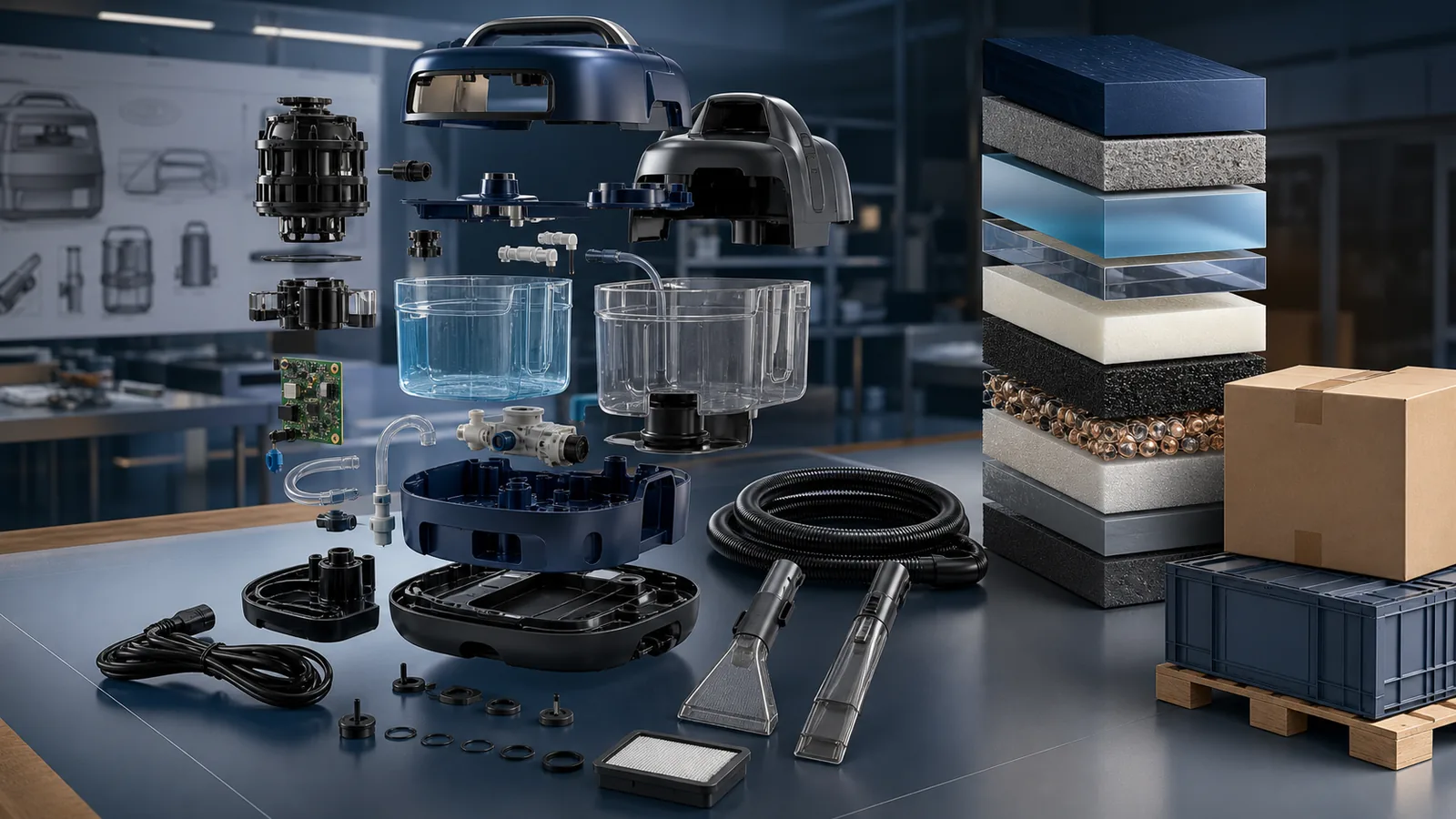
- Motor/fan, pump, tanks, hose and tool system, plastics, compliance, tooling and production yield are the largest cost and risk levers.
- A supplier quote is incomplete until the buyer adds NRE amortization, packaging, inspection, freight, duty, warehouse intake, formula program and warranty reserve.
In this article 13 sections
A practical 2026 planning model is approximately $28–45 factory cost for a basic corded portable spot cleaner on an existing ODM platform, $42–70 for a differentiated pet/auto platform and $70–130 or more for a heated, steam-assisted or battery product at meaningful volume. These are scenario ranges, not live supplier quotes, audited market averages or promised prices.
The warehouse cost can be materially higher after tooling amortization, compliance, packaging, inspection, freight, duty, formula, returns and warranty reserve.
Define the Cost Boundary
| Term | What it normally means |
|---|---|
| BOM | Purchased components and materials |
| Conversion cost | Assembly labor, testing, factory overhead and production loss |
| Factory cost | BOM plus conversion and factory overhead |
| EXW | Finished goods at the factory; buyer handles most logistics |
| FOB | Goods delivered through the named export port under the agreed Incoterm |
| Landed cost | Product plus freight, insurance, tariff/duty, brokerage and arrival charges |
| Warehouse cost | Landed cost plus inspection, labeling, handling and inbound storage |
| Fully loaded economics | Warehouse cost plus warranty, returns, finance, channel and operating costs |
Require every quotation to state currency, tax, Incoterm, port, packaging, accessory set, formula inclusion, MOQ and validity date.
Three Product-Tier Scenarios
Assume an established Asian household-appliance supply chain, an existing or semi-custom platform and annual demand near 10,000 units.
| Tier | Illustrative factory budget | Typical scope |
|---|---|---|
| Basic corded ODM | $28–45 | standard vacuum motor, diaphragm pump, two tanks, basic hose/tool, simple switch |
| Pet/auto differentiated | $42–70 | improved recovery, longer hose, multiple tools, hair handling, better storage and cosmetics |
| Premium platform | $70–130+ | heating or steam, battery, multiple pumps/valves, sensors, display, premium tooling and more compliance work |
Small trial orders, branded components, high cosmetic standards and low yields can push above the range. The ranges exclude retailer margin, VAT/sales tax and marketing.
If a quote is unusually low, inspect what is missing:
- copper and motor specification;
- pump life and pressure stability;
- tank volume and resin;
- hose length and chemical resistance;
- accessory tools;
- cord, plug and strain relief;
- safety and EMC reports;
- retail packaging;
- spare parts;
- warranty reserve;
- normal production yield.
BOM: The Main Cost Drivers
Motor, Fan and Recovery Air Path
The vacuum motor creates airflow and pressure difference for recovery. Cost depends on:
- motor type and input power;
- fan stages and balance;
- bearings and brush life;
- cooling;
- acoustic treatment;
- thermal protection;
- seals and inlet losses.
A higher wattage label does not guarantee more water recovery. Test complete-machine suction, airflow, extraction ratio, noise, thermal rise and blocked-air behavior.
Solution Pump and Fluid Circuit
The pump, tubing, check valves and spray nozzle must deliver stable flow without leaking during storage.
Specify:
- flow and pressure tolerance;
- priming time;
- dry-run limit;
- cycle life;
- detergent and oxidizer compatibility;
- hose-clamp method;
- anti-siphon behavior;
- leakage after shipping vibration;
- frozen-fluid exposure for relevant markets.
Chemical compatibility is a lifecycle cost issue. A low-price tube or seal can swell, crack or lose compression after repeated formula exposure.
Clean and Dirty Tanks
Tank cost is driven by volume, resin, transparency, wall thickness, molding complexity, caps, gaskets and cosmetic acceptance.
Design for:
- easy filling;
- stable placement at a sink;
- readable lines;
- reliable float shutoff;
- one-way dirty-water containment;
- no trapped residue;
- tool-free washing;
- drop resistance when full.
Every additional lid, latch and gasket adds tooling, assembly and leak-test points.
Hose and Hand Tools
The hose is both a user feature and a common field-failure part. Cost rises with:
- length and diameter;
- corrugation and bend life;
- clear versus opaque material;
- fluid and air pathways;
- strain relief;
- swivel;
- onboard storage.
Hand tools add molded parts, clear suction windows, brushes, spray nozzles and seals. A wide tool, crevice tool, pet tool and hose-rinse cap may require several molds and a larger carton.
Test hose flexing, pull force, crushing, leak rate and storage bends. Make the hose replaceable without discarding the entire machine.
Plastics, Structure and Cosmetics
The body must carry two fluid tanks, a motor, pump, cord and hose while remaining stable on stairs and in cars.
Cost levers include:
- resin mass;
- transparent versus colored parts;
- texture and gloss;
- paint or decoration;
- number of screws and clips;
- handle load;
- tank alignment;
- water separation barriers;
- ingress protection around electronics.
Premium gloss can increase rejection and scratch risk without improving cleaning.
Electronics and Cord Set
A basic corded machine may need a switch, wiring, thermal cutoff and pump/motor control. Features such as heating, steam, sensors, LEDs or self-clean programs add:
- PCBA;
- relays or power electronics;
- temperature and water-level sensing;
- firmware;
- abnormal-condition tests;
- EMC filters;
- diagnostics.
For battery platforms, add cells, BMS, charger, pack enclosure, cycle-life validation and lithium transport compliance. The battery changes both BOM and logistics.
Percentage Planning Model
For an early corded platform:
| Subsystem | Planning share of factory cost |
|---|---|
| Vacuum motor, fan and acoustic system | 18–26% |
| Pump, tubing, valves and spray system | 7–13% |
| Tanks, float, lids, caps and seals | 12–18% |
| Hose and cleaning tools | 10–18% |
| Body plastics and mechanical structure | 14–22% |
| Wiring, cord, switch and electronics | 6–12% |
| Assembly, test, overhead and normal loss | 10–18% |
Shares overlap by supplier accounting method. Use them to challenge a quote, not to replace a BOM.
Tooling and Non-Recurring Engineering
An existing ODM exterior can minimize tooling. New visible geometry, tanks and tools can require:
- industrial design;
- mechanical engineering;
- airflow and fluid prototypes;
- injection molds;
- transparent-part polishing;
- jigs and fixtures;
- leak-test stations;
- packaging dies;
- golden samples;
- pilot builds.
Amortize NRE explicitly:
`NRE per unit = total approved non-recurring cost / conservative lifetime volume`
Do not divide tooling by an optimistic forecast. Define mold ownership, storage, maintenance, shot-life and transfer rights in the contract.
Compliance and Market Access
The exact requirements depend on construction, voltage, market and claims.
Common workstreams include:
- electrical safety for household wet-extraction equipment;
- EMC and emissions/immunity;
- material and chemical restrictions;
- cord, plug and flammability requirements;
- label and instruction language;
- battery safety and UN 38.3 transport for cordless products;
- radio approval and cybersecurity if connectivity is added;
- formula labeling, safety data and chemical rules.
The Ecovacs X11 declaration illustrates that cleaning appliances can cite IEC/EN 60335 family requirements, but a spot cleaner’s final standard selection must be made by an accredited lab for its actual design.
Budget pre-compliance engineering before the formal test. A failed abnormal-operation, leakage or EMC test can force a new motor, filter, enclosure or PCBA layout.
Formula and Chemical Compatibility
A branded formula program is a separate commercial system:
- concentrate or ready-to-use format;
- fragrance and allergen policy;
- oxygen chemistry;
- shelf life;
- bottle compatibility;
- transport classification;
- safety data sheets;
- regional label registration;
- recurring margin;
- machine-warranty conditions.
Run accelerated soak and cycle tests on tubing, seals, pump diaphragms, tanks and spray nozzles using every approved formula and foreseeable dilution error.
Do not make stain, disinfection or odor claims without appropriate evidence.
MOQ, Pilot and Yield
Separate:
- sample quantity;
- engineering validation build;
- pilot run;
- first mass production;
- repeat-order MOQ;
- color and packaging MOQ;
- formula MOQ.
Track first-pass yield for:
- tank leakage;
- hose leakage;
- pump priming;
- motor current and noise;
- suction;
- spray pattern;
- electrical safety;
- appearance;
- packaging completeness.
The cheapest supplier quote can become expensive when rework, water leaks and returns are excluded from the initial number.
Packaging and Logistics
Spot cleaners are bulky relative to factory cost. The carton must protect tanks, latches, tools and hose while surviving parcel handling.
Model:
- retail carton;
- molded pulp or foam;
- master carton;
- pallet utilization;
- container utilization;
- dimensional parcel weight;
- drop and vibration tests;
- humidity;
- replacement-carton cost.
A longer hose or wider tool can increase carton dimensions enough to raise freight and e-commerce fees. Review packaging before freezing the industrial design.
Landed-Cost Waterfall
Use:
`factory price`
`+ NRE amortization`
`+ inspection and test`
`+ export handling`
`+ freight and insurance`
`+ tariff/duty and brokerage`
`+ destination charges`
`+ warehouse intake and labeling`
`+ warranty and returns reserve`
`+ formula and spare-parts launch stock`
Tariffs and freight are route- and date-specific. Obtain current advice for the origin, HS classification and destination.
Supplier RFQ Checklist
Request:
- exploded BOM by subsystem;
- motor and pump maker/model;
- verified tank volumes;
- hose length and bend-life report;
- extraction and residue test method;
- noise and thermal data;
- leakage and abnormal-operation tests;
- tool and formula list;
- certifications and report ownership;
- mold list and ownership;
- pilot yield;
- top warranty failure modes;
- spare-part prices;
- packaging dimensions and weight;
- EXW and FOB breakdown;
- lead time and payment terms.
Have the factory clean and dry the product after a realistic pet-soil cycle. Serviceability and odor control should be evaluated before cosmetic approval.
For development sequence, use the spot cleaner OEM and ODM guide. For user requirements, see the portable carpet cleaner buying guide. Compare the structure of another category in our cordless vacuum manufacturing cost guide.
FAQ
How much does a spot cleaner cost to manufacture?
For planning only, an existing corded ODM platform may be roughly $28–45 at meaningful volume, a differentiated pet/auto platform $42–70 and a premium heated, steam or battery product $70–130 or more. Obtain live quotes.
What is the biggest BOM cost?
The motor/fan system is often the largest single subsystem, while tanks, hose/tools and plastics together can represent a larger share.
How much does tooling cost?
It depends on how many tanks, body parts and accessories are new. Ask for an itemized mold list and amortize approved NRE over conservative lifetime volume.
Why is landed cost much higher than the factory quote?
Tooling, inspection, packaging, freight, tariff, brokerage, warehouse handling, formula stock, warranty and returns are outside many factory quotations.
Should a brand choose OEM or ODM?
ODM is faster when an existing platform meets safety and performance needs. Custom OEM development is justified when the new airflow, fluid system, serviceability or user experience creates defendable value.
Sources
- Cleva spot cleaner OEM and ODM manufacturing overview
- UN Manual of Tests and Criteria, lithium battery subsection 38.3 resources
- EU Low Voltage Directive official page
- EU electromagnetic compatibility official page
- Ecovacs declaration example listing household appliance safety standards
Sources were checked on July 26, 2026. Cost, freight, tariffs and compliance requirements require live project quotes.