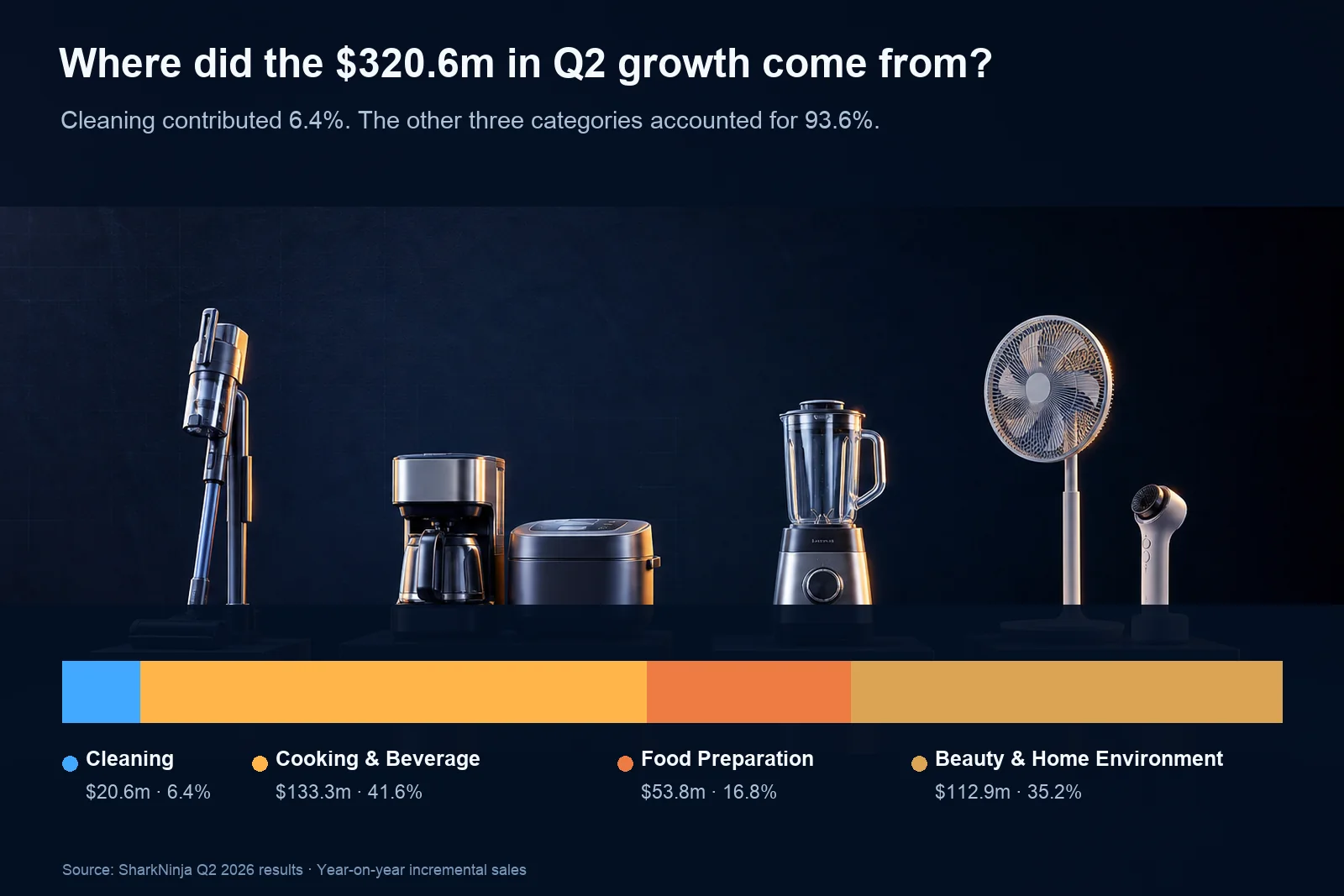
- Cleaning appliances remained SharkNinja's largest category in Q2, but contributed only 6.4% of the company's year-on-year incremental sales.
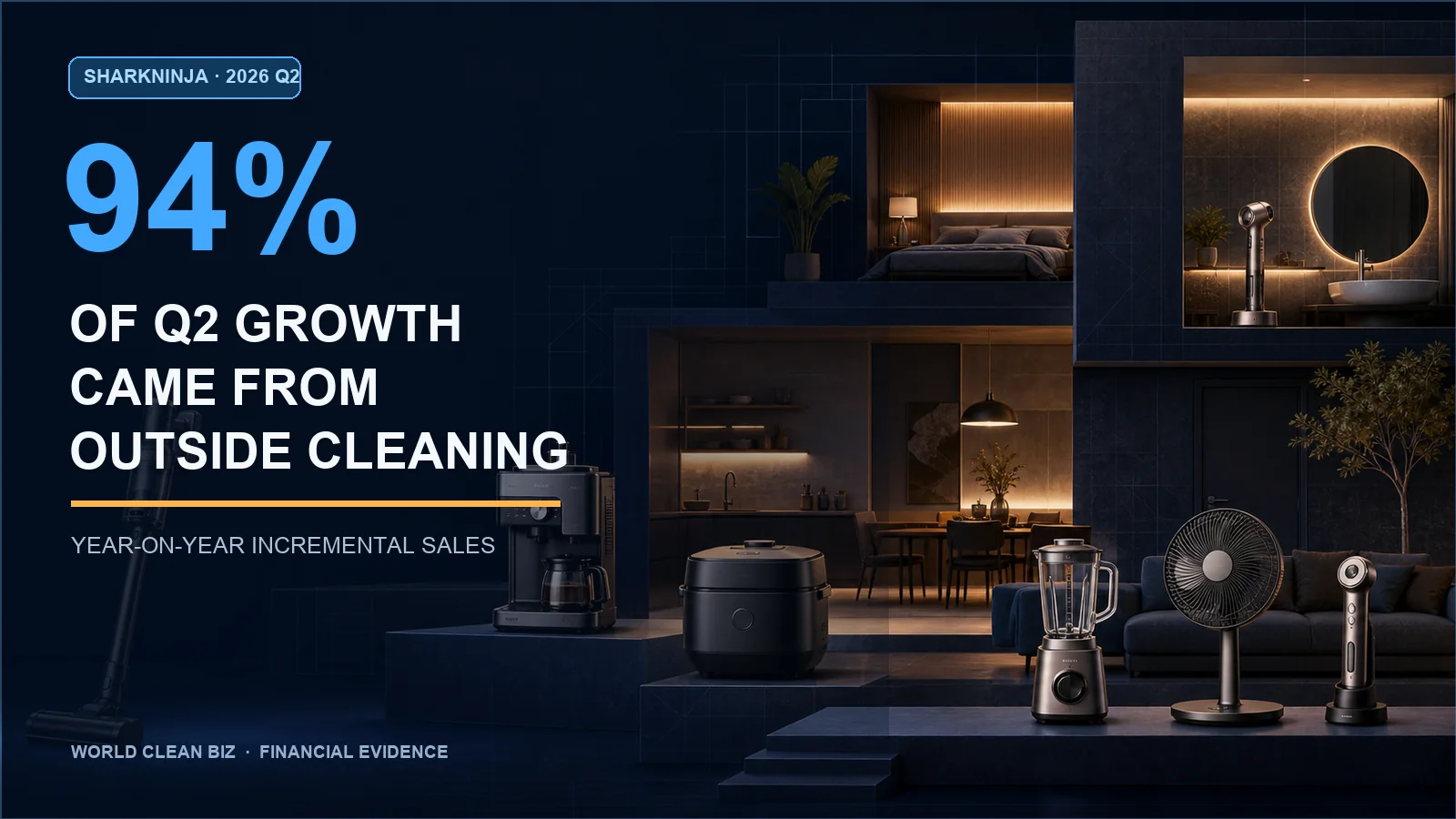
- Cooking and beverage, food preparation, and beauty and home environment appliances generated 93.6% of Q2 growth.
- SharkNinja is evolving from a cleaning-appliance company into a global household-products platform built around repeatable product development, retail execution, and external manufacturing.
SharkNinja's second-quarter sales reached $1.765 billion, up 22.2% year on year. It was the company's fastest quarterly growth rate since 2024.
At first glance, this looked like another chapter in a familiar SharkNinja story: keep launching products, enter more categories, and use retail distribution and marketing to scale them. But the composition of the $320.6 million increase tells a different story. Cleaning appliances added only $20.6 million, or 6.4% of incremental sales. The remaining 93.6% came from cooking and beverage, food preparation, and beauty and home environment appliances.
| Category | Q2 sales | YoY growth | Incremental sales |
|---|---|---|---|
| Cleaning Appliances | $522.0 million | 4.1% | $20.6 million |
| Cooking and Beverage Appliances | $499.0 million | 36.5% | $133.3 million |
| Food Preparation Appliances | $458.6 million | 13.3% | $53.8 million |
| Beauty and Home Environment Appliances | $285.8 million | 65.3% | $112.9 million |
Cleaning remains SharkNinja's largest category. Q2 sales reached $522.0 million, with carpet extractors and cordless vacuums still contributing growth. The 4.1% increase is not a bad result, but it is now far below the group rate. Cleaning represented about 34.5% of SharkNinja's revenue in 2025. In Q2, its share fell below 30%. Cooking and beverage appliances, at $499.0 million, were only $23 million behind. At current growth rates, the order of the two categories could soon change.
This is not a story about Shark vacuums going into decline. Shark still has a strong brand and retail position in North American vacuums, carpet cleaning and floor care. What has changed is that SharkNinja has found businesses that are growing much faster. Cooking and beverage contributed roughly 42% of the quarter's incremental sales, led by the Ninja Luxe Café espresso machine and Ninja Crispi. Food preparation rose 13.3%, mainly through blending, while beauty and home environment grew 65.3% on the continued strength of skincare products and fans.
Those products do not appear to have much in common with a vacuum cleaner. Put them back into SharkNinja's development history, however, and the route becomes clear. Shark first brought the company into North American homes through vacuums, building the brand, retail relationships and supply-chain base. Ninja then took it into kitchens, coffee, frozen drinks and food preparation. Beauty and home environment products opened another set of household occasions.
The shift had already been building. In 2025, Shark generated about $3.032 billion, while Ninja reached roughly $3.367 billion. Ninja was already the larger brand. Q2 now shows that this was not a temporary lift from a few successful kitchen products. The company's revenue structure itself is changing. Cleaning still provides a large and stable base, but kitchens, food preparation and beauty are increasingly setting the growth rate.
Many appliance companies expand by finding an existing product and putting their old brand on it. The SKU count rises, but the company never develops a real ability to enter new categories. SharkNinja has taken a different route. It begins with a consumer problem inside a specific household setting, then brings price, channel, demonstration and product function into the development process together. The US team stays close to consumers and retailers. China-based R&D teams and suppliers turn that definition into a product. Before the product is finished, the company is already asking whether it can be demonstrated in a store, understood in a short video, and accepted by a retail buyer.
That development model first produced vacuums, steam cleaners and carpet extractors. It was later applied to air fryers, blenders, coffee machines, frozen-drink makers, fans and skincare devices. As discussed in our earlier analysis of SharkNinja's hit-product pipeline, the capability being copied is not a particular vacuum technology. It is an organization that moves from consumer demand to R&D, supply chain, retail and marketing as one connected process. That is why SharkNinja does not enter a category merely to fill out a range. It tries to change the product form, price band or way the product is demonstrated.
Once that capability began to travel across categories, SharkNinja also started taking products that had worked in North America into more countries. US and Canadian sales increased 15.5% in Q2, while international sales rose 36.6% to $623.6 million. International markets accounted for about 35% of total sales and more than half of the quarter's increase. SharkNinja has traditionally been strongest at reading North American consumers and working with local retailers. It is now trying to reproduce that system in the UK, continental Europe and Latin America. If international growth continues to run well ahead of North America, geography will become a second expansion engine alongside new categories.
Maintaining this pace is expensive. Sales and marketing expenses reached $441.5 million in Q2, equal to 25% of sales. R&D spending rose 22.3% to $109.3 million. Adjusted gross margin fell 70 basis points, GAAP net income declined 7%, and adjusted net income increased 29.3%. Taken together, the figures show that SharkNinja's growth is not arriving automatically from an established brand. It requires more people, prototypes, testing, advertising, retail activation and channel support.
The company raised its 2026 sales-growth outlook from 11.5%–12.5% to 16%–17%. Its $247.1 million in accepted tariff-refund claims will also affect profit and cash flow, although part of the benefit is being reinvested in retail activation, media, technology and AI capabilities. As our separate analysis of the IEEPA tariff refunds explains, the full claim should not be treated as recurring operating profit.
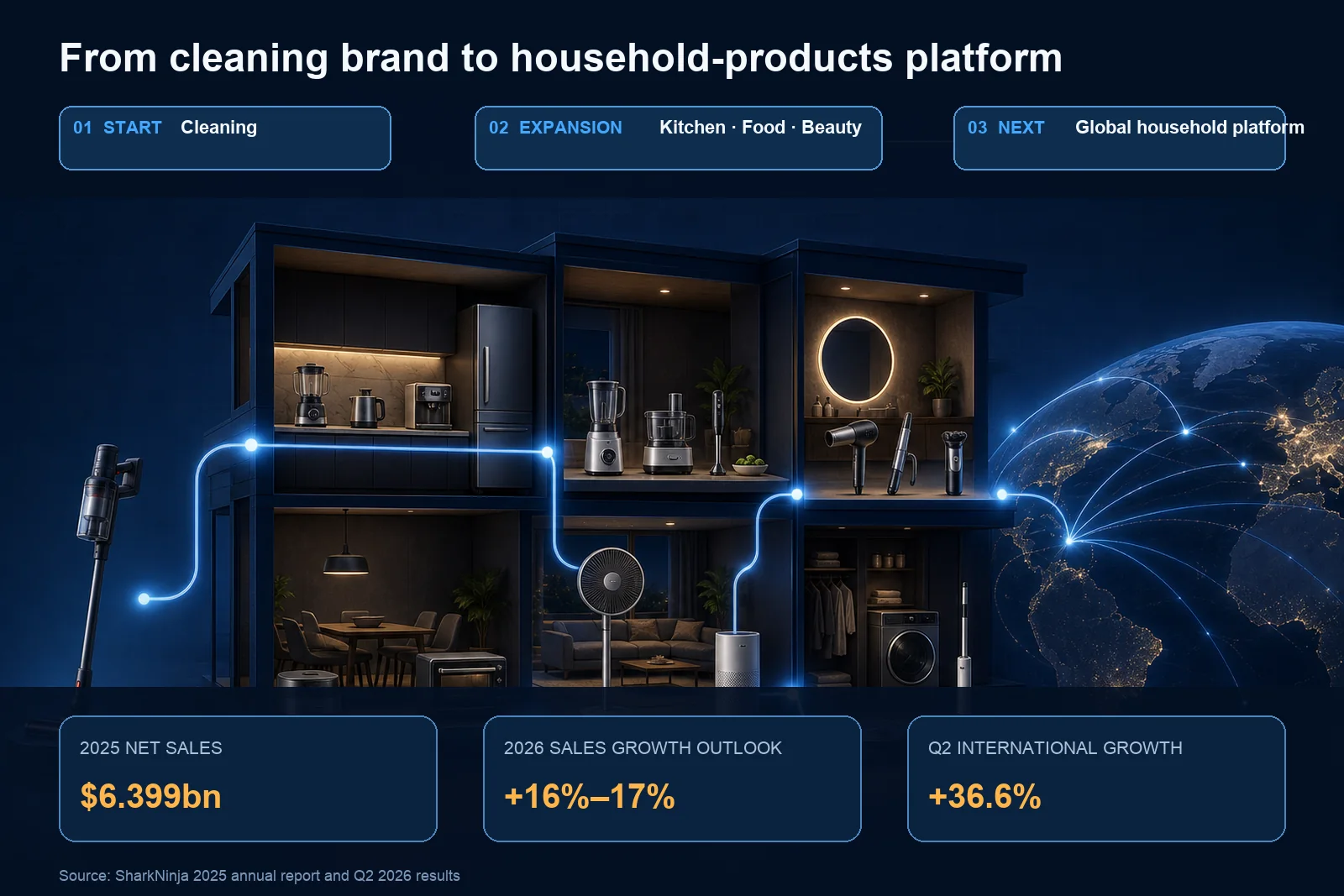
As cleaning becomes a smaller part of the mix, the future shape of SharkNinja is becoming easier to see. It is not turning back into a kitchen-appliance company, and it is unlikely to follow a traditional full-line appliance group into refrigerators, washing machines, air conditioners and televisions. Those products require long development cycles and heavy manufacturing assets, while their differences are harder to demonstrate quickly in stores or short-form video. That does not fit the operating model SharkNinja has built.
The company is more likely to keep entering household categories such as coffee, beverages, beauty, air care and cleaning equipment, where products can move quickly, visible differences can be demonstrated, and external manufacturers can support scale. Shark covers cleaning, floor care, air, beauty and the home environment. Ninja covers cooking, coffee, beverages and food preparation. The two brands address the same household from different rooms and use cases.
In that structure, SharkNinja begins to look less like an appliance brand and more like a household-product development platform. Market teams keep looking for consumer frustrations that have not been resolved. R&D teams and suppliers turn those frustrations into products. Brand, retail and marketing then scale the result. The company does not need to make every appliance. It needs to keep finding products that can still be redefined.
SharkNinja generated $6.399 billion in 2025. Under its latest outlook, 2026 sales could reach roughly $7.4 billion to $7.5 billion. If it can sustain double-digit growth for several more years, $10 billion is no longer a distant target. By then, its competitive set will extend far beyond Dyson, Bissell and other cleaning companies. It will increasingly meet De'Longhi, Groupe SEB, Philips-branded domestic appliances and more category specialists. Its ceiling will no longer be set by the size of the global vacuum-cleaner market, but by how many household occasions this product-development system can enter.
For Chinese cleaning-appliance brands, SharkNinja can no longer be studied only by taking apart one more vacuum. Product functions can be copied and suppliers can be found. The harder task is turning one successful launch into a repeatable ability to enter new categories. Shark built the company's foundation. Ninja is widening its boundaries. When 93.6% of quarterly growth is already coming from outside cleaning, that transformation is no longer a strategy on a presentation slide. It is visible in the revenue.