What small-appliance companies fear most is not a shortage of new products. It is that new products are becoming worth less and less.
An air fryer, floor washer or coffee machine can begin selling well and then be copied, discounted and surrounded by alternatives almost immediately. Online channels put price comparisons directly in front of consumers, while offline retailers expect brands to provide reliable supply, enough SKUs and a clear price ladder.
For a small-appliance brand, the difficult part today is not making a product. It is maintaining the right to explain its price after launch.
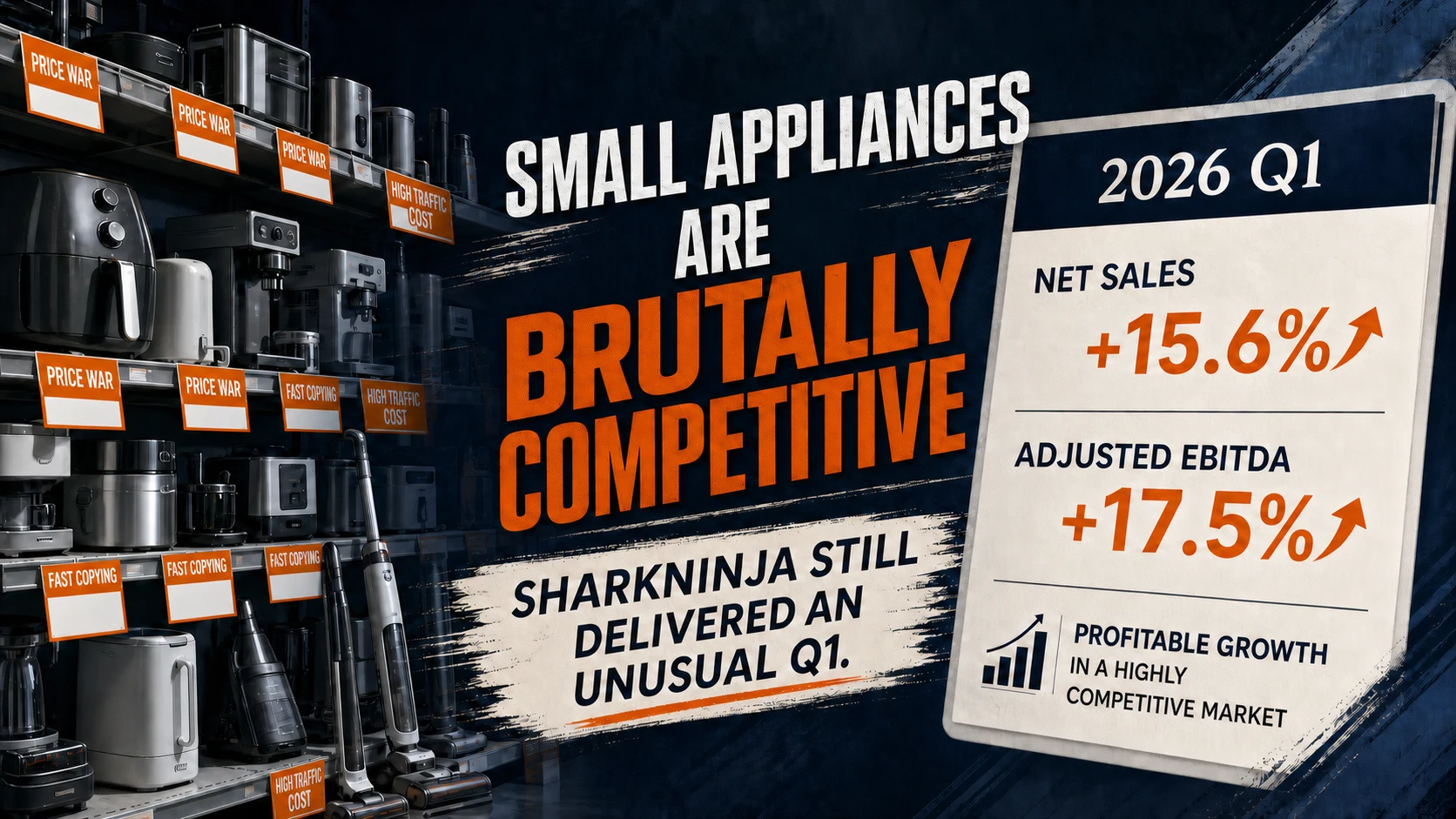
SharkNinja delivered an unusual set of numbers in the first quarter of 2026.
According to SharkNinja's May 2026 investor presentation, Q1 net sales reached $1.413 billion, up 15.6% year on year. Adjusted EBITDA reached $235 million, up 17.5%, while adjusted net income rose 25.1% to $155 million.
After the quarterly results, the company raised its full-year 2026 net-sales growth guidance from 10.0%–11.0% to 11.5%–12.5%. Adjusted EBITDA guidance was raised from $1.270–$1.280 billion to $1.290–$1.300 billion.
Revenue growth of 15.6% and adjusted EBITDA growth of 17.5% show, at the very least, that SharkNinja did not buy all of its growth by giving up profit. Adjusted net income growth of 25.1% also shows that costs and the financial structure did not swallow the increase in revenue. In today's small-appliance industry, results like these are unusual.

When people think of SharkNinja, the first products that come to mind are still Shark vacuums, floor washers and robot vacuums. Its revenue structure shows that it has long since become more than a cleaning-appliance company.
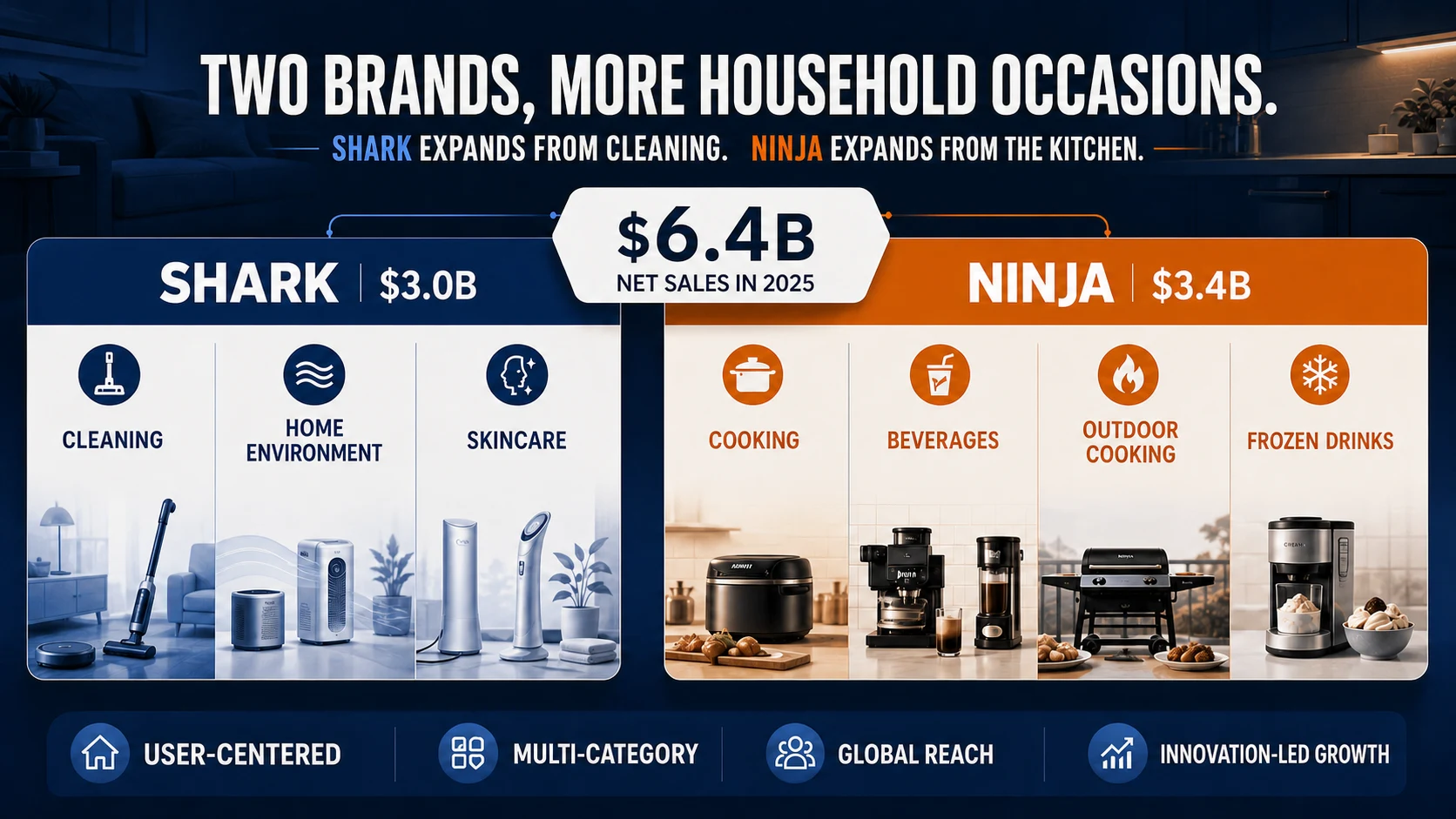
SharkNinja generated $6.4 billion in sales in 2025. Shark contributed about $3.0 billion and Ninja about $3.4 billion. Shark spans cleaning, home environment and skincare. Ninja spans cooking, beverages, outdoor cooking and frozen drinks.
Shark is extending from floor care into more home settings, while Ninja is expanding from kitchen appliances into beverages, outdoor products and frozen drinks. A household may start with a Shark vacuum, then buy a Ninja air fryer, followed by a coffee machine, frozen-drink maker, fan or outdoor-cooking product.
SharkNinja does not want to be a short-term winner in one category. It wants to appear repeatedly across more household occasions.
In its investor materials, SharkNinja divides its growth path into three parts: gain share in existing categories, enter adjacent and new categories, and continue expanding internationally. In recent years, it has entered many new categories. Shark has moved into carpet cleaners, workshop vacuums, fans and skincare devices. Ninja has moved into outdoor grills, sparkling-water makers, drinkware, frozen-drink machines, gas grills and fire pits.
These are not the same business.
In cleaning, Shark competes with Dyson, Bissell, Hoover, iRobot and Chinese cleaning brands. Carpet cleaning brings it up against a strong category brand such as Bissell. Vacuums put it against Dyson's premium positioning, while robot vacuums bring the speed of Chinese product iteration. In kitchens, it faces Breville, De'Longhi, traditional appliance brands and a large number of online brands. Outdoor cooking brings more specialized players such as Weber and Blackstone.
SharkNinja's challenge is not entering new categories. It is finding a position at each table that retailers will accept and consumers will understand.
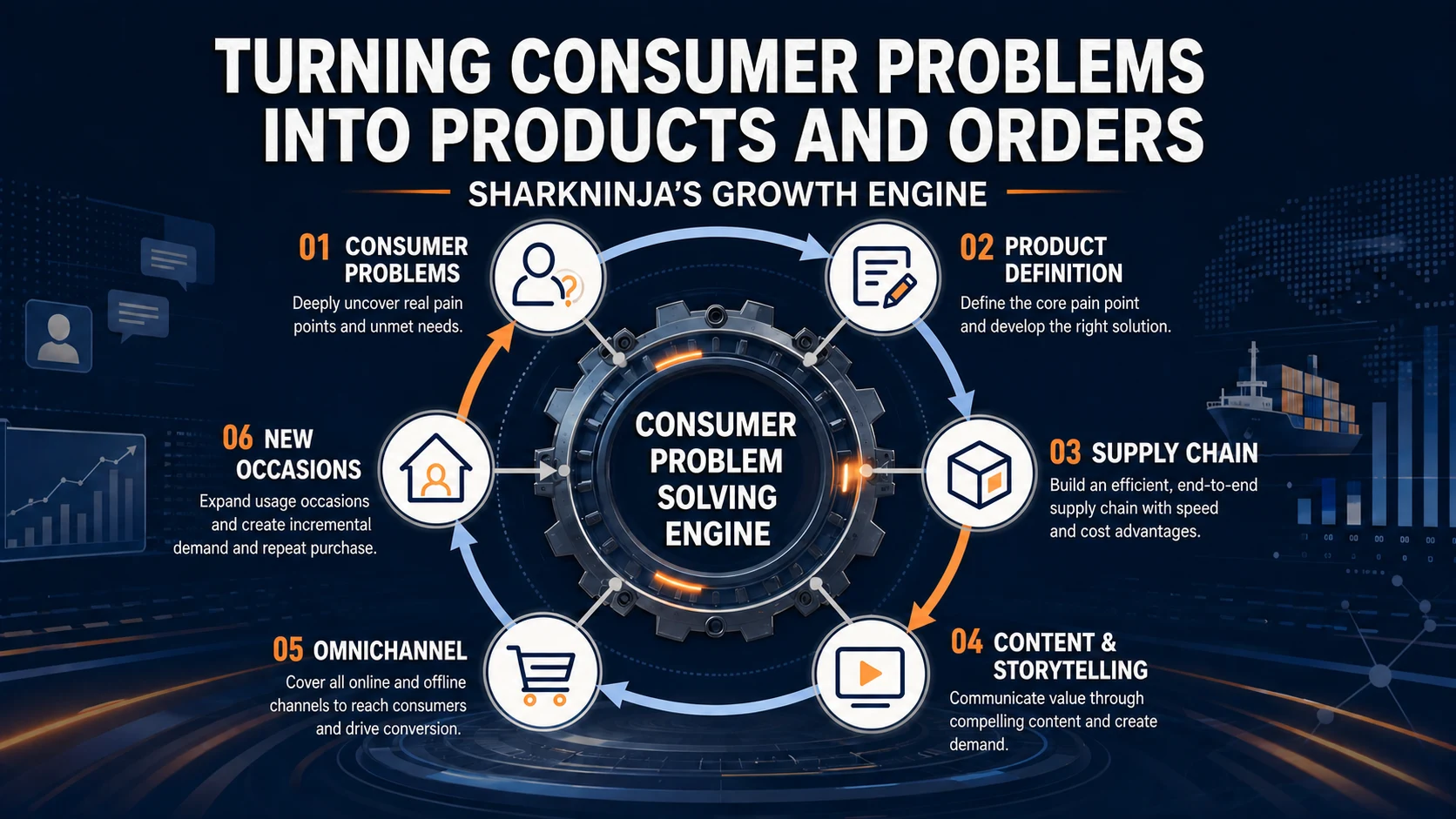
SharkNinja calls itself a “consumer problem-solving engine.” That phrase is closer to the capability it wants to describe than “hit-product company.” It is not asking how many more small appliances it can make. It is asking which frustrations in family life can be turned into products.
Where do existing products remain awkward to use? Can a mature category be redefined? Can a user pain point become a clear selling point? Can retailers understand it quickly enough to sell it? For a small-appliance company, these questions are harder than adding more specifications.
Its product requirement is written plainly: “SPEED PERFORMANCE QUALITY VALUE.”
Those four words explain SharkNinja's position. It is not simply playing at the high end or competing on low price. It aims to offer performance improvements consumers can feel within a mass-market price range, while maintaining a fast pace of new-product launches.
The materials highlight several new products.
Ninja Luxe Café takes Ninja into ultra-premium espresso machines, moving the brand from conventional coffee products into a higher-value, more design-led category. Shark FacialPro Glow takes SharkNinja into skincare devices and consumables, beginning an attempt to combine equipment with repeat-purchase products. Shark TurboBlade Fan extends the company into home environment by applying its motor and engineering capabilities to fans.
Ninja FlexFlame and Ninja FireSide360 show the boundaries moving further outward. FlexFlame takes Ninja into full-size gas grills. FireSide360 extends from outdoor cooking into outdoor heating and atmosphere. The company is no longer competing only to cook food. It is competing for the backyard, patio and social occasions around the home.
On the product side, SharkNinja has more than 1,000 cross-functional engineers and designers. Product-design teams in the United States, the United Kingdom and China create a 24-hour global innovation cycle. The company holds more than 5,500 active patents worldwide and targets 25 new product launches a year, with 20 coming from existing categories.
On the supply-chain side, 100% of its products are manufactured and assembled by third-party suppliers. The network spans China, Vietnam, Thailand, Cambodia, Indonesia and Malaysia, with dual-supplier strategies for key products. SharkNinja has not centered its model on building its own factories. It keeps control of product definition, quality standards, supplier relationships and launch timing.
For Chinese small-appliance companies, the supply chain is not the hardest part of SharkNinja to copy. The harder part is the way it connects product, content and retail channels early in the process.
The investor materials use the phrase “Always-on 360 Degree Marketing.” SharkNinja treats the development of the story behind a product as being as important as the product itself. While a product is still being defined, the company is already considering cultural context, creator use, media communication and the way retailers will explain it.
Many companies finish the product first and then decide how to sell it. SharkNinja brings “how it will be seen, understood and sold by retailers” into product development much earlier.
On the channel side, it emphasizes “Omni-channel Distribution.” The company does not seek retailer exclusivity. It wants to be everywhere consumers shop: physical retail, department stores, specialist retailers, its own websites, e-commerce platforms and international markets.
This is also what separates SharkNinja from many online brands. A hit product on Amazon can create speed, but reaching $6.4 billion in sales requires mainstream retail systems such as Walmart, Costco and Target to carry the portfolio.
The pressure also appears in the numbers.
In Q1 2026, SharkNinja's adjusted gross margin fell from 50.2% a year earlier to 49.2%. Tariffs, supply-chain costs and investment in new products will continue to weigh on margins. More categories also create more complicated competitive relationships and inventory management.
In the same quarter, however, revenue rose 15.6%, adjusted EBITDA rose 17.5%, and adjusted net income rose 25.1%. Based on these materials, SharkNinja has not yet sacrificed profit significantly to generate revenue growth.
Chinese small-appliance companies do not lack manufacturing capacity or product speed. The harder work is defining the user's problem, explaining the product benefit clearly, building deeper channel relationships and creating a sequence of purchases across multiple household occasions.
The window for a single hit product is getting shorter as competition in small appliances intensifies. What makes SharkNinja's quarterly report worth reading is that the company is still turning user problems into new products, content and channel orders.
Source: SharkNinja Investor Presentation, May 2026.