- SharkNinja grew to $6.399 billion in net sales in 2025, even as several foreign appliance brands lost momentum.
- Its structure is no longer just a vacuum cleaner story: Shark and Ninja now cover different rooms and use cases in the same household.
- The company's product process starts from concrete household pain points, not from an internal technology-first agenda.
- Sales, channel fit, demonstration value, China-based R&D, and supply-chain execution are built into the product definition early.
- For foreign consumer appliance brands, survival now depends less on brand legacy and more on a repeatable system for creating new products.
In 2025, SharkNinja sold $6.399 billion.
That number matters when placed inside today's cleaning appliance industry. In the same year, many foreign brands had already seen their presence in China fade. The sharper contrast was iRobot. The company that once defined the robot vacuum category entered Chapter 11 restructuring at the end of 2025 and was later taken over by Chinese supply-chain company Picea.
iRobot was once the global leader. Roomba was not just a product name. For many overseas consumers, it was their first mental image of a home robot. But as Chinese brands pushed all-in-one docking stations, mopping, navigation, obstacle avoidance, and aggressive pricing into the market at high speed, iRobot's first-mover advantage was gradually consumed.
The position of foreign brands in cleaning appliances is no longer what it was ten years ago.
But SharkNinja is one of the few exceptions.
It did not fall under the pressure of Chinese brands and Chinese supply chains. It kept growing.
| Year | Net sales | YoY |
|---|---|---|
| 2023 | $4.254 billion | - |
| 2024 | $5.529 billion | +30.0% |
| 2025 | $6.399 billion | +15.7% |
| 2026 Q1 | $1.413 billion | +15.6% |
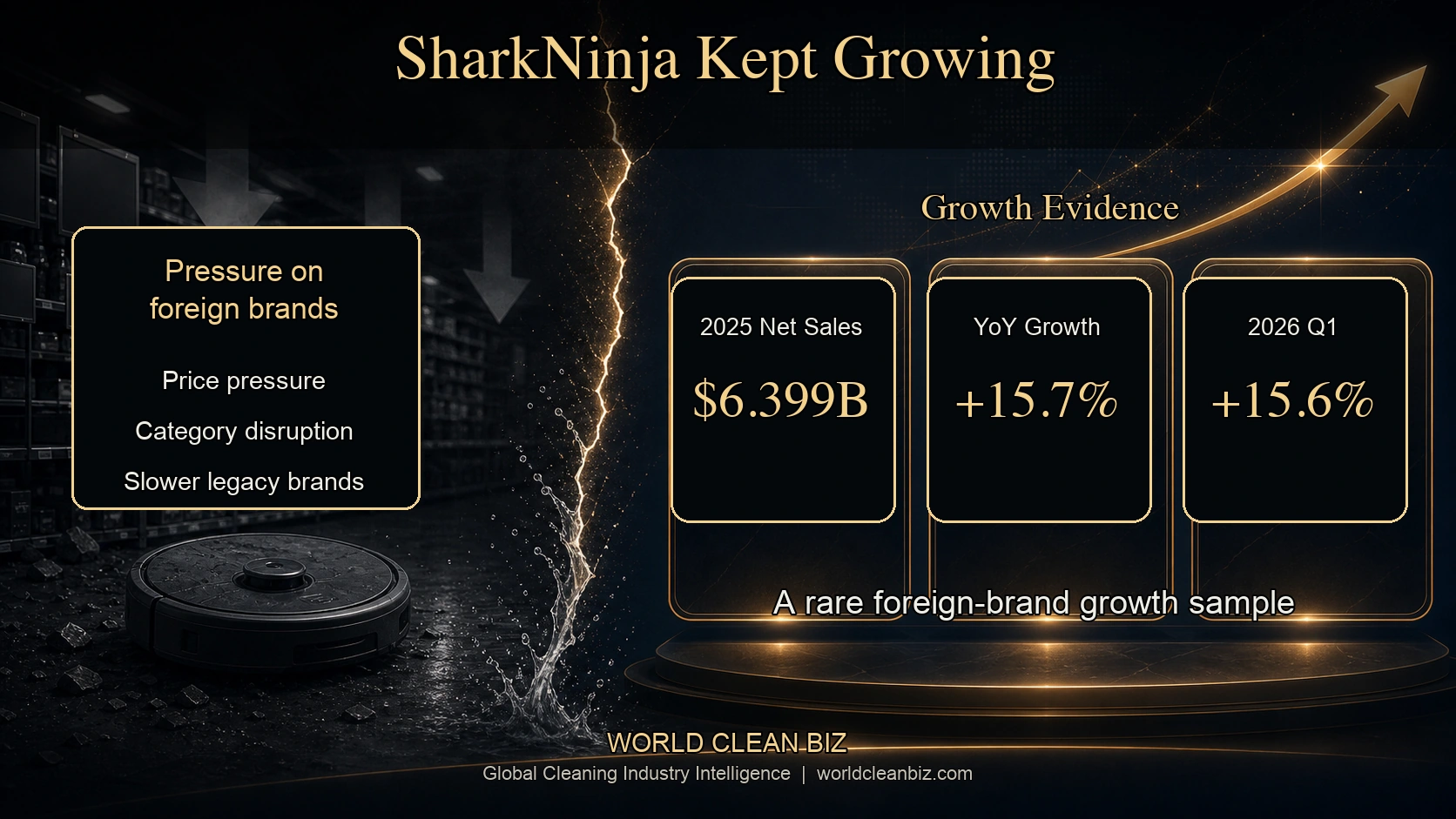
This set of figures should be read against the industry backdrop.
On one side, iRobot moved from category pioneer to restructuring. On the other, SharkNinja kept launching new products, expanding categories, and entering more household scenarios. When people look at SharkNinja, they often first see Shark vacuums, Ninja air fryers, coffee makers, ice cream makers, frozen drink machines, and carpet cleaners. Then they reach an easy conclusion: this company is good at creating hit products.
That judgment is right, but incomplete.
What makes SharkNinja worth studying is not simply that it has made hit products. It is why it can keep making them.
It does not rely on one product suddenly going viral, nor on one technology staying ahead for years. It is closer to a company that has connected product development, channel judgment, consumer pain points, supply-chain speed, and marketing expression into a single pipeline.
That pipeline first appears in its company structure.
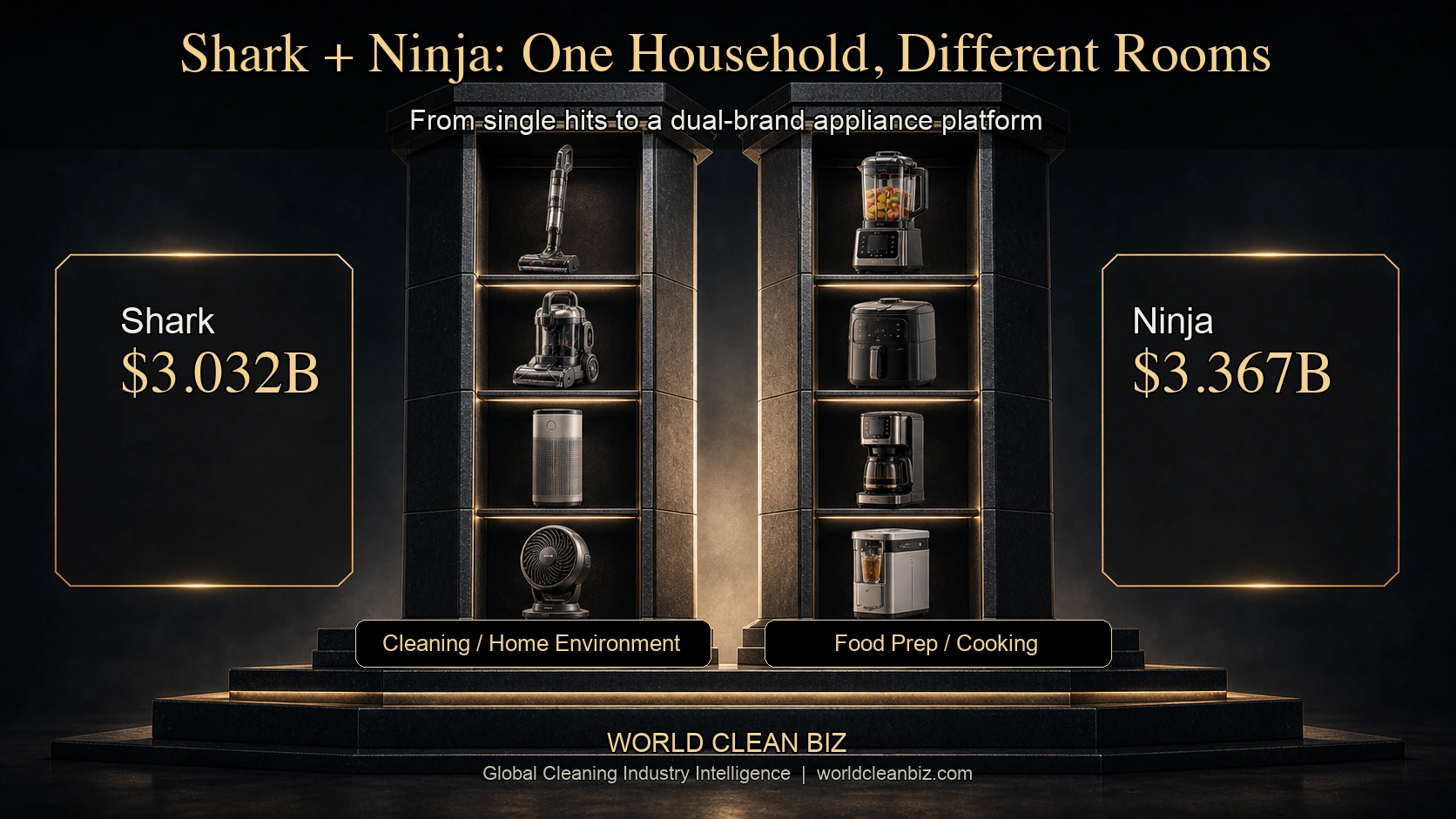
In 2025, SharkNinja's cleaning appliance revenue was $2.206 billion, still its largest category. But food preparation appliances reached $1.551 billion, up 31.6% year on year; beauty and home environment appliances reached $826 million, up 45.3%. By brand, Shark generated $3.032 billion, while Ninja generated $3.367 billion. Ninja is already slightly larger than Shark.
| Category | 2025 revenue | YoY |
|---|---|---|
| Cleaning Appliances | $2.206 billion | +6.9% |
| Cooking and Beverage Appliances | $1.816 billion | +5.7% |
| Food Preparation Appliances | $1.551 billion | +31.6% |
| Beauty and Home Environment Appliances | $826 million | +45.3% |
SharkNinja has long moved beyond the definition of a vacuum cleaner company.
Shark enters the living room, carpet, pet hair, air, and broader home environment. Ninja enters the kitchen, coffee, frozen drinks, and food preparation. The two brands face the same North American household. They simply enter through different rooms.
This forms a contrast with iRobot. iRobot was tied for a long time to one category: the robot vacuum. When Chinese brands pushed docking stations, mopping, navigation, obstacle avoidance, and price competition forward at the same time, iRobot had little room to turn. SharkNinja has a wider plate. If one category slows down, another can continue the growth.
But multi-category expansion alone does not explain the growth.
Many companies want to become multi-category companies. Many end up only piling up SKUs. SharkNinja's key is that when it enters a category, it first identifies a sufficiently specific household pain point instead of simply attaching its name to another product.
North American households have pets, so tangled hair becomes a pain point. Many homes have carpets, so carpet cleaning becomes a pain point. Kitchen users do not want to buy too many devices, so one machine that solves multiple scenarios becomes a pain point. Coffee, frozen drinks, and ice cream are also products that naturally lend themselves to demonstration and sharing.
SharkNinja's product definition often starts from these concrete scenarios.
It rarely begins with the question, "What technology do we already have?" It starts by asking where users are dissatisfied, where competitors have failed, whether the channel can explain the product clearly, and whether consumers can understand the difference as soon as they see a demonstration.
This is where it separates itself from many hardware companies.
Many companies develop new products by first looking at their own technology, tooling, and supply chain, and then finding selling points for the product. SharkNinja is more market-backward. While the product is still being defined, competitors, price bands, selling points, channels, and demonstration methods are already part of the discussion.
When I studied SharkNinja in earlier years, I summarized several of its early moves in vacuums: market research, selecting the right competitors, product positioning, sales moving forward, and fast response. Looking back now, that playbook is not outdated. It has simply expanded from vacuums into more household appliances.
Sales moving forward is an important part of that system.
Many new products fail not because the product has no value at all, but because sales problems appear too late. The product is finished, tooling is opened, inventory is prepared, and only then does the sales team go out to find customers, channels, and selling points. At that point, if the channel is not excited, the price is wrong, or the demonstration is weak, there is already little room to adjust.
SharkNinja products enter the sales scenario earlier.
Before a direction is fully fixed, price, configuration, channel, order expectations, and delivery schedule are discussed together. Early in development, the company has to answer: which channel is this product built for? Why would a retailer want to push it? Why would a consumer stop and pay attention? Is there a basis for the first batch of orders?
That feeds back into the product.
If a function requires a long explanation, retailers have little patience. If a product cannot demonstrate a difference, consumers will not stop. If the price cannot convince the channel that the product will move, buyers will not easily allocate resources.
So SharkNinja's hit products are rarely defined entirely in an office and then handed to the market for validation. They are more like products that have already been interrogated early by channels, pricing, demonstration, and order expectations.
Behind this mechanism is another, more hidden line: China-based R&D and supply chain.
SharkNinja does not own large-scale manufacturing factories. But people in the industry who have worked closely with it would not describe it as a light-R&D or light-supply-chain company.
Its R&D, project management, and supply-chain coordination capabilities in China are strong. The U.S. team is closer to the market, channels, and consumers. The China team is closer to R&D, prototypes, supplier validation, and mass production. The two sides form something close to a 24-hour project relay: the U.S. side pushes market signals, channel feedback, and consumer pain points forward, while the China side pushes structural solutions, supplier resources, cost, and delivery forward.
Many products do not start from zero after formal project approval. A large amount of pre-research, competitor teardown, prototyping, user research, and product trial work has already happened in advance. By the time the company decides to invest in tooling and mass production, the direction has already been pushed through several rounds by the market, channel, R&D, and supply chain.
This is the difference between SharkNinja and an ordinary asset-light brand.
An ordinary asset-light brand often only outsources manufacturing. SharkNinja keeps manufacturing outside, but it holds product definition, R&D rhythm, quality standards, supply-chain coordination, and delivery pressure in its own hands.
For Chinese ODMs, SharkNinja is both a large customer and a demanding customer. The orders are large, the requirements are high, the pace is fast, and the bargaining power is strong. Factories that can keep up with its rhythm get more than orders. They are also trained into stronger product and manufacturing organizations.
This explains why SharkNinja can keep pushing new products.
It does not simply rely on brand history or a single technical moat. It connects overseas market judgment, China's R&D speed, China's supply-chain response, and North American channel language.
The final link is marketing.
In 2025, SharkNinja spent about $1.458 billion on sales and marketing, equal to about 22.8% of net sales. This is not a company growing only through organic traffic. It needs continuous spending, continuous demonstration, and continuous consumer education.
But marketing is not something added only at the end.
A good Shark or Ninja product usually considers how it will be demonstrated while it is still being defined. A carpet cleaner needs to show the change in dirty water. A pet-hair cleaning product needs to show the difference at a glance. A coffee maker, frozen drink machine, or air fryer needs to let consumers see the result.
Whether a product works for television shopping, in-store demonstration, short video, or an e-commerce detail page is often already determined during product definition.
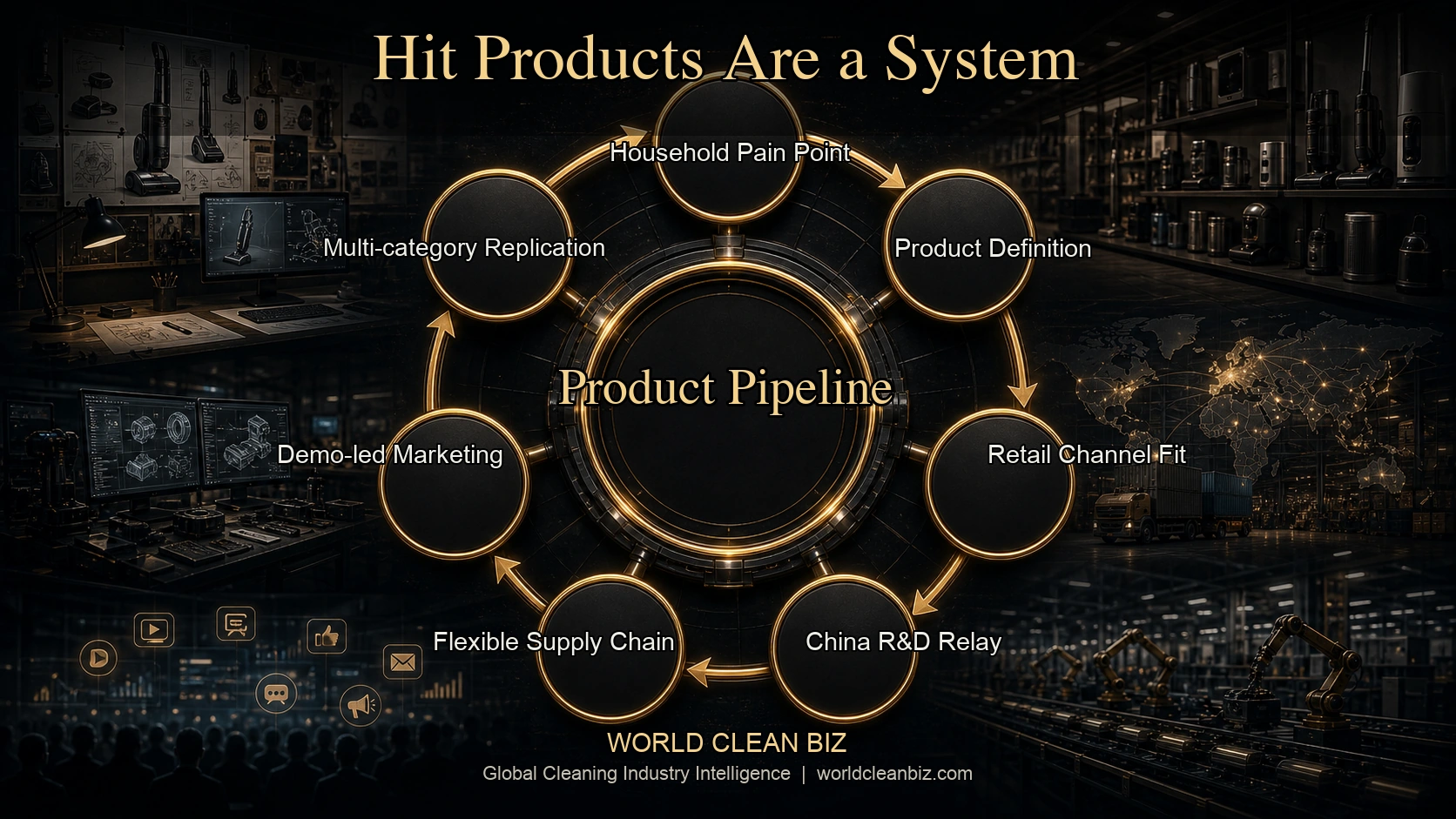
This is SharkNinja's hit product pipeline.
It is not a mysterious methodology. It has no universal formula. More accurately, it is a way of organizing products: start from household pain points, move into the channel early, use China-based R&D and supply chains to build products quickly, and then amplify them through strong demonstration and strong marketing.
This system explains why SharkNinja can still grow.
It also reminds foreign brands that brand history and channel inertia are no longer enough for survival. What matters is whether a company can connect market judgment, product definition, R&D relay, supply-chain speed, and channel language.
iRobot's story shows that first-mover advantage can be consumed.
SharkNinja's story shows that foreign brands can still grow. But the condition is that the company cannot remain only a brand. It has to become a system that can continuously produce new products.