- First confirm that the exact SKU and selected cycle are designed to clean walls; floor-only coverage is a product boundary, not a fault.
- A wall-capable robot may lose vertical performance because of filter loading, trapped air, worn traction parts, a slippery surface, difficult geometry or an internal pump or drive problem.
- Professional buyers should accept floor, wall and waterline performance separately in the real pool and document whether responsibility belongs to operation, maintenance, product selection or authorized service.
In this article 18 sections
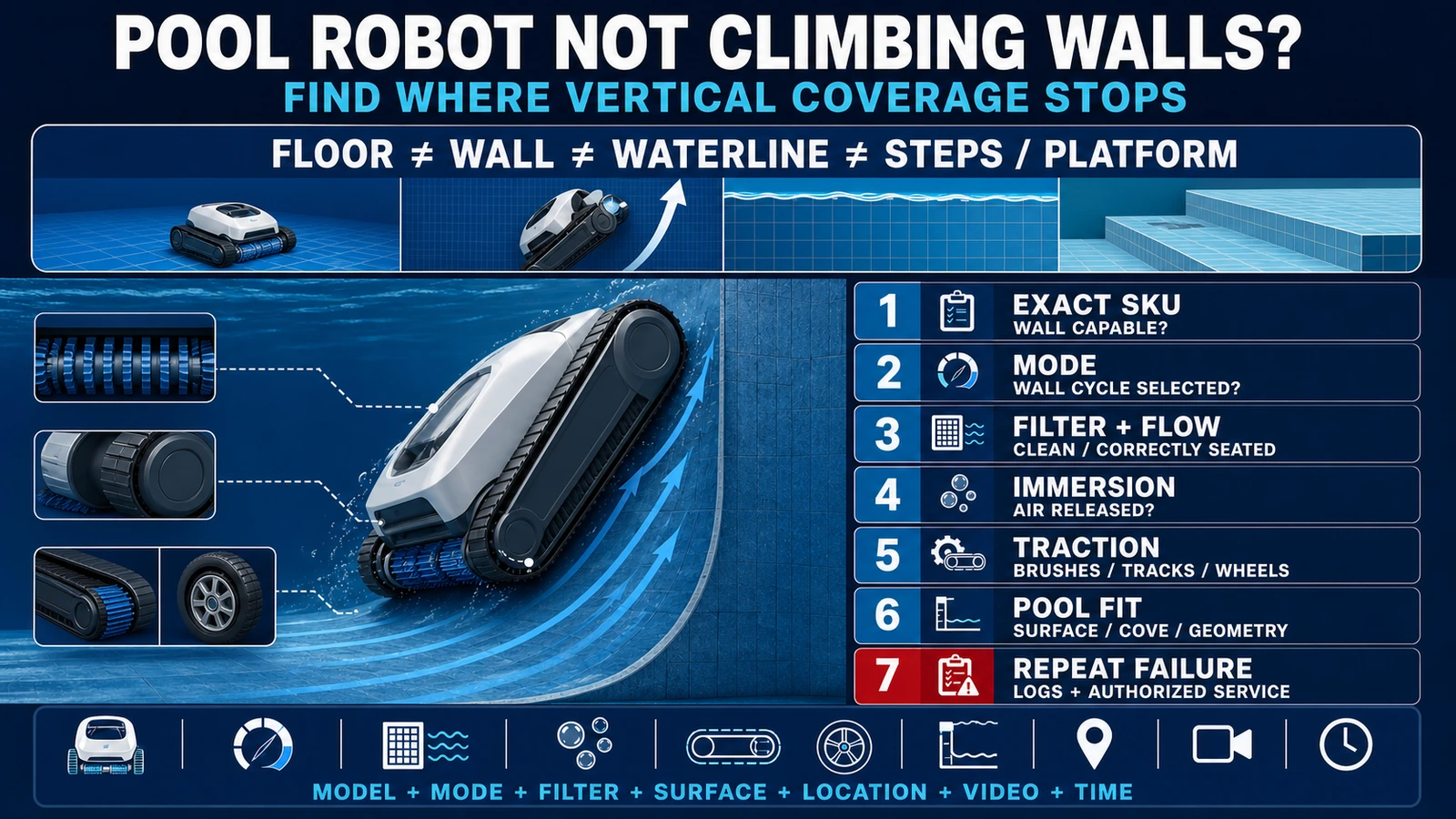
If your robotic pool cleaner is not climbing walls, first confirm that the exact model is designed to clean walls and that the selected cycle includes them. If it is wall-capable, check the filter load, correct submersion, brushes or tracks, visible water flow, pool-surface condition and floor-to-wall transition. A machine that moves well on the floor but repeatedly fails on vertical surfaces may have a pool-fit, maintenance, wear-part, pump, drive or control problem—not automatically a failed motor.
Do not treat wall climbing, waterline scrubbing, step cleaning and shallow-platform cleaning as one feature. A robot may climb walls but stop below the waterline. Another may reach the waterline but not travel sideways. A floor-only model may be working exactly as specified.
Wall-Climbing Problems at a Glance
| What you observe | Main area to investigate | First evidence to preserve |
|---|---|---|
| The robot never attempts to climb | Exact SKU coverage, selected mode, cycle and control settings | Product specification, mode screen and complete-cycle video |
| It reaches the wall and turns away | Floor-to-wall transition, wall detection, geometry, cable or mode | Repeated failure location and approach angle |
| It climbs partway and slides down | Filter loading, traction, brush/track wear, surface film or reduced flow | Filter condition, top water flow and close video of the slip |
| It climbs early but not later | Debris load, filter resistance, battery or protection state | Time in cycle, filter load and battery/status history |
| It climbs walls but does not reach the waterline | Waterline capability, pool depth/water level, mode and control behavior | Exact coverage claim and maximum repeatable height |
| It reaches the waterline but does not move sideways | Waterline-scrubbing capability, mode, propulsion/control and pool edge | Video of the complete waterline attempt |
| It fails only on one wall or transition | Surface material, algae or film, cove, ledge, fitting, return flow or geometry | Pool drawing, surface record and location-specific video |
| External checks are correct but failure repeats | Pump, drive, sensor, control, battery or sealed internal system | Serial number, code, logs and reproducible test result |
This table is a triage map, not a universal repair procedure. The correct maintenance method, permitted access and pass criteria come from the complete model manual and the purchased scope.
First Confirm That the Robot Is Supposed to Climb
Product families often contain floor-only, floor-and-wall, and floor-wall-waterline models that look similar. Model names can also vary by region or dealer channel. Confirm the complete SKU rather than relying on the brand, series name or housing shape.
The distinction is visible in current manufacturer information. Aiper’s Seagull SE page states that the product does not climb walls or stairs. That behavior is not a warranty failure. At the other end of the range, Aiper’s current Scuba S3 page lists separate Auto, Floor, Wall and Waterline modes.
Maytronics provides another useful distinction. Its current Dolphin LIBERTY 200 specifications list floor and wall coverage but no waterline scrubbing. The current Dolphin Sigma page lists floor, walls and waterline.
These examples do not rank the products. They show why a service ticket should begin with four questions:
- What is the complete model and market version?
- Does its current documentation promise wall coverage?
- Does it separately promise waterline coverage?
- Which cycle or mode was selected?
If the quotation promised a capability that the delivered SKU does not have, the problem is product selection, quotation accuracy or fulfillment—not a dirty machine.
Wall Climbing, Waterline Cleaning and Step Cleaning Are Different
“Full pool cleaning” is too vague for procurement or acceptance. Break the task into observable zones:
| Zone | What must be demonstrated |
|---|---|
| Floor | Travel, brushing, filtration and coverage on horizontal or sloped bottom surfaces |
| Floor-to-wall transition | Ability to recognize and cross the cove, radius or angle without becoming trapped |
| Wall | Stable vertical travel with the required brushing and filtration behavior |
| Waterline | Reaching the air-water boundary and performing the specified cleaning movement |
| Steps and ledges | Access to each declared depth and geometry without grounding, falling or missing the zone |
| Shallow platform | Operation within the product’s stated minimum depth and special-mode requirements |
A robot that touches the wall has not proved wall coverage. A robot that climbs vertically has not proved waterline scrubbing. And a product that cleans the waterline on a straight tiled wall has not proved that it will clean curved steps or a shallow sun shelf.
World Clean Biz’s guide to how robotic pool cleaners work explains the broader pump, drive, brush, filter and navigation system. This page focuses only on a current vertical-coverage failure.
Record the Failure Pattern Before Changing Anything
The way the machine fails is more useful than the statement “it does not climb.” Record one complete, safe operating cycle before resetting the App, moving equipment or replacing parts.
Capture:
- complete model, serial number, market version and firmware or App version where relevant;
- corded or cordless architecture;
- selected cycle and every wall, waterline or zone setting;
- pool type, surface material, shape, depth and water level;
- floor-to-wall transition, including coves, slopes, ledges and unusual radii;
- filter condition at the beginning and end of the cycle;
- visible top water flow or other model-approved status observation;
- whether the robot reaches the wall, begins climbing, slips, reverses or falls;
- maximum repeatable height and whether it reaches the waterline;
- whether failure occurs everywhere or at one location;
- time in the cycle, battery/status level and error message;
- a video showing floor travel, the approach and the full wall attempt.
Do not judge a programmed robot from one pass. Fluidra’s current WR000502 manual notes that the cleaner may not climb at the beginning or every time it meets a wall. The broader lesson is to observe the complete model-defined behavior, not to adopt that manual’s timing as a category-wide rule.
Understand What Keeps a Pool Robot on a Wall
There is no single wall-climbing mechanism across all robotic cleaners. Depending on the design, vertical performance can depend on a combination of:
- drive torque and the control of wheels, tracks or rollers;
- brush or track friction against the pool surface;
- pump flow, jet direction or hydrodynamic force that helps stabilize the body;
- correct buoyancy and removal of trapped air;
- body geometry and center of mass;
- wall detection, orientation and control logic;
- sufficient energy or stable corded power for the selected task.
This explains why a robot can move on the floor while failing vertically. Horizontal travel may tolerate lower grip, a loaded filter or marginal propulsion that becomes visible only when gravity and the wall transition increase the demand.
Avoid calling every hydrodynamic effect “suction.” Some designs use water flow and thrust to stabilize the robot without sealing themselves to the wall like a suction cup. Diagnose the complete machine rather than one marketing number.
Check the Selected Mode and Complete Cycle
Many current products offer separate floor, wall, waterline, automatic or custom cycles. Selecting a floor-only cycle can create a perfectly repeatable “failure” in a wall-capable machine.
BWT’s current F1R page distinguishes a floor-only cycle from floor-wall-waterline cycles. Aiper likewise presents wall and waterline choices as separate modes on current products.
Before troubleshooting hardware:
- confirm the selected mode on the device, power unit and App;
- confirm that a schedule did not use a different default mode;
- check whether a custom or energy-saving cycle excludes walls;
- record whether the robot attempts walls later in the cycle;
- confirm that the cycle completed rather than ending from low charge, protection or an error;
- check whether a firmware or account change reset the mode.
Do not force a model into repeated wall-only attempts unless its manual provides that mode. Repeating a high-load maneuver until the battery is empty can erase useful evidence and does not identify the failed subsystem.
Check Filter Loading and Water Flow
A filter basket can look only partly full and still impose significant resistance when fine particles, algae, hair or compacted debris cover the media. Reduced water flow can weaken cleaning and the hydrodynamic forces used during wall climbing.
Beatbot’s current help center identifies debris accumulation in the filter basket as a common factor when its AquaSense 2 family cannot climb walls. It also notes that a clogged filter can reduce climbing power, trigger repeated attempts and consume more battery. Those are model-family statements, but they support a useful cross-brand observation: compare climbing before and after a correctly cleaned filter under otherwise similar conditions.
Use only the manual-approved process:
- Stop the cycle and remove the cleaner safely.
- Isolate corded power or place a cordless product in its safe off state.
- Remove and inspect the user-accessible filter.
- Clean the filter with the permitted water pressure, tools and materials.
- Check that media, doors, seals and the basket are correctly seated.
- Reinstall the exact filter configuration required for the test.
Do not run the robot without its filter as a general diagnostic shortcut. Do not assume a coarse leaf basket and an ultra-fine filter create the same pump load. A dealer should record the installed filter part number when wall performance changes after a media swap.
Confirm Correct Submersion and Remove Trapped Air
Air inside the cleaner can change buoyancy, body angle and contact with the pool surface. The correct entry procedure varies: some products must be rotated underwater, some need time to release air, and some have model-specific startup timing.
The Fluidra manual cited above includes correct immersion among its wall-climbing checks. Use the exact procedure for the purchased unit and record whether bubbles continue after the robot reaches the floor.
Do not add weights, block vents or improvise ballast. If the cleaner repeatedly retains air after the approved procedure, or if its buoyancy changed after service, escalate the case rather than altering the design.
Inspect Brushes, Tracks and Other Traction Parts
Wall climbing converts wear that may be barely visible on the floor into a loss of vertical grip. Inspect only the external parts that the manual assigns to the user or trained maintenance team.
Look for:
- flattened, hardened, torn or missing brush material;
- tracks that are smooth, stretched, cracked, loose or unevenly tensioned;
- wheels or rollers that bind, slip or carry wrapped hair and fibers;
- different wear between the two drive sides;
- debris around accessible brush and track interfaces;
- a replacement brush that is not approved for the pool surface or model;
- an incorrect assembly after recent maintenance.
Maytronics’ UM-8151622 manual includes brush suitability, brush wear, filter condition, the impeller area and climbing settings in its product-specific wall-climbing checks. Its maintenance guidance also treats filters, impellers, brushes and tracks as ongoing maintenance areas.
Do not roughen a pool robot’s traction parts with sandpaper or fit a “similar” brush merely because it mounts. Material, geometry, buoyancy and pool-surface compatibility are part of the product system.
Inspect the Pool Surface and Water Condition
A visually clear pool can still have a slippery film on the walls. Algae, biofilm, oils or surface deposits can reduce friction; scale, damaged finishes or unusual textures can change contact in a different way.
Keep responsibilities clear:
- the robot supplier confirms the surfaces and finishes supported by the exact SKU;
- the pool operator owns water testing and treatment under the facility’s procedure;
- maintenance records whether the robot’s brush and track materials match the surface;
- authorized service diagnoses internal loss of pump or drive performance.
Do not turn one legacy manual’s chemical dose or pH instruction into cross-brand advice. Correct the pool condition through qualified pool operations, remove the robot when its manual requires removal during chemical treatment, and retest only after the pool is within its operating criteria.
For a warranty dispute, document whether the machine fails on every compatible wall or only on a particular finish. A product may climb gunite reliably but struggle on a smooth tile band, vinyl transition or an algae-coated surface. The exact compatibility statement matters.
Check the Floor-to-Wall Transition and Pool Geometry
The robot must first cross the wall base. A sharp corner, broad cove, compound radius, ledge, drain, return fitting or change in slope may cause it to turn away before true wall climbing begins.
Map the pool as an operating site:
- straight walls versus free-form curves;
- sharp, radiused or sloped transitions;
- vinyl seams, wrinkles and safety ledges;
- steps, benches, beach entries and shallow shelves;
- lights, outlets, drains and protruding fittings;
- water level and coping geometry;
- return jets or circulation flow that influence the approach;
- for corded products, available cable and pull from the floating cable.
If failure repeats at one wall, mark the location and compare it with an easier wall. If the robot climbs several compatible surfaces but fails at one complex transition, the pool-product interface deserves attention before an internal repair is authorized.
Why the Robot Climbs Halfway and Falls
A halfway fall is an observation, not a diagnosis. It can result from declining grip, filter loading, a surface change, cable pull, control behavior, marginal propulsion or a protection event.
Record whether the fall occurs:
- at the same height on every wall;
- only at a tile band or waterline;
- only after the filter collects debris;
- only late in the cycle;
- only when the cable is extended in one direction;
- with a change in pump sound, water flow, track motion or status;
- after recent brush, track, filter or firmware work.
A robot may also intentionally release from a wall as part of its navigation. Compare several attempts and the complete cycle against the model’s expected behavior before creating a service claim.
Why It Climbs Walls but Does Not Clean the Waterline
Wall travel and waterline cleaning require separate confirmation. A wall-capable machine may be designed to reverse below the top, touch the boundary without moving sideways, or clean the waterline only in a dedicated mode.
Check:
- whether the exact SKU specifies waterline cleaning;
- whether the selected cycle includes it;
- whether the pool’s water level and edge geometry are within the product’s limits;
- whether a handle, float, cable or body component was assembled correctly;
- whether the robot reaches a repeatable height before reversing;
- whether the manufacturer describes vertical contact or horizontal waterline travel.
Do not advertise “wall and waterline” from a generic family page if the supplied channel SKU offers only wall coverage. Dealers should preserve the dated specification and quotation used at the time of sale.
When to Stop and Contact Service
End operator troubleshooting when the next step requires opening a sealed compartment, live electrical diagnosis or model-specific service tools.
Escalate when:
- the filter, mode, immersion, traction and pool-fit checks are correct but failure repeats;
- top water flow is weak or changes abnormally with a clean, correctly installed filter;
- one drive side stalls, slips or behaves differently without an external obstruction;
- a pump, drive, sensor, communication or battery error persists;
- the cleaner has abnormal heat, odor, noise, swelling, corrosion or suspected water ingress;
- a floating cable, connector, charger or battery is damaged;
- wall performance changed immediately after an internal repair;
- the product is under warranty and further access could affect coverage.
Beatbot’s current help center asks customers to upload logs and provide the device serial number when filter cleaning does not restore climbing. A distributor should extend that intake package with the pool, mode, surface, filter and failure-location evidence described above.
Test Wall Performance Before Returning the Robot to Service
A repair is not complete because the robot climbed the easiest wall once with an empty filter.
Use a controlled return-to-service test:
- Confirm the exact SKU, approved pool surfaces and promised coverage zones.
- Record the installed filter, brushes, tracks, firmware and selected mode.
- Start with the correct charge or corded-power state and approved immersion process.
- Confirm normal floor travel, turning, brushing and filtration.
- Observe approaches at representative wall transitions.
- Record stable vertical travel and the highest repeatable point.
- Test waterline behavior only if the SKU promises it.
- Continue long enough to observe performance with a representative filter load.
- Confirm no recurring warning, abnormal sound or manual assistance.
- Record action, parts, result, test pool and person releasing the machine.
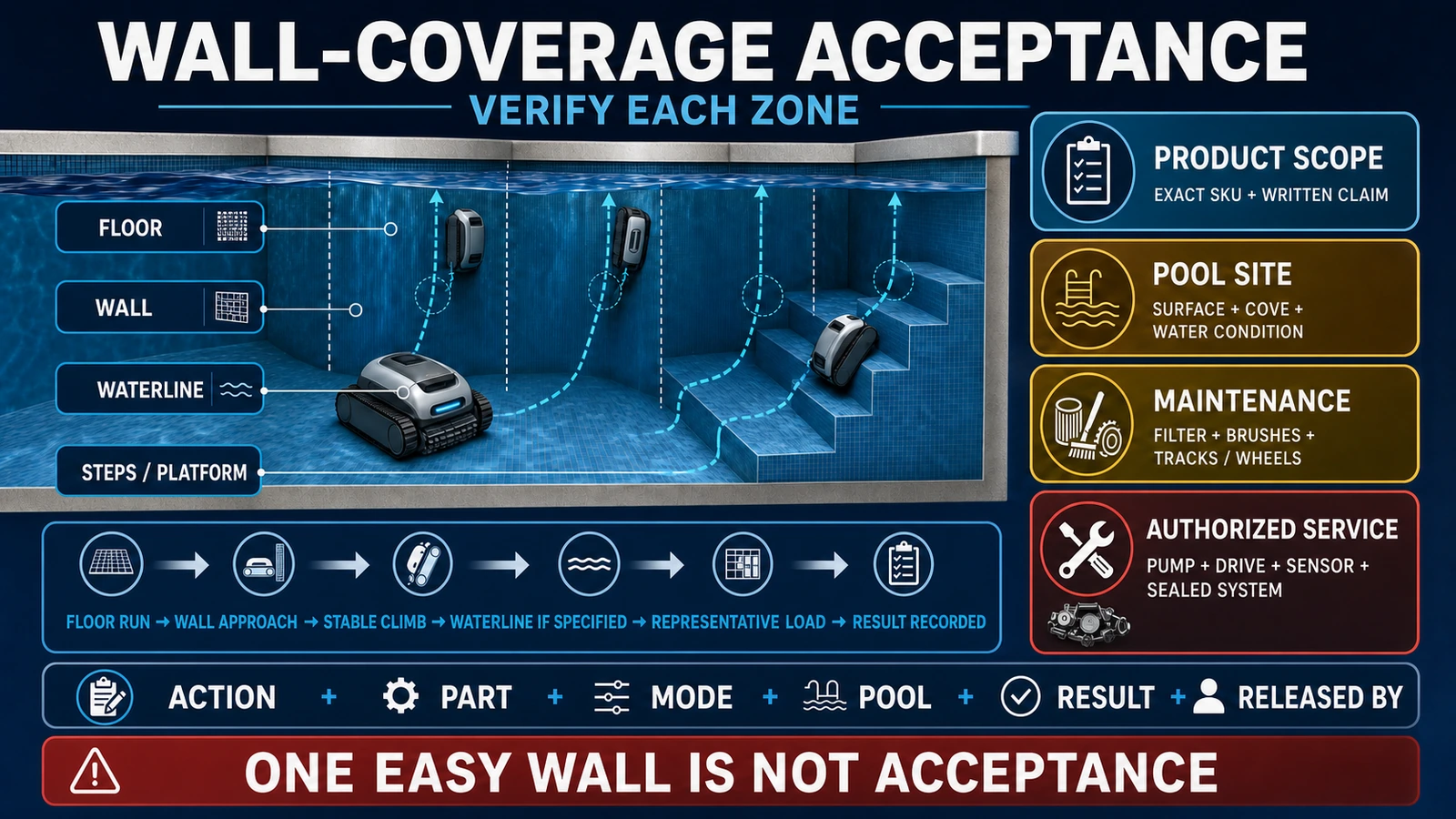
For a commercial pool or dealer demonstration, define the required number of representative walls and transitions before the test. “It climbed somewhere” is not an acceptance criterion.
B2B Lessons for Dealers, Importers and Pool Operators
Quote coverage by zone, not by marketing phrase
The quotation should list floor, wall, waterline, steps, ledges, shallow platforms and surface skimming separately. Add the exact model and market SKU. If a zone is not promised, say so.
Qualify the pool before selecting the robot
Record dimensions, depth, surface, shape, wall base, steps, fittings, waterline and principal debris. A high-spec robot can still be the wrong product for a particular transition or finish.
Separate site, maintenance and product responsibility
A slippery wall or incompatible geometry is not the same as a failed pump. A clogged filter is not the same as a false product claim. A missing waterline mode is not the same as worn tracks. Service contracts and warranty forms should keep these causes separate.
Stock the wear system, not only the complete machine
Maintain exact-SKU records for filters, baskets, brushes, tracks, rollers and other approved wear parts. Record whether replacement changes buoyancy, traction, filter resistance or surface compatibility.
Preserve claim evidence
Keep the serial number, dated product specification, seller, importer, warranty terms, App logs, mode, pool details, maintenance history, videos and replaced parts. Aggregated cases can reveal a product issue, a training gap, a recurring pool-fit problem or an inaccurate channel claim.
Define the release test in the service SLA
The SLA should say who supplies the test pool, who corrects water conditions, which zones must pass, how a loaded filter is represented, who authorizes internal repair and what happens when the delivered SKU cannot meet the quoted task.
World Clean Biz’s commercial robotic pool cleaner guide covers the wider facility, labor and procurement system. The corded-versus-cordless comparison explains why power architecture alone does not determine wall performance.
FAQ
Why is my robotic pool cleaner not climbing the walls?
First confirm that the exact model and selected mode support wall cleaning. Then inspect the filter load, correct submersion, visible flow, brushes or tracks, pool-surface condition and wall transition. If those checks are correct and the failure repeats, the pump, drive, sensor, battery or control system may need authorized diagnosis.
Do all robotic pool cleaners climb walls?
No. Some are floor-only, some clean floors and walls, and some also scrub the waterline. Steps, ledges and shallow platforms are additional capabilities that must be confirmed separately.
Can a dirty filter stop a pool robot from climbing?
Yes, on products whose vertical performance depends on maintaining adequate water flow. Fine debris or algae can load a filter before it looks full. Clean it only by the exact manual and retest under comparable conditions.
Why does the robot climb halfway and fall?
Possible causes include filter loading, reduced traction, worn brushes or tracks, a slippery surface, cable pull, a change in wall material, marginal pump or drive performance, or normal programmed release. Record several attempts before deciding which system is responsible.
Why does it climb walls but not clean the waterline?
The model may not include waterline cleaning, the selected cycle may exclude it, or the pool edge and water level may not suit the product. Wall climbing and horizontal waterline scrubbing are separate claims.
Can algae prevent a robotic cleaner from climbing walls?
Algae or biofilm can make a pool wall slippery and can also load the filter. The pool operator should correct water and surface conditions under the facility’s procedure, then retest the robot according to its manual.
Should I replace the tracks or brushes first?
Not before checking the exact SKU capability, mode, filter, immersion and pool conditions. Replace only parts that are worn, incorrect or outside specification, using the approved part and service level.
When should a dealer treat the case as a warranty fault?
When a wall-capable product repeatedly fails in a documented compatible pool after permitted setup and maintenance checks, preserve the full evidence and follow the seller, importer and manufacturer warranty path. Do not open sealed systems simply to prove a claim.
Final Answer
When a robotic pool cleaner will not climb walls, start with the promised task. Confirm the complete SKU, its wall and waterline coverage, and the selected cycle. Then check the filter, correct immersion, traction parts, visible flow, pool surface and floor-to-wall geometry.
Observe several representative attempts and the full cycle. Keep wall climbing separate from waterline, step and platform cleaning. If a compatible, correctly configured and maintained robot still fails, preserve the serial number, logs, video and pool record and move pump, drive, battery, sensor or sealed-system diagnosis to authorized service.