- Professional turf needs a zoned fleet and service plan, not a residential mower multiplied by area.
- Validate cut quality, positioning, event windows, interventions and dealer response on the real site before calculating labor savings.
- A useful ROI model counts reassigned labor, finishing work, downtime, backup capacity and the value of more consistent mowing.
In this article 15 sections
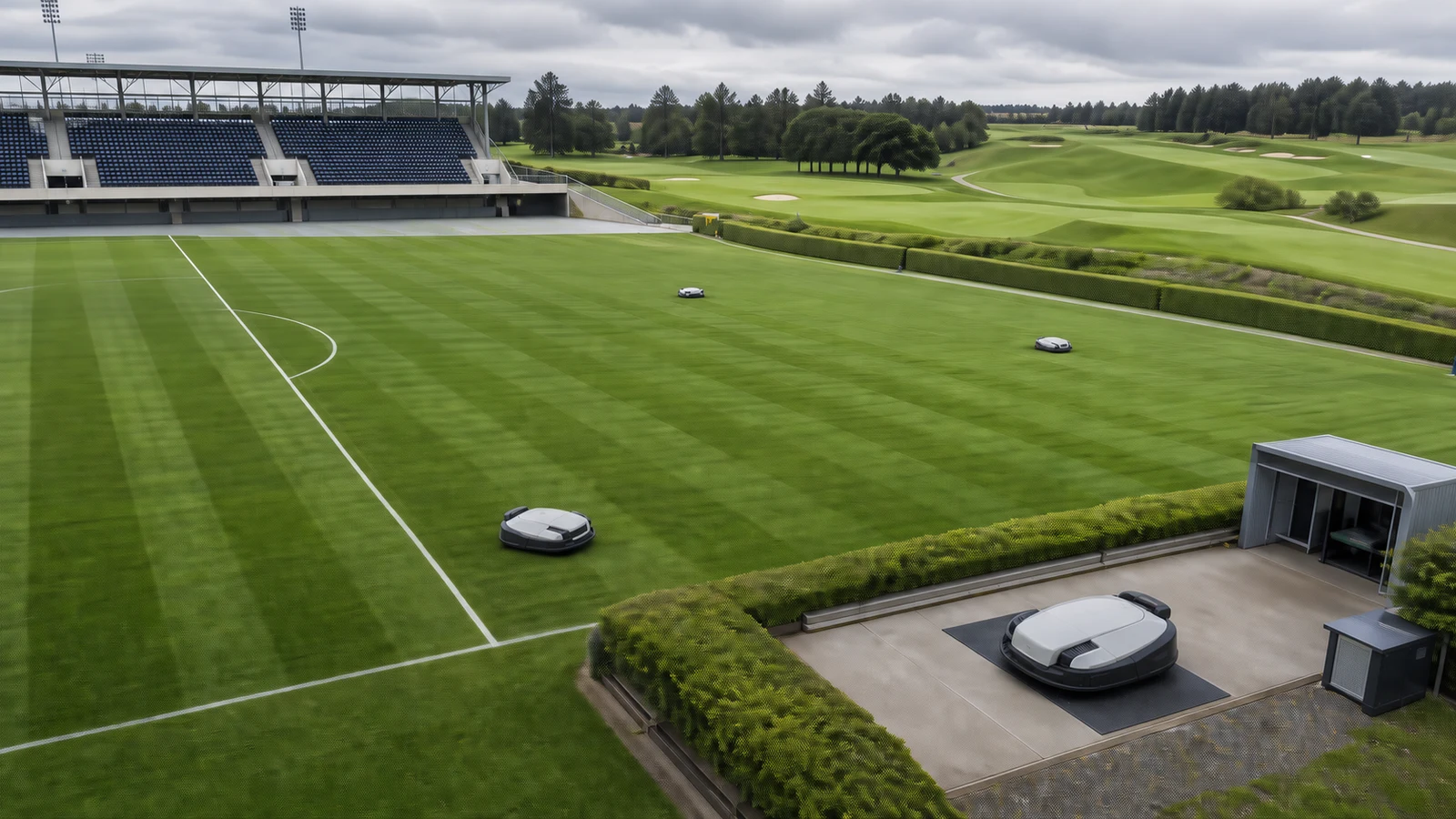
A golf course or sports facility should buy a robotic mowing system only after dividing the site into turf zones, proving positioning and cut quality, and agreeing who restores service when a machine stops. The correct unit of purchase is not one mower. It is a fleet, an installation and an uptime commitment.
Professional turf has different priorities from a residential lawn. Match presentation matters. Events create hard deadlines. People enter the site. Irrigation, renovation and line marking change the work zone. A machine that covers the advertised area can still fail the operation.
Where Professional Robot Mowers Fit
Robot mowers are best at repetitive maintenance on defined turf. They are not a universal replacement for every grounds machine.
Typical applications include:
- golf fairways and selected rough;
- tees and approaches where the cut-height range fits;
- football and soccer pitches;
- training grounds;
- school and university fields;
- parks and corporate campuses;
- large ornamental lawns.
They are less natural for rapidly changing construction zones, unmanaged rough, ground with frequent heavy debris or areas where public access cannot be controlled.
Husqvarna’s current golf-course range illustrates the professional split. The company positions CEORA for large-area mowing and Automower models for smaller or more complex zones. Its official material also combines fleet software, dealer support, training and service agreements. Segway Navimow similarly presents Terranox as a professional platform with multi-machine fleet control. These are manufacturer claims, but they show why procurement must cover the operating system around the robot.
Divide the Site Into Turf Zones
Do not start with total property acreage. Create a zone map.
| Zone | Main requirement | Common robot constraint |
|---|---|---|
| Golf fairway | Repeatable pattern and low cut | Positioning, clipping behavior and event presentation |
| Rough | Capacity and terrain handling | Height range, slope and hidden obstacles |
| Tee or approach | Precision and access timing | Small zones, traffic and finish expectations |
| Sports pitch | Consistent surface and fixed event windows | Line marking, temporary goals and player access |
| Training field | High availability | Multiple sessions and recovery time |
| Campus lawn | Quiet operation and public control | Pedestrians, furniture and temporary exclusions |
Measure each zone separately:
- net turf area;
- required height;
- acceptable mowing pattern;
- slope;
- satellite and cellular environment;
- transition route;
- irrigation schedule;
- public or player occupancy;
- debris load;
- deadline for a finished surface.
Two areas with the same size can need different machines because one requires a lower cut or has a narrower operating window.
Capacity Must Match Turf Quality
Manufacturers often publish several capacity figures for one platform because mowing frequency and finish change the workload.
Husqvarna’s U.S. CEORA page, for example, describes up to six acres for daily “pro sports quality” and higher acreage for less frequent regular-quality mowing. The distinction matters more than the largest number. A fleet designed from the maximum figure can miss the presentation standard.
Ask the supplier to calculate:
Daily required capacity = net zone area × required mowing frequency ÷ available operating days
Then apply an availability factor for charging, maintenance, weather, event closures and interventions. Do not plan the fleet at 100% theoretical utilization.
The capacity study should answer:
- How many machines complete the zone before the next event?
- What happens when one unit is unavailable?
- Can another unit accept its map or work area?
- How much capacity remains during peak growth?
- Is the charger accessible without crossing public routes?
Positioning Is a Site Infrastructure Decision
Professional systems increasingly use RTK-GNSS, local reference stations, network corrections, vision or combinations of these methods. Virtual boundaries make zones easier to change, but they depend on a stable signal chain.
Survey:
- tree canopy;
- grandstands and buildings;
- steep banks;
- narrow corridors;
- radio and cellular coverage;
- power for reference and charging equipment;
- places where the machine crosses hard surfaces;
- areas altered during tournaments or maintenance.
Test the weakest zone at the weakest time, not only an open fairway on a clear day.
The site also needs a change-control process. Someone must own map edits, temporary stay-out zones, firmware updates and new construction. A casual app change should not send a machine across a protected green or an event area.
Cut Quality Requires a Local Acceptance Test
“Professional quality” is not a universal result.
Define acceptance by:
- height tolerance;
- visible striping or pattern;
- missed grass;
- scalping;
- wheel marks and turn damage;
- clipping appearance;
- edge residual;
- performance after rain;
- performance during peak growth.
Run the proposed machine at the site’s real height. Inspect the turf after repeated cycles, not one demonstration.
Robot mowers cut small amounts frequently. That can support a consistent surface, but it changes agronomy and maintenance routines. The superintendent or grounds manager should decide whether the mowing pattern, clipping return and cutting system fit the turf program.
Event Windows Change the Schedule
Professional sites cannot treat the lawn as always available.
A sports field may host training, matches, setup and broadcasting. A golf course has play, tournaments and maintenance windows. The robot schedule must coordinate with people, irrigation, spraying, aeration, line marking and temporary structures.
Create a weekly operating calendar showing:
- safe autonomous windows;
- no-entry periods;
- irrigation;
- grounds work;
- public access;
- event setup and breakdown;
- charging;
- cleaning and blade service;
- contingency mowing.
Quiet operation can expand the available window, but safety and local rules still control when the machine may run.
Fleet Management Must Produce Action
A dashboard has value only when alerts create a response.
Require:
- machine location and status;
- work completion by zone;
- intervention history;
- charging status;
- blade or service reminders;
- geofence and theft alerts;
- role-based user access;
- firmware records;
- exportable operating data;
- a defined response owner.
Husqvarna states that Fleet Services can monitor and control robotic and other grounds equipment from mobile or desktop devices. Segway Navimow describes NavimowFleet for multi-unit control. During a trial, confirm which functions exist in the target region and whether they require subscriptions, connectivity or dealer accounts.
Do not give every employee full control. Separate viewing, scheduling, map editing and service permissions.
Safety Starts With Operating Boundaries
Commercial deployment needs a documented risk assessment based on the exact machine, manual and local requirements.
Controls may include:
- fenced or scheduled work zones;
- pre-run inspection;
- visible warning lights or signs where required;
- exclusion during public or player activity;
- safe blade-service procedure;
- remote stop and local emergency access;
- incident reporting;
- damaged-blade inspection;
- authorization before restart.
Obstacle sensing reduces risk and downtime; it does not justify operation among uncontrolled crowds. Temporary equipment, balls, ropes, flags and maintenance tools can also stop or damage a machine.
The operating plan should state who clears the field and who decides it is safe to resume.
Service Is Part of the Machine
Professional turf has an uptime deadline. A low-cost robot with distant support can cost more than a premium system with local recovery.
Request a service-level schedule:
| Service question | Evidence required |
|---|---|
| Who installs and maps? | Named trained dealer or technician |
| Who handles first response? | Contact and operating hours |
| What can staff repair? | Approved task list and training |
| Which parts are local? | Stock list and replenishment time |
| What requires depot repair? | Process and expected turnaround |
| Is a loan unit available? | Written conditions |
| Who remaps after site changes? | Price and lead time |
| What happens after model retirement? | Parts and software policy |
Husqvarna’s CEORA HyperCare program provides a useful example of the service layer: pre-installation survey, on-site setup, training and follow-up. A buyer should request the equivalent commitment from any supplier, not assume a product warranty provides operational uptime.
Maintenance and Backup Capacity
Daily or weekly tasks can include:
- removing grass and debris;
- inspecting blades and fasteners;
- checking wheels and drive areas;
- cleaning sensors;
- confirming charger condition;
- reviewing alerts;
- inspecting the work zone.
Use the exact manufacturer method. Disconnect and isolate the machine before service.
Calculate spare capacity around the consequence of failure. A training field may tolerate a delayed cycle. A tournament venue may need a ready replacement or conventional mower.
Backup options include:
- one spare robot shared across compatible zones;
- dealer loan unit;
- retained ride-on or reel mower;
- contracted emergency mowing;
- extra fleet capacity distributed across the week.
The cheapest backup is not always another robot. It is the option that restores the required finish before the deadline.
Build the ROI From Reassigned Work
Do not promise that robots “save labor” without naming the labor.
Record the current process:
- operator mowing hours;
- transport and setup;
- fuel or charging;
- trimming and cleanup;
- machine maintenance;
- weather rescheduling;
- contractor cost.
Then model the robotic process:
- supervision;
- rescue and exception handling;
- trimming;
- blade and cleaning work;
- software and connectivity;
- dealer service;
- backup mowing;
- finance and installation.
Use:
Annual operating benefit = avoided mowing and transport cost + value of reassigned productive work + avoided fuel and selected maintenance − robot supervision − finishing work − service, software and downtime
Reassigned work must be real. Examples may include irrigation checks, turf repair, bunker work or event preparation, but the site should record where the hours went.
A Professional Pilot Scorecard
Run the pilot through normal weather and at least one representative event cycle.
Track:
- accepted area completed;
- cut-height result;
- missed or damaged turf;
- interventions per 100 operating hours;
- staff minutes per intervention;
- charging and energy;
- edge-finishing time;
- alerts and connectivity loss;
- service response;
- parts used;
- event conflicts;
- staff and player feedback.
Agree pass/fail thresholds before the supplier starts. A demonstration without recorded criteria is sales activity, not validation.
Our robot mower cost guide helps structure ownership cost. For market and product context, see the robotic lawn mower market guide and robotic mower sales-channel analysis.
Procurement Checklist
- Zone the site by height, finish and operating window.
- Derate published capacity for real availability.
- Survey positioning and connectivity.
- Define map-change authority.
- Test cut quality across repeated cycles.
- Build a public and player safety plan.
- Obtain service response and local-parts evidence.
- Design backup capacity.
- Record a full pilot scorecard.
- Calculate ROI from verified labor and uptime.
FAQ
How many robot mowers does a golf course need?
There is no reliable answer from total acreage alone. Divide the course by turf requirement, operating window and terrain, then derate each machine’s capacity for charging, weather, maintenance and downtime.
Can robot mowers cut sports fields every day?
Some commercial platforms are marketed for daily sports-turf maintenance. The facility must verify the exact cut-height range, capacity, scheduling, safety and surface result on its own field.
Are virtual boundaries better than perimeter wires?
They make zone changes and temporary exclusions easier, but they depend on positioning infrastructure and site conditions. Wired systems introduce installation and repair work. Test the route rather than choosing by label.
What is the most important contract term?
For a high-consequence site, service recovery is as important as the product specification. Define response time, parts, loan equipment, remapping and responsibility after software or hardware failure.
Should a facility remove all conventional mowers?
Not until robotic capacity and recovery have been proven. Many sites retain conventional equipment for seasonal growth, rough areas, renovation and emergency backup.
Final Decision
A professional robot mower is not a labor-saving appliance placed on a field. It is a managed turf system. Buy it only when the fleet, mapping, safety, service and backup plan can deliver the required surface before every operational deadline.