- For a small yard, measure net mowable grass, the narrowest usable passage and turning space before comparing mower capacity.
- A mature boundary-wire mower can be a rational low-dependency choice; RTK, LiDAR and vision are useful when their signal, mapping and service requirements fit the property.
- The lowest total cost is the mower that completes the allowed schedule with little rescue and trimming work, not necessarily the cheapest or highest-capacity model.
In this article 16 sections
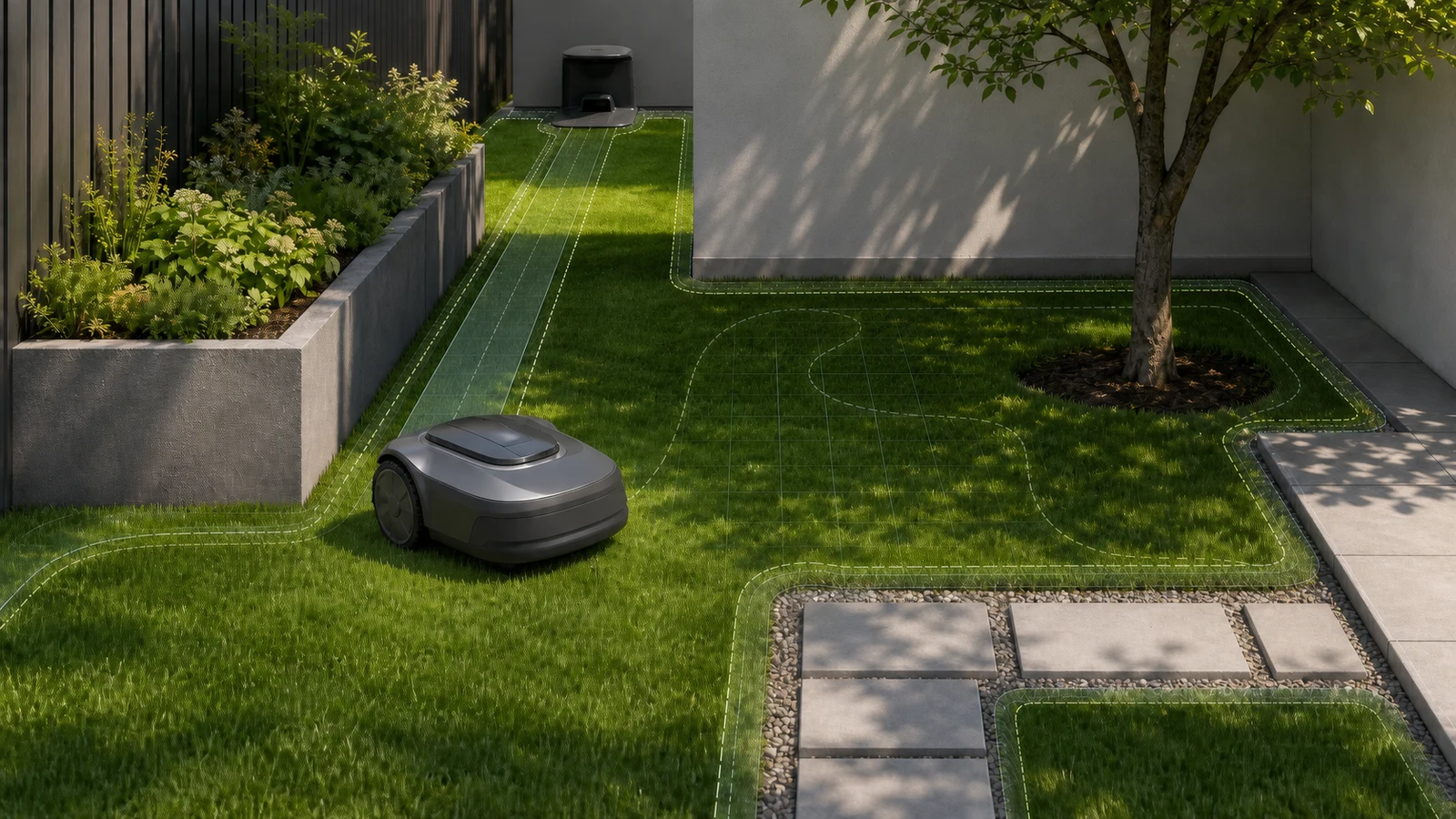
The best robot lawn mower for a small yard is not the smallest machine or the model with the largest area number. It is the mower that can pass through the real corridors, turn without damaging turf, localize under the yard’s trees and walls, cut the required edges and finish inside the allowed schedule with little rescue work.
Start with a tape measure and a simple site plan. Net mowable area, passage width, edge geometry and service cost eliminate unsuitable products faster than a list of advertised features.
Quick Decision Framework
| Yard condition | Prioritize | Verify before buying |
|---|---|---|
| One simple open lawn | Reliable boundary and return-to-charge | Installation space, edge strip, noise |
| Narrow connector | Compact body and proven passage handling | Usable width, approach, turn and exit |
| Trees and tall walls | Navigation that survives local blockage | Map stability under canopy and beside walls |
| Frequent layout changes | Editable virtual zones | Remapping, account and cloud dependence |
| Fixed mature layout | Boundary wire may be economical | Wire installation, repairs and future digging |
| Several small grass islands | Multi-zone or multi-map workflow | How the mower crosses or is transported |
| Many vertical edges | Edge mechanism and body geometry | Manual trimming minutes per week |
| Short daytime window | Throughput, charging and low rescue rate | One complete mow-charge-resume trial |
Do not choose by lawn area alone. A 200 m² courtyard with three narrow connectors can be harder than an open 800 m² rectangle.
For the wider category criteria behind these measurements, see our robot lawn mower buying guide.
Is a Robot Mower Worth It for a Small Yard?
It can be, especially when frequent manual mowing interrupts work, the lawn grows quickly or the owner values a consistently short cut. Robot mowers remove small clippings often rather than collecting a large weekly cut.
The economic case becomes weaker when:
- the grass takes only a few minutes to mow manually;
- most of the yard still needs string trimming;
- the robot must be carried between several islands;
- toys, furniture or hoses must be cleared every cycle;
- poor navigation creates frequent rescues;
- installation and winter storage cost more than the labor saved.
Estimate annual time saved, not just mowing time. Subtract setup, cleaning, blade changes, edge trimming, obstacle removal and service visits.
For a rental property or a garden that changes every season, flexibility may matter more than a five-year payback calculation. For an established home with one stable lawn, a simple system can create value for years.
Measure Net Mowable Area
Property size is not lawn size. Draw the grass and subtract:
- the house and outbuildings;
- patios, paths and driveways;
- flower beds and vegetable beds;
- tree pits and mulched islands;
- ponds, pools, play surfaces and gravel;
- permanent no-go zones;
- slopes or edges that cannot be used safely.
Break the remaining grass into zones. Record each zone’s area and the route between them.
Capacity should include reserve. If a mower is rated exactly for the measured lawn, bad weather, peak growth, battery ageing and complex routing can consume the schedule. A higher area rating may buy time margin, but an oversized chassis can be worse in tight corners.
The useful question is: can this exact mower maintain the net grass during peak growth inside the hours when the yard is available?
Measure the Narrowest Usable Passage
The opening between two walls is not necessarily the mower’s usable corridor.
Measure:
- physical width at the tightest point;
- plants, edging or drains that intrude;
- required distance from walls, drops or beds;
- entry angle;
- turning space before and after the passage;
- length and surface slope.
A manufacturer’s minimum can refer to wheel clearance, distance between boundary wires or a controlled straight test. These are not interchangeable.
GARDENA’s official SILENO guidance illustrates the difference. CorridorCut can work with 60 cm between boundary wires, but a wall on each side requires additional boundary-wire setbacks. GARDENA’s example reaches about 130 cm of actual wall-to-wall space. A long corridor without a guide wire is given a wider recommendation.
ECOVACS publishes a 0.7 m path claim for the compact GOAT O1000 RTK under its test conditions. The number is useful for screening, but the property still needs the approach, turn and safe edge clearance.
Create a cardboard outline of the mower’s body and turn it through the corridor. Then verify with the real machine before the return period ends.
Turning Space Matters as Much as Width
A robot can fit through a gate and still fail at the corner beyond it.
Look for:
- a 90-degree turn immediately after a narrow gap;
- a dead end with no recovery space;
- a slope across the turning area;
- soft turf where repeated pivots create wear;
- an inward corner that traps the chassis;
- a charging route that requires a sharper turn than mowing.
Review how the machine turns. Fixed casters, omni wheels and steered wheels leave different marks. Repeat the same turn after irrigation and inspect the turf, not just the app map.
Boundary Wire, RTK, LiDAR or Vision?
Small-yard buyers are often told that one navigation type is universally newer or better. The property determines the answer.
Boundary wire
A boundary wire creates a physical electromagnetic limit. Installation takes labor and future digging can damage it, but it does not depend on satellite visibility or visual features.
This can be a rational choice for a stable small lawn. GARDENA positions the SILENO minimo 250 and 500 as small-lawn wired machines. The package includes boundary cable and installation hardware, and the mower’s daily operation is not based on a remote cloud map.
Choose wire when the layout is stable, satellite visibility is poor, remote map editing is unnecessary and local technicians can repair the loop.
RTK
RTK uses corrected satellite positioning for repeatable virtual boundaries. It makes zones easy to edit, but the reference station, sky view, radio link or network service must fit the property.
In a courtyard surrounded by tall buildings, do not assume RTK will work because the lawn is small. Test the station site and the worst part of the lawn.
LiDAR
LiDAR maps surrounding structure and can work where satellite signals are difficult. Small courtyards often offer walls and trees as features, but reflective surfaces, repeated geometry, vegetation and dirty sensors can affect perception.
Vision
Vision helps identify grass, obstacles and boundary types. It depends on lighting, lens condition and the visual difference between grass and non-grass.
Many current machines fuse two or more methods. More sensors are useful only if the system recovers gracefully when one input becomes weak.
See our wire-free robot lawn mower guide for installation tradeoffs beyond the marketing labels.
Test Trees, Walls and Shade
Small yards can have high obstruction density: a single tree, shed and wall may surround most of the grass.
Map and mow at:
- midday and late afternoon;
- the deepest tree shade;
- beside metal fencing or tall walls;
- under an overhang;
- around moving leaves and low branches;
- after garden furniture changes position.
Record localization pauses, false obstacles, missed strips and boundary drift. Repeat the test. A successful mapping lap is not evidence that the mower can complete a week.
If a wireless design depends on internet coverage, verify it across the entire working area. Husqvarna’s official guidance notes that some perimeter-free systems require stable coverage in the full mowing zone. Ask what happens during an outage and whether the mower can return safely.
Edge Cutting and Remaining Trim Work
“Edge-to-edge” needs a boundary definition.
Classify every edge:
- flush, passable edge: wheels may overlap paving;
- vertical wall or fence: the body needs clearance;
- soft edge: grass blends into soil, mulch or gravel;
- drop or water edge: a larger safety margin is required;
- inside corner: body geometry limits blade reach;
- hedge: low branches may trigger obstacles.
Measure the uncut strip after three cycles. A sliding disc or integrated trimmer may reduce work, but no blade can safely cut through a wall.
Estimate manual trimming minutes per week. On a small lawn with a long perimeter, edge labor can dominate ownership cost even when mowing is fully automated.
Landscape design can be the cheapest upgrade. A flush mowing strip around walls and beds lets wheels overlap while keeping the blade guarded. It can deliver a more durable result than chasing a small difference in published edge distance.
Noise, Schedule and Neighbours
Small yards are close to homes. Check the rated sound level and, more importantly, the sound character at the property line.
GARDENA publishes 57 dB(A) for SILENO minimo. Other products may be similar or louder, and an integrated string trimmer can create a different sound from the main blade disc.
Quiet operation does not make every hour appropriate. Use a schedule that avoids sleeping rooms, outdoor meals and local restrictions.
Daytime mowing can also reduce wildlife risk. Husqvarna’s small-lawn guidance specifically raises the option of daytime-only operation to avoid nocturnal animals such as hedgehogs. Keep children and pets away from active mowing regardless of obstacle-recognition claims.
Safety in a Compact Garden
Small yards combine blades with people, toys, furniture and open gates.
Before mowing:
- remove hoses, cables, toys and loose tools;
- inspect for small wildlife;
- close access to streets and shared paths;
- protect ponds, drops and steps with suitable boundaries;
- set no-go zones around temporary hazards;
- check lift and tilt stops;
- supervise initial cycles.
Camera and AI obstacle systems reduce risk but do not make a lawn a safe play space during operation.
Avoid mowing excessively tall or wet grass. Robot mowers maintain height by frequent light cuts; they are not designed to clear an overgrown yard.
Multiple Zones and Grass Islands
Count disconnected grass areas before choosing the mower.
Ask whether the product supports:
- multiple zones on one map;
- separate independent maps;
- automatic travel through a connector;
- placement and localization after manual carrying;
- more than one charging station;
- map backup and account transfer.
A strip of stepping stones may be passable physically but unsuitable for blades or wheels. A gate may be open only at certain times. Stairs require carrying.
If the owner must move the mower every week, include that labor in the decision. A small conventional mower can be faster than maintaining a complicated multi-map workflow.
Installation and Charging Station
The station needs more space than its footprint.
Verify:
- level approach and departure;
- required straight distance;
- drainage and irrigation spray;
- power outlet and cable protection;
- satellite, radio, Wi-Fi or visual conditions;
- access for cleaning and winter removal;
- shade and temperature;
- visibility to thieves versus convenience.
Do not place the station solely where it looks unobtrusive. A poor approach causes docking retries, wheel wear and incomplete schedules.
Professional installers should document the station position, boundary offsets, firmware, map, zones, passwords and recovery procedure.
Total Ownership Cost
Purchase price is only one line.
Build a three- to five-year model with:
- mower, station and taxes;
- boundary wire or reference hardware;
- installation and landscape preparation;
- optional gateway, cellular module or subscription;
- blades, screws and cleaning tools;
- battery replacement;
- wheel, sensor and charging-contact parts;
- winter service and storage;
- warranty shipping or technician travel;
- manual edge trimming;
- rescue and remapping time.
The cheapest mower can be expensive if it needs weekly intervention. A high-capacity flagship can also be wasteful if the small yard never uses its deck, slope or battery capability.
Our robot mower cost and maintenance guide provides a fuller ownership model.
Product Tiers for a Small-Yard Assortment
Retailers and distributors should stock by job, not by maximum area.
Tier 1: stable wired lawn
For customers with a fixed layout, modest remote-control needs and difficult satellite coverage. Prioritize reliable passage handling, low noise, simple blade supply and local wire repair.
Tier 2: compact wire-free lawn
For customers who want editable zones and fast setup. Prioritize chassis width, mapping recovery, app region, station requirements and a real narrow-passage demonstration.
Tier 3: complex terrain or premium edge work
For slopes, multiple zones, demanding boundaries or limited mowing hours. Stock only when the service team can support sensors, firmware, batteries and specialized edge hardware.
Offer a paid site survey. Measuring the garden before the sale prevents returns more effectively than adding another model to the shelf.
Buyer Checklist
- Measure net mowable area, not property size.
- Mark every grass zone and connector.
- Measure the narrowest usable width plus entry and turning space.
- Classify flush, vertical, soft and hazardous edges.
- Record slopes, wet areas, roots and drops.
- Test navigation under the worst tree and wall conditions.
- Confirm station power, drainage and approach.
- Set an allowed daytime schedule.
- Estimate weekly manual trimming and rescue time.
- Confirm app region, internet and account-transfer rules.
- Obtain blade, battery, repair and warranty terms.
- Complete a full mow-charge-resume trial before final acceptance.
FAQ
What size robot mower is best for a small yard?
Choose enough capacity to complete the net mowable area during peak growth with schedule reserve. Do not oversize so far that the chassis becomes difficult in passages and corners.
How narrow can a robot mower passage be?
It depends on the model and boundary system. Official examples range from 60 cm between installed boundary wires to about 0.7–0.8 m for compact wire-free products. Actual wall-to-wall space may need to be wider because of safety offsets and turning room.
Is boundary wire outdated?
No. Wire requires installation and repair, but it can be dependable where the layout is stable and satellite or internet conditions are poor. It remains a rational small-yard option.
Is RTK suitable for a small courtyard?
Only if the mower and reference workflow maintain reliable satellite and communication conditions in that courtyard. Tall walls and trees can make a small property harder, not easier.
Will a robot mower eliminate edge trimming?
It can reduce trimming, especially at flush paths. Vertical walls, corners, hedges and hazardous edges usually leave some manual work unless the landscape is redesigned or the mower has appropriate additional edge hardware.
Can a robot mower cross stepping stones?
Some can cross suitably level, stable connectors, but blade safety, wheel grip, gaps and map behavior must be checked. Never assume multi-zone support means the machine can cross every hardscape.
Are robot mowers safe around children and pets?
They include safety systems, but the lawn should not be treated as a play area while mowing. Remove objects, supervise commissioning and schedule operation when children and pets are away.
What should a dealer demonstrate?
Demonstrate the narrowest passage, worst navigation area, four edge types, repeated turns, docking and a complete mow-charge-resume cycle. Provide written warranty, parts and software terms.
Explore 2026 new models