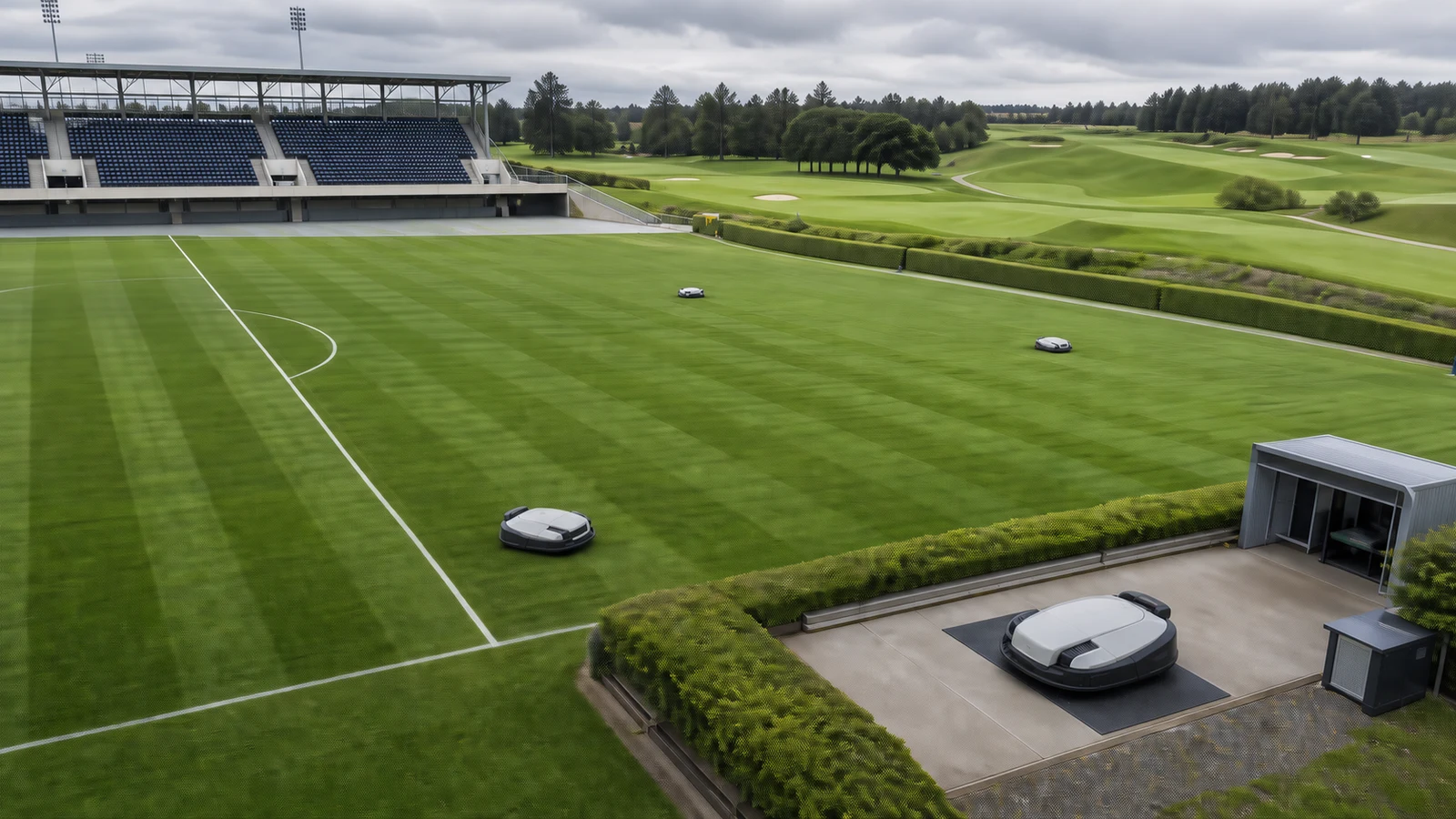
- Choose a robot mower for frequent autonomous maintenance on a stable, well-defined site; choose a ride-on when one operator must rapidly handle variable ground, overgrowth or changing tasks.
- Do not compare rated acreage with deck width alone. Measure net mowable area, terrain, edge work, supervision, transport and recovery from interruptions.
- The correct cost model includes labor, installation, energy, blades, service, downtime, finishing work and the value of equipment flexibility.
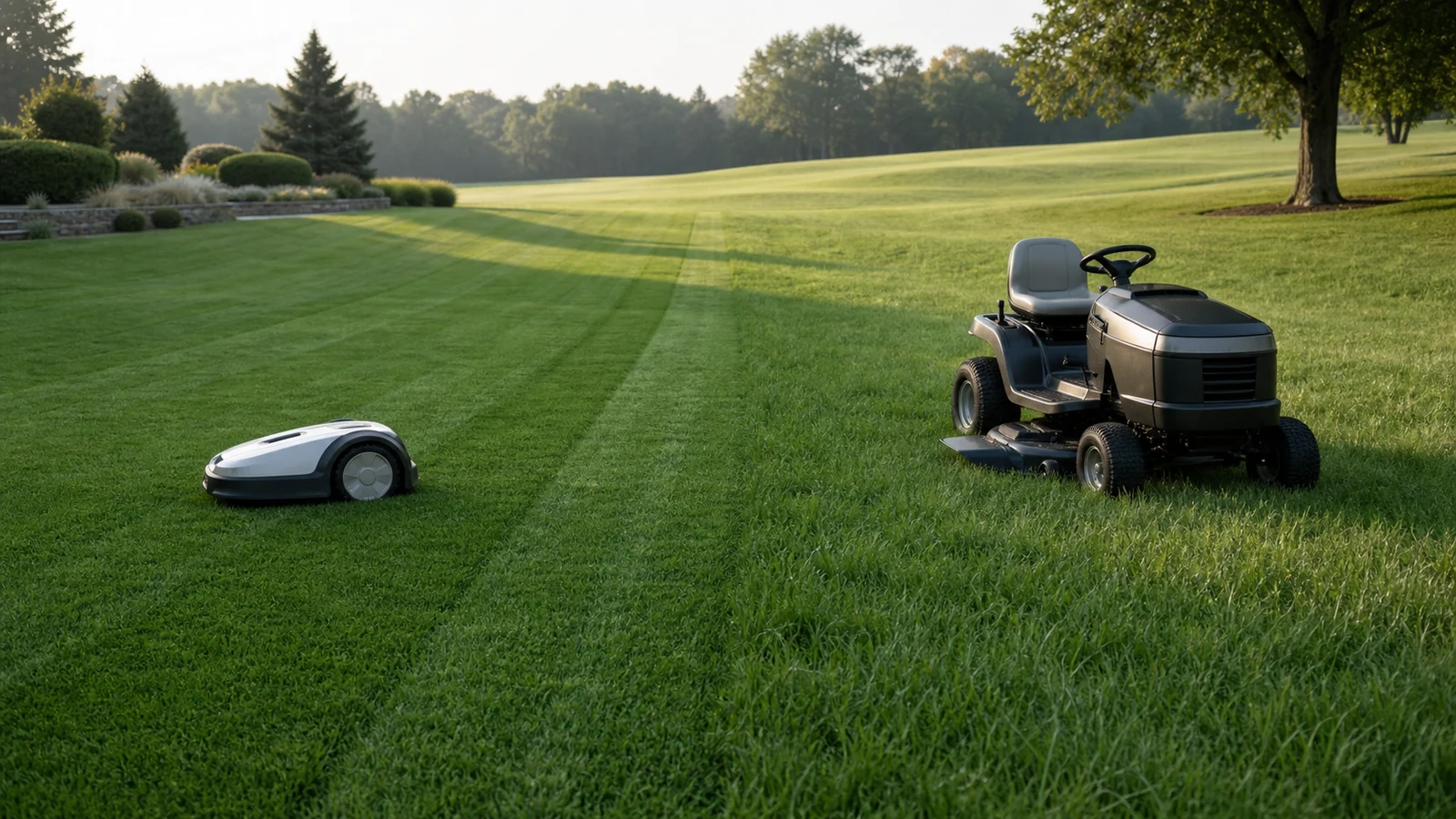
Choose a robot lawn mower when the main job is frequent maintenance of a stable, mapped lawn and the value comes from reducing operator mowing hours. Choose a ride-on mower when the site changes often, grass can become overgrown, transport between properties matters, or one machine must finish a large area quickly under direct control.
This is not simply a comparison between a small mower and a large one. A robot changes mowing from an operator task into a supervised system. A ride-on concentrates cutting into scheduled work sessions. The better choice depends on the whole route, not the headline acreage.
Robot Mower vs Ride-On Mower at a Glance
| Decision | Robot mower | Ride-on mower |
|---|---|---|
| Operating model | Frequent autonomous cycles | Operator-controlled work sessions |
| Best fit | Stable, mapped lawns | Variable sites and rapid intervention |
| Labor | Supervision, rescue and finishing | Operator for the full mowing period |
| Grass condition | Regularly maintained growth | Can recover from longer growth more easily |
| Edges | Often needs separate finishing | Can cover more edges but still needs trimming |
| Obstacles | Must be mapped, avoided or removed | Operator can react immediately |
| Transport | Usually installed at one site | Easy to move between sites with suitable transport |
| Noise window | Often suitable for longer schedules | Shorter but more intensive sessions |
| Main risk | Site interruptions and service dependency | Labor availability and operator productivity |
These are category tendencies, not guarantees. Commercial robot mowers, compact riders and zero-turn machines overlap. Compare the exact configuration on the actual property.
Start With Net Mowable Area
Advertised lawn capacity is not the same as the area a machine will maintain successfully.
Measure the grass that must actually be cut. Remove buildings, ponds, hardscape, planting beds and permanently excluded zones. Then record the route between sections. A property with two open hectares is easier than the same area divided by gates, trees, narrow passages and road crossings.
For a robot, ask:
- Can every work area connect to the charging station?
- Does the positioning method remain reliable near trees and buildings?
- Are slopes inside the machine’s operating limits?
- Will wet ground, holes or exposed roots create repeated rescues?
- Can temporary event zones be changed without rebuilding the installation?
For a ride-on, measure:
- productive cutting width after overlap;
- turning and reversing time;
- transport time;
- fuel or charging stops;
- clipping or collection workflow;
- access through gates;
- time spent avoiding people, vehicles and irrigation.
Do not select a robot by rated acreage or a rider by deck width alone. Record accepted area per paid hour and the work left for another tool.
The Labor Difference Is Not “Person or No Person”
A ride-on requires an operator while it is cutting. Its labor cost is visible.
A robot replaces much of that driving time, but it creates other work:
- site setup and mapping;
- pre-run inspection;
- blade changes and cleaning;
- recovery after a stop;
- edge trimming;
- app and connectivity management;
- seasonal storage and restart;
- dealer or technician coordination.
The useful metric is:
Annual labor cost = (operator mowing hours + supervision and rescue hours + finishing hours + maintenance handling hours) × loaded hourly labor rate
Use loaded labor cost, not wage alone. Include payroll burden, supervision, vehicle time and contractor margin where applicable.
Robot economics improve when the machine cuts reliably during hours that would otherwise require paid labor. They weaken when staff must repeatedly visit the site to clear toys, branches, fallen fruit, irrigation hoses or positioning faults.
Cutting Frequency Changes the Turf Result
Ride-on mowing commonly removes more growth in one pass. The operator chooses when to mow and can respond to uneven conditions.
Robot mowers normally remove small amounts more frequently. This can maintain a consistent appearance and return fine clippings to the turf. It also means the site must stay within the robot’s normal operating envelope. A robot designed for maintenance should not be treated as a recovery machine for tall, wet or neglected grass.
Ask how the site behaves during:
- peak spring growth;
- heavy rain;
- leaf fall;
- irrigation changes;
- holiday shutdowns;
- landscaping work;
- events that block part of the lawn.
A ride-on can wait and then attack the accumulated job. A robot fleet needs a recovery plan: temporary schedule changes, manual mowing or backup equipment.
Terrain and Boundaries Decide Reliability
Open, even ground converts a robot’s autonomy into useful coverage. Complex ground consumes that advantage.
Robot buyers should test:
- the steepest real slope, including approach direction;
- transitions between surfaces;
- tree roots and drainage channels;
- soft edges beside water or drop-offs;
- narrow passages;
- satellite obstruction for RTK systems;
- reflective or texture-poor areas for vision systems;
- boundary-wire integrity for wired systems.
Read the manufacturer’s limits as test boundaries, not promises. Husqvarna’s current commercial CEORA page, for example, describes virtual boundaries, customized work areas, temporary stay-out zones and fleet control. Those functions are valuable only after the site is surveyed and the installation is proven under local conditions.
A ride-on is more adaptable moment to moment, but slope stability, traction, rollover risk and ground damage still matter. The operator must have a documented safe route. A powerful rider is not automatically suitable for every bank or wet surface.
Edge Work Can Reverse the Labor Saving
Robots protect their cutting system by keeping blades inside the body. Physical walls, raised curbs, fences and planting edges can therefore leave an uncut strip.
Measure the total linear edge, not just lawn area. A large open field may need little finishing. A small formal garden can contain hundreds of meters of borders.
Classify edges:
- flush paving that a mower can safely overlap;
- raised hard edge;
- soft planting edge;
- fence or wall;
- water, drop-off or traffic boundary.
Estimate the weekly trimming time for each. A robot that saves three mowing hours but adds two difficult trimming hours has not delivered the expected labor result.
Safety Requires an Operating System
Both machine types contain cutting equipment. Automation changes responsibility; it does not remove it.
For a robot installation, define:
- allowed operating windows;
- inspection before unattended operation;
- exclusion of children, pets and public activity;
- handling of toys, cables and temporary objects;
- safe shutdown before lifting or servicing;
- incident and damaged-blade procedure;
- who receives alarms;
- who can remotely restart the machine.
For a ride-on, require trained operators, machine inspection, slope rules, safe transport and control of the work zone. The site’s risk assessment must follow local law and the exact manual.
Never assume sensors make a robot safe around uncontrolled public activity. A commercial buyer should test obstacle behavior and build physical or scheduling controls around the residual risk.
Build a Three-to-Five-Year Cost Model
Compare systems over the same period and the same accepted result.
Robot mower costs
- robot, charging station and positioning equipment;
- installation and site preparation;
- connectivity or fleet software;
- electricity;
- blades and wear parts;
- seasonal service;
- battery or drive repair reserve;
- supervision and rescue labor;
- edge finishing;
- backup mowing;
- downtime and dealer travel.
Ride-on mower costs
- machine and attachments;
- finance cost;
- fuel or electricity;
- operator labor;
- blades, belts, tires and filters;
- scheduled service and repair;
- trailer or transport;
- storage;
- insurance where applicable;
- trimming and cleanup;
- downtime and replacement rental.
Use this structure:
Five-year TCO = purchase and installation + finance + energy + labor + consumables + service and repair + transport and storage + downtime − residual value
Do not enter a zero for a cost that has not been quoted. Mark it “unknown” and request evidence.
Our robot mower cost and maintenance guide provides the broader ownership inputs. Buyers evaluating the category should also use the robot lawn mower buying guide.
When the Robot Is Usually the Better Choice
A robot is strongest when:
- the site is stable and remains at one location;
- frequent mowing is desirable;
- the route can be mapped reliably;
- edges are manageable;
- staff can supervise several machines;
- local service and parts are available;
- quiet operating windows create value;
- the organization wants to reassign mowing labor.
The business case should name the tasks receiving the released labor. “Labor saving” is incomplete if employees remain idle or if the robot adds new service trips.
When the Ride-On Is Usually the Better Choice
A ride-on is stronger when:
- sites change daily;
- grass height varies substantially;
- one machine must handle several attachments;
- transport between contracts is normal;
- immediate operator judgment is required;
- the lawn has frequent temporary obstacles;
- service coverage for robotics is weak;
- the operation needs rapid recovery after weather delays.
Contractors often value flexibility more than continuous autonomous coverage. A rider can leave one property and serve the next. A robot installed at one site cannot automatically create the same utilization.
A Mixed Fleet Is Often the Practical Answer
The decision does not have to be one machine replacing the other.
A robot can maintain predictable open zones while a ride-on handles recovery, seasonal growth, rough ground and sites that cannot support an autonomous installation. The rider also provides resilience during robot downtime.
Compare the mixed fleet with both single-system options. Include utilization: an expensive backup that rarely operates may be justified at a high-consequence site, but not at every property.
Run a Paid Pilot Before Fleet Rollout
Use a representative site and a full growth period.
Record:
- accepted mowable area;
- scheduled and completed robot hours;
- intervention events;
- operator and finishing minutes;
- missed zones;
- turf damage;
- energy;
- blades and consumables;
- service response time;
- public or staff complaints;
- manual recovery work.
Do not let the supplier select only the easiest lawn. Include the worst narrow passage, tree cover, slope and edge condition that the production fleet must handle.
For channel and service planning, see our robotic mower sales-channel guide.
Procurement Checklist
- Map net mowable area and every transport route.
- Calculate loaded labor, not wage alone.
- Measure edge-finishing time.
- Test the real slope and weakest positioning zone.
- Define public-safety operating windows.
- Obtain parts, battery and service commitments.
- Model weather recovery and backup mowing.
- Compare accepted result over three to five years.
- Run a pilot with agreed KPIs.
- Put downtime responsibility in writing.
FAQ
Is a robot mower cheaper than a ride-on mower?
It can be when stable autonomous coverage replaces substantial paid driving time. It can be more expensive when installation, rescues, finishing work and weak service consume the saving. Compare total cost for the same site and result.
Can a robot mower replace a ride-on mower completely?
Sometimes on a predictable maintained site. Many operations still need a rider or contractor for seasonal recovery, rough areas, major debris and robot downtime.
Which mower is better for several customer properties?
A ride-on is usually easier to transport and redeploy. Installing robots can work for long-term service contracts, but the commercial model must recover installation, service and asset risk at each site.
Does a robot mower eliminate lawn-care labor?
No. It reduces direct mowing time and shifts labor toward inspection, finishing, maintenance, exception handling and turf work.
What should a dealer prove before sale?
Site survey competence, installation quality, positioning performance, parts availability, service response and a documented recovery process.
Final Decision
Choose the operating model before choosing the machine. A robot mower buys repeated autonomous coverage. A ride-on buys immediate control and flexibility. The winner is the system that produces the required turf result with the lower verified labor, service and downtime burden on the actual site.