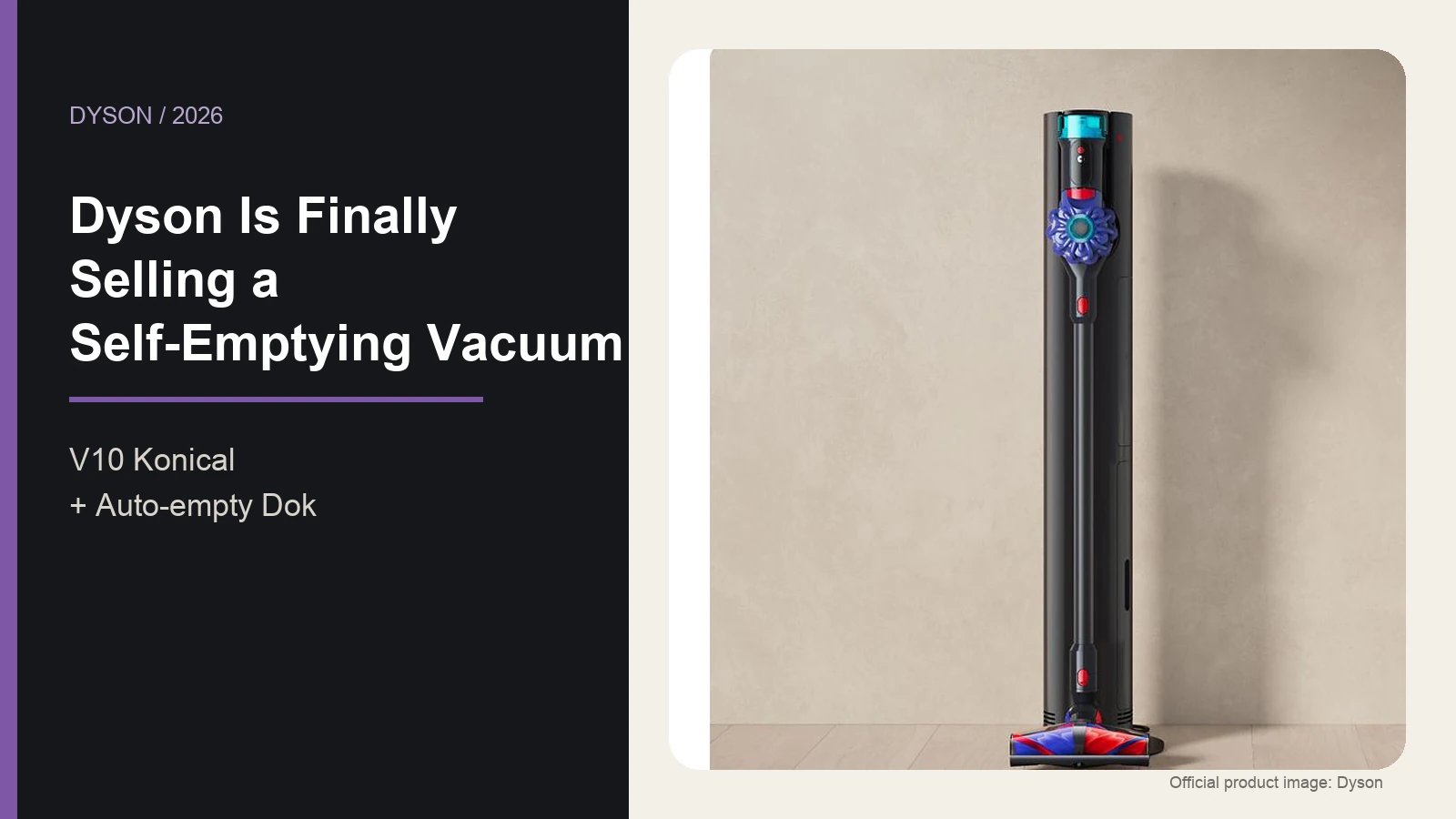
- V16 Piston Animal is the feature upgrade: 315 AW claim, conical anti-tangle head, floor sensing and CleanCompaktor dust compression.
- Gen5detect remains attractive when discounted and can match or beat the newer machine on some real pickup tasks, so do not buy on Air Watts alone.
- Check head maneuverability, bin hygiene, tool compatibility, weight, battery replacement and local repair pricing before upgrading.
In this article 12 sections
Buy the Dyson V16 Piston Animal for its new all-floor conical head, higher 315 Air Watt claim and CleanCompaktor bin—not because a larger specification guarantees better pickup. Buy Gen5detect when it is materially cheaper, its proven heads fit your floors and you do not need dust compression.
Independent testing has shown that the older Gen5detect can still outperform the V16 on some debris and floor combinations. The upgrade decision is therefore about the whole cleaning system.
V16 Piston Animal vs Gen5detect at a Glance
| Decision factor | V16 Piston Animal | Gen5detect |
|---|---|---|
| Maximum manufacturer suction claim | Up to 315 AW | Up to 280 AW, depending on market specification |
| Main floorhead | All Floor Cones Sense with two conical rollers and floor-type adaptation | Digital Motorbar plus Fluffy Optic head in common Absolute bundles |
| Hair handling | Conical bars spiral long hair toward the inlet | Anti-tangle vanes on Digital Motorbar; separate soft roller for hard floor |
| Bin | CleanCompaktor compression and wipe-clean emptying | Conventional point-and-shoot bin |
| Runtime headline | Up to 70 minutes | Up to 70 minutes |
| Built-in tool | Crevice/dusting access in the wand | Built-in crevice/dusting tool on common models |
| Best fit | Buyers wanting fewer bin-empty cycles and one adaptive head | Buyers valuing proven pickup, separate specialized heads and discount value |
Bundle contents and names vary. Compare the complete model code and tools, not only “V16” and “Gen5.”
Cleaning Performance: Air Watts Are Not Pickup
Dyson states that V16’s 900 W Hyperdymium motor can produce up to 315 AW. Gen5detect’s headline is lower. But a complete cleaner must transfer airflow through the head, seal against the floor and agitate debris.
Pickup changes with:
- nozzle opening;
- roller geometry and speed;
- floor seal;
- automatic power behavior;
- filter loading;
- debris size;
- push force;
- battery state.
Use four controlled tests: fine dust on hard floor, cereal at a wall, sand in medium carpet and long hair across mixed flooring. Weigh the debris before and after and inspect roller ends.
The V16 is not a guaranteed upgrade if the new head pushes large debris, seals too strongly to a rug or is less maneuverable around furniture.
All Floor Cones Sense vs Gen5 Heads
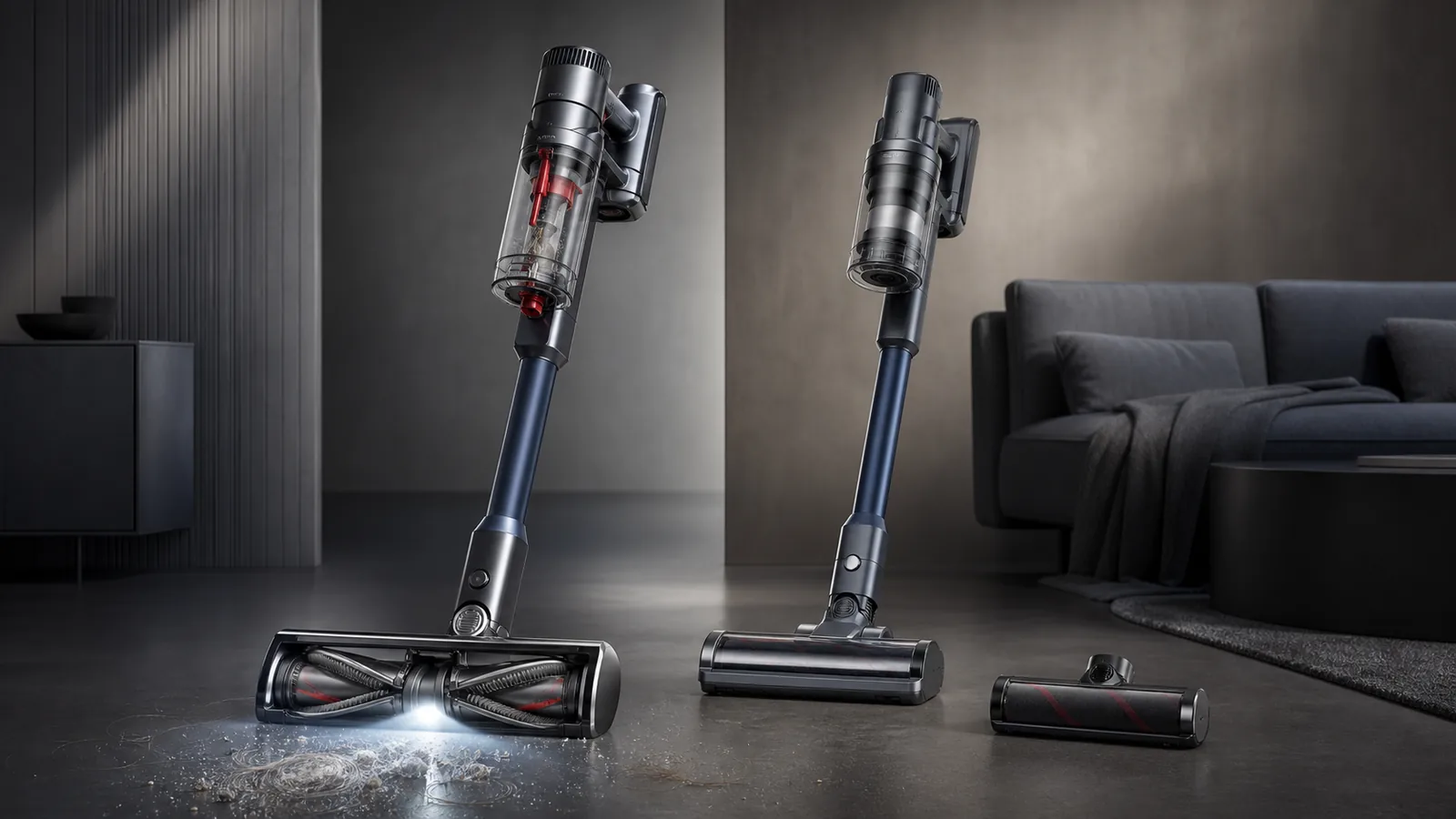
V16’s main engineering change is a pair of conical brush bars. Hair moves down the taper toward the central inlet instead of wrapping around a straight cylinder. The head also detects floor type and adjusts suction and brush speed.
Gen5detect commonly uses two heads:
- Digital Motorbar for carpet and mixed flooring;
- Fluffy Optic for fine hard-floor dust, with an angled light that reveals particles.
One adaptive head reduces tool changes. Two specialized heads can deliver better results when the user accepts storage and swapping.
Evaluate:
- front-edge pickup;
- wall-edge pickup;
- large-debris snowplowing;
- carpet seal and push force;
- movement under low furniture;
- hair left on cones or end caps;
- light visibility in daylight;
- replacement-head price.
Dust Compression and Bin Hygiene
V16’s CleanCompaktor is the clearest daily-use difference. Dyson states that it compresses debris to hold up to 30 days’ dust under its test conditions and wipes the bin interior during emptying.
This can reduce volume and emptying frequency, but it does not create more cyclone capacity. The manual still says to empty at the MAX line and warns that overfilling can affect performance and particle readings.
Compression trade-offs include:
- heavier debris column;
- more force at emptying;
- moist dust sticking together;
- more mechanism to clean;
- potential seal and lever wear;
- less visible indication of when fine filter loading has increased.
Gen5detect’s simpler bin has fewer moving parts. It may need emptying more often but is familiar and easy to inspect.
Do not compress damp dirt, liquids, ash or hazardous dust in either machine.
Hair, Pets and Fine Particles
V16’s conical head specifically targets long-hair shedding. Gen5detect’s Motorbar uses detangling vanes, while the Hair Screw Tool handles upholstery and pet beds.
Test three locations:
- main roller surface;
- roller ends and bearings;
- bin inlet and cyclone shroud.
Hair can leave the visible roller and still accumulate in an end cap. Pet owners should also compare the availability of mini motorized tools, washable filters and replacement rollers.
Both product families use particle counting and LCD feedback on applicable models. Treat counts as cleaning guidance, not as a certified air-quality measurement.
Filtration and Maintenance
Dyson markets sealed HEPA filtration on relevant configurations. Filtration depends on the assembled machine: filter media, seals, joints and correct installation all matter.
Routine work includes:
- emptying before overfill;
- washing the filter only as instructed;
- allowing full drying before refitting;
- clearing cyclone shroud debris;
- removing roller hair;
- checking airway blockages;
- wiping, not washing, electrical parts.
Buying a second genuine filter can reduce downtime, but the owner must rotate only completely dry filters.
Weight, Runtime and Battery
Both have up-to-70-minute headlines under defined modes and tools. Motorized floorheads, carpet resistance, Boost mode, dirt response and battery age reduce practical time.
Measure productive runtime:
`minutes cleaning floor – tool changes – blockage clearing – bin emptying`
V16’s compression can save interruption time in a high-debris home. Gen5detect may feel easier if the preferred head is lighter or more maneuverable.
Before purchase, handle the vacuum for several minutes at:
- floor level;
- stairs;
- overhead;
- handheld upholstery cleaning;
- bin emptying.
A heavy high-power cleaner can deliver excellent pickup and still be the wrong product for a user with limited wrist or shoulder strength.
Tools and Compatibility
Do not assume V15, Gen5 and V16 floorheads or powered tools are electrically and mechanically interchangeable. Dyson changes connectors, software communication and bundle contents.
Inventory:
- main floorhead;
- hard-floor head;
- Hair Screw Tool;
- combination tool;
- built-in crevice tool;
- charger and wall dock;
- spare battery;
- wet Submarine head, if applicable.
The V16 Piston Animal Submarine is a different bundle from dry-only V16. Price the extra wet head only if the user will clean compatible sealed hard floors and maintain the tank and roller after every use.
Repair, Parts and Warranty
Dyson’s U.S. pages list a two-year limited warranty for both families when purchased through the applicable route. Warranty does not eliminate downtime.
Check live availability and price for:
- battery;
- filter;
- bin and compression parts;
- cleaner head and roller;
- wand;
- charger;
- trigger/control assembly.
Gen5detect has been in market longer, which can improve repair knowledge but can also mean some colors or bundles are being phased down. V16 has newer parts with less field history.
Value: Upgrade or Discount?
Use:
`purchase price + required heads + filters + battery risk + expected repair + time saved emptying`
Choose V16 when the price premium buys a real benefit: hair shedding, fewer emptying cycles or a better one-head workflow.
Choose Gen5detect when:
- the discount is substantial;
- its two-head bundle suits hard floor and carpet;
- pickup is strong in your own test;
- simple bin hardware is preferred;
- parts are available locally.
For the previous generation decision, see Dyson V15 Detect vs Gen5detect. For company context, read Who owns Dyson?. Product teams can use our cordless vacuum manufacturing cost guide.
FAQ
Is Dyson V16 more powerful than Gen5detect?
Its manufacturer maximum is higher at up to 315 AW. That does not guarantee better pickup on every floor because the head and air path determine how power reaches debris.
Does the V16 bin really hold 30 days of dust?
Dyson states up to 30 days under its test conditions. Household debris volume varies, and the manual still requires emptying at the MAX line.
Is V16 better for long hair?
Its dual conical head is designed to move long hair toward the inlet. Inspect roller ends and test the actual hair type before relying on the claim.
Does Gen5detect still have an advantage?
It can offer better value when discounted, proven specialized heads and strong real-world pickup without a compression mechanism.
Can V16 and Gen5 tools be shared?
Do not assume compatibility. Confirm the exact part number with Dyson for the destination machine.
Sources
- Dyson V16 Piston Animal official product page
- Dyson V16 launch and engineering overview
- Dyson Gen5detect official product page
- Dyson V16 official user guide
- TechRadar V16 vs Gen5detect comparison
Sources were checked on July 26, 2026. Price, bundles and parts availability can change.