- A carpet extractor applies liquid water or cleaning solution and vacuums dirty liquid back; a true steam cleaner uses boiler-generated vapor and an ordinary steam cleaner does not automatically recover soil and liquid.
- The service term steam cleaning often means hot water extraction, so identify the machine by its liquid-delivery, boiler, suction and wastewater systems instead of its marketing name.
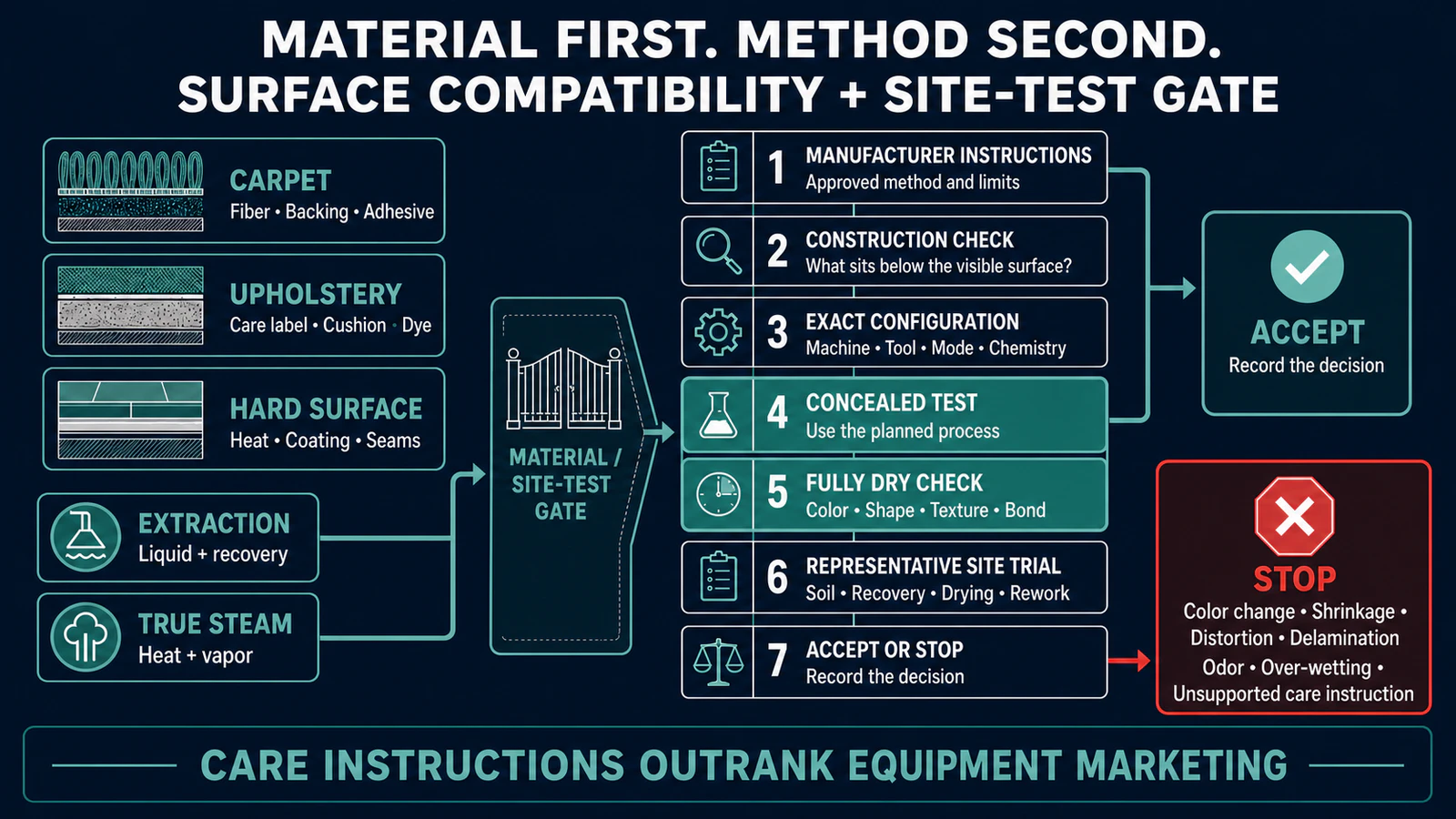
- Choose the method only after checking the material instructions, construction and care code, then test the exact machine, tool and process in a concealed area and inspect it again when fully dry.
In this article 10 sections
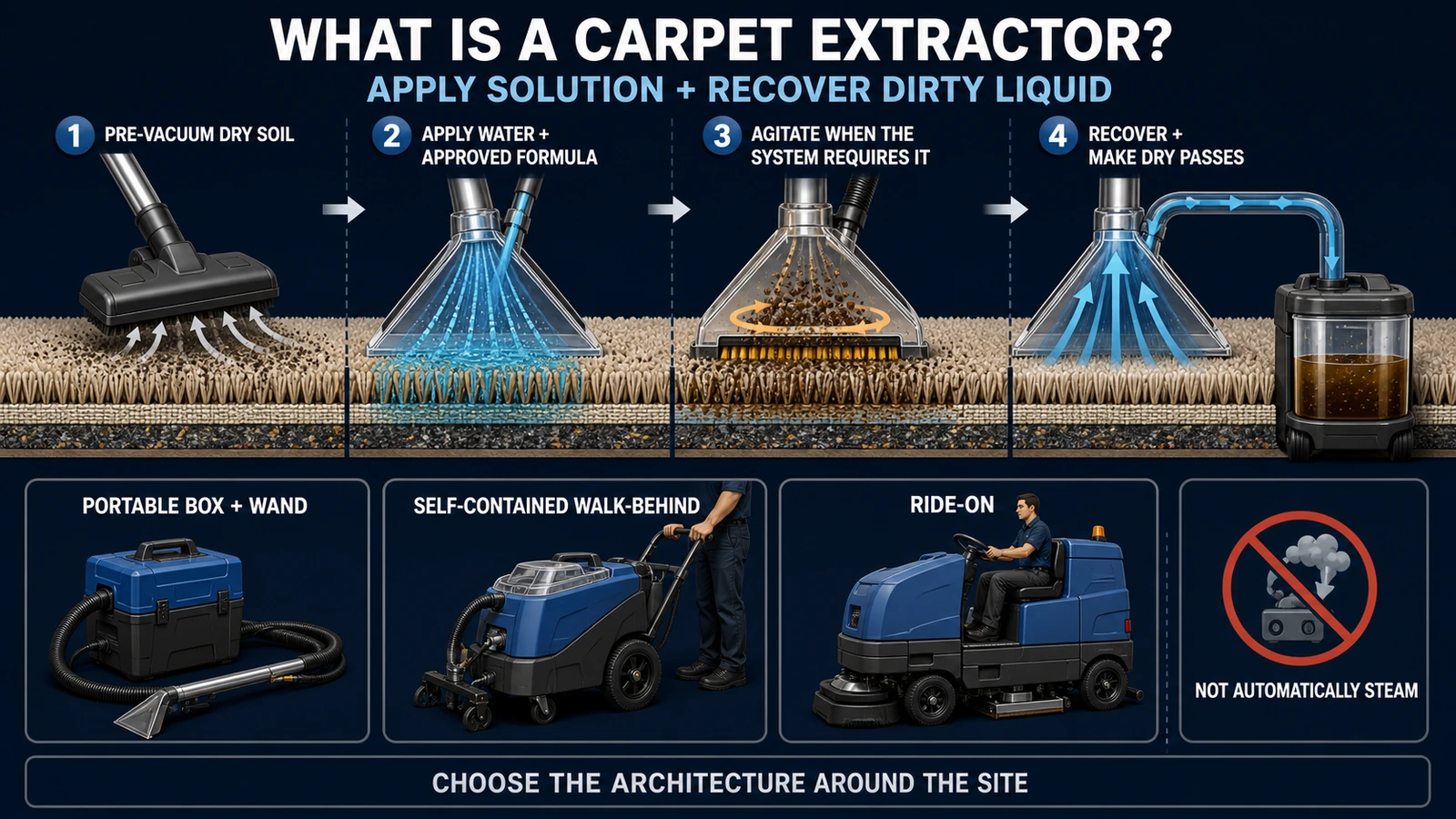
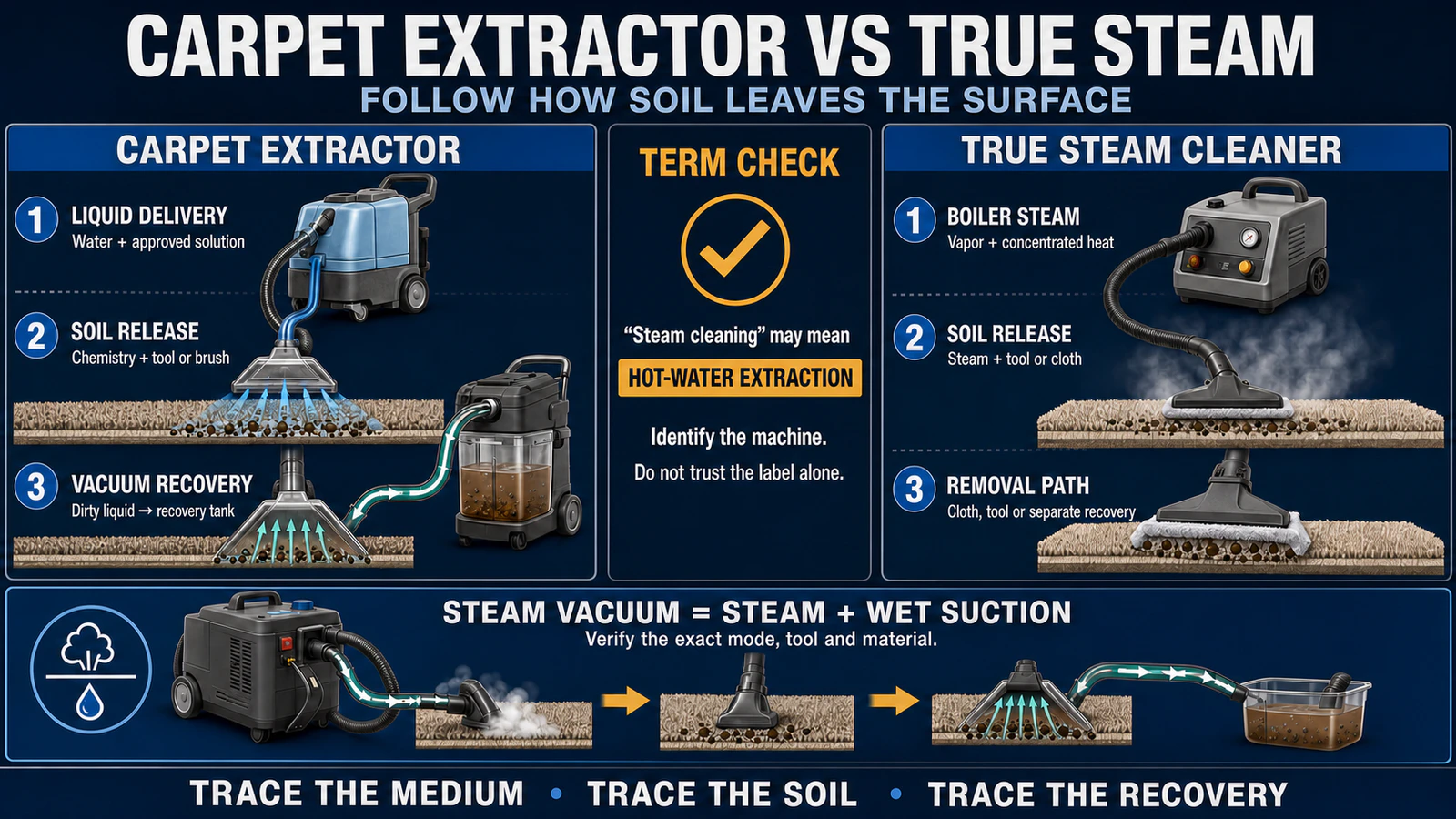
A carpet extractor applies liquid water or an approved cleaning solution to carpet or upholstery, loosens soil and vacuums the dirty liquid into a recovery tank. A true steam cleaner uses boiler-generated vapor and heat. An ordinary steam cleaner does not automatically extract the loosened soil or liquid, although a separate class of steam vacuum cleaners combines steam with wet vacuum recovery.
The names create the first risk. Carpet-cleaning contractors and product pages sometimes use “steam cleaning” to mean hot water extraction, even when no vapor steam is produced. Before choosing a method, identify the machine: does it spray liquid, generate boiler steam, provide suction and collect wastewater?
Carpet Extractor vs Steam Cleaner at a Glance
| Equipment | Working medium | Main soil-release action | How soil leaves the surface | Liquid recovery | Main material question | Typical role |
|---|---|---|---|---|---|---|
| Carpet extractor | Liquid water or approved cleaning solution | Chemistry, dwell time, spray, tool or brush action | Soil is suspended in liquid and vacuumed into a recovery tank | Integrated | Can the fiber, backing, adhesive and padding tolerate the wet process? | Deep or corrective cleaning of approved carpet and upholstery |
| Ordinary steam cleaner | Boiler-generated vapor, sometimes with a small amount of hot water | Heat, vapor and tool or cloth action | Soil is transferred to a cloth, tool or a separate recovery step | Not automatic | Can the material tolerate concentrated heat and moisture? | Approved heat-resistant surfaces; limited textile refreshing or spot work when allowed |
| Steam vacuum cleaner | Steam plus wet vacuum recovery; some models add water or detergent modes | Heat, vapor, tool action and suction | Loosened soil and liquid can be vacuumed into a wastewater tank | Integrated on the specific machine | Are the selected mode, tool and recovery path approved for the target material? | Specialized commercial cleaning where the exact machine and accessory are validated |
This table compares processes, not performance rankings. A machine still has to prove the required result on the actual carpet, backing, adhesive, upholstery and soil.
Why “Steam Cleaning” Does Not Identify the Machine
The Carpet and Rug Institute notes that facility carpet deep cleaning is known by names including hot-water extraction and steam cleaning. In that usage, “steam cleaning” may describe a wet extraction service rather than a boiler producing vapor.
BISSELL makes the engineering distinction directly: its carpet-cleaning FAQ describes a carpet cleaner as applying hot water and cleaning solution, then extracting the solution and dirt. An actual steam cleaner uses steam.
A tender, rental listing or contractor quote should therefore name the process and equipment. Record whether the unit has a solution tank, spray pump, boiler, suction motor and wastewater tank. “Hot,” “heated,” “steam” or a product name cannot answer those questions.
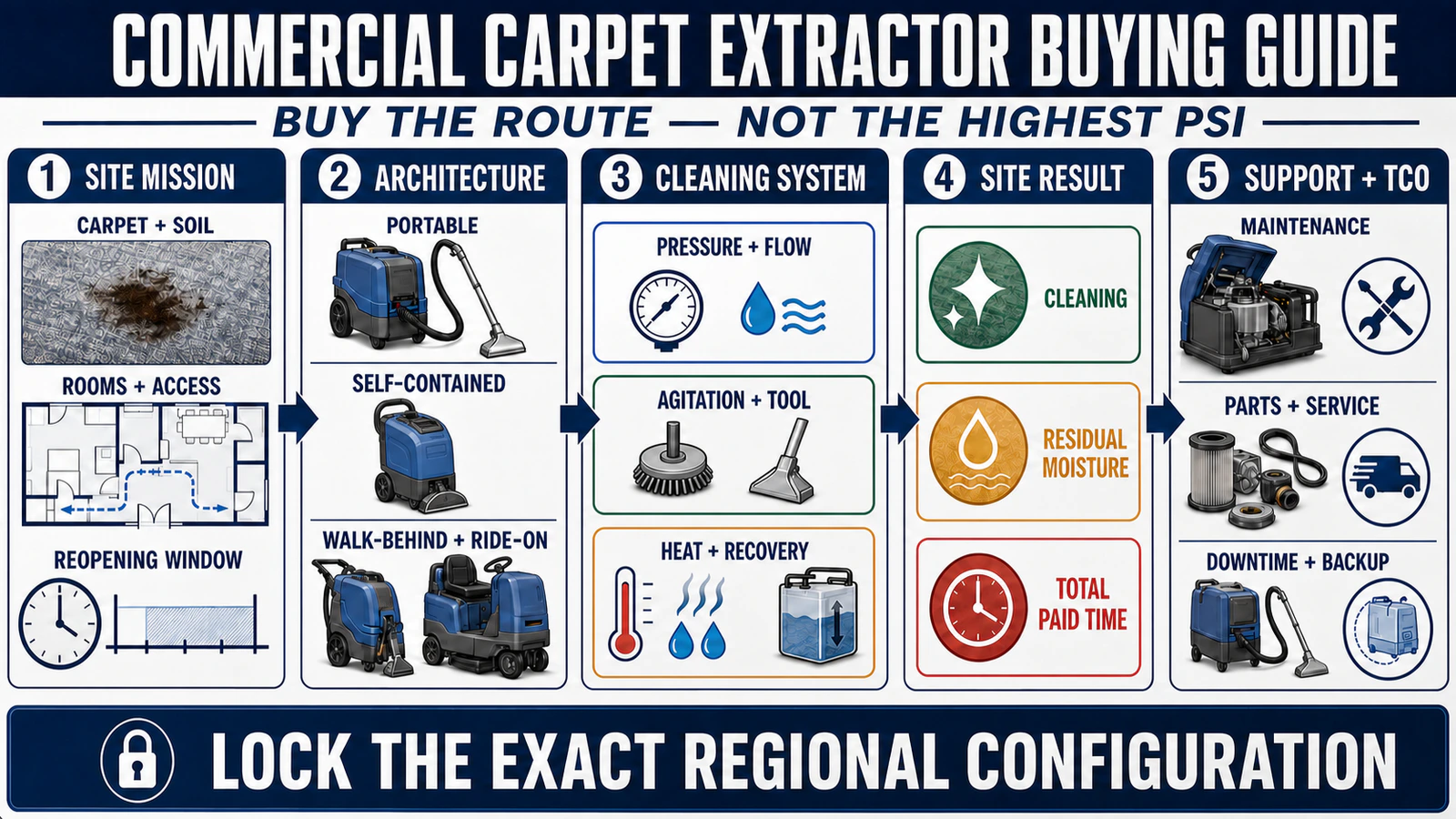
For the broader extractor definition and main equipment formats, read What Is a Carpet Extractor?. Buyers comparing extractor specifications, facility fit and ownership cost should use the Commercial Carpet Extractor Buying Guide.
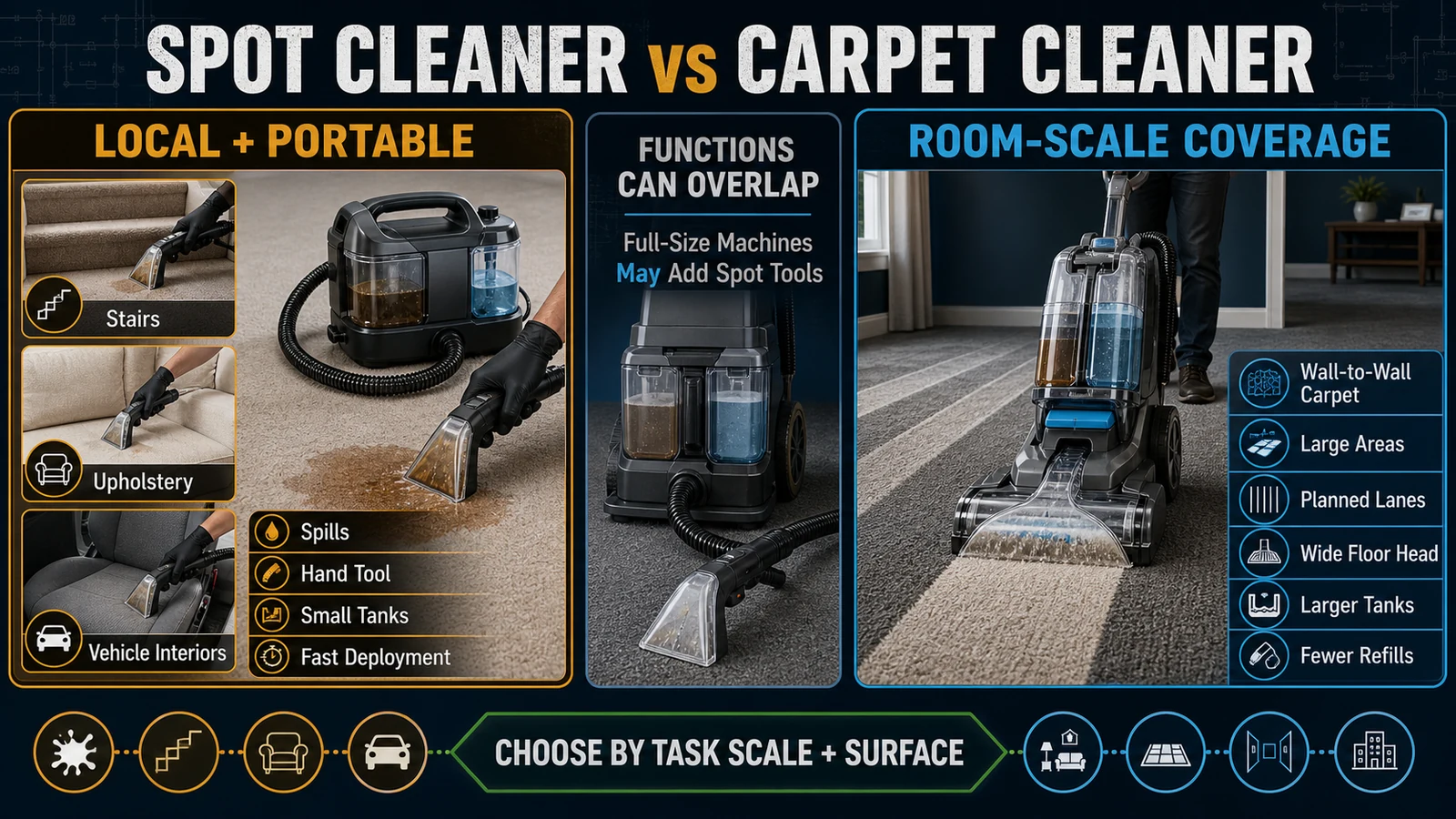
If the decision is between a portable incident-response machine and a room-scale upright, see Spot Cleaner vs Carpet Cleaner. That is an equipment-size question, not the extraction-versus-steam method decision covered here.
How a Carpet Extractor Removes Soil
In spray extraction, liquid carries chemistry to the carpet and helps suspend loosened soil. A wand, floor head or powered brush controls contact with the surface. Suction then recovers the dirty liquid.
Kärcher’s professional spray-extraction guidance describes a one-step method in which cleaning water is sprayed into the covering while loosened dirt is immediately taken up as dirty water. Its two-step method separates solution application and dwell from the clear-water rinse and recovery pass.
That recovery step is central. The Carpet and Rug Institute evaluates extractors through separate measures for soil removal, surface appearance change and residual moisture. Its residual-moisture method records the machine, attachment, settings, speed, wet passes and dry passes before weighing the carpet after a cleaning cycle.
Pressure, water temperature or vacuum claims cannot replace that system result. The relevant question is whether the exact process removes the target soil, preserves appearance and recovers enough liquid for the required reopening window.
How a True Steam Cleaner Removes Soil
A true steam cleaner heats water in a boiler and delivers vapor through a hose and tool. Heat and moisture soften or loosen suitable soil; the tool, brush or cloth then carries soil away from the surface.
That is different from flooding a textile with extraction solution, but lower liquid volume does not make the process universally safe. Kärcher’s SC 3 instructions require a concealed textile test, followed by drying and a check for changes in color or shape. The same instructions warn that heat and moisture can damage sensitive surfaces.
An ordinary steam cleaner also lacks the extractor’s standard dirty-water path. Kärcher states in its steam-cleaner FAQ that a steam cleaner can refresh the surface of carpet or address a spot, but it is not a deep carpet cleaner.
The Steam Vacuum Cleaner Exception
Some professional machines combine steam and suction. Kärcher’s SGV 8/5 operating instructions list steam-and-vacuum modes, a steam suction hose and a wastewater container. That equipment should be evaluated as a specific steam vacuum cleaner, not used to redefine every steam machine.
The exception does not remove the material gate. The selected tool, operating mode, heat exposure, suction path and cleaning procedure still need approval for the target surface.
Water, Heat and Drying Are Separate Questions
Hot water is not the same as vapor steam
A carpet extractor may accept warm or hot inlet water, include a heater, or operate without onboard heat. The working medium can remain liquid throughout the process. Confirm the boiler and output state before calling a machine a true steam cleaner.
Less liquid does not prove lower material risk
Steam uses a different water-and-heat profile, but concentrated heat can change color, shape, coatings or adhesives. Extraction introduces more liquid into the work cycle and therefore makes recovery, ventilation and full drying central controls. Each method has a different risk path.
Vacuum recovery does not prove complete drying
An extractor or steam vacuum can collect dirty liquid, yet moisture can remain in the fiber, backing, adhesive or cushion. CRI measures residual moisture after a defined cleaning cycle because the presence of suction alone does not describe the result.
Interface’s carpet-tile maintenance guide instructs users to make additional passes with solution turned off, avoid over-wetting and keep traffic off until the carpet is completely dry. Its temperature limit applies to the Interface products covered by that guide; it is evidence for checking the material manufacturer’s limit, not a universal number for every carpet.
Heat is not a universal stain or hygiene answer
Different soils respond differently to heat, water and chemistry. A hygiene claim also depends on a defined organism, surface, contact procedure and test method. Evidence for a hard, non-porous surface cannot be transferred to carpet or upholstery without matching validation.
Which Method Fits the Surface and Task?
| Surface or task | Extractor decision | Steam decision | Required gate |
|---|---|---|---|
| Installed carpet requiring deep soil removal | Often the relevant process when the carpet system permits wet extraction and the site can manage recovery and drying | An ordinary steam cleaner is not a substitute for deep extraction | Carpet manufacturer method, fiber, backing, adhesive, chemistry and reopening window |
| Carpet surface refresh or isolated mark | A spot extractor or approved tool can provide controlled liquid delivery and recovery | A steam tool may be allowed for limited work on a compatible material | Hidden test, soil type, heat response and dry-state inspection |
| Upholstery with a water-cleaning code | An approved upholstery extractor can clean below the surface and recover liquid | Steam remains a separate heat-compatibility decision | Furniture manufacturer instructions, care label, cushion construction and concealed test |
| Heat-sensitive fiber, coating, backing or adhesive | Wet extraction may still be restricted by moisture, chemistry or construction | Concentrated steam exposure can create a separate damage path | Written material limits; do not proceed from appearance alone |
| Hard, heat-resistant surface | A carpet extractor is usually the wrong architecture | A true steam cleaner may fit when the surface and tool are approved | Surface manufacturer instructions and exact steam procedure |
| Hygiene-controlled facility | Evaluate the full extraction process, wastewater handling and verified outcome | Evaluate only claims tested for the exact machine, surface and procedure | Site protocol, test scope, contact procedure, records and service responsibility |
No cell in this table grants universal approval. The same visible fabric can use different backing, adhesive, dye or cushion systems.
How to Validate the Method Before Full Use
- Read the material instructions. Start with the carpet, flooring, furniture or textile manufacturer—not the cleaning-machine marketing page.
- Identify the construction. Record the visible fiber, backing, adhesive or fixing, cushion and any coating. For upholstery, read the care label if one is present.
- Lock the cleaning configuration. Record the exact machine, regional model, tool, mode, cleaning agent, dilution, water source and operator procedure.
- Test a concealed area. Use the planned process on a location that represents the material without exposing the whole asset.
- Wait until it is fully dry. Check color, shape, texture, odor, residue, shrinkage, delamination and adhesive change after drying.
- Run a representative site trial. Measure soil removal, appearance, liquid recovery, drying, labor and any required rework on the real route.
- Stop when the material changes. Escalate discoloration, distortion, coating change, odor, over-wetting, backing movement, adhesive failure or an unsupported care instruction.
Kärcher’s spray-extraction guidance specifically says not to decide textile suitability until the test area has dried. Its steam instructions also require the textile to dry before checking color and shape. That dry-state gate belongs in both methods.
For upholstery, BISSELL advises users to check the manufacturer’s tag and limits its water-based deep-cleaning guidance to furniture carrying the relevant `W` or `WS` code. If a label instead specifies solvent-only or professional cleaning, a water extractor is not authorized by that guidance. A water code also does not prove that vapor steam is acceptable.
How Buyers and Contractors Should Specify the Job
Write the required result before naming the machine. State the surface and construction, soil, area, access, acceptable chemistry, reopening window and acceptance test. Then require the bidder to identify:
- whether “steam cleaning” means hot water extraction or true vapor steam;
- the exact equipment, tool and operating mode;
- how loosened soil and liquid are removed;
- the manufacturer instruction supporting the method;
- the concealed-test and dry-state approval process;
- the response if over-wetting or material change occurs.
This prevents a familiar service label from hiding a different process. It also separates the method decision from the equipment purchase decision.
Frequently Asked Questions
Is hot water extraction the same as steam cleaning?
It depends on how the term is being used. Carpet contractors often call hot water extraction “steam cleaning,” even though the machine applies liquid and vacuums dirty water. A true steam cleaner generates vapor. Check the equipment and recovery path.
Does a carpet extractor make steam?
Not necessarily. An extractor can use warm or hot liquid without producing vapor steam. Onboard or inline heat is a product feature, not proof that the machine is a steam cleaner.
Can a steam cleaner deep-clean carpet?
Do not assume so. An ordinary steam cleaner may refresh the surface or support an approved spot task, but it does not provide the controlled liquid extraction cycle used for deep carpet cleaning. A steam vacuum cleaner is a separate combined architecture.
Which method leaves more water behind?
There is no universal answer from the category name. Compare the exact machine, tool, process, material and operating passes. For extraction equipment, residual moisture should be measured after a controlled cleaning cycle; for steam, heat exposure and any uncollected moisture still require a dry-state check.
Can either machine clean upholstery?
Only when the furniture manufacturer permits the exact process. Water-based care codes can support an extractor on approved upholstery, while steam requires its own heat and moisture compatibility check. Test a concealed area and inspect it after full drying.
Is steam better for stains or hygiene?
Not as a general rule. Soil chemistry and material compatibility determine stain treatment. Hygiene claims require evidence for the exact machine, surface, organism and procedure. Do not transfer a hard-surface result to carpet or upholstery.
Final Decision
Choose a carpet extractor when the approved task requires liquid cleaning, soil suspension and dirty-water recovery from carpet or upholstery. Choose a true steam cleaner when the material permits concentrated heat and the task can be completed with its tool and soil-removal path.
If a supplier claims both steam and recovery, verify that the machine is a steam vacuum cleaner and test the exact mode and accessory. In every case, the material instructions and a fully dry site trial decide whether the process belongs on the surface.