- A car vacuum has no credible universal factory price until power architecture, airflow target, battery, tools, materials, packaging and test plan are frozen.
- Use a normalized 100-unit cost model to compare suppliers, then replace each assumption with quoted BOM, tooling, compliance, quality and logistics evidence.
- The lowest ex-factory quote can produce the highest landed cost when battery transport, low yield, returns, replacement parts or certification gaps are excluded.
In this article 20 sections
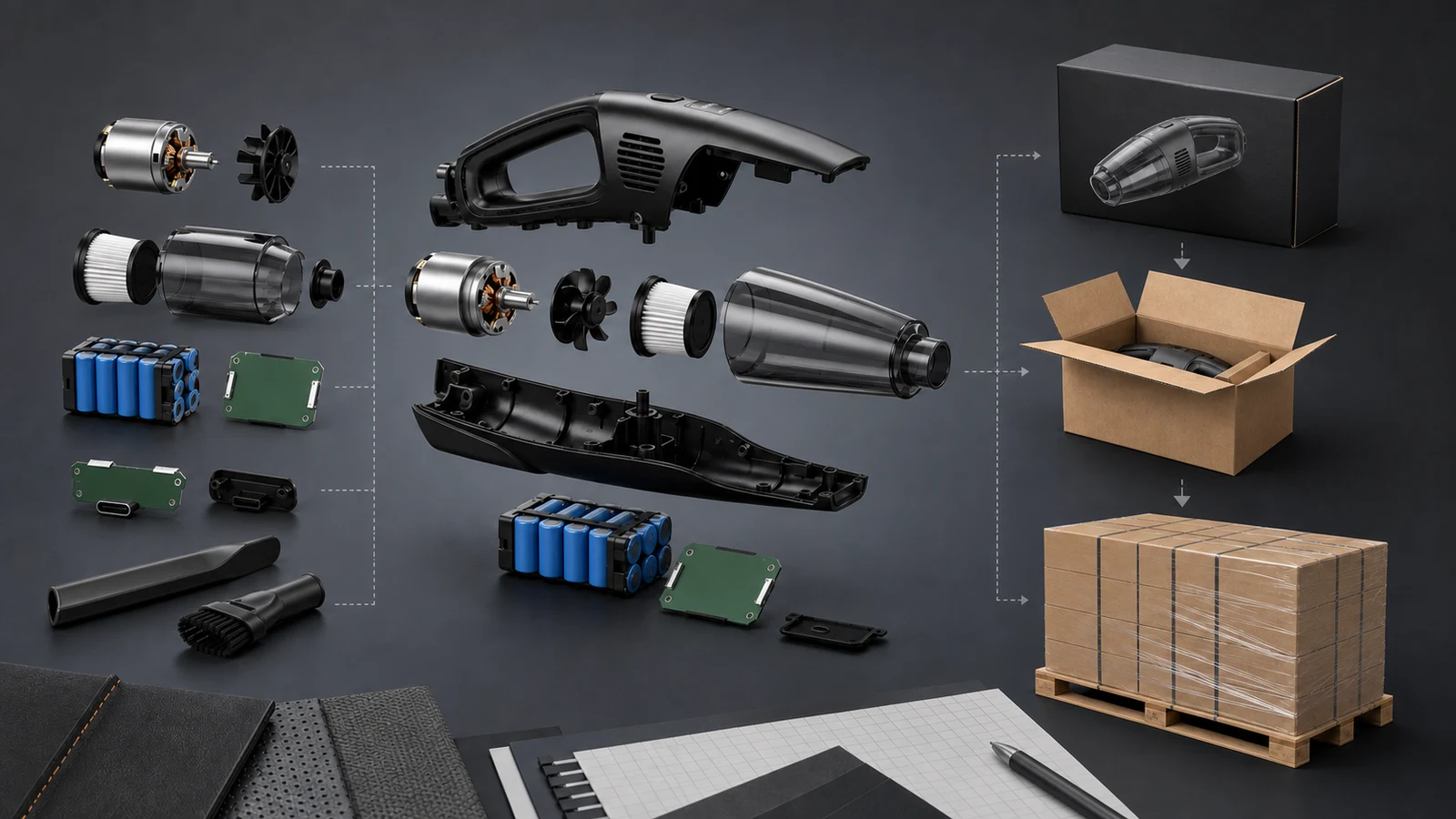
There is no reliable universal manufacturing cost for a car vacuum cleaner. A credible cost begins with a frozen specification: 12 V corded, basic rechargeable, USB-C rechargeable or high-output battery platform; target airflow under restriction; cell and charger system; attachments; plastics; filtration; packaging; compliance and warranty scope. Compare factory quotes only after every supplier prices the same definition.
For early planning, use a cost index rather than an unsupported dollar promise. Set the complete ex-factory product at 100 cost units, allocate the main systems, then replace each unit with RFQ evidence.
Cost Boundary: What Does “Manufacturing Cost” Mean?
Buyers often mix five numbers:
- material and direct conversion cost;
- factory ex-works or FOB quotation;
- non-recurring engineering and tooling;
- landed cost after logistics, duty and insurance;
- commercial cost after returns, warranty and channel fees.
Ask the supplier which number is being quoted.
Commercial unit cost = normalized factory price + allocated tooling and compliance + logistics and duty + inspection and yield loss + warranty and return reserve
This article provides a structure for that calculation. It does not replace a live quotation.
Freeze the Product Architecture
The first cost decision is the power system.
| Architecture | Main cost drivers | Main commercial fit |
|---|---|---|
| 12 V vehicle cord | DC motor, cable, plug, protection, housing | Low-cost in-car use with vehicle power |
| Basic rechargeable | Motor, cells, BMS, charger, dock or cable | Convenience-focused retail product |
| USB-C rechargeable | Cells, BMS, Type-C/PD implementation, thermal design | Travel and consumer-electronics positioning |
| High-output battery platform | Brushless motor, larger pack, controls, thermal path | Higher-performance detailing and premium use |
Do not compare a 12 V corded quote with a USB-C battery product as if the difference were supplier margin.
Freeze:
- target use time;
- cleaning duty;
- dry-only or approved wet pickup;
- motor type;
- cell count and capacity;
- charging input;
- bin volume;
- filtration;
- noise target;
- attachments;
- materials and finish;
- package contents.
Motor, Impeller and Air Path
The motor invoice does not equal suction performance.
The working result depends on:
- impeller;
- inlet restriction;
- seals;
- bin geometry;
- filter loading;
- exhaust path;
- attachment diameter.
A supplier can fit a cheaper motor and advertise a high no-load pressure. The product may lose airflow when connected to a narrow crevice tool or when the filter loads with fine dust.
Request:
- airflow and pressure curve;
- input power;
- performance with a clean filter;
- performance after a defined dust load;
- temperature rise;
- noise at a defined distance;
- motor-life test conditions.
Cost the complete air system, not only the motor.
Battery, BMS and Charging
Battery cost includes more than cells:
- selected cell and traceability;
- cell matching;
- pack structure;
- protection devices;
- BMS;
- temperature sensing;
- wiring and connectors;
- charger or USB-C power electronics;
- pack validation;
- transport documents.
UL notes that the battery, charger and machine should be evaluated as a complete system for relevant battery-powered products. Changing cells, BMS or charger after testing can trigger engineering and compliance consequences.
PHMSA states that lithium batteries offered for transport must pass the applicable UN 38.3 design tests, and manufacturers and subsequent distributors must make the test summary available under the applicable rules. A supplier saying “the cell has UN 38.3” is not the same as proving that the shipped battery design and documents match the product.
Request:
- cell manufacturer and exact model;
- pack drawing;
- BMS limits;
- charger specification;
- cycle and storage tests;
- UN 38.3 test summary;
- applicable safety reports;
- change-control commitment.
USB-C Is Not a Cosmetic Connector
A Type-C receptacle can be used in a basic power-only design or in a negotiated Power Delivery system. These have different controllers, protection, firmware and test requirements.
The USB-IF Type-C testing index lists separate functional, interoperability and Power Delivery compliance work. If the product claims USB Power Delivery or uses USB-IF marks, confirm the applicable specification, test plan and licensing requirements.
Cost decisions include:
- supported input profiles;
- charging time;
- cable and adapter included;
- third-party charger behavior;
- thermal limit at the port;
- connector cycle life;
- moisture and dust exposure;
- certification and logo use.
Do not pay for a premium Type-C claim that has not been validated across real chargers.
Plastics, Bin and Mechanical Structure
Housing cost depends on:
- part count;
- resin;
- wall thickness;
- transparent parts;
- cosmetic finish;
- inserts;
- seals;
- assembly method;
- drop requirements.
A clear dust bin can require better tooling polish and stricter cosmetic control than an opaque body. Soft-touch coatings and decorative plating add rejection risk.
The cheapest structure often uses more screws, manual alignment or post-processing. Measure assembly time and first-pass yield.
Filtration and Dust Handling
Filter cost is small compared with the cost of a product that quickly loses performance.
Define:
- primary screen;
- pleated or foam filter;
- exhaust filter;
- seal path;
- washable status;
- drying instruction;
- replacement interval;
- spare included.
Test fine dust, hair and mixed vehicle debris. Inspect bypass dust inside the motor area.
A higher-grade filter without a sealed air path does not deliver a sealed system.
Tools and Vehicle Fit
A car vacuum needs reach more than floor area.
Common accessories include:
- long crevice tool;
- brush tool;
- flexible hose;
- upholstery tool;
- blower nozzle;
- storage bag.
Each tool adds plastic, tooling, packaging volume and fit risk. A hose also adds pressure loss.
Test the exact kit in:
- seat rails;
- door pockets;
- center console gaps;
- carpet;
- mats;
- trunk;
- child-seat seams.
Remove any attachment that does not change the cleaning result. Decorative accessory count increases cost without creating value.
Packaging Is Part of Product Cost
Packaging must:
- protect the clear bin and finish;
- control loose tools;
- isolate the charger;
- survive drop and vibration;
- carry required battery and market markings;
- fit the intended shipping carton.
A smaller retail box can reduce freight and fulfillment fees, but only if product protection remains adequate.
Ask for:
- packaged dimensions and weight;
- master-carton quantity;
- pallet pattern;
- drop-test plan;
- battery-shipping configuration;
- packaging artwork responsibility.
A 100-Unit Planning Model
The following is an illustrative buyer model, not an industry average or supplier quotation.
| Cost block | Basic 12 V corded | Rechargeable USB-C | High-output rechargeable |
|---|---|---|---|
| Motor and air path | 24 | 18 | 22 |
| Battery and charging | 0 | 28 | 32 |
| Plastics and bin | 28 | 20 | 17 |
| Electronics and controls | 6 | 10 | 10 |
| Filtration and tools | 14 | 11 | 9 |
| Assembly, test and factory overhead | 18 | 13 | 10 |
| Packaging | 10 | 10 | 8 |
| Total | 100 | 100 | 108 |
The third column exceeds 100 to show that a high-output target can break the original budget. Normalize it again after the architecture is chosen.
Use the table to expose assumptions, not to negotiate a false universal price.
Tooling and NRE
Separate:
- product tooling;
- accessory tooling;
- jigs and fixtures;
- test equipment;
- industrial design;
- mechanical and electrical engineering;
- firmware;
- compliance samples;
- golden samples;
- packaging development.
Ask who owns each mold, where it is stored, how maintenance is charged and whether the buyer can transfer it.
An existing ODM shell can reduce tooling but may limit:
- air-path changes;
- battery choice;
- exterior differentiation;
- attachment compatibility;
- compliance reuse;
- exclusive markets.
Compliance Budget
The final checklist depends on market and product architecture. Do not copy a generic certificate list.
Possible workstreams include:
- appliance electrical safety;
- battery and charging safety;
- electromagnetic compatibility;
- radio approval if wireless is added;
- chemical and materials restrictions;
- energy or external-power requirements;
- lithium-battery transport;
- product markings and instructions.
Use a qualified laboratory to map the exact product and destination market.
Budget for:
- pre-compliance engineering;
- test samples;
- laboratory fees;
- travel or retest;
- document translation;
- factory follow-up;
- change control.
Certification is not a one-time logo purchase. A component change can require review.
MOQ, Yield and Unit Economics
Low order quantity changes:
- component purchasing price;
- color and packaging setup;
- cell availability;
- assembly efficiency;
- inspection cost;
- amortized tooling;
- supplier willingness to reserve capacity.
Compare quotes at the same volume and forecast.
Effective factory cost per sellable unit = total accepted production invoice ÷ units passing the agreed acceptance criteria
A low quote with 5% unusable product is not cheaper than a higher quote with stable yield.
Define defect ownership:
- rework at factory;
- replacement before shipment;
- debit note;
- spare units;
- field replacement;
- recurring corrective action.
Quality-Control Cost
Include:
- incoming cell and motor checks;
- airflow or current test;
- charging test;
- noise screening;
- leakage or wet-pickup control if applicable;
- drop and vibration sampling;
- final appearance;
- packaging verification;
- third-party inspection.
Choose tests that detect the agreed failure modes. A long generic checklist can miss the actual air-path leak.
Warranty and Spare Parts
Reserve cost for:
- DOA replacement;
- battery degradation claims;
- charger failure;
- broken latches;
- cracked bins;
- missing tools;
- motor failure;
- customer misuse diagnosis.
Ask the factory for replacement filters, bins, chargers, batteries and attachments with prices and lead times.
The product’s commercial life may be longer than its first production run. Parts discontinuation can turn a minor service issue into a full replacement.
From FOB to Landed Cost
Build the model line by line:
Landed cost = factory price + tooling and compliance allocation + inspection + origin handling + freight + insurance + duty and tax + destination handling + warehousing
Then add commercial costs:
- marketplace or retailer fees;
- fulfillment;
- returns;
- warranty;
- promotions;
- channel margin.
Do not multiply a factory price by a generic retail factor. Every channel has different costs.
RFQ Cost Sheet
Require each supplier to complete the same sheet:
Product
- full architecture and target performance;
- material and finish;
- battery and charging;
- filter and bin;
- tools;
- package contents.
Commercial
- EXW and FOB price;
- MOQ;
- price breaks;
- payment terms;
- lead time;
- validity period;
- key component assumptions.
Non-recurring
- mold by part;
- fixture and test equipment;
- engineering;
- firmware;
- certification;
- packaging;
- sample charges.
Quality and support
- acceptance criteria;
- inspection;
- warranty allowance;
- spare-part price;
- component change process;
- corrective-action response.
Where to Reduce Cost Safely
Good candidates:
- remove unused tools;
- simplify cosmetic parts;
- share an existing battery or charger platform;
- reduce part count;
- standardize screws and fasteners;
- right-size packaging;
- automate a repeatable end-of-line test.
High-risk shortcuts:
- unknown cells;
- undersized protection;
- unverified USB-C implementation;
- weak filter seals;
- thinner latches;
- omitted durability tests;
- certificates that do not match the model.
Cost reduction should remove waste, not evidence.
Frequently Asked Questions
How much does a car vacuum cost to manufacture?
The answer depends on its power, battery, charging, tools, materials, volume, testing and commercial scope. Freeze those inputs and request matched quotes; a universal public number is not reliable.
What is usually the largest cost block?
In a corded product, motor, plastics and assembly dominate. In a rechargeable product, battery and charging can become the largest system.
Does USB-C make the product cheap to charge?
Not automatically. A robust Type-C or Power Delivery implementation needs compatible controls, protection, thermal design and validation.
Can a supplier reuse an existing UN 38.3 report?
Only when the shipped battery design and documentation are demonstrably covered. Request the test summary and match manufacturer, model and configuration.
Should tooling be included in the unit price?
Keep it visible. A supplier may amortize tooling into the price, but the buyer should know the amount, volume assumption and mold ownership.
Bottom Line
Car vacuum manufacturing cost is a design and evidence problem. Freeze the architecture, normalize every quote, expose tooling and compliance, and calculate cost per sellable unit through the destination warehouse. The lowest number on the first quotation is useful only when it includes the same product and the same obligations.
Continue with the car vacuum OEM and ODM guide, the cleaning-appliance MOQ and hidden-cost guide, and the factory audit guide for cleaning-appliance suppliers.