- Choose the architecture from the debris and cleaning session: 12V for long vehicle-powered use, cordless handheld for convenience, or a larger platform for carpet and pet hair.
- Pa, air watts, watts and airflow are not interchangeable; test pickup, seal, loaded performance and runtime with the supplied tools.
- For a product stored around vehicles, battery traceability, high-temperature warnings, filters, replacement parts and a realistic cleaning test matter as much as peak suction.
In this article 17 sections
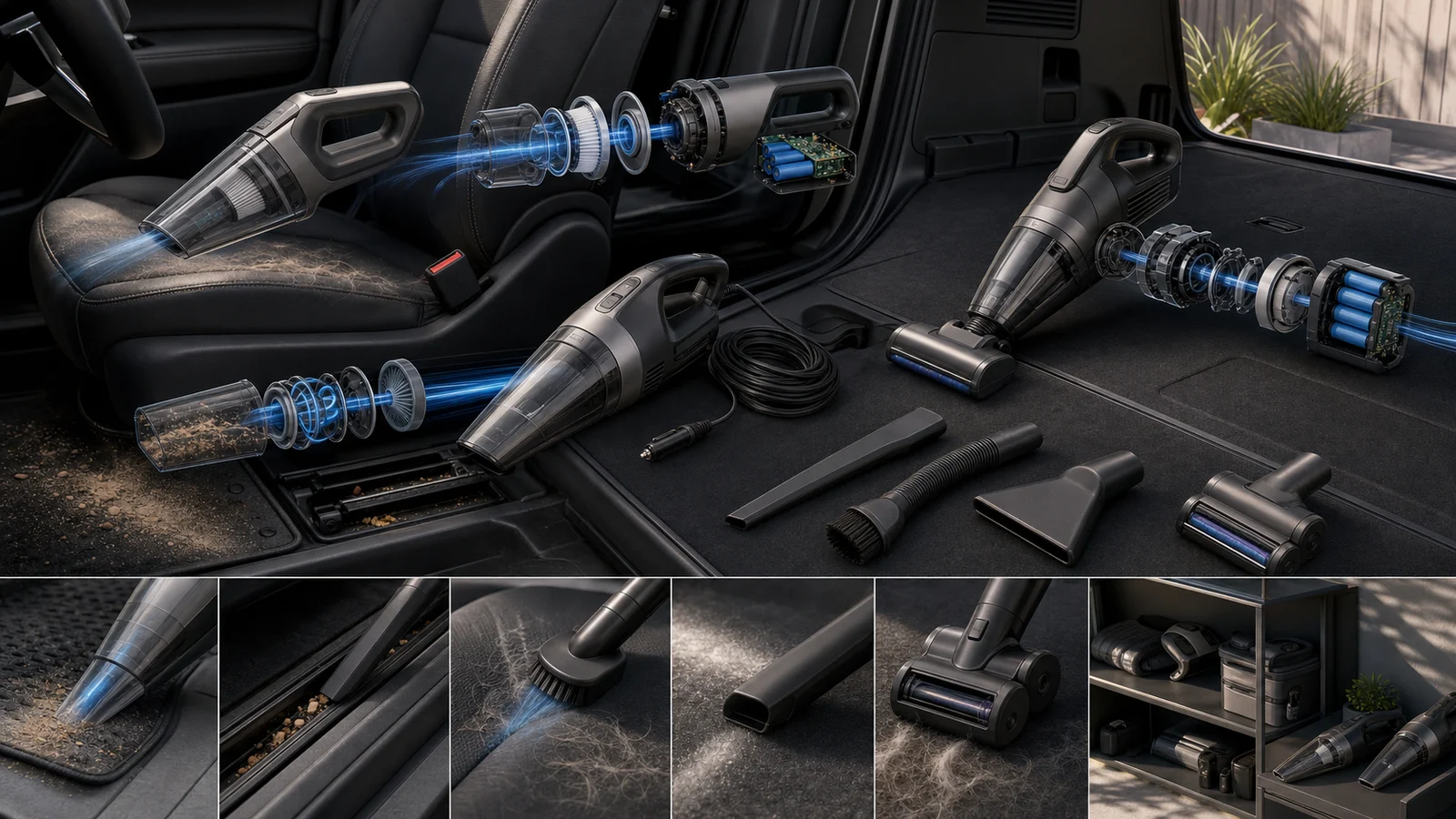
The best car vacuum is the one whose power system, air path, tools and filtration match the debris in your vehicle. For quick crumbs and dust, a compact cordless handheld may be enough. For long sessions without battery anxiety, a well-designed 12V model can make sense. For embedded sand, carpet and pet hair, a larger handheld or stick-vacuum platform with a motorized tool usually deserves priority.
Do not choose from a large “Pa” number alone. Static pressure, airflow, air watts and electrical watts describe different parts of the system. A narrow nozzle, dirty filter, leaking dust cup or weak brush can change real pickup more than a headline number.
Quick Decision Table
| Use case | Best starting architecture | What to verify |
|---|---|---|
| Crumbs, console dust, quick cleanup | Compact cordless handheld | One-hand balance, crevice access, emptying |
| Long family-car session | 12V vehicle-powered vacuum | Cable reach, plug protection, stable loaded suction |
| Sand and floor-mat grit | Higher-airflow handheld or stick-derived unit | Wide nozzle pickup, filter loading, dust-cup volume |
| Pet hair on carpet | Motorized mini brush platform | Hair removal, brush access, battery at loaded power |
| Fleet or detailing route | Swappable-battery or professional platform | Spare packs, runtime records, parts and warranty |
| Allergy-sensitive household | Sealed, verified high-efficiency system | Whole-machine leakage, filter availability and cleaning |
1. Start With the Debris, Not the Vacuum
Vehicle interiors combine several difficult soils:
- coarse grit and road sand in floor mats;
- crumbs in narrow seat rails;
- fine dust on dashboards and vents;
- hair embedded in needle-punch carpet;
- pet hair on textured upholstery;
- small leaves and stones in cargo areas;
- occasional moist debris that a dry vacuum should not collect.
A small high-pressure nozzle may pull crumbs from a crevice but clean a floor mat slowly. A wide nozzle can move more air across a mat but lose its seal around seat contours. A motorized brush can release hair, yet adds weight, cost and a new failure point.
Define the top three jobs before comparing products. “Clean a car” is too broad for a useful specification.
2. Choose the Power Architecture
12V vehicle-powered vacuums
These plug into a vehicle accessory socket and avoid an internal traction battery. Advantages can include long sessions, low storage weight and no battery aging inside the product.
Check:
- total cable length from the front socket to the cargo area;
- fuse and plug temperature under continuous load;
- vehicle socket current limits;
- whether the engine should be running under the vehicle maker’s guidance;
- cable storage and strain relief;
- voltage drop under load.
The “12V” label does not guarantee strong pickup. Current available at the socket, motor efficiency, fan design and air-path losses still matter.
Built-in-battery handhelds
These offer the fastest grab-and-go experience. They fit quick cleanups and can use a compact charging dock.
Tradeoffs include:
- limited high-power runtime;
- battery aging;
- longer recharge than cleaning time;
- a product that may be discarded if the pack is not replaceable;
- heat exposure if left in the vehicle.
BLACK+DECKER’s current Dustbuster range illustrates the mainstream compact-handheld format, including 12V MAX cordless models with washable bowls and filters.
Removable-battery platforms
A removable pack supports longer sessions and can connect the vacuum to a wider tool ecosystem. The buyer must still confirm:
- pack and charger availability;
- whether the pack is user-replaceable without defeating safety controls;
- genuine-pack cost;
- backward compatibility;
- cell, BMS and thermal protection;
- warranty treatment of the battery.
Stick-derived handhelds
Some higher-performance car vacuums reuse the motor, cyclone and battery architecture of a cordless stick vacuum. Dyson’s current Car+Boat handheld, for example, publishes 115 AW in Max mode, 40 minutes maximum runtime, a 5-hour charge, 4.2-pound weight and a 0.14-gallon bin.
This category can offer more pickup and motorized tools, but it is larger, heavier and more expensive than a mini handheld. Maximum runtime is normally measured in a lower-power configuration—not at the published Max suction.
3. Understand Pa, Airflow, Air Watts and Watts
Pascals: static pressure
Pa measures pressure difference. It helps describe the vacuum’s ability to maintain suction against restriction. It does not tell you how much air moves through a wide nozzle.
A very small inlet can produce a dramatic pressure figure while collecting broad debris slowly.
Airflow: L/s or CFM
Airflow describes volume moved per unit of time. It is important for carrying loose dust and debris through the nozzle and tube.
Published airflow is meaningful only when the measurement location and setup are stated. Free-air flow at the motor is not the same as flow at the end of a supplied crevice tool.
Air watts
Air watts relate pressure and airflow to pneumatic power. AW can be more informative than either value alone, but only when brands use compatible methods and measurement points.
Electrical watts
Input watts describe electrical consumption, not pickup efficiency. For battery products, a high input may reduce runtime and increase heat without proportionally improving cleaning.
The comparison rule
Do not convert Pa to AW without pressure and airflow data from the same operating point. Do not rank a 120W product above a 90AW product. If the units or test conditions differ, run a controlled pickup test.
4. Motor, Fan and Air-Path Design
Real suction at the surface depends on the whole path:
- inlet geometry;
- tool seal;
- hose or duct diameter;
- bends and transitions;
- cyclone or separator pressure loss;
- pre-filter loading;
- final filter resistance;
- dust-cup gasket leakage;
- fan efficiency;
- control logic as voltage drops.
Look for a short, smooth air path with sealed joints. Detach and reinstall the dust cup several times. A latch that feels convenient in a showroom may leak after tolerances, dust and gasket compression accumulate.
For private-label projects, the motor sample and the complete vacuum must be tested separately. A strong fan module can underperform in a restrictive housing.
5. Battery Capacity and Runtime
Battery energy is measured in watt-hours:
`Wh = nominal voltage × amp-hours`
Wh is more useful than mAh alone when comparing different voltages. Even Wh does not predict runtime without power draw, control strategy, cell temperature and cutoff limits.
Ask for:
- runtime in each power mode;
- runtime with the motorized tool attached;
- suction at the beginning and near cutoff;
- charge time and charger output;
- pack temperature after a full high-mode run;
- cycle-life test conditions;
- replacement-pack availability;
- cell maker and pack traceability.
A vacuum that runs 25 minutes but loses pickup quickly under filter load may be less useful than one with a stable 15-minute session.
6. High-Temperature Storage and Charging
Cars can become extremely hot in sunlight. The US Fire Administration advises storing lithium-ion batteries at room temperature when possible, not keeping them in hot cars or direct sunlight, and not charging below 32°F/0°C or above 105°F/40°C.
Practical guidance:
- do not treat the glovebox or trunk as permanent battery storage;
- do not charge a hot vacuum immediately after it has sat in the sun;
- use the supplied, safety-matched charger;
- stop using a pack that swells, leaks, smells unusual, makes noise or becomes abnormally hot;
- keep terminals and charging contacts free of metal debris;
- follow local battery-recycling rules.
For importers, a warning in the manual is not a substitute for verified cells, BMS protection, pack tests, charger safety and production traceability.
7. Filtration: Filter Media Is Not the Whole System
Fine dust collected from a car should not immediately leak back through the exhaust.
A practical filtration system may include:
- a mesh or screen for hair and large debris;
- a cyclone or settling chamber;
- a washable pre-filter;
- a fine final filter;
- seals that force exhaust through the intended media.
“HEPA filter” is often used loosely. The US EPA explains that a HEPA vacuum requires the HEPA filter as the final stage and a machine designed so air does not leak around it. A HEPA-like material in an unsealed body is not equivalent.
Ask:
- is the claim for filter media or the complete machine?
- what particle size, efficiency, dust loading and test method apply?
- is the exhaust path sealed?
- can the filter be washed, and how long must it dry?
- how much does suction fall with a normally loaded filter?
- are replacements available by exact model?
Never reinstall a wet filter unless the manual explicitly permits it. Moisture can damage the motor and encourage odor.
8. Dust Cup and Emptying
Small cups keep the vacuum compact but fill quickly with bulky hair and leaves. Evaluate usable capacity, not only molded volume.
Check:
- whether the maximum line is visible;
- whether debris bridges before the cup is nominally full;
- one-touch emptying versus removing the filter by hand;
- how much dust escapes during dumping;
- whether hair wraps around the shroud;
- whether the cup and seals can be washed;
- drying time and reassembly error risk.
For retailers, record how often testers touch dirty components. An elegant emptying claim can become a return driver if hair must be pulled out manually.
9. Accessories That Actually Matter
Long crevice tool
Essential for seat rails and console gaps. Verify that the tip fits the target gap without choking airflow completely.
Flexible extension hose
Improves reach and lets the main body stay outside a tight footwell. It also adds pressure loss and may collapse if the wall is too soft.
Dusting brush
Useful for vents and dashboards, but bristles must be soft enough not to scratch glossy trim.
Wide upholstery nozzle
Speeds flat-seat and cargo-area cleaning. A transparent head helps the user see blockage.
Motorized mini brush
Often the best tool for embedded pet hair. Check tangle removal, shaft sealing, bearing life and whether the tool has its own current draw and runtime disclosure.
Inflator or blower function
Some mini products add blowing or inflation. Treat these as separate performance modes. Reversing airflow does not automatically make a good tire inflator, electronics duster or safe compressed-air tool.
10. Weight, Balance and Noise
Handheld weight is carried at the wrist. A 4-pound product may be manageable for a short cargo-area session but tiring in a long footwell clean.
Test:
- center of gravity with an empty and half-full cup;
- trigger force and grip circumference;
- reach under front seats;
- whether the exhaust blows dust ahead of the nozzle;
- high-frequency motor tone near the user’s ear;
- vibration through the handle;
- ability to set the product down without rolling.
Noise should be reported with test distance, room and power mode. A bare dB number without conditions is not comparable.
11. Wet Debris and Safety Boundaries
Most car vacuums are dry-only. Do not collect spilled drinks, flammable liquids, hot ash, sharp metal or fine hazardous dust unless the manufacturer explicitly rates the product and provides the required controls.
If a product claims wet-and-dry operation, verify:
- liquid capacity and float shutoff;
- separation between liquid and motor/electronics;
- cleaning and drying procedure;
- corrosion resistance;
- misuse tests at slopes likely inside a vehicle.
“Wet and dry” is a safety architecture, not a marketing icon.
12. A Buyer Test That Reveals More Than the Box
Build a repeatable test kit with:
- fine standardized dust;
- sand of defined size range;
- cereal crumbs;
- short and long hair;
- carpet, rubber mat and upholstery coupons;
- a real seat-rail fixture.
For each vacuum:
- condition the filter and battery consistently;
- weigh the debris;
- run the same stroke pattern and time;
- weigh collected and remaining debris;
- repeat after loading the filter;
- record runtime with the supplied tool;
- check battery, plug and housing temperatures;
- measure emptying and cleanup time;
- inspect dust leakage around seals;
- repeat after drop, vibration and dust-cup cycling tests.
Report both pickup percentage and time. A product that collects 90% in 20 seconds can be more useful than one that reaches 95% after two minutes.
13. Maintenance and Replacement Parts
Before buying, search the exact model for:
- filters and pre-filters;
- dust cup and seals;
- crevice and brush tools;
- charger;
- battery pack;
- motorized-brush roller and belt;
- warranty support.
Washable does not mean permanent. Filter fibers, seals and batteries age. A low-priced vacuum with no replacement filter can have a shorter useful life than a more expensive supported platform.
14. Private Label and OEM Checklist
For a branded car-vacuum program, the RFQ should define:
- target debris and surface mix;
- 12V, built-in battery or removable pack;
- target pressure, airflow and complete-machine AW method;
- runtime by mode and tool;
- dust-cup usable volume;
- filtration efficiency and whole-machine leakage;
- noise test method;
- high/low-temperature operation and storage;
- cell, BMS, charger and supplier traceability;
- UN 38.3 test summary for transport;
- destination-market electrical, EMC, chemical and labeling plan;
- drop, switch, latch, hose and filter-life tests;
- replacement filter and battery availability;
- artwork, carton and multilingual manual requirements.
PHMSA notes that lithium-cell and battery designs offered for transport must pass UN 38.3 and that test summaries must be available through the supply chain. Verify the underlying model identifiers and reports; do not accept a cropped certificate image.
Our car vacuum cleaner OEM/ODM guide goes deeper into project development. Also review the hidden risks in cordless vacuum development, cordless vacuum manufacturers in China and cleaning-appliance compliance guide.
Frequently Asked Questions
How many Pa should a good car vacuum have?
There is no universal threshold. Pa is static pressure and must be considered with airflow, tool geometry, measurement point and loaded-filter behavior. Run a pickup test on the debris you actually have.
Are air watts better than Pa?
AW combines pressure and airflow and can be more informative, but only when products use comparable methods. It still does not measure brush agitation, filtration leakage, noise or runtime.
Is a 12V corded car vacuum better than cordless?
It is better for some long sessions and avoids internal-battery aging. Cordless is faster to deploy and works away from the vehicle socket. Compare cable reach, socket limits, actual pickup and storage conditions.
Can I leave a cordless vacuum in the car?
Permanent hot-car storage is not recommended. USFA specifically warns against keeping lithium-ion batteries in hot cars or direct sunlight.
Does a HEPA filter make the vacuum HEPA?
Not necessarily. Effective HEPA performance requires the final filter and a sealed air path that prevents bypass leakage.
Should I buy a motorized brush?
It is valuable for embedded pet hair and carpet, but adds cost, weight, current draw and maintenance. Test it with the actual hair and textile.
Can a dry car vacuum pick up liquids?
No, unless the exact model is designed and rated for wet pickup. Liquid can reach the motor, battery or electronics.
Bottom Line
Choose a car vacuum from the job backward. Define debris, surfaces, session length and storage conditions; then compare the power architecture, complete air path, supplied tools, filtration, emptying and replacement parts.
A large suction number can attract a click. Stable pickup with a loaded filter, a battery that is safely documented, a crevice tool that reaches the seat rail and filters that remain available are what create a product people keep using.