- BISSELL currently sells two FlexClean robot vacuum-and-mop models in the United States, so the current answer is clearly yes.
- The 2026 platform adds LiDAR, app control and self-emptying while keeping BISSELL’s pet-hair, wet-cleaning and formula positioning.
- Official product pages prove the brand, model and support offer, but they do not identify the physical OEM factory behind a specific unit.
In this article 13 sections
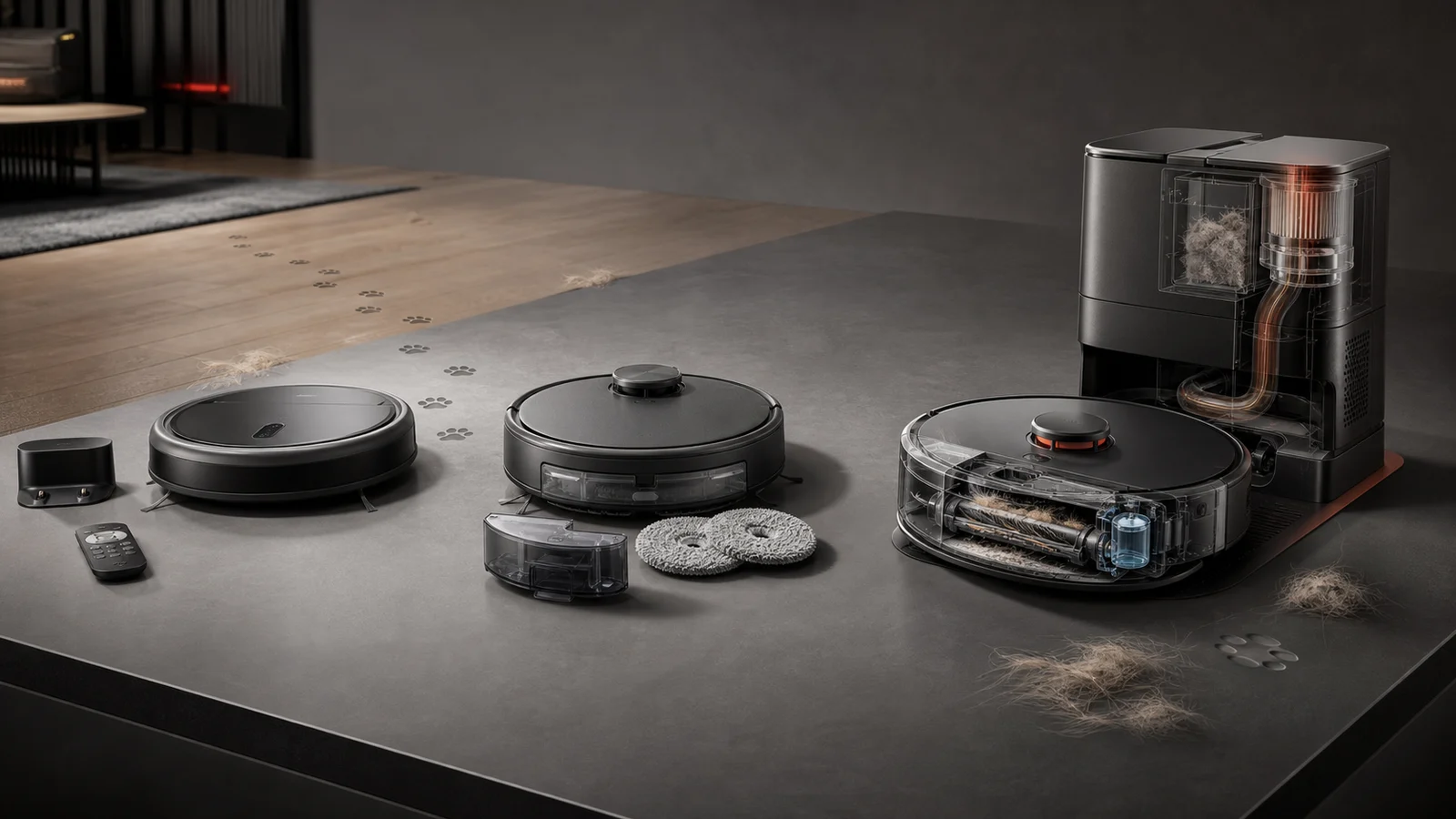
Yes. BISSELL currently sells robot vacuums under its own brand. As of July 25, 2026, the company’s U.S. robot-vacuum category lists two new vacuum-and-mop robots: the FlexClean model 4270 and the FlexClean FurForce model 4270L. Both add LiDAR navigation, App control and a self-emptying base to BISSELL’s established pet-cleaning and wet-floor-care position.
There is an important qualification. A brand product page proves that BISSELL offers, supports and warrants the model through its channel. It does not by itself identify the factory that physically builds the robot. “Does BISSELL make robot vacuums?” therefore has two answers:
- Brand and product answer: yes.
- Exact contract-manufacturer answer: not disclosed in the official public pages reviewed for this article.
That distinction matters to consumers, retailers and OEM suppliers for different reasons. Consumers need the correct current model, parts and App. Retailers need to know which generation they are listing. Industry buyers need evidence at the legal-entity, model, factory, component and software levels instead of turning a familiar brand name into an unsupported manufacturing claim.
The Current BISSELL Robot-Vacuum Lineup
BISSELL’s U.S. category page currently presents two closely related models. Prices are volatile, so the figures below are the regular prices displayed by the category page when checked on July 25, 2026; a product page or retailer may show a promotion.
| Model | Official U.S. positioning | Core published features | Category-page price checked July 25, 2026 |
|---|---|---|---|
| FlexClean 4270 | 2-in-1 Vac and Mop Robot | 6,000 Pa motor claim, 360React LiDAR, App scheduling, self-empty dock, HEPA filtration, up to 180 minutes | $579.99 |
| FlexClean FurForce 4270L | Pet-focused 2-in-1 Vac and Mop Robot | LiDAR, NeverTangle brush roll, App, self-empty base, hair-pickup comparison claim, up to 180 minutes | $599.99 |
The two official product pages list the same 3-liter dirt capacity, 0.25-liter clean-water capacity, five-hour charge time and 19-pound product weight. They use different colors and product names, and the FurForce page gives greater prominence to its pet-hair comparison claim.
Those similarities suggest that buyers should treat 4270 and 4270L as exact model variants that require line-by-line comparison, not assume that every marketing-name difference means a different chassis. The product label, package contents, warranty, firmware and channel SKU remain the final references.
What the FlexClean 4270 Actually Adds
The FlexClean 4270 product page describes a robot that can vacuum carpets, rugs and hard floors, then add mopping on sealed hard floors. The buyer controls cleaning through an App, while an LDS area-mapping sensor supports LiDAR navigation.
The platform’s practical change is not one specification. It is the combination of:
- mapped navigation rather than a basic remote-controlled routine;
- dry pickup and hard-floor mopping in one robot;
- a self-emptying dock rather than a charging-only dock;
- a 180-minute published maximum runtime;
- a pet-hair-oriented brush and debris message;
- a replaceable-pad and cleaning-formula system.
BISSELL lists a 6,000 Pa suction motor and says the machine has twice the suction of a named Shark Matrix model. The footnote is essential: the comparison is stated at the motor inlet using ASTM F558. That is not the same as proving twice the pickup on every carpet, twice the airflow at the floor head or twice the whole-home cleaning result.
For a careful comparison, keep at least four evidence levels separate:
- motor or sealed-suction result;
- airflow and air-power through the assembled robot;
- controlled pickup on a defined surface and debris;
- whole-mission coverage, avoidance, bin loading and battery behavior.
A strong headline can be valid within its test boundary and still be insufficient for a purchase decision.
What FurForce Changes in the Message
BISSELL announced the FlexClean FurForce on March 2, 2026. Its official launch release does not position the machine as a technology experiment. It positions it as an automatic pet-mess product.
The release emphasizes:
- more pet-hair pickup against a named comparison model;
- a NeverTangle brush roll;
- vacuuming and mopping;
- 360React LiDAR navigation;
- a HEPA-filtered docking station;
- a bagless self-emptying base;
- remote start, stop and scheduling through the App.
The 4270L product page states that the base can hold up to eight weeks of debris. Treat that as a maximum marketing condition, not a guaranteed emptying interval. A multi-pet home, fine dust, long hair or a high-frequency schedule can fill or contaminate the system faster.
The stronger strategic point is that BISSELL has translated its existing brand promise into robot-vacuum requirements. “Pet cleaning” becomes a brush-roll design, an auto-empty frequency, a filter and seal system, a hair-pickup test, a maintenance procedure and a replacement-parts plan.
From EV675 to SpinWave R5 to FlexClean
BISSELL did not begin with FlexClean. Its official site and support system preserve a useful product-development trail.
| Generation | Navigation and control | Cleaning architecture | Dock and maintenance | Current status signal |
|---|---|---|---|---|
| EV675 2503 | Remote control, schedule, cliff detection, self-docking; no Wi-Fi | Vacuum only, dual edge brushes and rotating brush roll | Charging dock; user empties robot | Official page says “No Longer Available” |
| SpinWave R5 33771 | 360-degree LiDAR and BISSELL Connect App | Separate dry-vacuum and wet-mop tank modes | Charging dock; user services tank and pads | Product/support pages remain, but it is absent from the current U.S. category list |
| FlexClean 4270 / 4270L | 360React LiDAR, mapping and App | Vacuum on multiple floors; vacuum and mop on sealed hard floors | Self-empty base, robot water tank, pads, filters and formula | Listed as new current models |
The EV675 page shows the older category logic clearly. It offered up to 100 minutes of runtime, automatic charging and scheduled cleaning without Wi-Fi. That was a convenience robot, but not a mapped, connected floor-care platform.
The SpinWave R5 page moved to LiDAR, App control and wet cleaning. BISSELL published up to 140 minutes in dry mode and 80 minutes in wet mode. The user inserted a dry dirt tank for vacuuming or a wet tank with spinning pads for mopping.
FlexClean keeps the mapped, connected and wet-cleaning direction, then adds self-emptying and a more explicit pet-hair claim. It is better understood as a new platform generation than as BISSELL’s first robot vacuum.
Why the 2026 Relaunch Fits BISSELL
BISSELL describes itself as a fifth-generation, family-led company with a long floor-care history. Its robot strategy is most coherent when viewed beside its wider portfolio, not only against specialist robot brands.
Pet cleaning is the demand anchor
Pet hair, dander, tracked dirt and spilled water create repeated daily cleaning missions. A robot addresses frequency; an upright or cordless vacuum handles deeper carpet work; a spot cleaner addresses accidents; a CrossWave-type machine handles controlled wet floor care.
That gives BISSELL a household problem set rather than a single robot SKU.
Wet cleaning connects to existing product knowledge
The company already sells hard-floor washers, carpet cleaners, spot cleaners, formulas and replacement consumables. A robot vacuum-and-mop can reuse the commercial logic of surface guidance, approved formula, tank hygiene, pads and recurring replenishment.
For more background, see BISSELL CrossWave and the early logic of hard floor washers.
Self-emptying answers the automation gap
A robot that navigates automatically but needs its small bin emptied after every pet-hair mission does not feel fully automatic. A self-emptying base improves that experience without adding the full complexity of automatic mop washing, clean-water filling, wastewater handling and dock drying.
That places FlexClean in a practical middle position: more automated than an earlier charging-dock robot, but less mechanically complex than a full-service water-management dock.
Where FlexClean Sits in the Robot-Vacuum Market
The current market should not be reduced to one suction number. Platforms can be grouped by the work moved from the user to the dock.
| Platform level | Robot tasks | Dock tasks | Typical buyer concern |
|---|---|---|---|
| Charging dock | Vacuum or basic mop | Charge only | Low entry price, frequent manual emptying |
| Self-empty dock | Vacuum and optional mop | Charge and extract dry debris | Bag/bagless hygiene, extraction reliability, filter service |
| Full-service wet dock | Vacuum and mop | Empty dust, wash/dry pads or rollers, manage clean/dirty water | Higher automation, larger dock, odor and water-path maintenance |
FlexClean’s public specification places it in the self-emptying vacuum-and-mop tier. This can be attractive to pet households that value hair pickup and less frequent bin handling but do not want a large water-service station.
The limits should remain visible:
- LiDAR mapping does not by itself prove small-object avoidance performance;
- a mop pad does not prove deep stain removal or dirty-water recovery;
- “up to” runtime depends on mode, surface and configuration;
- “up to 60 days” or “eight weeks” depends on debris load;
- HEPA language should be tied to the named filter or docking system, not generalized into a sealed whole-machine claim.
The App and Cloud Are Part of the Product
Mapped robots are connected products, not only appliances. BISSELL’s privacy notice says that registered connected devices may transmit device health, cleaning data, movement, map and obstacle information. It also says some connected products can be used without Wi-Fi, although features may be unavailable.
Consumers should check which functions remain available offline. Retailers and OEM buyers need a wider lifecycle review:
- account creation and regional App availability;
- map storage, deletion and privacy notice;
- firmware update responsibility;
- cloud-service availability;
- support after a phone operating-system update;
- transfer of the product to a new owner;
- behavior if the router or internet connection is unavailable;
- security-response and end-of-support policy.
A stable mechanical platform can still become difficult to support if its App or cloud dependency is poorly governed.
What Parts Availability Reveals
The official 4270L parts page lists robot and dock components including a brush roll, side brush, wet tank, collection tank, mop pads, filter parts and cleaning formulas.
That does not guarantee that every part is always in stock or available in every country. It does show that the product has been structured as a serviceable system with model-level replenishment records.
Retail buyers should capture a dated parts snapshot and ask:
- which items are consumables versus warranty parts;
- which are shared between 4270 and 4270L;
- how long parts will be supplied;
- whether the battery, wheels, LiDAR module and pump are service parts;
- which repairs can be completed locally;
- what happens to paired accounts when a controller or mainboard is replaced;
- whether approved formula is required for warranty or flow performance.
For pet-focused products, brush, filter and dock-path access may matter as much as the robot’s new-unit specification.
What Can and Cannot Be Said About Manufacturing
BISSELL’s official pages establish the brand offer, model numbers, stated performance, parts catalog, support system and U.S. channel. They do not identify the physical factory that assembles 4270 or 4270L.
Do not collapse these layers:
| Evidence layer | Question it can answer |
|---|---|
| Brand and ownership record | Who controls the BISSELL brand? |
| Product page and manual | What model and functions does BISSELL offer? |
| Rating label and regulatory record | Which legal entity is responsible for this exact unit in a market? |
| Import and shipment record | Which entity shipped a specific batch, subject to data limitations? |
| Factory audit and quality file | Which site built the product and controlled the process? |
| Component traceability | Who supplied the battery, motor, LiDAR, electronics or dock subsystem? |
BISSELL is family-owned; that is covered separately in Who owns BISSELL?. Family ownership does not prove factory ownership. A U.S. headquarters does not prove U.S. assembly. A model page does not prove one permanent OEM across all production lots.
The responsible answer is: the reviewed official sources do not publicly name the exact contract manufacturer.
OEM and Supplier Implications
The FlexClean launch provides a useful brief for suppliers without revealing BISSELL’s own supplier.
A platform now needs a complete dock system
The supplier capability boundary extends beyond the robot:
- debris extraction path and seals;
- bagless collection and compression;
- dock filtration;
- charge contacts and alignment;
- clog detection and recovery;
- acoustic and dust-leak behavior;
- shared firmware and fault codes.
A low-cost robot quotation that excludes dock validation is not comparable to a complete self-empty platform.
Pet claims need test governance
Hair pickup and tangle resistance depend on hair type and length, debris mixture, carpet, brush wear, bin loading and cleaning frequency. A buyer needs the complete test method, comparison unit, sample count, conditioning and acceptance limits—not only a percentage.
Wet cleaning creates a consumables system
Tank materials, seals, pump or flow control, formula compatibility, pad construction and storage hygiene become one architecture. The commercial opportunity includes formula and pads, but so does the return risk from leaks, streaks, odor or incorrect chemistry.
Software rights need explicit control
The RFQ should name ownership and support responsibility for firmware, App, maps, cloud accounts, cybersecurity updates, analytics, regional data handling and service tools.
Variant control matters
4270 and 4270L demonstrate how two closely related models can carry different names, colors, claims and prices. OEM agreements should define:
- common platform and unique parts;
- approved bill-of-material differences;
- channel or region exclusivity;
- model-name and package control;
- firmware-branch control;
- which changes trigger regression testing;
- shared tooling and mold rights.
For a wider cost framework, see robot vacuum manufacturing cost.
Retailer and Distributor Checklist
Before listing a BISSELL robot vacuum, verify the exact model rather than using a generic product-family title.
- Record the model number, suffix, color and package contents.
- Confirm whether the official channel currently lists the model as new, available, promotional or no longer available.
- Separate maximum runtime and debris-storage claims from the household’s likely duty cycle.
- Check App availability, account region and Wi-Fi requirements.
- Identify the robot and dock filters, brush, side brush, mop pads, water tank and formula.
- Confirm warranty coverage and which party handles returns.
- Train staff on vacuum-only, wet-cleaning and carpet restrictions.
- Do not claim an OEM factory or country of manufacture without model-level evidence.
- Archive the dated product page, manual, label and parts list because web listings change.
This protects both search accuracy and after-sales economics. Selling an EV675 as if it has current FlexClean functions—or merging 4270 and 4270L into one undocumented specification—is likely to create avoidable returns.
Final Answer
BISSELL does make robot vacuums in the consumer sense that matters most: it currently offers and supports branded robot-vacuum products. Its 2026 U.S. lineup centers on FlexClean 4270 and FlexClean FurForce 4270L, both combining LiDAR navigation, App control, vacuuming, hard-floor mopping and self-emptying.
The relaunch is strategically consistent with BISSELL’s strengths in pet cleaning, wet floor care, formulas and replacement parts. It also shows the minimum platform expected in the middle of today’s robot-vacuum market: the robot, dock, brush, filter, wet path, App, cloud and service system must work together.
What the launch does not reveal is equally important. Public BISSELL pages do not identify the physical OEM factory for the exact models. Anyone making a sourcing, investment or channel decision should keep brand ownership, model responsibility and factory identity separate until model-level documents and audits connect them.
Frequently Asked Questions
Does BISSELL currently sell robot vacuums?
Yes. BISSELL’s U.S. robot-vacuum category listed FlexClean 4270 and FlexClean FurForce 4270L as new products when checked on July 25, 2026.
Is FlexClean a vacuum-only robot?
No. BISSELL describes both current FlexClean models as 2-in-1 vacuum-and-mop robots. They vacuum multiple floor types and add mopping on sealed hard floors.
Does FlexClean have a self-emptying dock?
Yes. BISSELL lists a self-emptying base for both current models. The public product pages describe a bagless debris-collection system; actual emptying frequency depends on use.
Is the SpinWave R5 still BISSELL’s main robot vacuum?
Its official product and support pages remain online, but the current U.S. category page lists the two FlexClean models. R5 is best treated as an earlier generation unless a regional BISSELL channel shows otherwise.
Is the EV675 still available?
The official U.S. EV675 product page says “No Longer Available.” Support information may remain useful to existing owners.
Who manufactures BISSELL robot vacuums?
The official public sources reviewed here do not identify the exact contract manufacturer for models 4270 or 4270L. Check the rating label, regulatory and importer records, supplier documents and factory evidence for the exact model and production batch.