- Most suction loss begins with restricted airflow or an air leak: check the setting, bag or bin, filters, airway, hose and seals before assuming the motor has failed.
- Poor pickup is not always low suction; a stopped brushroll, wrong floor setting or blocked floorhead can leave debris behind while the motor still produces airflow.
- Use the exact manual for filter washing and disassembly, let washable parts dry completely, and stop for electrical damage, burnt odor, abnormal heat or an internal motor fault.
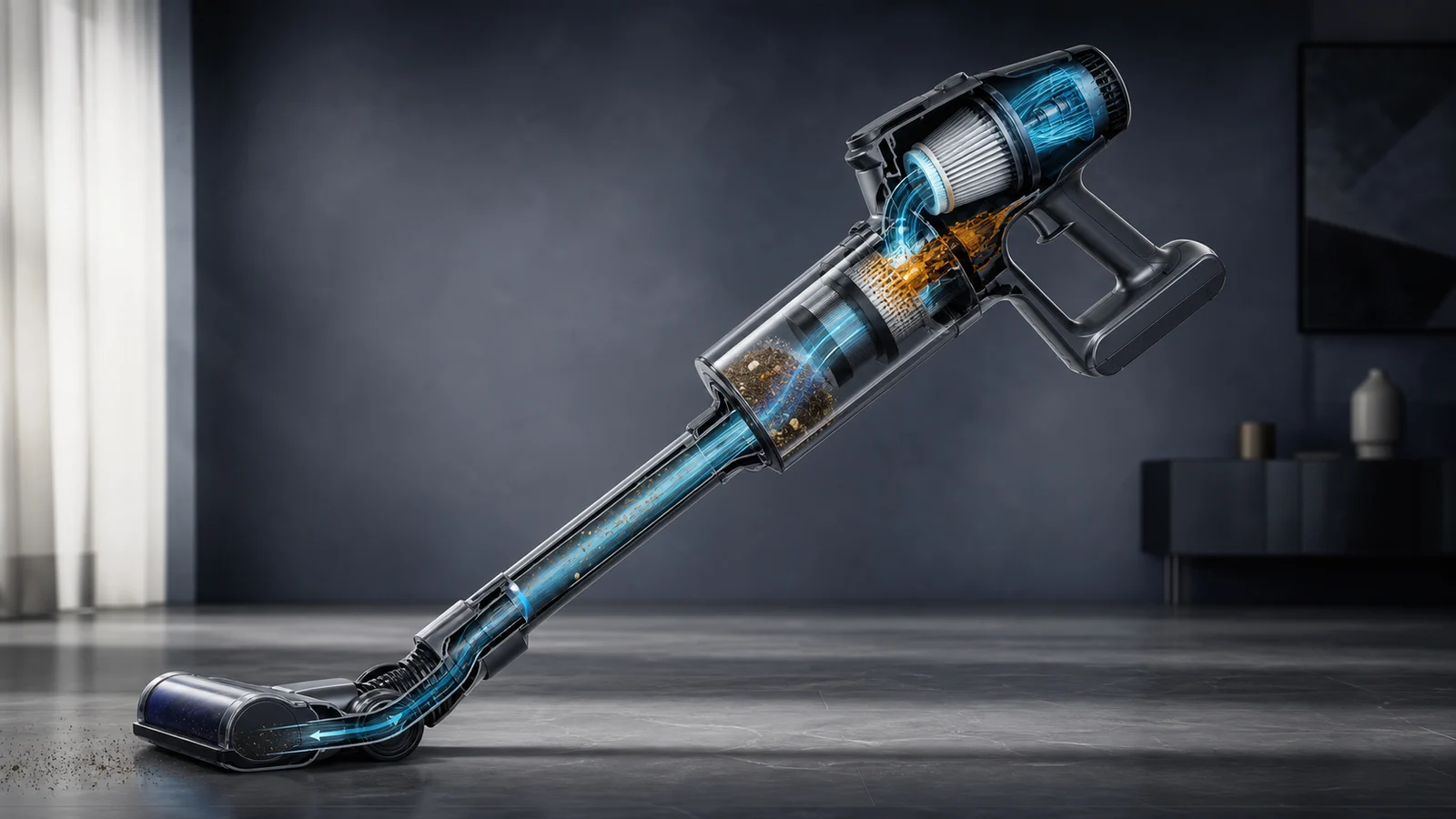
A vacuum cleaner usually loses suction because airflow is restricted or leaking before it reaches the motor. Start with the suction setting, full bag or bin, dirty filters, blocked floorhead, wand or hose, poorly seated parts and damaged seals. Do not assume the motor has failed until the accessible airflow path has been checked using the exact model's instructions.
Poor pickup and low suction are related but not identical. A jammed brushroll, wrong floor setting or worn floorhead can leave dirt behind even when suction at the hose is normal. Diagnose where performance disappears instead of replacing every filter and attachment at once.
Vacuum Suction Problems at a Glance
| What you observe | Likely area | First check |
|---|---|---|
| Weak suction everywhere | Bag/bin, filters, main airway, seal or motor | Empty the collector and inspect the approved filters |
| Strong suction at hose but weak at floorhead | Wand, floorhead, brushroll or setting | Isolate the attachment path and inspect for obstruction |
| Suction improves when an attachment is removed | That attachment or its connection | Inspect the removed tool and joining seal |
| Motor pulses or repeatedly stops | Blockage, dirty filter, overheating or power issue | Switch off and follow the model's protection procedure |
| Dirt falls back out after shutdown | Full collector, blocked airway, failed flap or seal | Empty and inspect the intake path and non-return feature |
| Vacuum is hard to push but pickup is poor | Excessive suction setting, wrong floorhead position or brush issue | Check the floor setting and suction-release control |
| Whistling or hissing appears | Air leak, cracked hose, open valve or unseated part | Inspect joints, seals and the hose exterior |
| Burnt smell, sparks or unusual heat | Motor, wiring, belt or electrical fault | Stop use, isolate power and use qualified service |
Understand the Airflow Chain
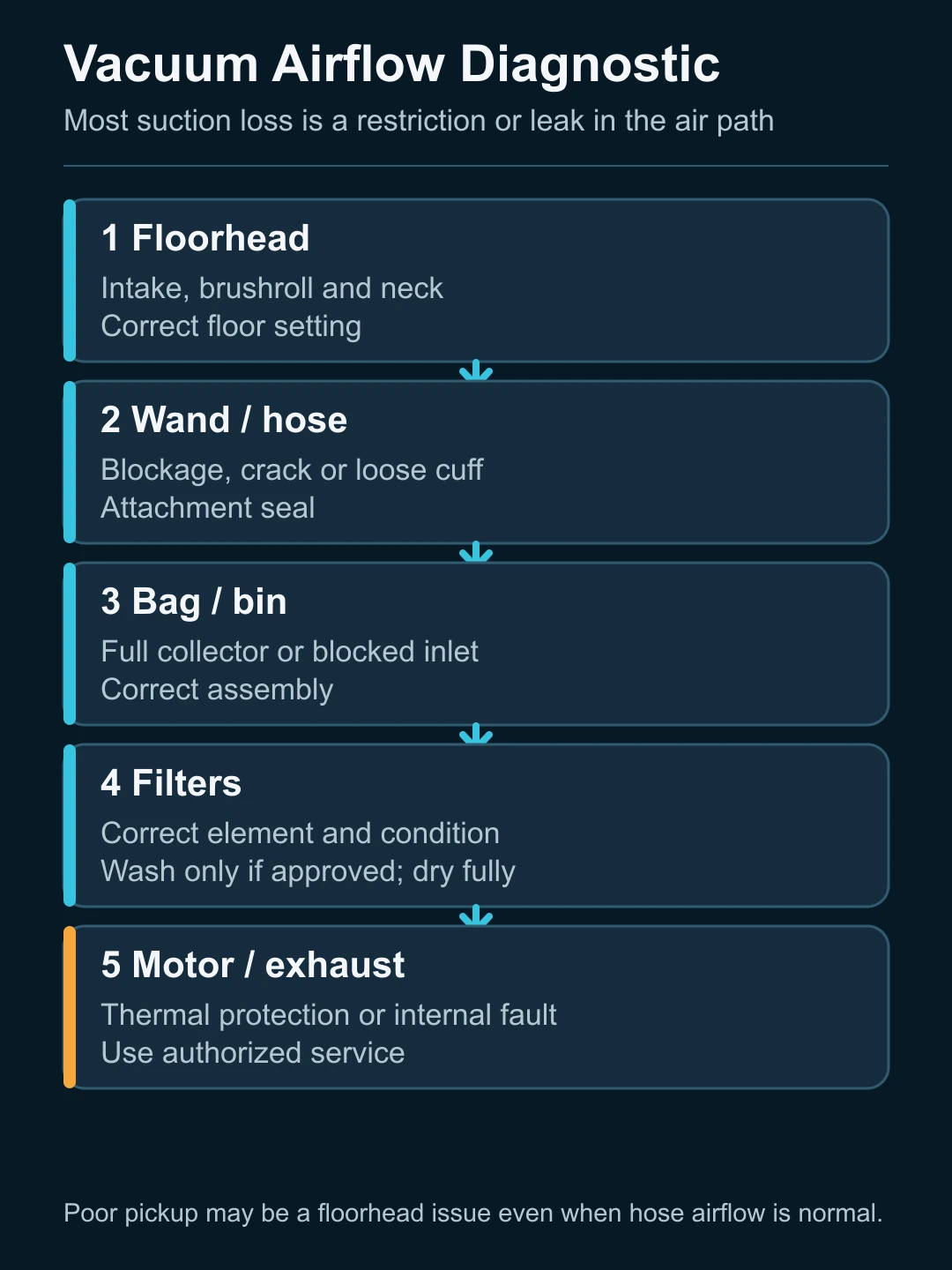
A vacuum does not pull dirt through "suction power" alone. The floorhead loosens or admits debris, airflow carries it through the intake, wand and hose, the bag or bin separates it, filters protect the motor and room air, and sealed joints keep unwanted air from bypassing the cleaning path.
Performance can fall when:
- the intake is blocked;
- the brushroll cannot agitate carpet;
- the bag or bin restricts flow;
- a filter is loaded, wet, damaged or incorrectly installed;
- a hose or seal leaks;
- the suction-release valve is open;
- the selected mode reduces power;
- the motor or control system cannot maintain airflow.
The best diagnostic question is: where does normal airflow stop?
Stop and Isolate the Vacuum First
Before accessing a bag, bin, filter, brushroll or airway, switch off the vacuum and unplug it or remove it from the charger as the manual requires. Keep fingers and tools away from a brush or fan that can start unexpectedly.
Stop using the product and escalate if there is:
- a damaged cord, plug, charger or battery;
- smoke, sparks, burnt odor or melting;
- unusual heat that returns after the approved cooling procedure;
- liquid inside a dry-only vacuum;
- a cracked battery or swollen enclosure;
- an internal electrical or motor fault;
- a blockage that cannot be reached without prohibited disassembly.
Do not use a wire, sharp object, compressed air or liquid unless the exact manual authorizes it for the specific part.
Check the Suction Setting and Floor Configuration
Before dismantling anything, confirm the machine is in the expected mode.
Some vacuums provide variable suction, an air-inlet valve, carpet-height setting, floorhead slider or an Eco/Auto/Boost mode. A partly open suction-release valve can feel like a leak. An incorrect height or brush setting can reduce pickup or make a floorhead difficult to move.
BISSELL's official Hard Floor Expert canister support begins by checking the variable-suction level and whether the dirt container and door are correctly installed. That sequence is model-specific, but it illustrates why configuration should be checked before parts.
Record the original mode so that the final test uses the same conditions.
Empty the Bag, Bin or Tank
A full collector adds resistance and can move fine material into filters or cyclones. Empty or replace it at the limit specified by the product, not only when it is packed solid.
Check that:
- the correct bag is installed and not torn;
- a bag collar or bin inlet is seated correctly;
- the bin is fully assembled and latched;
- a cyclone, shroud or screen is not packed with fine dust;
- a wet/dry tank is configured for the intended pickup mode;
- the lid and collector seals are clean and undamaged.
Dyson's V15 support tells users to empty the bin at the MAX line and identifies a full bin, blocked tool and dirty filter as separate causes. Do not transfer that product's maintenance interval or assembly steps to another model.
Inspect Filters Correctly
Filters are a common restriction, but not every filter is washable. Some are tapped clean, some are washed, some are replaced and some are part of a sealed cartridge.
Use the exact manual to identify:
- pre-motor and post-motor filters;
- washable versus non-washable elements;
- permitted water temperature and cleaning method;
- required drying time;
- replacement interval or condition;
- correct installation direction and seal.
Shark's official upright-vacuum maintenance guidance lists emptying the dust cup, cleaning filters and checking the hose, wand, pod, handle and nozzle for blockage when suction is low. It also says washed filters must dry completely before reinstallation.
Never reinstall a damp filter in a dry vacuum. Moisture can restrict airflow, carry dirt into the machine, create odor and damage components. Do not wash a paper or HEPA element unless its manual explicitly permits it.
Trace Blockages from the Floorhead to the Motor Inlet
Inspect the accessible air path in order:
- floorhead intake and brush chamber;
- floorhead neck and swivel;
- wand or tube;
- flexible hose and both cuffs;
- collector inlet and cyclone path;
- accessible pre-motor duct;
- approved exhaust and post-filter area.
BISSELL's CleanView low-suction guidance follows the same general logic: empty the tank, inspect the cyclone and inlet, then check the hose and intake areas. It warns against sharp objects that can puncture a hose.
Fine construction dust, flour, fireplace ash and similar material can load filters quickly and may be prohibited by a household vacuum manual. The absence of one large clog does not prove the path is clear; distributed fine dust can create the same pressure loss.
Inspect Hoses, Seals and Assembly Joints
A split hose or missing seal admits room air after the floorhead, reducing useful airflow at the cleaning surface. Symptoms can include hissing, performance that changes as the hose bends or normal motor sound with weak pickup.
Look for:
- cracks between hose corrugations;
- loose or incompletely latched cuffs;
- distorted gaskets or O-rings;
- a bin, lid or filter not fully seated;
- an open suction-release valve;
- damaged attachment seals;
- missing service parts after cleaning.
Do not tape over a safety vent or valve whose function is uncertain. Replace a damaged hose or seal with a verified part for the exact model.
Separate Brushroll Problems from Low Suction
Carpet pickup depends on agitation as well as airflow. A brushroll wrapped with hair, a stopped belt, a blocked floorhead or an incorrect height setting can imitate suction loss.
With the product safely isolated:
- inspect visible hair and fibers using the approved method;
- confirm the brushroll is installed and turns only as the manual permits;
- check the floorhead airway separately from the hose;
- record any brush warning light or error;
- stop if the belt, motor, wiring or powered connection requires internal access.
If suction is strong at the hose but weak pickup returns only when the floorhead is attached, the problem is downstream of the hose. This boundary will also keep the future dedicated "brush not spinning" article from duplicating the present page.
Test the Air Path in Sections
Some manufacturers provide a model-specific method for checking suction at an inlet or with an attachment removed. Use only the sequence authorized for the exact product; never expose a moving fan or energized electrical part.
The logic is simple:
- weak airflow before attachments points toward collector, filters, main duct or motor;
- normal airflow before the hose but weak airflow after it points toward the hose;
- normal hose airflow but poor floor pickup points toward the wand, floorhead, brush or setting;
- normal airflow but short runtime points toward battery or power management rather than an airflow restriction.
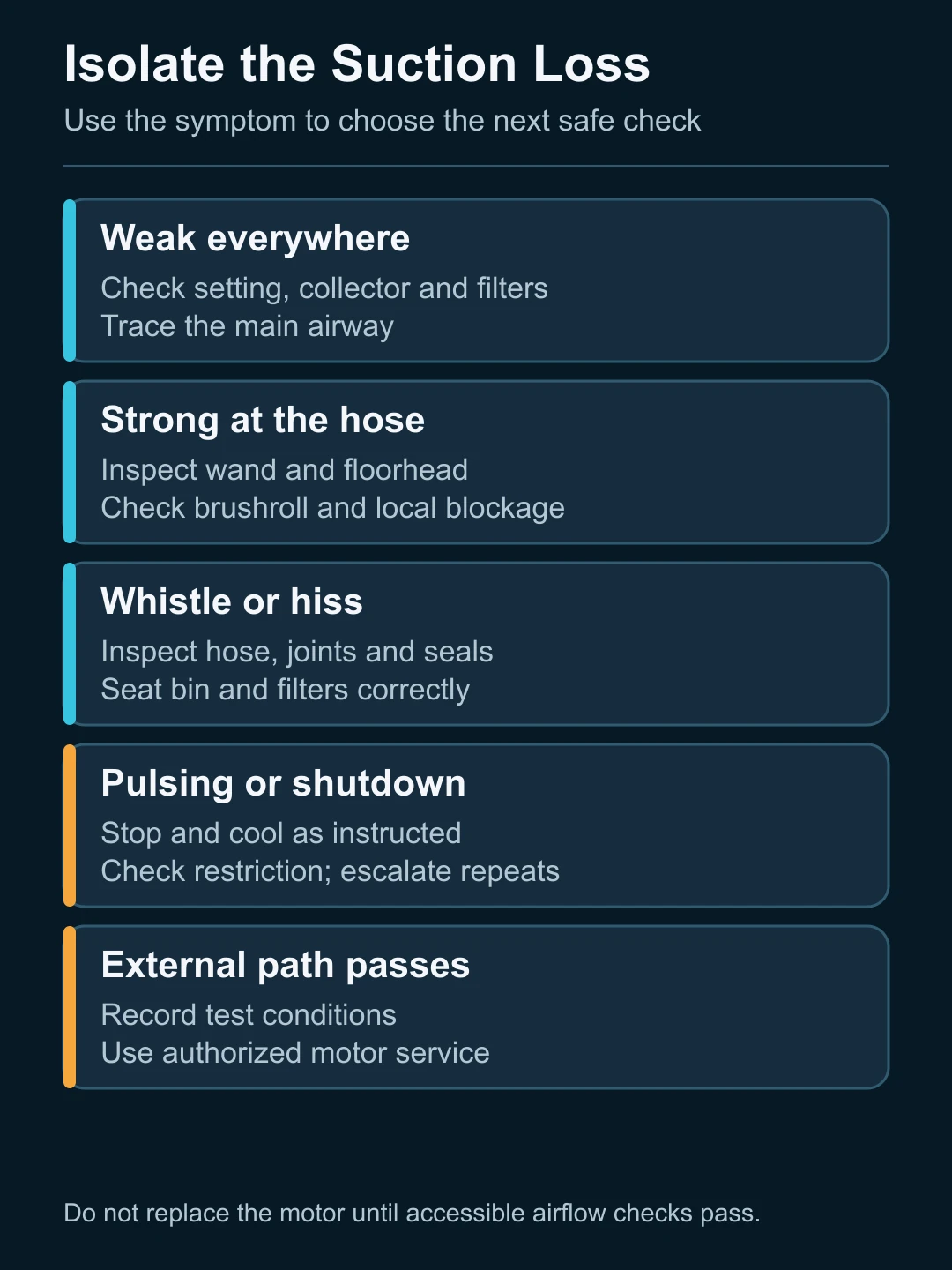
Change one condition at a time and record the result. Reassembling several parts at once can hide the actual cause.
When the Motor or Electronics Become the Leading Suspect
An internal fault becomes more plausible when the approved external air path is clear, filters and collector are correct, seals are intact, attachments have been isolated and suction remains weak at the manufacturer's approved test point.
Service indicators include:
- abnormal motor sound or speed;
- recurring thermal shutdown after airflow is restored;
- burnt odor, sparks or electrical noise;
- damaged fan, motor bearing or controller suspected;
- no change after verified filter and airway correction;
- a sealed or inaccessible internal blockage;
- cordless power that collapses only under load.
Do not open a motor, battery pack or high-speed fan assembly as a general household troubleshooting step. Preserve the model, serial number, fault behavior and maintenance history for service.
Verify the Repair Under the Same Conditions
After the approved correction and complete reassembly:
- confirm every filter and seal is installed in the right orientation;
- verify washed parts are fully dry;
- use the same mode, attachment and floor area as the original complaint;
- compare sound, pickup and airflow without creating a hazardous hand test;
- check that dust remains contained and no warning returns;
- record any replaced filter, bag, hose, seal or floorhead part number.
For buyers comparing architectures, World Clean Biz's robot vacuum versus cordless vacuum guide explains the different maintenance burdens, while the Shark versus Dyson cordless vacuum guide compares filtration, batteries and support at brand-platform level.
FAQ
What is the most common cause of a vacuum losing suction?
Restricted airflow from a full bag or bin, dirty filter or blockage is common, but an air leak, open suction valve, incorrect setting or floorhead problem can produce a similar complaint.
Can a dirty filter reduce vacuum suction?
Yes. A loaded filter increases resistance and can reduce airflow or trigger protective behavior. Clean or replace it only according to the exact manual, and reinstall washable filters only when completely dry.
Why does my vacuum have suction at the hose but not the floorhead?
The wand, floorhead airway, brushroll, belt, powered connection or floor setting may be limiting pickup. Inspect the downstream attachment path.
Why does my vacuum pulse or keep stopping?
Some products pulse or shut down when airflow is restricted or the motor overheats. Power and battery faults can also cause cycling. Follow the model-specific warning and cooling procedure.
Can I wash every vacuum filter?
No. Filter materials and cleaning rules differ. Washing a non-washable filter can damage it and the vacuum. Check the exact filter and manual.
When should a vacuum go to service?
Use service for electrical damage, burnt odor, abnormal heat, recurring shutdown, an internal blockage, motor or controller symptoms, damaged battery, or weak suction after every authorized external check passes.
Final Answer
When a vacuum cleaner loses suction, diagnose the complete airflow chain: mode and floor setting, bag or bin, filters, intake, wand, hose, seals, floorhead and brushroll. Most faults are restrictions or leaks, but poor pickup can also be a brush or configuration problem.
Use the exact model's cleaning and disassembly limits, dry washable parts completely, and escalate electrical, battery, motor and inaccessible internal faults rather than replacing parts by guesswork.