- The lawn mower robot industry is entering the eve of the coronation of a new king.
- But this is not the birth of a new king in a blank market, but an industrial alternation in which the old king defends and new forces attack.
- Orders for lawn mower robots this year have clearly exceeded industry expectations and are stronger than many people imagined at the beginning of the year.
The lawn mower robot industry is entering the eve of the coronation of a new king.
But this is not the birth of a new king in a blank market, but an industrial alternation in which the old king defends and new forces attack. In the past few years, this category has been regarded more as a segment in the European and American garden tool markets, and industry discussions have mainly focused on technical routes such as borderless, RTK, visual recognition, LiDAR, and automatic mapping. But starting from this year, what deserves more attention is not "whether this category can be established", but "who will become the new king of this industry."
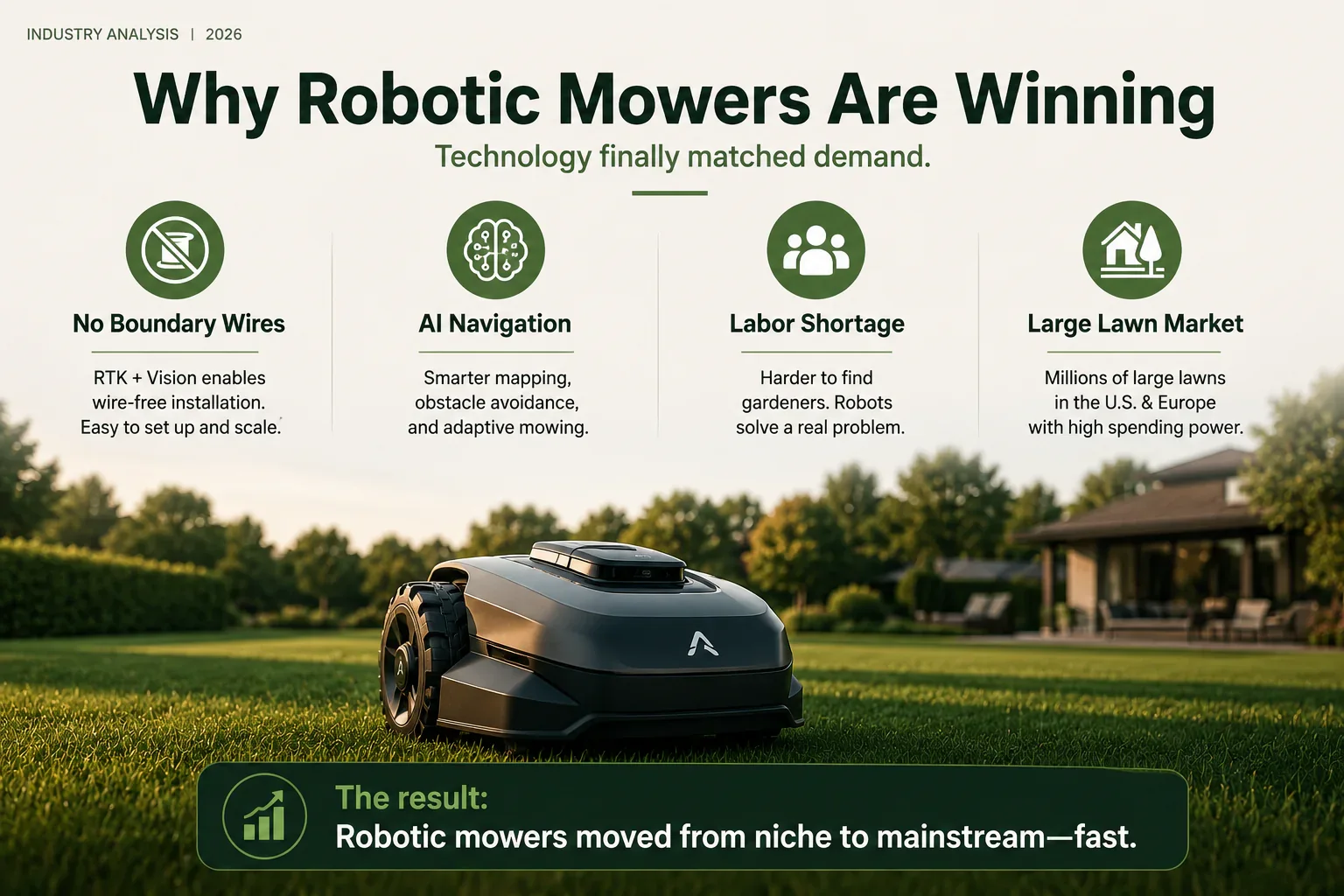
Orders for lawn mower robots this year have clearly exceeded industry expectations and are stronger than many people imagined at the beginning of the year. Now when channel dealers call various brands, they often get the result that they are out of stock. This kind of shortage is not a problem of a single brand, but the result of changes in the supply and demand relationship of the entire borderless lawn mower robot. In the past, the industry was still discussing whether consumers were willing to accept borderless lawn mowing robots. Now the more realistic question has become: who has the goods, who has the channels, and who can deliver stably.
The total number of borderless lawn mowing robots was probably more than 3 million units last year, and the total number may reach 6 million units this year. This growth not only comes from the replacement of traditional buried lawn mower robots, but also replaces part of the market share of riding lawn mowers and manual lawn mowers. What’s more, this substitution continues. Borderless lawn mower robots are moving from “an internal upgrade of robotic lawn mowers” to a redistribution of the entire yard lawn mowing tool market.
This is why the lawn mower robot industry suddenly has the imagination of the capital market. Some of the leading players in the industry have begun to approach sales of RMB 3 billion or RMB 4 billion. This is no longer a business for niche robotics companies, but a consumer robotics track that may outperform listed companies.
The robot vacuum industry once gave a clear example. Roborock was not the first company to make a robot vacuum. iRobot, Ecovacs and many other companies were earlier than it. But it really changed the industry when it swept the market with the 1,499 yuan Xiaomi robot vacuum, bringing LiDAR navigation, path planning, cleaning experience and price to a position that consumers could not ignore. After that machine, the robot vacuum was no longer just an expensive, useless, toy-like product, but began to become a consumer product that ordinary families could seriously consider purchasing. Roborock also took advantage of this wave of category restructuring to quickly be listed on the A-share market, and its market value once exceeded 100 billion.
The significance of this case is not that "another Roborock" will definitely be born in the lawn mowing robot industry, but that it illustrates what happens when a new category truly explodes: leading companies do not just sell more products, but redefine consumer perceptions, price systems, and industry thresholds. Today's lawn mowing robots are also waiting for such reconstructors.
But until the new king is crowned, the old king remains at the card table. The core players of lawn mower robots in the past were Husqvarna and Positec. They represent the last round of industry capabilities: one is the global king in the era of traditional lawn mowers, and the other is the benchmark for Chinese power tool brands to go overseas.
After the borderless lawn mowing robots really became popular, the basis of industry competition has changed. In the era of traditional lawn mowers, the comparison is about mechanical structure, cutterhead, motor, channels and dealer system; in the era of borderless lawn mower robots, the comparison is about positioning, mapping, obstacle avoidance, algorithms, software iteration, supply chain and cost control. This set of capabilities happens to be the capabilities that Chinese robotics companies, cleaning appliance companies, and consumer hardware companies have repeatedly trained over the past decade or so.
The opportunities for Chinese companies are not just low prices. Low prices will certainly change the market, but the underlying change is that sensors, algorithms, lithium batteries, brushless motors, structural parts, machine manufacturing, App iterations and cross-border channels are maturing at the same time. In the past, these capabilities were scattered in different industries, but now they are beginning to converge in the new category of garden robots. The real power of Chinese brands is that they can combine technical solutions, supply chain costs and product iterations at a faster speed.
This is why Husqvarna may be facing an iRobot-style dilemma. It's not that iRobot didn't know how to make robot vacuums back then, but after the industry shifted from "robot inventor competition" to "consumer electronics efficiency competition", product iteration, supply chain response, cost control and channel efficiency were gradually caught up or even surpassed by Chinese companies. Husqvarna has a similar problem today. Of course it understands lawn mowers, but the lawn mower robot is becoming less and less like a traditional lawn mower and more and more like an outdoor robot.
Therefore, to judge who can win at this stage, we cannot just look at the technical route, nor can we just look at a certain product. What this industry will really compete next is four types of capabilities: whether the old king can hold on to its basic market, whether the new force can turn its first-mover advantage into a stable share, whether listed companies can continue to catch up with capital and organizational resources, and whether the new financing force can continue to survive after the industry enters the cash-out period.
Lawn-cutting robots are not an industry where the battle can be ended by the explosion of a single product in the short term. It requires channels, after-sales, local services, inventory, research and development and continuous price competition. Companies without real shipments will soon be verified; companies without financial capabilities will have a hard time making it to the next round.
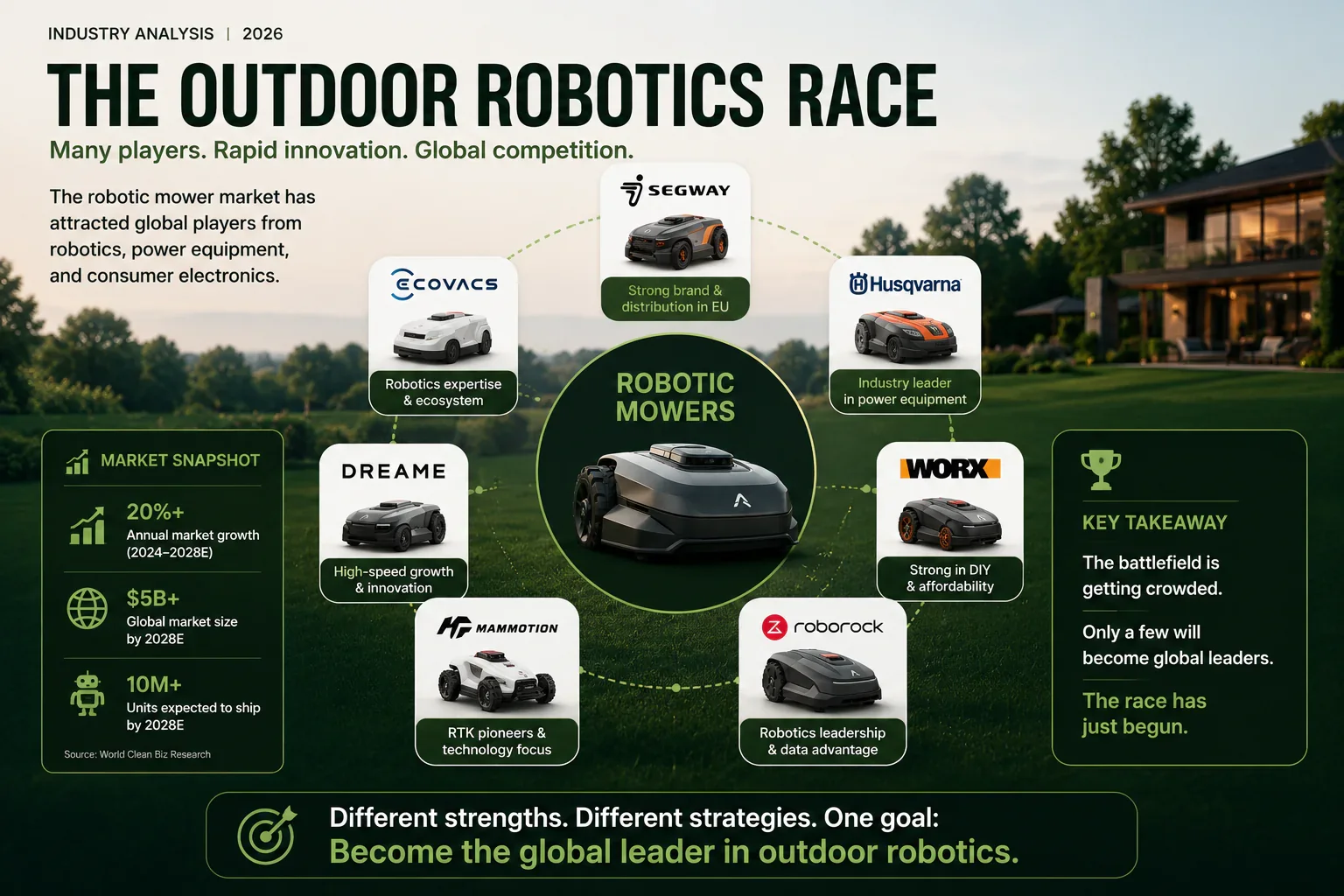
The first type of players are the old kings Husqvarna and Positec.
Husqvarna has long been the leader in borderless lawn mowing robots. At its peak, Husqvarna once occupied more than half of the market share of borderless lawn mowing robots. Until 2025, Husqvarna's lawn mower robot business will still have sales of approximately 5 billion to 5.5 billion yuan, accounting for approximately 17% of the entire Husqvarna Group's sales, and is the third largest business of the entire group. This shows that Husqvarna is not a traditional company that has withdrawn from the poker table. It is still one of the most important existing forces in the lawn mowing robot industry.
Facing the strong rise of new Chinese forces, Husqvarna did not choose to be passively defensive. On the one hand, Chinese brands are using lower prices to seize market share, which is changing European channels and consumers' price perception of lawn mower robots; on the other hand, Husqvarna has also begun to fight back strongly, promoting the anti-dumping investigation of lawn mower robots in the EU. At the same time, Husqvarna is also adjusting its supply chain strategy and starting to cooperate with domestic OEMs for complete machines. According to friends in the industry, Husqvarna is now cooperating with Zhongjian Gao Krypton.
This matter is worth pondering. It shows that Husqvarna does not fail to see the efficiency of China's supply chain, nor does it fail to understand the pressure of cost competition. The old king’s counterattack includes both policy tools and supply chain adjustments. Countless new kings wanted to take the throne, but the old king was unwilling to quit like this.
Positec is another old king. It has always been the pride of domestic power tools. When many companies are still busy with OEM business, Positec chooses to directly all in its own brand, becoming a banner for domestic brands to go overseas. In terms of borderless lawn mowing robots, Positec was also the only domestic brand at the time that could compete head-on with Husqvarna.
However, with the rise of new forces, Positec's borderless lawn mowing robot business has also been significantly affected. What’s even more interesting is that no matter which company you go to now that makes lawn mowing robots, you can almost see former Positec employees. In a sense, Positec has become the Whampoa Military Academy of the entire lawn mowing robot industry. It may not still be at the forefront as it was in the past, but it has exported a lot of talent, experience and methods to the industry.
Therefore, the first type of player is not a new force, but an old king. Only by understanding Husqvarna and Positec can we understand why today's competition is fierce. Because the new king wants to be crowned, he must not only run fast, but also truly surpass the channels, brands, talents and industry experience left by the old king.
But the existence of the old king did not prevent the new forces from accelerating their arrival on the table. On the contrary, it is precisely because the old king's system has begun to loosen that companies that have already gained a position in the market have the opportunity to turn first-mover advantages into a new industry order.
The second type of players are companies that have already achieved a leading position in the market.
One of the biggest differences between a lawn mower robot and a robot vacuum is that it relies more on channels. Robot vacuum can quickly increase sales through online e-commerce, content cultivation, live broadcasts and promotions, but lawn mower robots are more complicated in the European and American markets. It covers yard area, lawn environment, installation guidance, after-sales maintenance, local service and dealer recommendations. When consumers purchase, they not only look at parameters, but also rely on channel explanations and service capabilities.
From this point of view, Wildland 9, Mammotion, and MOVA/Dreame currently have certain advantages at this stage.
The most noteworthy thing about Wildland is not just its speed, but its stability. According to what is heard in the industry, Wildland has shipped about 300,000 units last year, and the 1 millionth machine has been offline some time ago. If the pace goes smoothly this year, there is a chance for hundreds of thousands more units. This number is of course important, but more importantly, it is not a company that came out by a sudden burst, but followed the previous path step by step to get to where it is today.
At the roll-off ceremony of Wildland’s 1 millionth machine, I had a conversation with their CEO Ren Guanjiao. My sense is that this is not a particularly aggressive company. It will not suddenly disrupt the industry with very exaggerated moves, but prefers to push products, channels, supply chains and organizations forward bit by bit at its own pace. This style is less like a radical startup and more like a long-term hardware company: not rushing to tell a huge story, but continuing to iterate and deliver along a determined path.
Behind Wildland is Number Nine. Nine is a very special company. It is not a traditional home appliance company, nor a typical cleaning appliance company, but a company that is very familiar with overseas channels and the scale of consumer hardware. Nine has done everything in categories such as electric scooters and balance bikes. For products like lawn mower robots that are highly dependent on the European and American markets, Nine’s channel experience, supply chain capabilities and overseas operations experience are very important. Lawn mowing robots will definitely experience channel competition, price competition, after-sales competition and U.S. market expansion in the future. Stable organizational capabilities and continuous delivery capabilities will become more important as time goes by.
Mammotion represents another path. This company was founded by former DJI product manager Wei Jidong. After discovering the opportunity for lawn mower robots, he chose to go all in directly. Last year, Mammotion reportedly shipped hundreds of thousands of units, and the company also gave cars to its employees. The reason why this detail is widely spread in the industry is not because of the importance of car delivery itself, but because it sends a signal: this company does not just tell financing stories, but has actually achieved staged business results in new categories.
Wei Jidong is a typical product-based founder. Friends in the industry speak highly of his product capabilities and believe that he has his own uniqueness in product judgment. The company Mammotion also has a very obvious founder style: strong control over product definition, fast decision-making speed, and willingness to bet in key directions. This is very important in the early stages of a new category, because there is still no completely standard answer for lawn mower robots, and many judgments must be made by the founders themselves.
What's really noteworthy about Mammotion is that it has proven that startups can quickly form scale in this category. After the lawn mowing robot industry enters a period of heavy volume, speed itself is a threshold. However, a lawn mowing robot is heavier than a robot vacuum. Especially in the European and American markets, installation, maintenance, returns, local service and dealer systems will all become long-term barriers. Whether Mammotion can transform from a high-speed growth company driven by its founder to a consumer robotics company that can support a global service system will determine how far it can go.
MOVA/Dreame is the most offensive variable at this stage. Many people in the industry know that Dreame was one of the first companies to use LiDAR on lawn mowing robots. At that time, a LiDAR cost two to three thousand yuan, which was even more expensive than many other parts combined. It’s not that many companies don’t know that LiDAR can improve the experience, but they don’t dare to bear the cost, pricing and supply chain pressure it brings.
The choices of Dreame and MOVA reflect their consistent product strategies: first improve the experience, and then absorb costs through scale and supply chain. Later, the market feedback was good, which also led them to sign a large number of orders with Hesai and Sagitar. This signal is critical because it shows that the technology route of lawn mower robots is not just about cost comparison, but about re-finding the balance between user experience and scale efficiency.
What's more, Dreame doesn't treat the robot lawnmower as a small project. Yu Hao, the founder of Dreame, has made it clear in the industry group that he wants Dreame and MOVA to become the leaders in the lawn mowing robot industry. Dreame’s group goal this year is RMB 100 billion, and lawn mower robots are obviously an important part of the entire group’s growth goals. For a company that is expanding at a rapid pace, new categories are not the icing on the cake, but a battlefield where incremental contributions must be made.
This also explains why the Dreame series is so radical in this category. It is not simply testing the waters, nor is it following the trend and making a product line, but turning the lawn mower robot into a part of the group-level growth curve. If MOVA plus Dreame can ship hundreds of thousands of units this year, they will become one of the most aggressive players in the industry.
The third type of players are listed companies with financial capabilities.
Lawn-cutting robots are not an industry that can be determined in the short term. Once it enters a scale war, money will become very important. R&D costs money, overseas channels cost money, local after-sales systems cost money, inventory costs money, and price wars also cost money. The advantage of a listed company is that as long as the management has an idea, there are capital tools for continuous investment. Representative companies are Ecovacs, Roborock and LD Robot.
Ecovacs' problem has never been a lack of capabilities, but strategic priorities. It came early to lawn mowing robots. A few years ago, I wrote about the "Suzhou duo", talking about Ecovacs and Positec. But in the past few years, Ecovacs’ actions on lawn mowing robots have not been radical. There are reports in the supply chain that Ecovacs produced more than 100,000 lawn mower robots last year, and this year’s goal is about 200,000 units. This scale cannot be said to be small, but given the speed of today's industry, it cannot be said to be particularly large.
What’s really interesting about Ecovacs is whether it can reallocate resources if it treats lawn mower robots as a second growth curve. Ecovacs has experienced the complete cycle of robot vacuum from category education, price war, channel war to global competition, and also has robot research and development, supply chain and overseas market foundation. If the lawn mower robot is just used as a new category addition, it will be difficult for it to become a key variable in the industry; but if it really decides to continue to burn money, continue to iterate, and continue to expand channels, it will still be a player that cannot be ignored at the poker table.
The entry of Roborock is an important signal that the lawn mower robot industry is becoming mainstream. As a listed company that has completed category restructuring in the robot vacuum industry, Roborock’s entry means that this market is no longer just a competition between traditional tool companies and startups, but has also begun to attract systematic investment from mature consumer robot companies. Last year at IFA, Roborock demonstrated three lawn mowing robots at one time, covering basic areas from small to large areas. Such a product matrix is usually not a simple test of the water, but shows that the company has a relatively complete judgment on this category. There is also talk in the supply chain that Roborock’s goal for lawn mower robots this year is more than 200,000 units.
The advantage of Roborock is that the company itself is stable enough. The robot vacuum business can still provide stable performance, and the team is relatively stable. Coupled with its status as a listed company, Roborock has enough resources to continue investing in a new track. Lawn-cutting robots are not an industry that can be completed in a year or two. This stable cash flow, organizational capabilities and capital market status will give Roborock a higher room for error in long-term competition.
But Roborock's problem is also clear: it entered the game a little late. Lawn mowing robots are not a blank market now. Companies such as No.9 Wildland, Mammotion, and MOVA/Dreame have already gained certain first-mover advantages in the European market and channels. Roborock displayed three lawn mower robots at IFA last year, indicating its determination in this category. However, when it comes to catching up, it is no longer a group of startups that are still validating their products, but a group of opponents that have begun to ship products on a large scale. What Roborock needs to prove is not whether it can make a lawn mowing robot, but whether it can use its stable performance, mature team and listed company resources to catch up in a market where there are already first-mover players, and migrate the product definition, supply chain and channel capabilities accumulated in the robot vacuum industry to the garden robot market.
LD Robot is another type of listed company. In the past, it mainly produced robot vacuum navigation algorithms and modules, and was listed on the Hong Kong stock market with its navigation-related business. For such companies, the complete machine business has always been attractive because they are close enough to product definition and core solutions, and they are familiar with cost structures and customer needs. The complete machine business can bring greater sales and market valuation. However, in the field of robot vacuum, directly manufacturing complete machines will easily form a competitive relationship with original customers.
Lawn mowing robots provide LD Robot with a new entry point. It can use its past accumulation in navigation and module solutions to enter the market at a lower price. LD Robot may not be the ultimate winner in the lawn mower robot industry, but it may be a disruptor of the price system. In the early stages of a new category, the impact of a price disruptor is often significant because it forces all companies to recalculate product planning, gross profit models, and channel strategies, thereby accelerating industry adoption.
The fourth type of players is a new force that can still make big money.
Financing for lawn mowing robots has been very popular in the past few years. As long as you are building a lawn mowing robot, financing is relatively easy. The market sees the opportunity for borderless lawn mowing robots to replace traditional lawn mowers, and also sees the huge space in European and American courtyard scenes. But starting last year, the industry entered a cash-out period. Investors no longer just listen to stories, but look at products, shipments, channels, gross profit and organizational capabilities.
Several startups have begun to close down, such as Senhe Innovation, Hesenberg, etc. This shows that the industry has entered the "results testing period" from the "financing-friendly period". At this stage, it will become increasingly difficult for ordinary startups. The new forces that can stay have either already shipped large-scale products, or they can continue to receive huge amounts of financing.
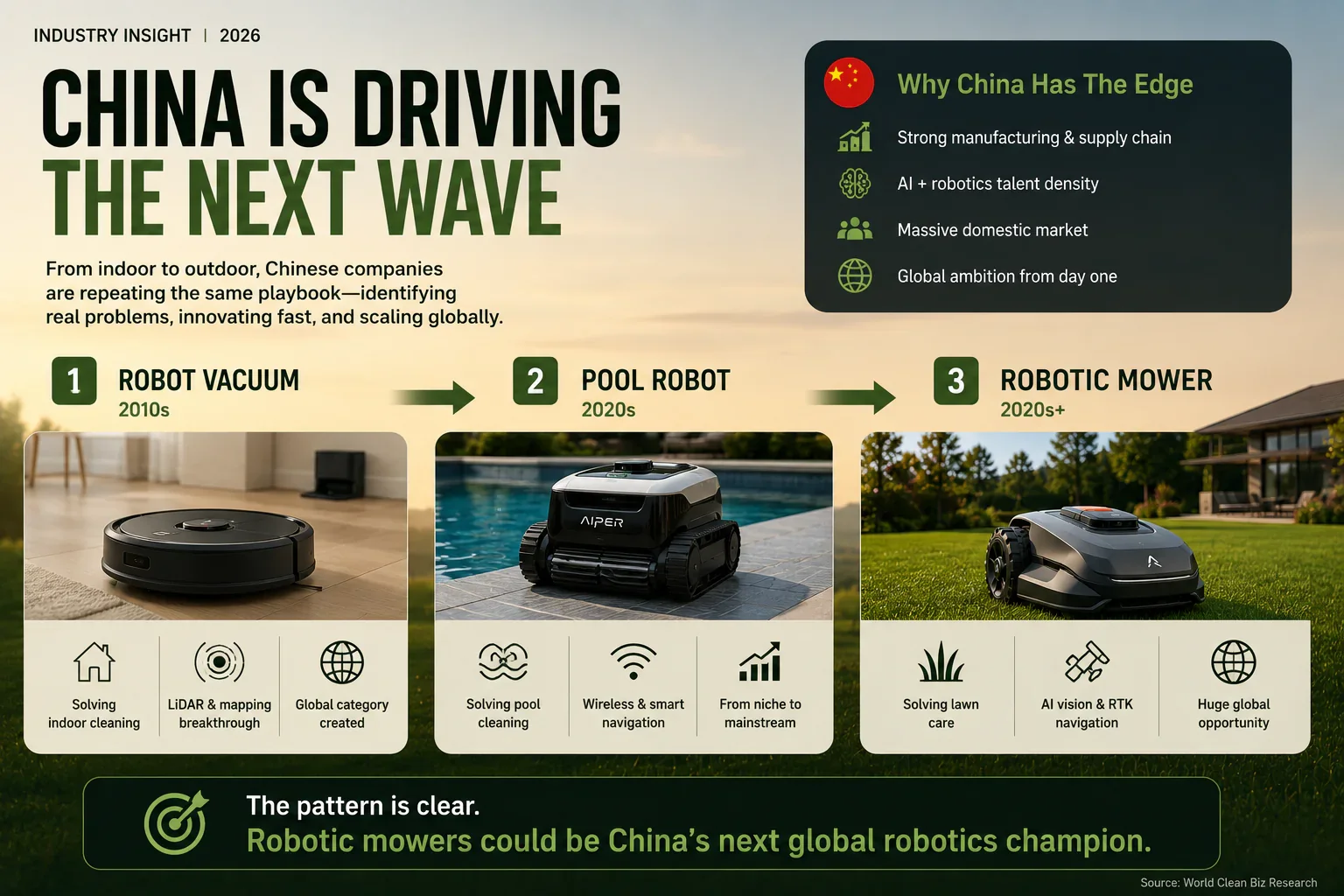
Beatbot Innovation and Aiper Intelligent fall into this category. Beatbot has raised more than 1 billion yuan, and Aiper has also raised several hundred million yuan. Their original main battlefield was swimming pool robots, but lawn mower robots must be a battleground for them. The reason is very simple. European and American courtyards are not just swimming pools, nor are they just lawns. What consumers need in the future may be a complete set of garden robot solutions.
From this perspective, the entry of Beatbot and Aiper into lawn mowing robots is not a simple crossover, but an expansion from the swimming pool scene to the entire courtyard scene. They already have experience in overseas markets, experience in products with high customer unit prices, and a certain channel base. If these capabilities can be transferred to lawn mower robots, there is an opportunity to transform a pool robot company into a yard robot company. But the biggest problem for new forces is also here: whether there is enough money, whether the organization can sustain it, and whether the product can be realized quickly. Lawn mowing robots are not an industry that can be ended by burning a round of money. It requires continuous investment, and the investment is heavy. The stronger the financing capability, the greater the room for error; once financing is cut off, it will soon be hindered by channels, inventory, after-sales and R&D.
These four types of players make up the main table of the current lawn mower robot industry. But the real variable that may reshuffle the situation is not in Europe, but in the United States.
Looking at lawn mower robots now, it is easy to regard the European market as the main battlefield. The European market is indeed more mature, consumers have accepted lawn mowing robots earlier, and the dealer system is more complete. The reason why companies such as Nine Wildland, Mammotion, and MOVA/Dreame seem to have more advantages at the current stage is largely because they have already gained a position in the European market.
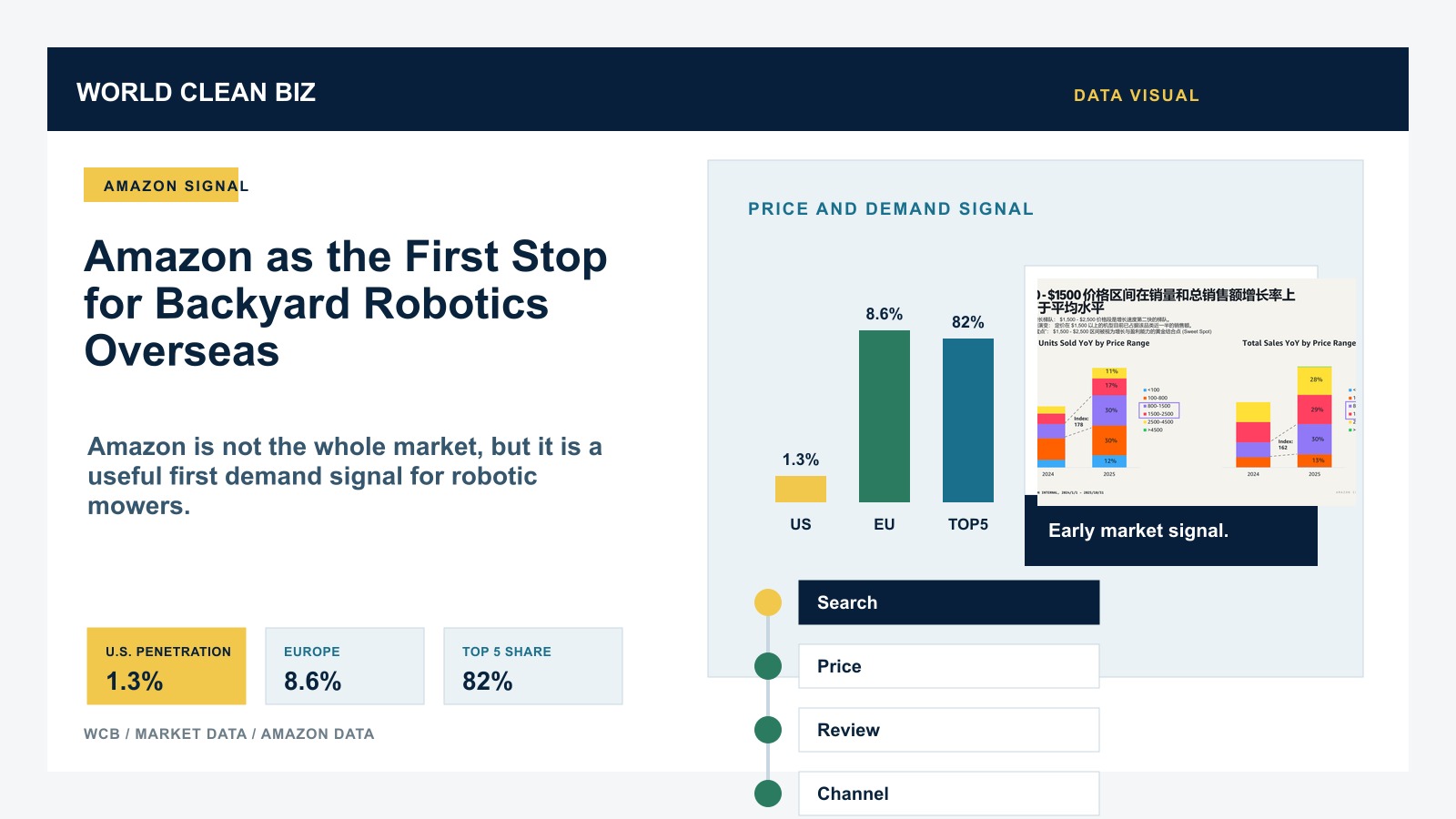
But the U.S. market may be where the next round really changes the industry rankings. The current penetration rate of robotic lawn mowers in the United States is only about 1.3%, and the European market is about 8%. There are many single-family homes in the United States, with large lawn areas and strong demands for yard maintenance, but robotic lawn mowers are still in their early stages. Based on current penetration rates, the annual capacity of the U.S. market is approximately between 500,000 and 800,000 units.
If the U.S. market penetration rate increases to 10% in the future, the corresponding total market capacity may reach 3 million to 5 million units per year. This magnitude means that the United States is not a supplement to the European market, but may be the second main battlefield that determines global industry rankings.
This is why the lawn mower robot industry cannot draw premature conclusions yet. The fact that the European market is leading does not mean that the global market has been locked in. The channel structure, courtyard environment, user habits and after-sales requirements of the American market are all different from those in Europe. Whoever can take the lead in solving the problems of American users may directly break into the top three in the industry by virtue of the large volume in one market.
For Nine, Mammotion, and MOVA/Dreame, the United States is the second battlefield to consolidate their leading position; for listed companies such as Ecovacs, Roborock, and LD Robot, the United States may be the biggest opportunity to catch up later; for new forces in garden robots such as Beatbot and Aiper, the U.S. market may even be more important than Europe, because they have already accumulated channels and user bases in overseas high-priced courtyard scenes.
Therefore, the outcome of the lawn mower robot industry will not be decided only in Europe. Europe will decide who comes out first, and the United States may decide who really becomes big.
The U.S. market will test four types of players at the same time: whether the old king can maintain its global position, whether the leading new force can complete its ascension, whether the listed company can catch up from behind, and whether the new financing force can prove that it is not a concept company.
The time when the industry’s status will truly be determined will most likely be in 2027. In 2026, various brands will promote crazily in the US market, paving channels, making prototypes, educating users, and verifying after-sales systems. By 2027, the U.S. market will begin to give clearer results: whose products can run stably, whose channels can sell well, whose after-sales service is good, and whose brand can be remembered by consumers.
That’s why 2026 looks like a mess. Every company will talk about the U.S. market, garden robots, and their overseas layout. But what is really meaningful is not who announces its entry into the United States first, but who can scale the U.S. market by 2027. The European market has already allowed the first batch of companies to emerge, and the U.S. market may determine the final ranking.
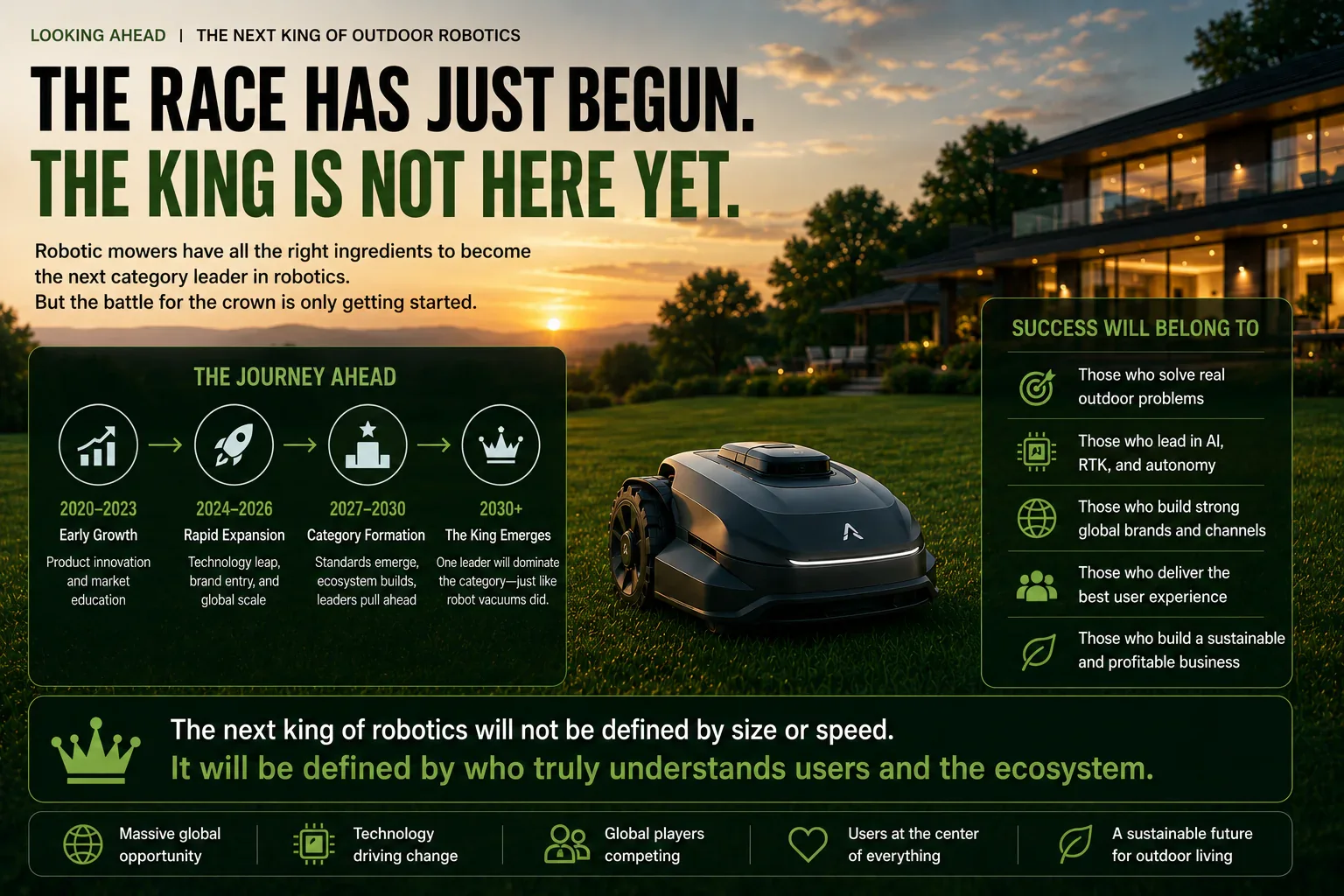
It's too early to tell the ultimate winner. Husqvarna still has the business volume, channel foundation and counterattack capabilities of the old king, while Positec has left behind the domestic brand overseas and industry talent system; Wildland has stable scale and overseas channel capabilities, Mammotion has demonstrated the speed of a startup and the product capabilities of its founders, Dreame and MOVA are changing the intensity of competition with more radical product definitions, Ecovacs and Roborock have the capital and organizational resources of listed companies, LD Robot may change the price system, and Beatbot and Aiper represent another possibility for the expansion of the garden robot scene.
But these companies ultimately face the same problem: lawn mowing robots are not a market that simply competes with RTK, vision or LiDAR. The technical route is of course important, but it is not enough to determine victory or defeat. The real threshold for this category lies in whether the product can work stably for a long time in complex outdoor environments, whether the cost can be reduced to a large enough consumer group to accept it, whether overseas channels and local services can support large-scale sales, and whether the organizational capabilities can handle the growth from hundreds of thousands to millions of units.
The robotic lawn mower industry is waiting today for a company that will truly redefine the game. It is no longer just a verification requirement, but it has not yet formed a final seat. In the next few years, whoever can transform the complexity of outdoor robots into products that ordinary consumers are willing to buy, use, and recommend, whoever can hold on to their position in Europe, open up the market in the United States, and survive the reshuffle in terms of funding and organization, will be most likely to be crowned the new king of the lawn mowing robot industry.