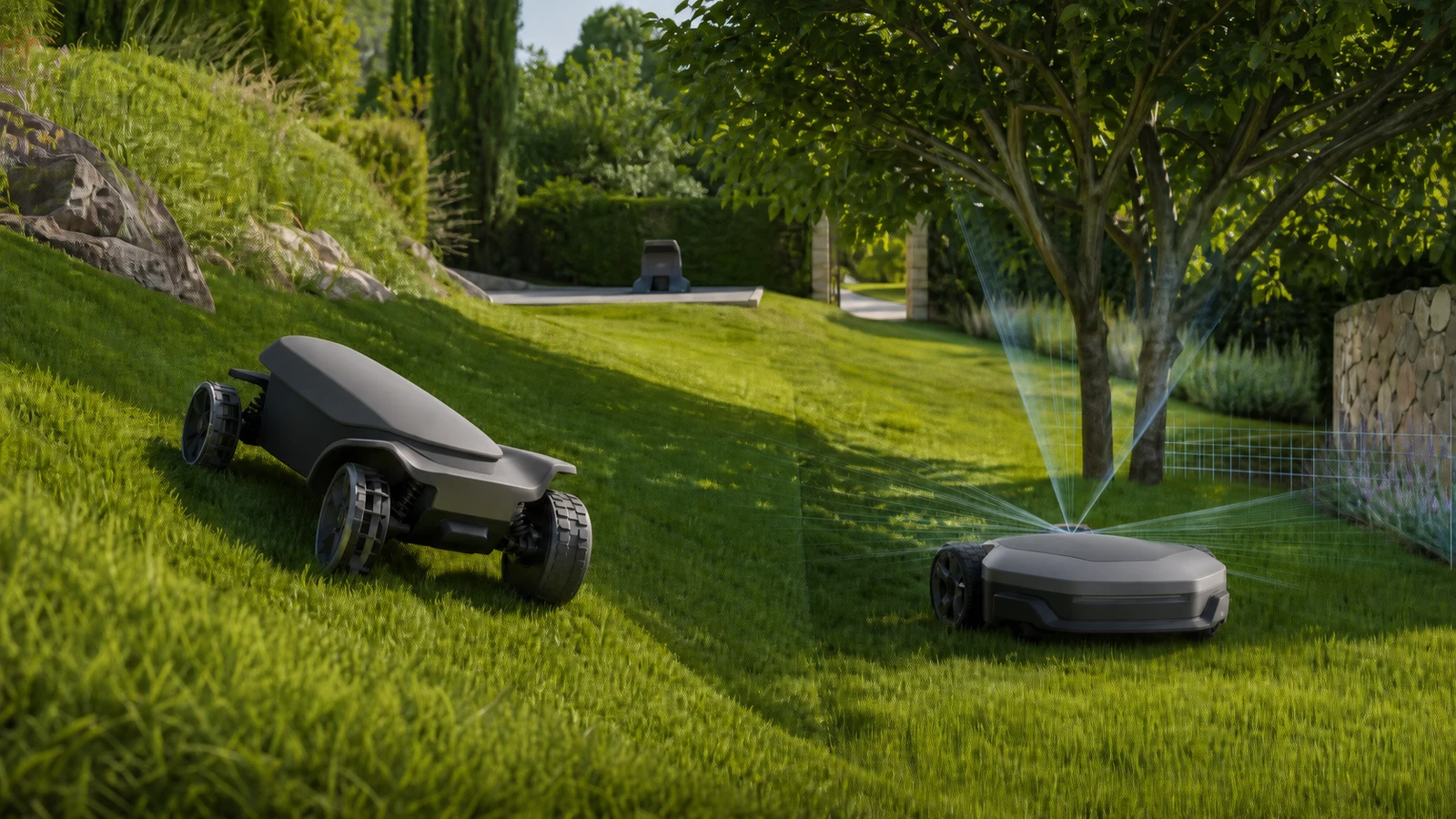
- Choose RockMow Z1 when active front-wheel steering, dynamic suspension and a narrower 24 cm cutting system fit a rugged lawn where controlled turns matter.
- Choose LUBA 3 AWD when a 400 mm dual-disc deck, LiDAR-led sensor fusion and established multi-zone outdoor-robot workflows matter more.
- Both brands publish an 80% maximum slope, but that headline does not establish wet-grass traction, cross-slope safety, edge clearance or recovery in your lawn; a mapped site trial is essential.
In this article 17 sections
Choose Roborock RockMow Z1 when active front-wheel steering, dynamic suspension and a narrower cutting system are useful on a rugged lawn where controlled turns matter. Choose Mammotion LUBA 3 AWD when a wider 400 mm dual-disc deck, LiDAR-led sensor fusion and mature multi-zone workflows matter more.
Both manufacturers publish an 80% maximum slope, but that shared headline does not prove equal performance on wet grass, cross-slopes, soft soil, boundaries or turning zones. The right decision begins with the exact regional SKU and a site trial.
Quick Comparison
| Decision factor | Roborock RockMow Z1 series | Mammotion LUBA 3 AWD series |
|---|---|---|
| Primary terrain design | AWD, active front steering, dynamic rear suspension | AWD with omni-directional front wheels and lightweight chassis |
| Published maximum slope | 80% / 38.7° | 80% / 38.6° |
| Navigation | Full-band RTK plus VSLAM under Sentisphere | 360° LiDAR, AI vision and NetRTK on 3000/5000; 1500 configuration differs |
| Cutting system | 24 cm, one six-blade cutting system | 40 cm dual-disc system, six pivoting blades per disc |
| Cutting height | 20–70 mm on current European Z1 | 25–70 mm standard; 55–100 mm high-cut regional versions |
| Edge system | Optional PreciEdge module; open-boundary ride-on strategy | Wide dual discs; edge result depends on boundary geometry and map |
| Narrow passage claim | 0.8 m | 0.7 m |
| Area range | Z115, Z130 and Z150 regional models | 1500, 3000 and 5000 regional models, plus H variants |
| Service maturity | First Roborock mower generation, formal garden warranty and distributor route | Fourth-generation LUBA platform, broad accessories, app releases and service pages |
These are manufacturer specifications, not a controlled side-by-side test. Model names, included RTK hardware, cutting heights, warranty periods and software features vary by market.
Compare the Exact SKU, Not the Family Name
“RockMow Z1” and “LUBA 3 AWD” each cover more than one product.
Roborock’s current European warranty lists RockMow Z115, Z130 and Z150. Those names correspond to different intended lawn capacities. Mammotion sells LUBA 3 AWD 1500, 3000 and 5000, with standard and high-cut versions in some markets.
The LUBA 3 AWD 1500 also has an important positioning difference. Mammotion’s current product page says the 1500 uses 360° LiDAR and AI vision, while the larger versions add NetRTK and the associated positioning workflow. Buyers should not copy the 5000 specification into a 1500 quotation.
Before comparing price or performance, put these on the RFQ:
- exact model and region code;
- standard or high cutting-height version;
- lawn area and maximum mapped zones;
- included RTK station, antenna, cables or NetRTK service;
- 4G module and included data term;
- edge module, garage and spare blades;
- warranty for main unit, battery and accessories.
AWD and the 80% Slope Claim
Both product pages publish a maximum slope around 80%, or about 38.6–38.7 degrees. That number is useful for screening, but it is not a complete terrain specification.
A mower can climb a clean straight test ramp and still struggle with:
- wet grass or loose soil;
- a slope that ends at a wall, pond or drop;
- side-hill travel rather than straight ascent;
- a tight turn at the top or bottom;
- roots, holes and transitions that unload one wheel;
- a loaded cutting deck in thick growth.
The site survey should record grade, direction of travel, soil, drainage and the safe setback from hazards. Test the return-to-charge route as well as the mowing route.
Neither 80% headline should be used to promise safe mowing beside an unprotected slope edge. Boundary placement, anti-fall sensing and physical landscape design still matter.
RockMow Z1: Active Steering and Suspension
Roborock’s official Z1 page describes four-wheel drive combined with active front-wheel steering. Instead of dragging fixed front casters through a tight turn, the system steers the front wheels.
That architecture can matter in three ways:
- turf protection: less scrub during direction changes;
- path control: a more deliberate turn on a slope or narrow route;
- efficiency: fewer multi-point corrections when the geometry is suitable.
Roborock also uses a dynamic suspension with independent springs and a floating cutting deck. The design aims to keep the chassis and deck controlled over dips and uneven ground.
These are promising mechanical choices, but the field question is not whether suspension exists. It is whether the deck maintains the required cut without scalping, lifting or leaving strips across the property’s actual contours.
LUBA 3 AWD: Omni Wheels and Lower Mass
Mammotion’s LUBA architecture uses four driven wheels with omni-directional front wheels. The current LUBA 3 page emphasizes a weight around 19 kg and smooth turning intended to reduce turf scratching.
Omni wheels and active steering solve the turning problem differently. Omni rollers allow lateral relief during a turn; active steering changes wheel direction.
The better architecture depends on:
- soil softness and drainage;
- grass species and rooting;
- the frequency of zero-radius turns;
- cross-slope loads;
- roller wear, mud retention and local parts availability.
Do not decide from a showroom floor. Make repeated turns on the most vulnerable turf after normal irrigation, then inspect both wheel marks and cut consistency.
Navigation: RTK plus VSLAM vs LiDAR, Vision and NetRTK
RockMow Z1 uses Roborock’s Sentisphere environmental perception, which the company describes as full-band RTK fused with VSLAM. Its current European package list includes an RTK reference station.
LUBA 3 AWD 3000 and 5000 combine 360° LiDAR, dual-camera AI vision and NetRTK. Mammotion calls this Tri-Fusion. The 1500 configuration is listed differently and should be verified separately.
The labels describe architecture, not guaranteed coverage.
Where RTK helps
RTK can provide repeatable centimeter-level positioning when the reference and satellite geometry are sound. It supports straight lines, mapped boundaries and repeatable multi-zone routes.
Where LiDAR and vision help
LiDAR can use surrounding structure under trees or near buildings. Vision can classify obstacles and supplement localization. Both still depend on clean sensors, suitable environmental features and software behavior.
What to test
Map and mow:
- under the densest tree canopy;
- beside tall walls and metal structures;
- through the narrowest route;
- around visually repetitive hedges;
- at dusk and in changing light;
- after moving furniture or garden equipment.
Record every localization pause, boundary drift, rescue and remapping action. One successful mapping lap is not proof of a stable season.
The broader RTK vs LiDAR robot mower guide explains why sensor redundancy should be judged by failure recovery, not by the number of technologies in a headline.
Automatic Mapping and Map Editing
Both systems are software-defined. That means buyers need to separate shipping functions from announced functions.
Roborock’s page flags several capabilities as OTA-dependent, including elements of obstacle behavior, multi-zone management and custom pattern mowing. The exact status may change by app and firmware version.
Mammotion’s product page has also carried launch timing notes for LiveMap, straight-line adjustment and cloud backup. Its July 2026 app release notes say cloud backup for up to ten maps, EcoSleep and mapping without a charging station were added for LUBA 3 AWD.
At handover, save:
- mower firmware version;
- app version and account region;
- map backup status;
- zone and no-go-zone count;
- dealer-tested recovery procedure;
- screenshots of every promised function.
A sales brochure should never be the only evidence that a feature is active.
Cutting Width, Deck and Daily Capacity
This is the clearest hardware difference.
RockMow Z1 uses a 24 cm cutting width with six blades, a floating deck and a published 20–70 mm European cutting-height range.
LUBA 3 AWD uses a 400 mm dual-disc system with six pivoting blades per disc. Mammotion lists standard versions at 25–70 mm and high-cut versions at 55–100 mm in North America.
Why RockMow’s narrower deck may help
- tighter terrain following;
- less deck overhang in irregular passages;
- potentially more controlled cutting around local contours;
- smaller cutting load at a given moment.
Why LUBA’s wider deck may help
- fewer passes across a large open area;
- higher theoretical area throughput;
- less travel distance for the same rectangular lawn;
- two cutting discs across a broad swath.
Wider is not automatically better. A wide deck can bridge a dip or crown, while a narrow deck needs more passes. The right comparison uses mowing hours, charge cycles, missed strips and edge labor on the intended property.
Roborock publishes up to 5,000 m² per day for the Z1 under internal EGMF-standard conditions. Mammotion publishes different per-charge and daily figures by LUBA model. Do not compare one brand’s daily area with another model’s rated lawn size or per-charge area as if they were the same metric.
Edge Cutting and Manual Trimming
Roborock offers an optional PreciEdge cutting module. Its own page explains that the 3 cm figure is a structural distance to the boundary and that actual results depend on the lawn edge and software.
That disclosure is important. No mower can cut beyond its safe mechanical reach. A raised wall, fence or drop requires clearance. A flush paved edge may allow the machine to overlap and reduce the uncut strip.
LUBA’s wide dual discs also cannot eliminate geometry. Measure:
- blade-to-body distance;
- safe boundary offset;
- the uncut strip at walls;
- behavior at flush paving;
- time required for manual string trimming.
For dealers, “minutes of manual edge work per week” is a more useful demonstration outcome than a single millimeter claim.
Obstacles, Wildlife and Safety
Roborock lists quad-vision obstacle avoidance, lift protection, alarms and wildlife-friendly scheduling. Mammotion lists AI obstacle recognition, anti-fall behavior, lift stop and a wildlife safety mode.
None of these features makes unattended mowing risk-free.
Before every trial:
- remove hoses, wire, toys and small loose objects;
- inspect areas used by children and pets;
- identify ponds, drops, traffic routes and public access;
- test small branches and low-contrast objects without creating a hazard;
- set no-mow periods for wildlife activity.
Night mowing may reduce visual supervision and increase wildlife exposure. Quiet operation is not by itself a reason to schedule the mower overnight.
App, Connectivity and Data
Both products depend on an app for mapping, schedules, zones, updates and status. Both also promote 4G-related anti-theft or remote functions.
Ask:
- Which features work over Bluetooth, Wi-Fi and 4G?
- Is cellular data included, for how long and in which countries?
- Does NetRTK require a covered service area?
- Can a dealer transfer the machine cleanly to the buyer’s account?
- What happens when a property changes Wi-Fi or ownership?
- How long are security updates promised?
Mammotion currently publishes a security-update support period for LUBA 3 AWD through January 2031. Roborock publishes software and warranty routes for its garden range, but the exact regional support period and 4G terms should be documented at sale.
Maintenance and Spare Parts
Both mowers require routine inspection of:
- pivoting blades and fasteners;
- cutting discs and guards;
- wheel tread or omni rollers;
- suspension and steering joints;
- LiDAR/camera/RTK surfaces;
- charging contacts and station anchoring.
RockMow’s active steering and suspension add mechanical modules that a dealer should understand. LUBA’s twin cutting discs, omni wheels and sensor stack create a different parts list.
Request exploded parts diagrams, module replacement procedures and lead times. A premium mower should not become unusable during peak growing season because a wheel assembly, charging supply or sensor cover is unavailable.
Warranty and Dealer Support
Roborock’s current European policy lists three years for the main Z115/Z130/Z150 unit and two years for the battery, with blades excluded. It also says the local dealer is the first contact for a locally purchased product and excludes renting or commercial use.
Mammotion’s current US policy lists three years for LUBA 3 AWD battery, motors, LiDAR/vision module, PCBA, GPS kit, charging station and applicable RTK station. Terms differ by country and channel.
Those pages show that both brands have formal service structures. They do not answer the dealer’s operational questions:
- Who owns first-line diagnosis?
- Who pays two-way freight?
- Can a local dealer replace a wheel, PCBA or sensor module?
- What is the turnaround target in growing season?
- Is commercial property maintenance covered?
- Must the original carton be retained?
- How are firmware-related returns classified?
The first-year gross margin can disappear in one whole-unit return. Include packaging storage, pickup, loan units and technician time in the margin model.
Which One Should You Choose?
Choose RockMow Z1 when:
- the lawn is rough and controlled steering is a priority;
- repeated turns make turf scrub a major concern;
- a 24 cm floating deck suits the terrain better than maximum width;
- local Roborock garden service and the exact RTK package are confirmed;
- the buyer accepts that some software capabilities may depend on OTA status.
Choose LUBA 3 AWD when:
- a 400 mm dual-disc deck can reduce passes on large open areas;
- LiDAR-led localization is valuable under trees or near structures;
- the correct 1500/3000/5000 and S/H version is clearly selected;
- existing Mammotion accessories, app workflows and local service are available;
- NetRTK and 4G coverage and terms have been checked.
Do not select either from the specification sheet alone when:
- the lawn has wet cross-slopes or unprotected drops;
- the charging route crosses a hazard;
- canopy and walls create severe positioning constraints;
- narrow routes are close to the published minimum;
- local service cannot provide seasonal response times.
Dealer Trial Protocol
Use the same mapped test for both machines:
- verify SKU, app and firmware;
- measure total mowable area, maximum grade and narrowest route;
- map under canopy and beside structures;
- mow a dry cycle and a normal post-irrigation cycle;
- count rescues, boundary corrections and localization pauses;
- inspect turn marks and cut consistency;
- time charging and task resumption;
- measure uncut edge width by boundary type;
- replace blades and clean sensors;
- simulate a warranty intake and parts order.
The robot lawn mower buying guide provides a wider site-survey framework. For this flagship comparison, the evidence must come from the buyer’s terrain and the seller’s support network.
FAQ
Which mower is better for steep slopes?
Both manufacturers publish a maximum slope around 80%. That does not establish equal traction or safety on wet grass, cross-slopes, soft soil or slope boundaries. Test the exact lawn and route.
Which mower has the wider cut?
LUBA 3 AWD publishes a 400 mm dual-disc cutting system. RockMow Z1 uses a 24 cm cutting system. A wider deck can improve open-area throughput, while a narrower floating deck may follow irregular terrain differently.
Does RockMow Z1 use LiDAR?
The current standard European RockMow Z1 page describes full-band RTK plus VSLAM. Roborock also sells a separate RockMow Z1 LiDAR model in some markets. Do not merge the two specifications.
Does every LUBA 3 AWD use NetRTK?
No. Mammotion’s current page distinguishes the 1500 configuration from the 3000 and 5000. Verify the exact regional SKU and included positioning hardware or service.
Which one is gentler on turf?
RockMow uses active steering to reduce wheel drag, while LUBA uses omni-directional front wheels and lower mass. Turf impact depends on soil, moisture, turn frequency and path planning, so repeated field turns are the useful test.
Can either mower eliminate edge trimming?
Not at every boundary. Flush paving can allow close cutting, while walls, fences and drops require clearance. Roborock’s optional PreciEdge claim also notes that real results depend on boundary geometry and software.
Which brand has better dealer support?
Mammotion has a longer dedicated outdoor-robot product history, while Roborock now publishes a formal garden warranty, support and distributor route. Actual support quality depends on the country, dealer contract, parts stock and repair turnaround.
Are announced OTA features guaranteed at purchase?
No. Confirm the mower firmware and app version, then demonstrate each required feature before handover. Keep screenshots or a signed acceptance record.
Sources
- Roborock RockMow Z1 official product page
- Roborock RockMow Z1 official specifications
- Roborock lawn mower warranty policy
- Mammotion LUBA 3 AWD official US product page
- Mammotion LUBA 3 AWD official UK product page
- Mammotion LUBA 3 AWD user manual portal
- Mammotion US after-sales policy
- Mammotion product security update support
- Mammotion July 2026 app release notes