- Roborock has entered robotic mowing with three product platforms, while Europe and North America use different model names.
- The first generation has made a solid start in basic operation, but pricing, software and edge performance still need work.
- Roborock has the scale to fund several product generations; the first full mowing season will show whether RockMow has established a durable market position.
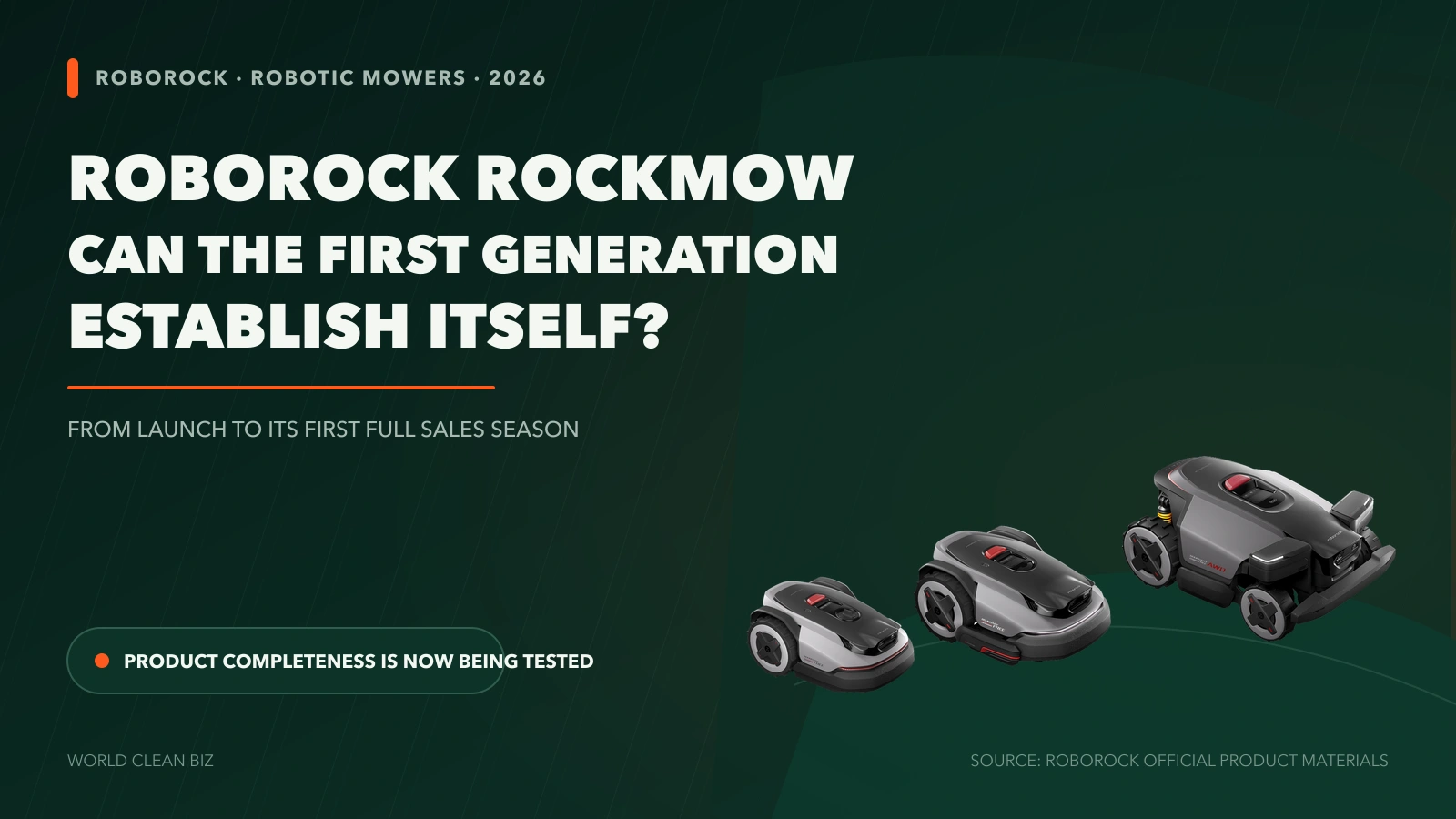
In September 2025, Roborock unveiled the RockNeo Q1, RockMow S1 and RockMow Z1 at IFA. By spring 2026, the products had begun entering dealer and retail channels in Europe. From June, the RockNeo Q1 and the flagship range, renamed X1 for North America, began arriving in that market. RockMow had entered its first full sales season.
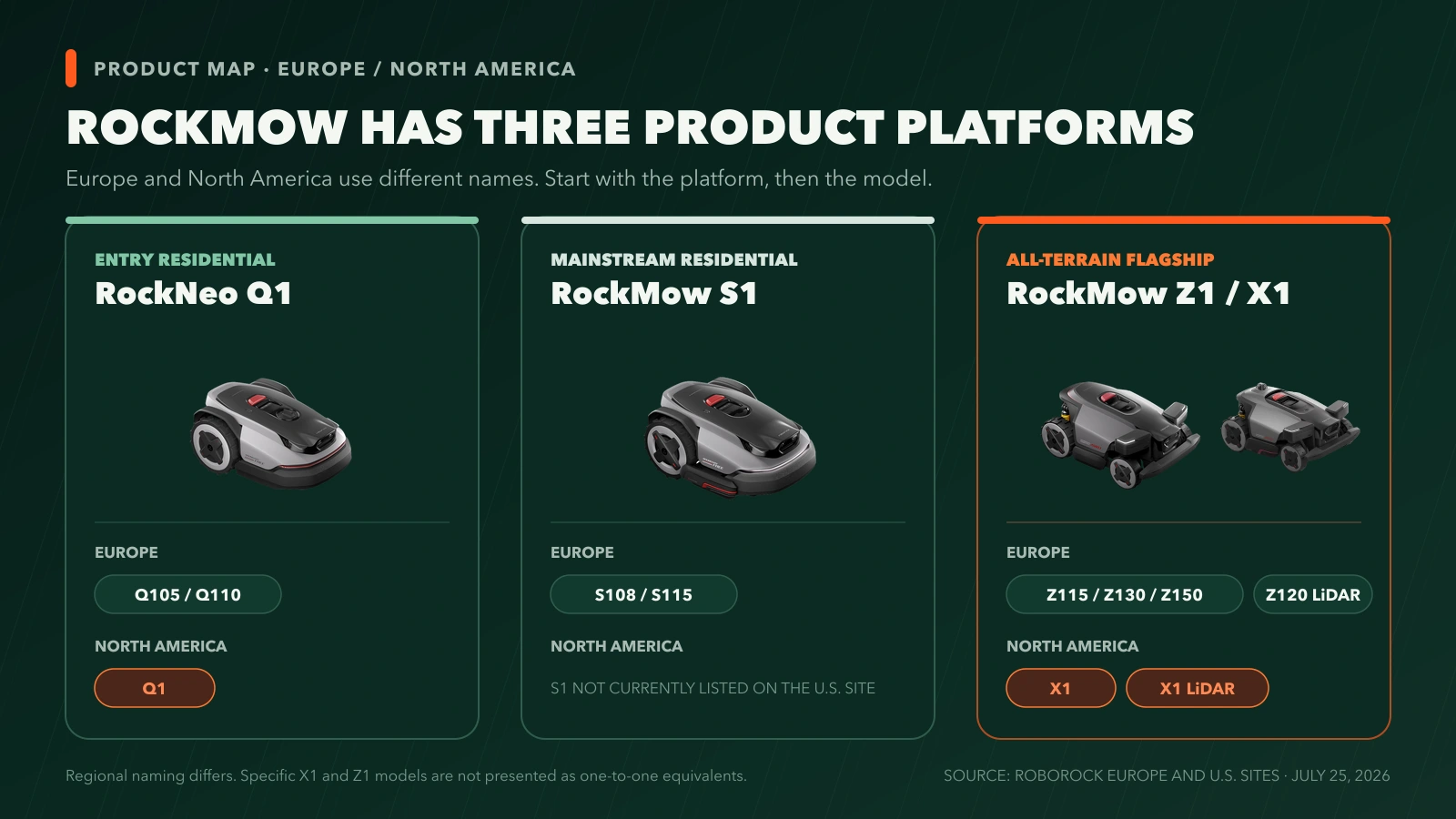
Roborock did not place its entire lawn-care bet on a single machine. The RockNeo Q1 is aimed at ordinary residential lawns, while the S1 moves up in specification. With the Z1/X1, the focus shifts to more difficult terrain and the chassis changes to all-wheel drive with active front steering. Europe uses the Z1 name and North America uses X1. The number at the end of a model name refers to coverage, while North American models carrying an H have a higher cutting range. The seemingly complicated Q105, S115, Z120 and X120H names ultimately come from three product platforms.
From the current products and early reviews, RockMow has made a solid first-generation start. Its flagship chassis is distinctive and the portfolio already has a clear shape. Price is the immediate weakness. Some software functions and edge performance also need further work. Long-term reliability will only become clearer after the first machines complete a full mowing season. The two main questions for 2026 are straightforward: whether the machines can operate consistently, and where their real selling prices settle after promotions.
The Q1 and S1 both combine RTK with vision and are better suited to yards with a relatively open view of the sky. Both use rear-wheel drive and a 22cm cutting deck. Roborock rates them for passages about 70cm wide and slopes of 45%, equivalent to roughly 24 degrees. The Q1 has manual cutting-height adjustment, and its edge-cutting module is sold separately. The S1 adds electric height adjustment and comes in versions covering about 800 and 1,500 square metres.
The Z1/X1 is defined mainly by its chassis. Many all-wheel-drive robotic mowers turn in place by counter-rotating the wheels on each side, which can repeatedly scrub soft or wet turf. Roborock added active front steering so the mower can turn along an arc. The suspension follows changes in the ground, while the floating deck helps maintain a more consistent cutting height. Roborock rates the machine for slopes up to 80%, or about 39 degrees, and obstacles up to 8cm high. More user evidence is still needed on wet cross-slopes and turns on soft ground.
The flagship range comes with either RTK or LiDAR positioning. The RTK version is intended for lawns with a relatively open sky. The LiDAR version uses a 360-degree scanner and cameras to build a yard map, reducing its dependence on satellite reception around trees and buildings. European models offer a cutting range of 20–70mm, while the North American H versions raise that to about 41–89mm.
The Z1/X1 weighs about 21.7kg and uses a single 24cm cutting deck with six blades. That width is adequate for an ordinary yard, but productivity becomes a concern when the product is sold for areas of 3,000–5,000 square metres. Similarly priced flagships such as the Navimow X4 already use wider dual decks, reducing the number of passes and charging cycles needed to cover the same area.
RockMow is close to the market at entry and mainstream prices. The flagship range faces greater pricing pressure. The comparison below uses public German prices on July 25, 2026, and shows the alternatives consumers encounter within the same budget.
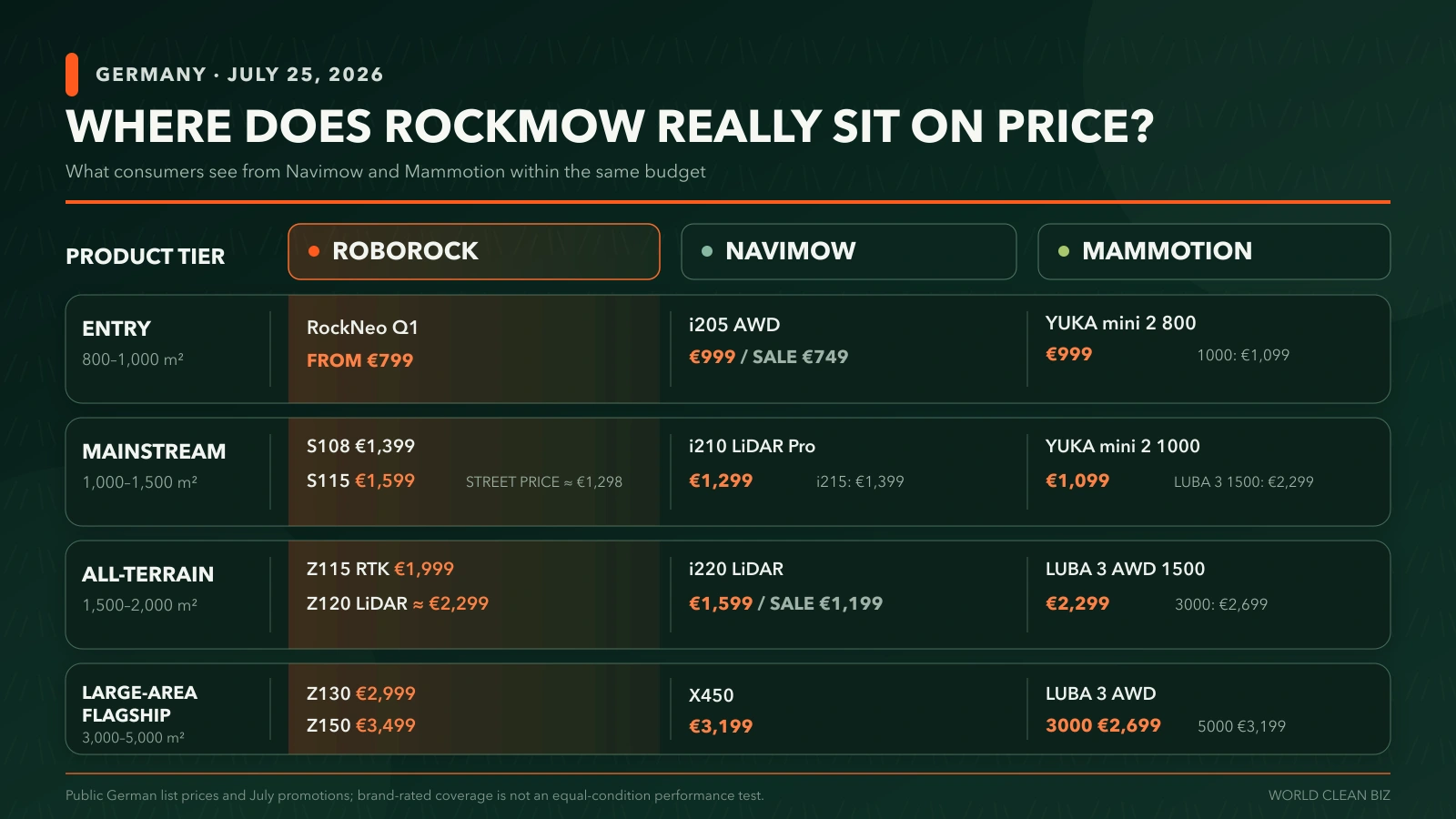
Prices come from the German websites of Roborock, Navimow and Mammotion. The Z120 LiDAR uses a publicly available channel price of about €2,299. Coverage figures follow each brand's own rating and are useful for comparing market position, not performance under identical test conditions.
The Q1 has already entered the mainstream European price band. Once the S115 reaches a transaction price of around €1,300, its specification also becomes competitive. The Z115 and Z120 LiDAR rely mainly on their chassis to stand apart. By the time the range reaches the Z130 and Z150, pricing is close to the Navimow X4 and Mammotion LUBA 3. At that level, a single 24cm deck looks narrow.
One North American user said he would not buy the X1 LiDAR above $2,299 because the machine still used only one cutting deck at that price.
The gap is more visible in North America. The RockNeo Q110H is listed at $1,299, with a launch price of $1,169. The Navimow i110, also rated for about a quarter acre, was selling for $789 in July. After the RockMow X120H LiDAR fell from $3,199 to $2,499, it entered the same price band as the Navimow X430 and Mammotion LUBA 3 AWD 3000. The X120H is rated to cover about half an acre per day, making cutting width and productivity central to the purchase decision.
European dealers have already started discounting the range, while some are using free accessories to attract buyers. Discounts also appeared shortly after the North American launch. Pricing is still being tested. July sales events and inventory levels after the season will gradually reveal RockMow's real transaction prices.
RockMow has not been on the market for long. Most of the available evidence comes from short media tests and early owners. These samples can show how complete the first generation feels, but they cannot establish a long-term failure rate.
Initial feedback on basic operation has generally been positive. Computer Bild used the Z1 LiDAR for four weeks and found that it continued completing jobs and returning to charge. In Notebookcheck's Q105 test, RTK positioning remained stable. The mower occasionally took a detour or skipped a small patch, but generally returned to cover it before the job ended.
A Z120 LiDAR owner on Roboter-Forum also reported stable operation on his lawn. For a first-generation product, consistently finishing a job and returning to the dock clears the most basic threshold.
The more concentrated complaints currently concern software. Automatic mapping is not yet fully available on the Z1/X1, so early users have had to drive the mower around the boundary manually. Multi-zone scheduling also remains immature. One owner with experience using several robotic mowers found that the Z120 did not clearly show the order in which zones would be completed and could move back and forth between lawns that were far apart.
Some functions already familiar from Roborock's robot vacuums have not carried over completely. If the mower misses a small patch, the user cannot simply select that point on the map for another pass and must create a temporary mowing zone. The mower has cameras, but the app does not currently provide a live view of the yard. Mammotion already offers that function on similarly priced flagships.
Obstacle avoidance handles common large objects, but remains less consistent with thin items close to the ground. In Clubic's Z1 LiDAR test, the mower detected a hose about two-thirds of the time. Owners still need to clear the lawn before mowing.
Edge cutting is another recurring complaint. One S108 owner found that the mower still refused to approach a hedge even though there was clearly enough room.
The PreciEdge module reduces the structural distance between the blade and boundary to about 3cm, although the actual result still depends on the shape of the edge and the software strategy. The Z120 owner mentioned earlier was left with a strip of 10–15cm even after installing the module and still needed a string trimmer. Installing the module also reduces part of the Z1's obstacle clearance from 8cm to about 5cm.
North America launched later, so there are fewer failure reports. One early X120H buyer received an E101 cutting-motor error on the day the mower arrived. It could drive and map the yard, but the cutting deck would not operate. He summarised the problem as “drives, maps—but no cutting.” For now, this is an isolated early case, but after-sales response time is already part of what first buyers are watching.
Coverage ratings can also be misread. The Z1's maximum 5,000-square-metre rating and the X1 LiDAR's half-acre-per-day claim both include multiple charging cycles. In one Z1 LiDAR test, a charge covered roughly 400–500 square metres, meaning 2,000 square metres required four or five charges. For buyers considering a large-area model, total completion time and the number of charging stops are more useful than the maximum coverage figure.
Roborock's European warranty gives the Q1 mower a two-year warranty and the S1 and Z1 three years, while batteries are covered for two years. Local dealers are normally the first point of contact. A mowing season lasts only a few months, so a repair that takes several weeks can consume much of it.
Robotic mowers spend their working lives outdoors, and sealing or whole-machine durability issues often emerge only after a complete season. RockMow's long-term reliability will still take two or three mowing seasons to establish. Roborock has the capacity to wait that long.
Behind RockMow is a listed company with annual revenue close to RMB 18.7 billion. According to Roborock's 2025 annual results and first-quarter 2026 update, 2025 revenue reached RMB 18.695 billion, an increase of 56.51%, with overseas markets contributing about 56%. Research and development spending reached RMB 1.42 billion that year. A company of this size can support several RockMow generations without requiring the first sales season to prove profitability.
Roborock products are already sold in more than 170 countries and regions, and cumulative robot-vacuum sales have exceeded 25 million units. Years of experience in consumer robotics can help RockMow move into mass production and mainstream channels more quickly. Yard equipment depends more heavily on local service, and Roborock still needs to build that network market by market.
Industry-channel information puts the annual target at roughly 200,000 units, although Roborock has not publicly confirmed the figure. The first year's sales matter mainly as a test of sell-through. Products that reach homes will give Roborock operating data from real yards and a reason for dealers to keep investing. Inventory that remains in the channel will create greater pressure to discount.
In 2026, RockMow needs to deliver all three product lines consistently and complete its first full mowing season without major disruption. The problems that emerge from those early machines will determine the priorities for the second generation. In 2027, Roborock can expand into more markets and use scale to bring prices down. The company's existing operating base is large enough to support RockMow as a multi-generation program. If the first generation establishes a foothold and later products mature, RockMow has a credible path into the industry's leading group.