- 3. What would it look like if the home appliance industry had One.
- 4. Small household appliances are divided into several.
- We talked about the One power of electric tools before, that is, one battery pack can support dozens or even hundreds of products.
1.One power of power tools
- One power in the home appliance industry is inevitable
- What would it look like if the home appliance industry had One power?
- Small household appliances are divided into several categories
--Electric type (2-3 specifications)
--Electric heating type (2-3 specifications)
- Medium category of battery
- Current issues
- Prerequisites for future realization
- Approximate time point
------------------
We talked about the One power of electric tools before, that is, one battery pack can support dozens or even hundreds of products. The advantage of this is that when purchasing a product, you can buy a version without a battery pack, and the purchase cost can be significantly reduced.
In the past, some leading power tool companies such as TTI and Grebo also tried One Power for home appliances, but they were not very successful.
Will the small home appliance industry be able to enter One Power in the future? If so, when will it be?
First of all, we need to make one point clear. The benefit of One Power to consumers is that they don’t have to buy battery packs repeatedly and can save money. For companies, if consumers buy my battery pack, they will also give priority to my products when purchasing new products.
First of all, small household appliances need to be lithium-ionized first, and then centralized battery packs. If lithium-ionization has not been completed, it is impossible to start battery pack centralization.
At present, small household appliances are mainly divided into two categories, electric and electric.
Electric ones are those with motors, such as vacuum cleaners, juicers, fans, etc.
Electric heaters are those with heating devices, such as rice cookers and electric baking pans.
From a technical point of view, electric lithium batteries will be faster than electric ones, because electric ones consume power too quickly and the battery cannot last long.
Another thing to consider is that if a product is left motionless, there is not much need for lithium batteries, such as rice cookers and microwave ovens.
So based on the current status:
Cleaning appliances: vacuum cleaners, robot vacuums, and hard floor washers must be fully lithium-ionized, and the time is estimated to be within 3-5 years.
Small kitchen appliances: handheld blenders and portable coffee machines are lithium-ionized. Fans are required in some scenarios. Electric heating: air fryers, microwave ovens, ovens, etc.
Small personal care appliances: electric toothbrushes, hair removal devices and other small appliances have begun to use lithium batteries, and hair dryers, which are currently popular, are not yet wireless.
Therefore, it can be seen that the road to lithium-ionization of small household appliances is still long. In addition to cleaning appliances, there are insufficient lithium-ionization scenarios for other small household appliances.
It turns out that there was a scene in camping. At that time, lithium electric fans, lithium electric juicers, and lithium electric insulators had been popular for a while. But in the latter scene, everyone found that I had a better solution, which was to bring a large mobile power supply for better use, so the waiter, Zhenghao, etc. were able to survive. Moreover, many new energy vehicles have an adapter board that can also power these electrical appliances.
So based on the above situation, we can draw the following conclusions.
- There is still a long way to go before the comprehensive lithium electrification of small household appliances, among which the comprehensive lithium electrification of cleaning appliances will come sooner.
- If the heating problem is solved in the future, electric heating equipment such as rice cookers/air fryers/ovens have basically no need to move, so I think lithium-ionization will be insufficient.
- If we assume that lithium batteries are really used, what will the lithium batteries look like? Because the shape of small household appliances is the biggest selling point, the shape of the battery pack is also very important. But from a cost perspective, I think there is a high probability that it will still be a cylindrical lithium battery.
Don’t think about the centralization of battery packs within 4.5 years, otherwise you will most likely face huge losses. When is the time to consider starting? Look at the actions of giants such as Midea, Xinbao, Shark, and SEB.
-----------------------
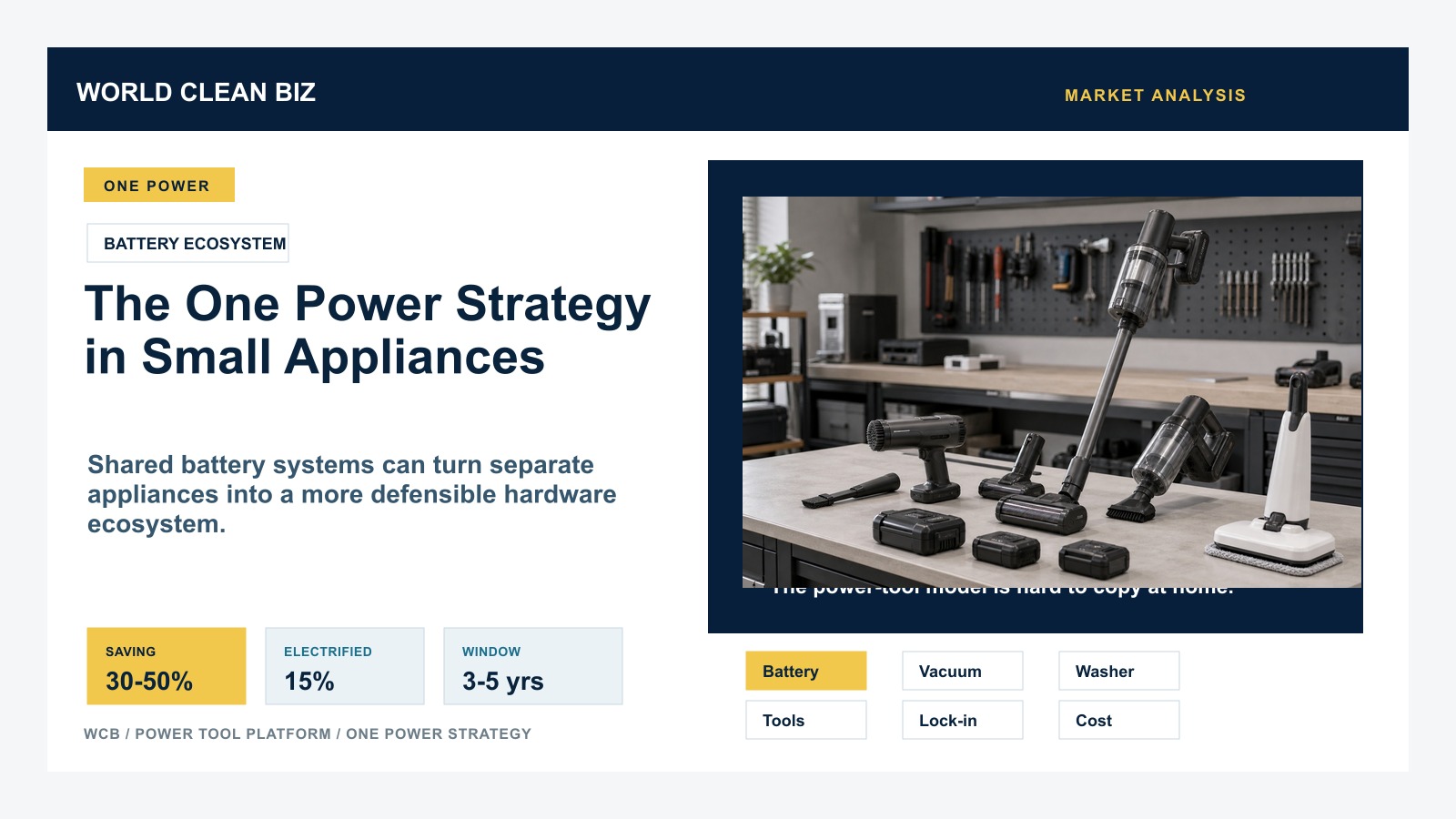
The "One Power (universal battery)" model has been successfully proven in the field of power tools - a single battery pack can be adapted to dozens of products, and consumers can save 30-50% of costs by purchasing bare metal, making it more sticky for brands.
Companies such as TTI and Grebo have tried to transplant this model to the home appliance field, but with little success. The core contradiction is that there is a strong demand for mobile use of power tools, while 90% of traditional home appliances are used in fixed scenarios.
The prerequisite for realizing a universal battery is lithium electrification. The current penetration rate of lithium batteries in small household appliances is only 15%, mainly concentrated in cleaning appliances (vacuum cleaners/hard floor washers/robot vacuums) and personal care products (electric toothbrushes/hair removal devices). Only some small kitchen appliances are lithium electrified.
From the perspective of product type, small household appliances are divided into two major categories:
- Electric (motor driven): lithium-ion batteries for highly mobile appliances such as vacuum cleaners will be completed within 3-5 years. Electric small household appliances that are not very mobile, such as electric fans, coffee machines, air cleaners, etc., have some demand, but the overall power of lithium-ion batteries is not enough.
- Electric heating (heating devices): Due to heating energy consumption, it is necessary to wait for more efficient heating technology and battery technology to be improved before lithium electrification is possible. Even if the above technologies are solved, most small electric heating appliances have no mobile needs, and the possibility of lithium electrification is relatively low.
During the mask period, the camping scene once promoted a brief explosion of lithium-ion small household appliances. However, with the increase in new energy vehicles and the use of large-capacity mobile power supplies (Zhenghao, Dianxiaoer), 78% of users prefer to carry a combination of mobile power supplies + traditional electrical appliances.
- There is still a long way to go before the comprehensive lithium electrification of small household appliances. Among them, the comprehensive lithium electrification of cleaning appliances will come sooner. It is possible that Dreame, Ecovacs/Tineco, Roborock, etc. will first unify the battery packs in cleaning appliances, but these battery packs are unlikely to be common to other home appliances.
- If the heating problem is solved in the future, electric heating equipment such as rice cookers/air fryers/ovens have basically no need to move, so I think lithium-ionization will be insufficient.
- If we assume that lithium batteries are really used, what will lithium batteries look like? Because the shape of small household appliances is the biggest selling point, the shape of the battery pack is also very important. But from a cost perspective, I think it is most likely to be cylindrical lithium batteries, which will be divided into several different specifications according to power.
Don't think about the issue of "universal batteries" in 4.5 years, otherwise you will most likely face huge losses. If universal batteries are indeed feasible, the biggest gains will definitely be those giants, such as Xiaomi and Midea. If they don't move, the most important thing is to keep an eye on your wallet.