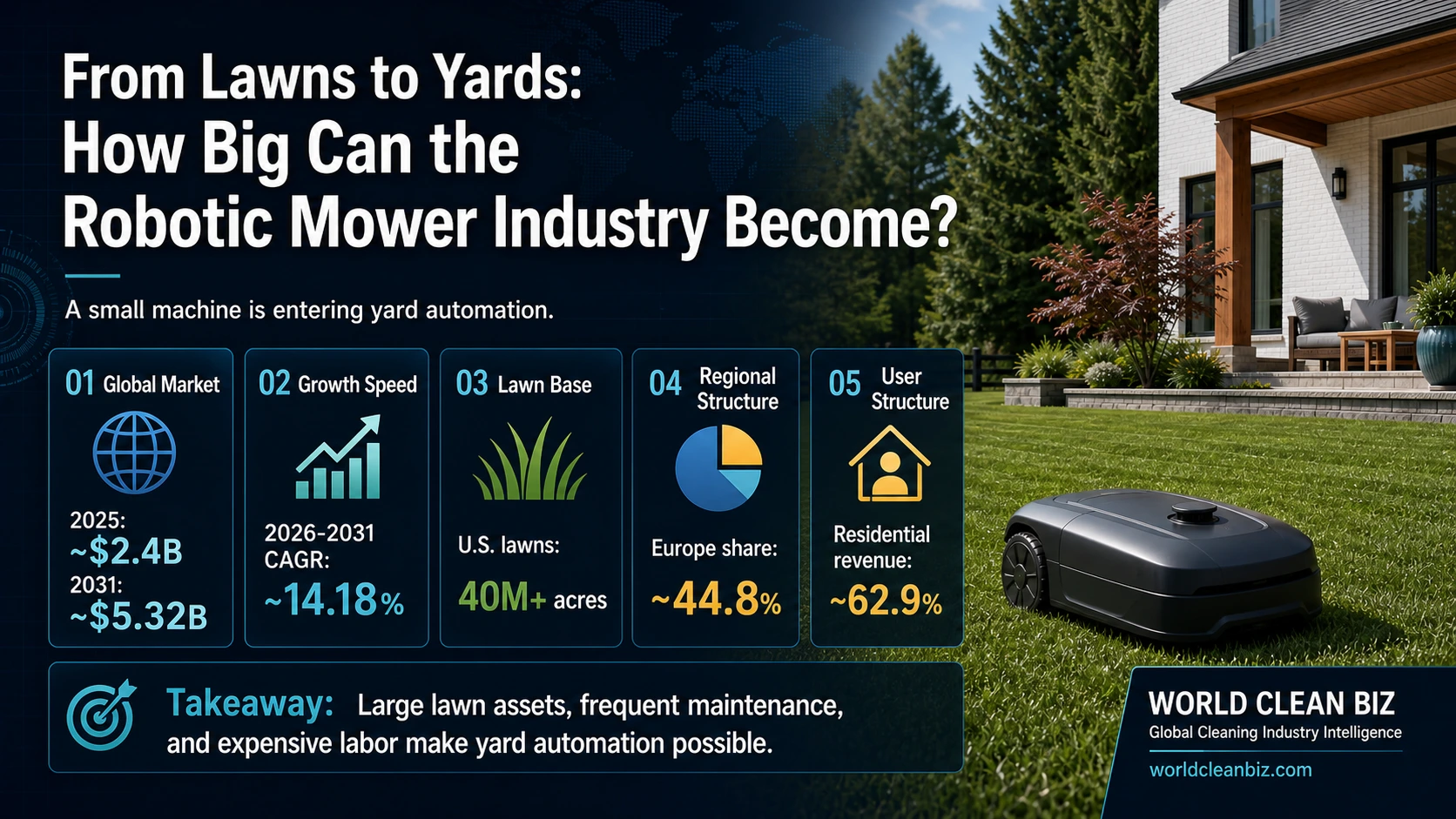
- Robotic mower competition is shifting from coverage and slope ratings toward task completion and reduced human intervention.
- Entry and mainstream products now split across RTK, vision, LiDAR and AWD routes, making yard-fit diagnosis more important than area alone.
- Commercial buyers are purchasing uptime, remote recovery and service capacity rather than a mower in isolation.
In this article 7 sections
Robotic mowers are entering another period of rapid growth. Wireless boundaries are replacing perimeter wire, while RTK, LiDAR, sensor fusion and all-wheel drive are moving quickly into new products. The market is also expanding from small residential lawns into complex yards, all-terrain properties and professional grounds care. Competition has moved beyond whether a machine can mow by itself. The new questions are what kind of property it can cover and how often a person still has to intervene.
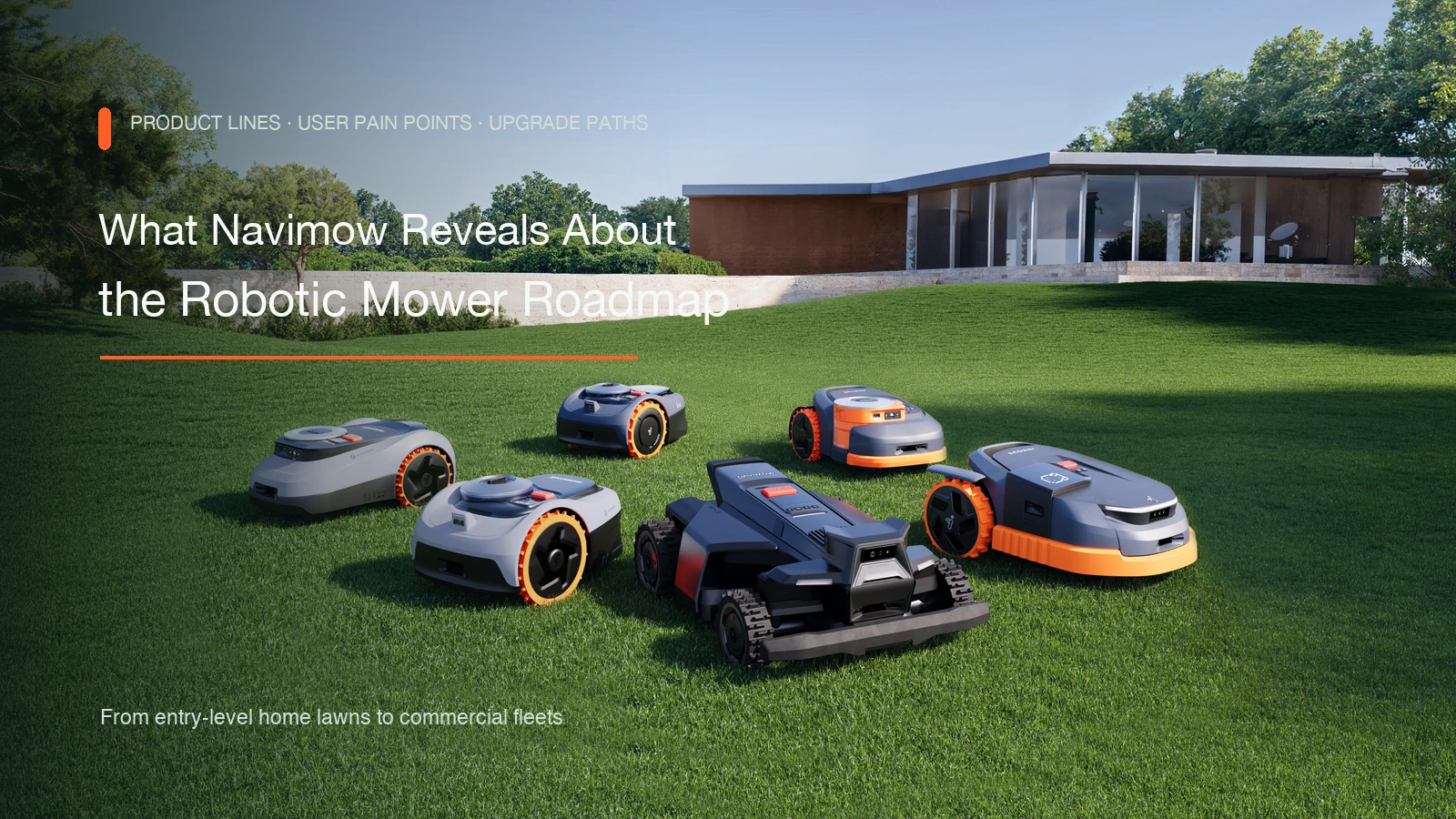
Navimow has one of the more complete product portfolios in this expansion cycle. The i1, i2, H2, X4 and Terranox extend from low-cost residential models to commercial fleets. They also represent five technology directions: wireless entry products, alternative positioning routes, multi-sensor fusion, all-terrain platforms and fleet management. Following the portfolio from one tier to the next shows which problems the robotic mower industry is trying to solve and where the next upgrades are likely to occur.
The Navimow i210 and H210 both target lawns of roughly 0.25 acre, but the former costs $1,299 and the latter $1,799. The additional $500 does not buy more nominal area. It buys a more complex positioning system and a better chance of keeping the machine working beneath trees, through narrow passages and across multiple zones.
Area still affects battery capacity and operating efficiency, but it no longer explains price on its own. The real distinction between price tiers is how often a person must step in when the mower meets a complex environment.
Navimow Roadmap at a Glance
- i1: affordable wireless mowing for smaller, simpler lawns.
- i2: alternative AWD and LiDAR routes for mainstream yards.
- H2: multi-sensor positioning for obstruction, narrow passages and complex zones.
- X4: a wider all-terrain platform where traction and turf protection matter together.
- Terranox: commercial fleets where uptime, remote recovery and service determine value.
This portfolio is not a simple ladder of larger coverage areas. Each step attempts to remove a different cause of human intervention, which is why task completion—not a single specification—is the most useful way to read the roadmap.
Prices in this article are snapshots of the US market on July 22, 2026. Consumer discussions come from communities focused on Navimow, Mammotion, ECOVACS, Dreame, Worx and Kress. The article first identifies issues repeated across different brands or independent discussions, then selects comments that explain the trigger and practical consequence. These examples do not represent an industry-wide complaint ranking.
Value Entry: Sub-$1,000 Machines First Need to Complete the Automation Loop
Product Line and Competing Products
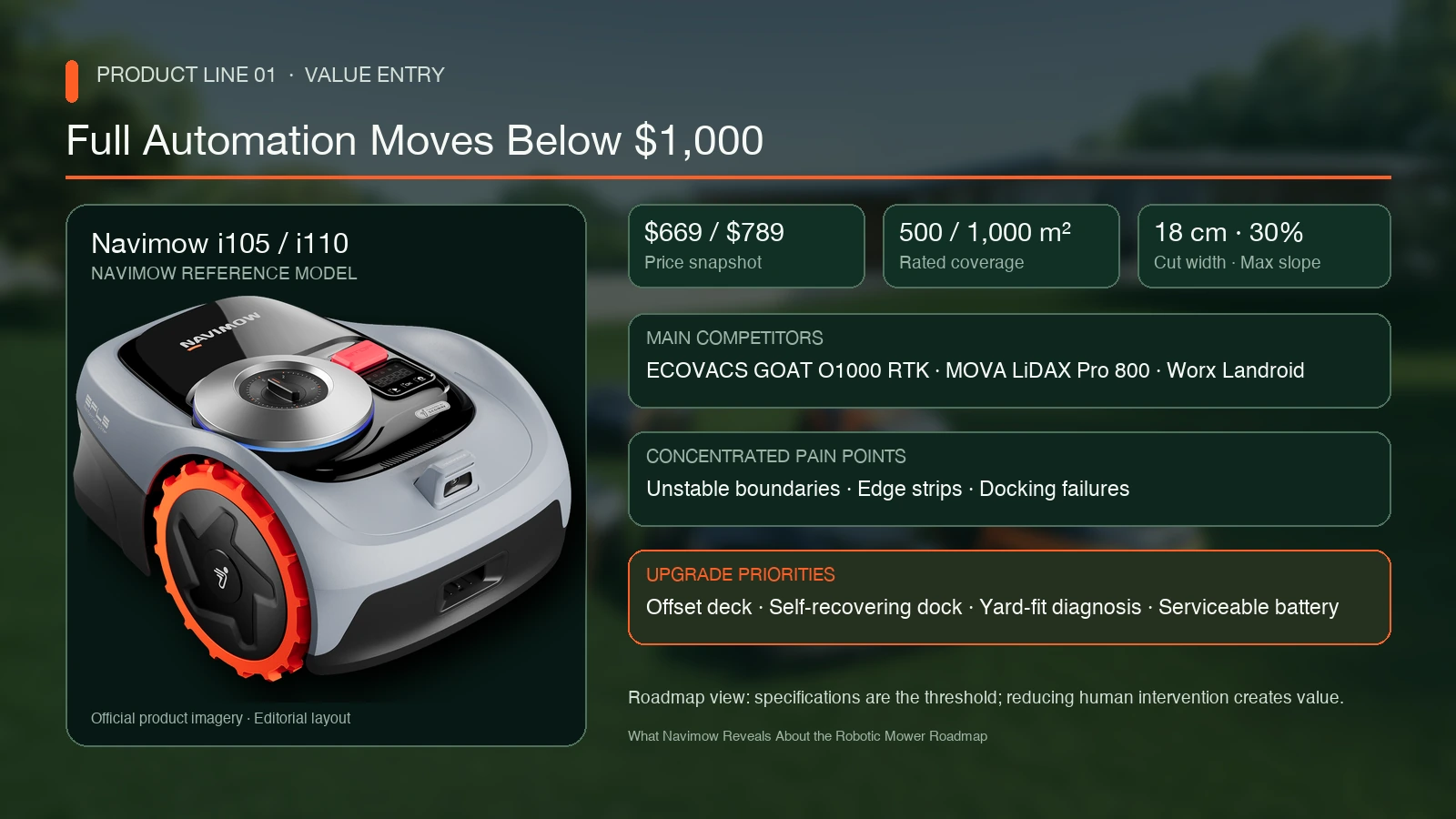
The Navimow i105 and i110 cost about $669 and $789 and cover approximately 500 and 1,000 square meters. Both use a compact body measuring about 545 × 385 × 285 millimeters and weigh around 10.9 kilograms. The main difference is battery capacity and runtime: roughly 60 minutes for the i105 and 120 minutes for the i110. Both have an 18-centimeter cutting width, three pivoting blades, manually adjusted cutting height from 20 to 60 millimeters and a rated maximum slope of 30%. The narrow deck keeps the machine affordable and helps it pass through small yards, but it also requires more passes to cover the same area.
The i1 uses EFLS 2.0 to combine satellite positioning with a 140-degree RGB camera. It supports wireless mapping, mowing zones, obstacle avoidance and automatic docking. Its low, rounded shell resembles a household appliance. Two large rear wheels provide drive while smaller front wheels support steering. The structure is light, narrow and easy to carry, and it can move between flowerbeds and outdoor furniture. The trade-off is limited traction, obstacle clearance and space for cutting close to a wall.
Direct competitors include the ECOVACS GOAT O1000 RTK, which was on promotion for about $700, the $799 MOVA LiDAX Pro 800 and Worx Landroid wire-guided models priced from roughly $500 to $750. Their shapes already reveal different technology routes. Wire-guided machines do not need a prominent positioning unit on top. Some LiDAR models raise the sensor to gain a wider view, while RTK-plus-vision machines try to remain low and flat. The low-cost market is therefore not simply selling the same machine for less. Four positioning approaches are competing for the same small-lawn customer.
What Consumers Complain About Most
Customers can easily choose the wrong system for their yard. Product selectors usually ask about area but rarely examine tree cover, narrow passages or boundary shape. A buyer may choose the right capacity and the wrong positioning route, only discovering after delivery that the charging station must be moved, magnetic strips added or the map redrawn. One i105E owner reported unstable routing despite an open lawn and good satellite reception:
“The mower ‘wanders’ and makes a lot of small corrections, especially near edges.” — Navimow i105E owner
Edge cutting remains inadequate. The safety distance between the deck and the outer shell leaves uncut grass beside walls and flowerbeds. Conservative vision and mapping behavior can make the strip wider, and remapping does not necessarily solve it. Another i105 owner rebuilt the map repeatedly and received the same result:
“New maps don’t affect it. Seems that we have to deal with it.” — Navimow i105 owner
The robot finishes its task, but the owner still has to bring out a string trimmer.
A docking failure stops the entire unattended workflow. Mud on the contacts, a misaligned approach or uneven ground in front of the station can leave a mower at the dock without a successful connection. A Worx Vision owner wrote:
“My landroid vision once every 4-5 days get stuck trying to getting into the base charge.” — Worx Vision owner
Small failures are especially damaging at the value tier. If the owner is away, one unsuccessful docking attempt can cancel every remaining scheduled task.
How the Segment Should Evolve
Hardware must first complete the basic operating loop. The cutting deck can be offset slightly toward one side, with a flexible guard, lift detection and slower edge travel preserving safety. Charging contacts need self-cleaning features and greater alignment tolerance. Front wheels, tire tread and grass-discharge paths should reduce stalls caused by wet clippings and mud. Batteries, drive wheels, cutting assemblies and charging stations should not force the entire mower into retirement when one component fails.
Software should reduce failures rather than add more features. When a machine makes repeated corrections near a boundary, it should record positioning confidence and slow down automatically. After a first docking failure, it should clean the contacts, back away and try a different approach angle. If it becomes lightly stuck, wheel-speed differences should help distinguish slipping, suspension or grass entanglement before the mower selects a recovery maneuver. If recovery still fails, the app should tell the owner exactly what to inspect.
Purchase and installation should become a yard assessment. The customer walks the lawn once with a phone while the system checks boundary clarity, satellite obstruction, the narrowest passage and possible charging-station locations. It can then recommend wire, RTK or vision. After unboxing, the user confirms only the low-confidence boundary segments identified by the system instead of learning a mapping tool from scratch.
Even low-cost models need transparent lifecycle costs. In addition to machine price, the product page should list blade, battery, tire, connectivity and required accessory costs. It should state the software-support period and which basic functions will continue if a cloud service is discontinued. Brands can demonstrate value through three-year ownership cost rather than a promotional price alone.
The scorecard must focus on unattended operation. The most meaningful figures in this tier are not the number of object classes recognized. They are docking success rate, average uncut edge width, monthly rescue events and the time required to finish one schedule. Only when these measures continue to improve will low-cost wireless machines become ordinary household tools rather than novelty products.
Mainstream Entry: Ordinary Households Must Now Choose a Technology Route
Product Line and Competing Products
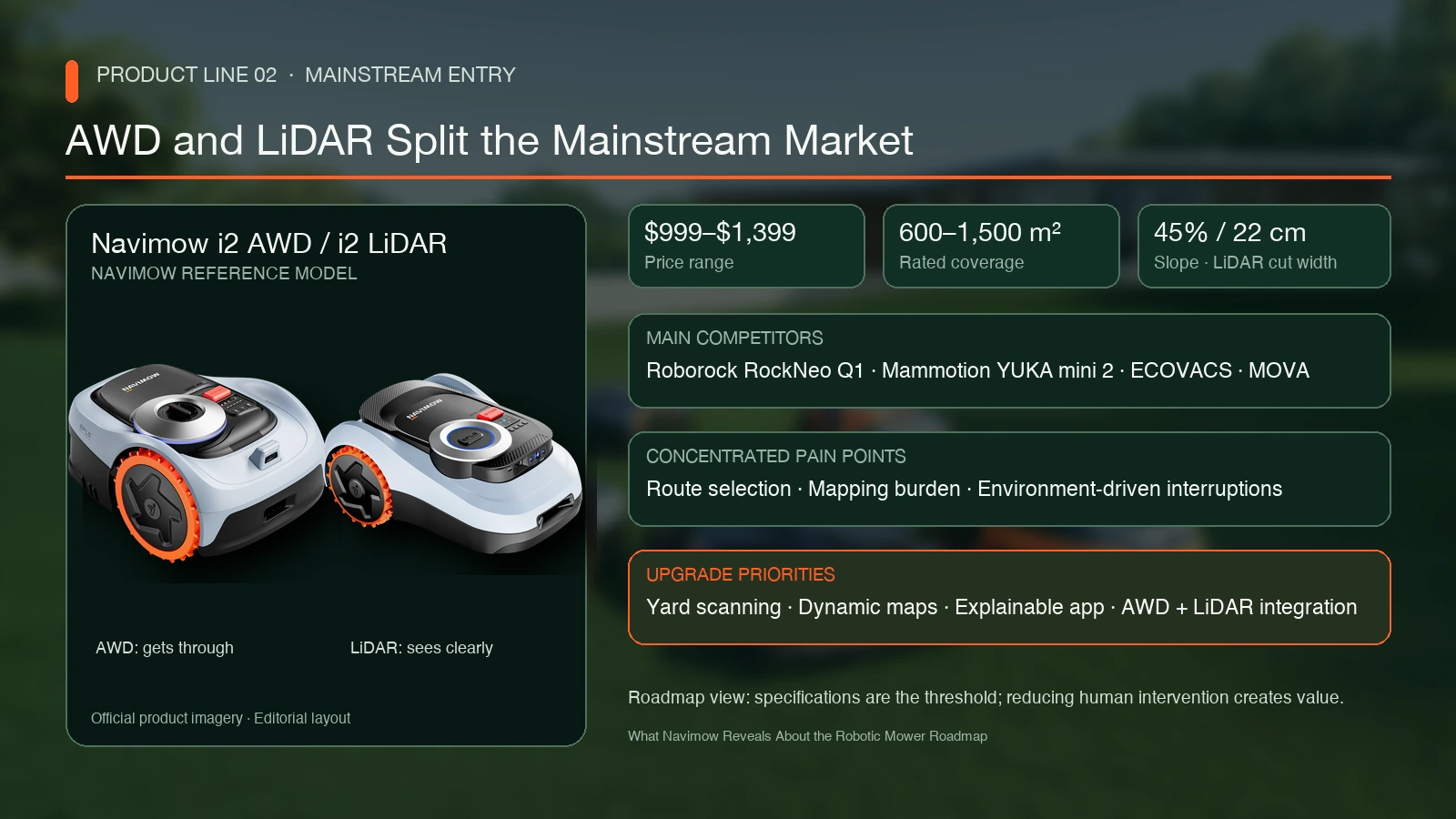
Navimow has split the mainstream entry tier into two physical forms. The i206 AWD and i210 AWD cost $999 and $1,299 and cover approximately 600 and 1,000 square meters. They retain the compact 545 × 385 × 285-millimeter body and weigh around 12 kilograms. Cutting width remains 18 centimeters, but the blade count rises from three to five. All-terrain tires, four-wheel drive, built-in 4G and antenna-free NRTK-plus-vision positioning raise the rated slope from 30% on the i1 to 45%. The shape remains compact and low, but with heavier tread and a chassis that emphasizes grip for small sloping or wet lawns.
The i215 LiDAR costs about $1,399 and covers roughly 1,500 square meters. It weighs around 15 kilograms, widens the cut to approximately 22 centimeters and replaces manual height adjustment with an automatic range of about 20 to 70 millimeters. LiDAR plus vision reduces dependence on satellite reception, making the machine more suitable for dense tree cover, building obstruction and complex boundaries. Its shape also shifts from a low compact vehicle to a thicker and wider sensing platform. The larger body creates room for the LiDAR field of view, height-adjustment mechanism and battery, but buyers need to check carrying, storage and narrow-passage clearance more carefully.
The same price band includes the $1,299 Roborock RockNeo Q1, the $1,399 Mammotion YUKA mini 2 and LiDAR products from ECOVACS and MOVA. Competitors differ in more than specifications. Some place LiDAR at a prominent high point, some retain a low vision-led body and others use four-wheel drive for slope stability. By launching both AWD and LiDAR products, Navimow is effectively acknowledging that mainstream households face two different problems: whether the machine can see the route clearly and whether it can physically travel through it.
What Consumers Complain About Most
Consumers must diagnose the technology route themselves. AWD, RTK and LiDAR solve different problems, yet area and maximum slope do not answer whether a mower can pass through a narrow corridor or keep positioning beneath trees. One i210 LiDAR user found that the mower could climb in a straight line but could not mow horizontally across a slope:
“In a ~20° it cannot hold the horizontal line and slides down.” — Navimow i210 LiDAR owner
The pre-purchase technology decision is being left to households with little experience.
Wireless boundaries have not eliminated installation, mapping or rescue work. RTK still requires base-station adjustment. LiDAR requires stable environmental features. Flowerbeds, no-go zones and connecting paths still have to be edited in the app. An ECOVACS GOAT O1200 LiDAR Pro owner expected the machine to return weekend time:
“Thinking it would buy me time on weekends (wrong).” — GOAT O1200 LiDAR Pro owner
Environmental change can prevent task completion. Growing plants, temporary objects and changing light all alter whether a route remains passable. One YUKA owner reported that the mower still knew its position but became stuck under trees at dusk:
“only problem is that it gets stuck at dusk under trees so it’s impossible to complete a task overnight.” — Mammotion YUKA owner
Base stations, 4G service and trimming accessories may still cost extra, and software or subscription costs need to be explained before purchase. But in the consumer discussions reviewed here, the more concentrated complaints concern model selection, mapping and the failure to complete tasks continuously.
How the Segment Should Evolve
Product definitions should become capability combinations rather than three separate labels. AWD, LiDAR and RTK should not force consumers to answer a technology exam. Brands can retain different SKUs in the near term, but they should share a common chassis, battery and software platform, then combine drive and sensing according to yard difficulty. In the medium term, lighter products that combine AWD and LiDAR will reduce the need to choose between traction and positioning stability.
The map should become a yard model that learns. The machine should record long-term signal quality beneath trees, cross-slope slipping, narrow-passage success and temporary obstacles instead of storing only a static boundary. If an area is repeatedly missed, it can change the mowing direction automatically. It can return after a play structure is removed. If growing plants encroach on a passage, it should ask the user to confirm a local boundary change rather than rebuild the entire map.
The app must translate complex technology into an action. Users do not need a stack of sensor terms. They need messages such as “positioning is unstable beneath the trees; switching to a vision-led route,” “cross-slope slipping detected; route changed to uphill and downhill travel,” or “the ground in front of the charging station is uneven.” The machine should also show which positioning source it is currently using, why it has stopped and where it will resume.
The sales entry point should shift from selecting a model to selecting a yard. After a phone scan or uploaded aerial image, the system can inspect satellite obstruction, slope direction, lawn entrances and the narrowest passage. It can then provide a fit score, charging-station position and complete configuration list. The price page should also explain 4G, NRTK, accessory and subscription periods, together with the functions that remain available after connectivity or service expires.
Mainstream success means less care. Brands should disclose initial mapping time, the number of map edits required in the first month, cross-zone task completion, docking success and average edge residue. Those measures answer the consumer’s real question: after bringing the mower home, how much time will be spent looking after it?
Complex-Yard Models: More Sensors Have Not Eliminated Human Rescue
Product Line and Competing Products
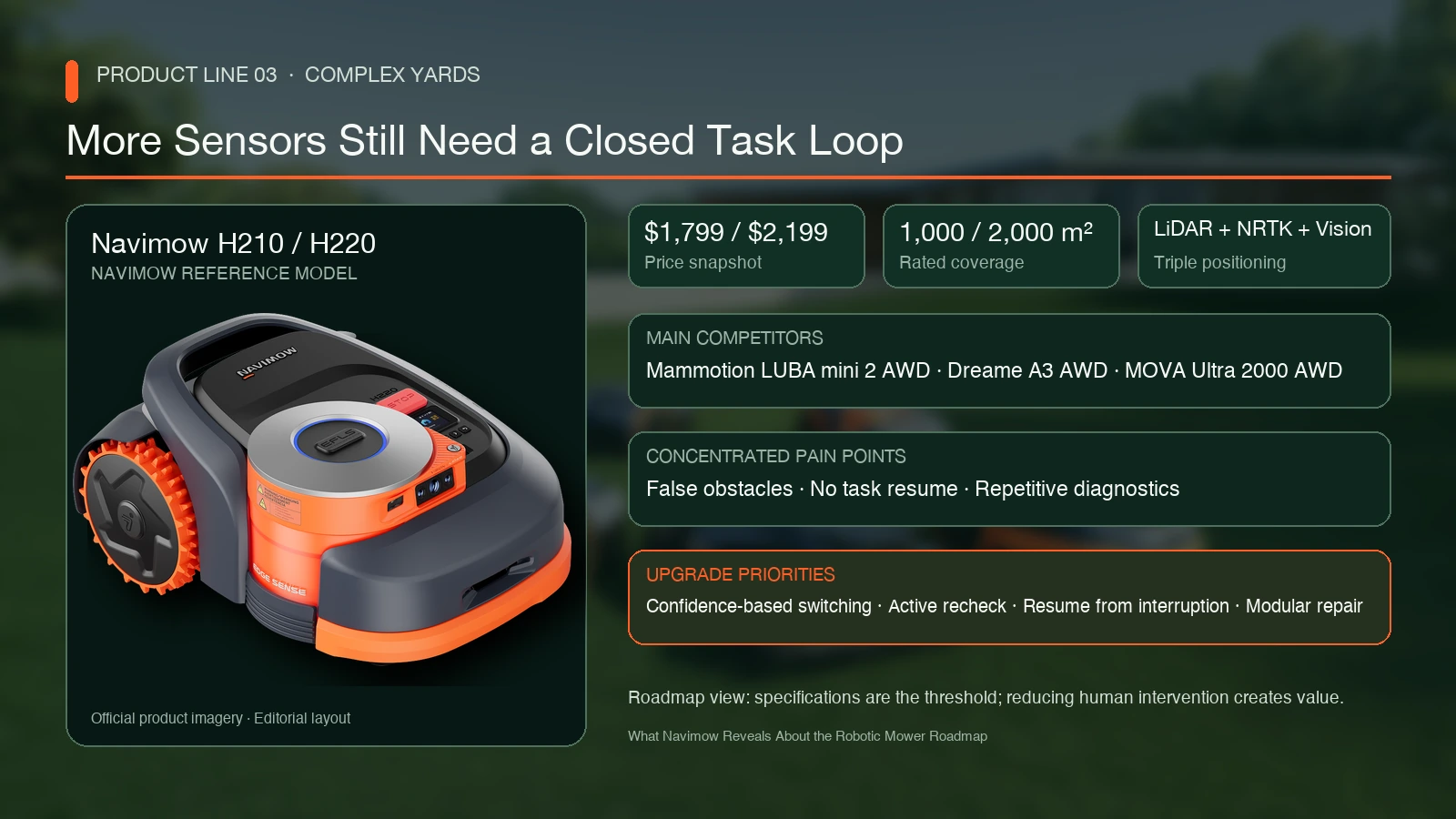
The Navimow H210 and H220 cost $1,799 and $2,199 and cover about 1,000 and 2,000 square meters. The H210 overlaps the i210 in nominal area. The $500 premium is not for a larger lawn. It combines LiDAR, Network RTK and vision to maintain positioning across tree cover, passages of roughly 70 centimeters, night operation and open ground. The H2 also adds automatic mapping, a photographic map, automatic cutting-height control, a rated maximum slope of 45% and separate schedules for each zone. The goal is to reduce installation and intervention in a complex yard.
The cutting system uses a 100-watt motor, six blades and an anti-clog deck with all-terrain tires. When edge mowing, it can straddle a safe boundary and leave approximately five centimeters beside a wall. The H2 is wider and thicker than the i series but retains a rounded, low-center-of-gravity body. Its solid-state LiDAR is integrated into the shell instead of being raised on a rotating tower that is easier to strike. The shape protects the sensors, fits narrow passages and keeps a low profile in residential settings. Navimow’s current product page does not publish complete body dimensions, weight or cutting width, so this article does not substitute specifications from the previous H series.
The Mammotion LUBA mini 2 AWD, Dreame A3 AWD and MOVA Ultra 2000 AWD occupy a similar band with different structures. The LUBA mini emphasizes four-wheel traction. Dreame and some MOVA models use top-mounted LiDAR to capture a broad environmental outline. The H2 integrates its sensors into a more enclosed shell. Complex-yard competition is therefore not about who installs more sensors. It is about which machine can still finish its work when obstruction, narrow paths, slopes and temporary objects occur in sequence.
What Consumers Complain About Most
After misclassifying an obstacle, the mower does not verify the result. Tree shadows, grass debris or disagreement between sensors can be interpreted as danger. The machine stops without changing its viewing angle, routing around the object or returning later to cover the missed area. One LUBA 2 AWD owner wrote:
“It keeps getting stuck… saying there’s an obstacle… but there’s absolutely nothing there.” — LUBA 2 AWD owner
If the user misses the notification, the mower can remain stationary until the battery is depleted and then has to be carried back to the dock.
An interrupted task cannot resume. One software error can terminate an entire zone. If the mower cannot continue from the interruption point, the user has to restart the job and inspect the same area again. A Dreame A3 AWD user described the problem as an inability to finish a zone:
“It almost never completes mowing a zone without some failure.” — Dreame A3 AWD owner
The more sensors a machine contains, the harder an unexplained stoppage becomes to diagnose.
Diagnostics and repair have not kept pace with hardware complexity. A generic error in the app does not tell the owner whether to clean a sensor, move a base station or edit the map. After repeatedly submitting logs and device details, one LUBA mini 2 AWD owner still had to answer the same questions:
“Every time, it feels like the conversation starts from zero.” — LUBA mini 2 AWD owner
Shipping the entire machine for repair can remove it from service for a large part of the mowing season.
How the Segment Should Evolve
Sensor fusion must progress from “having everything” to knowing which source to trust. The system should calculate separate confidence levels for LiDAR, vision and RTK. When satellite reception falls beneath trees, it should transition smoothly to local environmental positioning. When raindrops affect a lens or night conditions reduce visual quality, it should slow down and narrow the operating area instead of stopping abruptly. The app should record the reason for every switch so support does not default to asking the user to remap.
The machine needs active verification and task continuation. When a possible obstacle is detected, the mower should back away, look from another angle and then decide whether to route around it, wait or notify the user. Any missed patch should be added to a return queue. A restart, charging cycle or short positioning loss should preserve task progress and resume from a safe checkpoint rather than mowing the entire zone again.
Complex maps need automatic governance. The system can turn repeated false alarms, slipping, low branches and narrow entrances into problem hot spots. It can then recommend an action: change travel direction, reduce speed, add a safety offset to one boundary segment or trim a plant. The user should see a yard map showing what needs attention, not an expanding list of advanced settings.
A higher price must include a stronger service loop. With user authorization, remote logs should flow directly into a support ticket so the technician can see positioning, wheel speed and sensor states before the failure. LiDAR modules, cameras, drive wheels and batteries should be replaceable by a dealer in the field. If the mower cannot be repaired within a promised period during mowing season, the customer should receive a loaner or rapid replacement.
The premium needs new acceptance metrics. This tier should disclose task completion rate, false-obstacle stoppage rate, resume success, human interventions per 100 operating hours and mean time to repair. Those figures explain whether multi-sensor hardware actually reduces rescue work far better than a claim to recognize 200 types of obstacle.
All-Terrain Flagships: Slope Ratings Are Losing Differentiation
Product Line and Competing Products
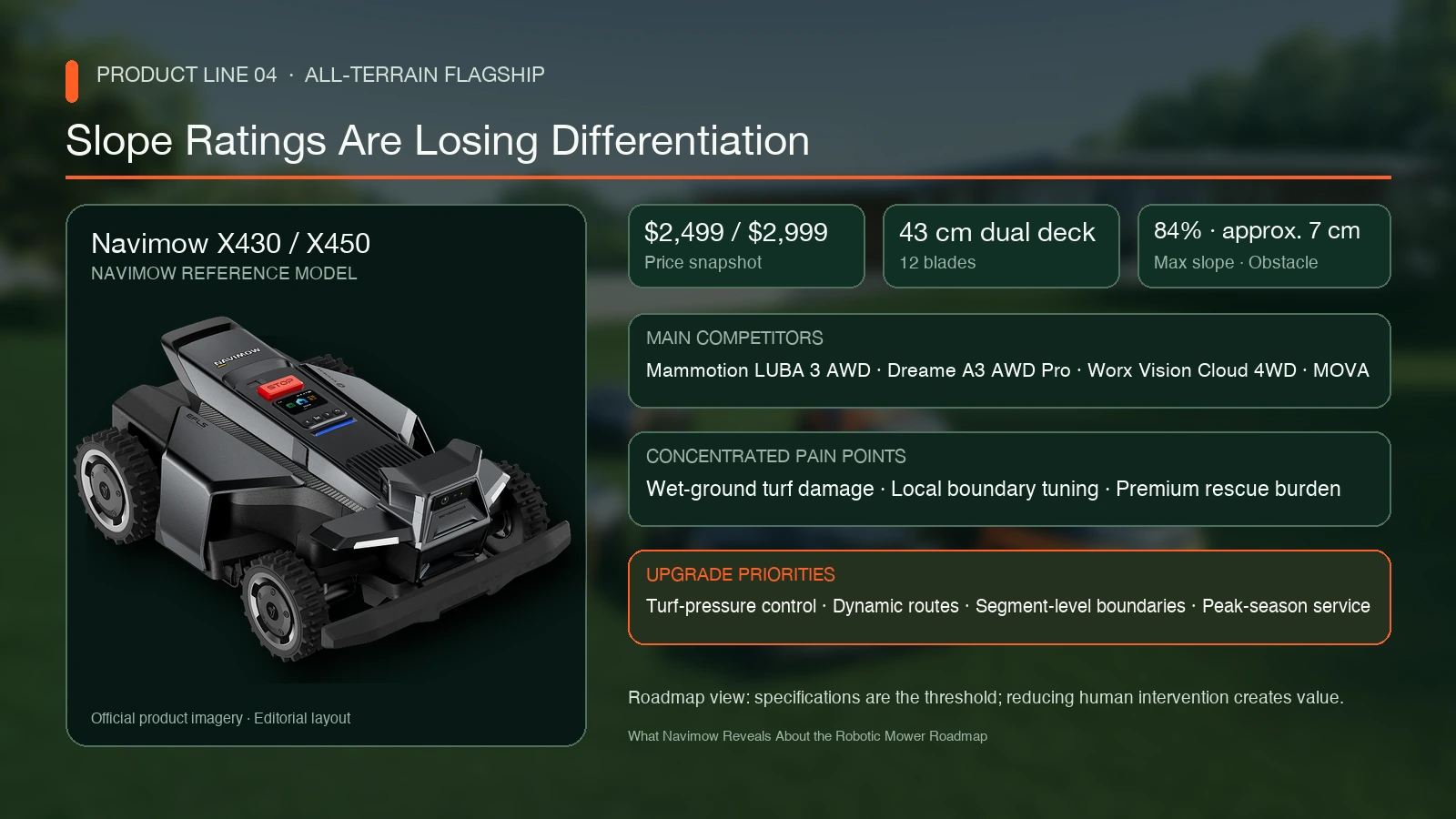
The Navimow X430 and X450 cost $2,499 and $2,999 and cover about 1.0 and 1.5 acres. The machines weigh roughly 28.8 to 29.2 kilograms and use a 43-centimeter dual cutting deck with 12 blades, two 180-watt cutting motors and a height range of approximately 20 to 95 millimeters. Compared with the 18-centimeter cut of the i series, the X4 covers more than twice the width in one pass. A roughly 90-minute fast charge and travel speed of up to about 0.8 meters per second are designed to complete large properties within limited windows before dew, rainfall or site opening.
The chassis is the real product definition. Four large wheels, 5:5 axle-load distribution, dual suspension, traction control and active front steering support a rated slope of 84%, or 40 degrees, and obstacle clearance of approximately seven centimeters. Unlike common four-wheel-drive mowers that turn by reversing left and right wheels like a tracked vehicle, the X4 adds front-wheel zero-radius and Ackermann steering logic. The objective is not only faster turning but also less turf tearing on slopes and soft ground.
Positioning combines triple-frequency Network RTK, 360-degree visual SLAM and visual-inertial odometry. A floating deck follows changes in terrain to maintain cutting height. In appearance, the X4 is no longer a larger household appliance. It is a wide, low autonomous platform with four exposed wheels. The dual deck dictates the width, the nearly 29-kilogram mass and low center of gravity support slope stability, and the large wheels make terrain capability visible. The machine is more stable and efficient, but narrow entrances, manual handling and pressure on the turf become new issues.
The Mammotion LUBA 3 AWD, Dreame A3 AWD Pro, Worx Vision Cloud 4WD and MOVA Ultra 3000 AWD occupy similar price territory. Large four-wheel platforms, wide decks and multi-sensor arrays are becoming common, and flagship shapes and specifications are converging quickly. These buyers previously relied on riding mowers or lawn-care services. Their standard is no longer whether a robot can climb one steep section, but whether it can complete the entire property on time without damaging the turf.
What Consumers Complain About Most
Maximum slope does not represent field performance. Laboratory ratings rarely explain wet grass, soft soil, cross-slope travel or turning on a hill. Larger batteries and wider decks increase efficiency and weight. One LUBA 2 AWD owner described what high-torque turning did on soft soil:
“It’s really awful, because not only does it do damage to the machine, and tear out the lawn, but it also digs down into the soft dirt and gets stuck.” — LUBA 2 AWD owner
When four-wheel drive slips, terrain capability turns into turf damage.
A local boundary problem can force repeated changes to the entire map. One curb requires strict adherence to the mapped boundary, while another open edge is better handled by crossing slightly for trimming. If edge behavior can only be switched for an entire zone, correcting one location creates another problem. One Navimow X430 owner wrote:
“I’ve been tinkering for two weeks.” — Navimow X430 owner
High terrain capability does not guarantee task completion or recovery. A fixed docking route can create ruts. A rated 1.5-acre capacity does not explain how many charging cycles are required or whether the schedule will finish on time. Another LUBA 2 AWD owner summarized the combination of product and support problems:
“Unfortunately, my experience has shown that the reliability of the product and the quality of customer support do not currently match the premium price tag.” — LUBA 2 AWD owner
If a premium machine still requires manual trimming or a long repair wait, flagship hardware has not completed the task loop.
How the Segment Should Evolve
The next flagship should first be an all-terrain platform that protects turf. Wheel-speed differences, suspension travel, motor current, slope direction and recent rainfall can jointly estimate grip. On soft ground, the machine should widen its turning radius and prohibit counter-rotation. On a cross-slope, it should switch to uphill and downhill travel. When the tires begin digging, it should unload torque and back away rather than apply more power.
Route planning must optimize both efficiency and turf pressure. Fixed docking corridors, repeated turning points and slope bases create ruts. The system should rotate docking approaches, starting positions and travel direction while recording how often each patch is crossed. A wide-deck machine can also use grass height and battery state to decide whether maximum speed is necessary, placing fast completion and low compaction in the same plan.
Boundary control needs segment-level rules. The mower can cross an open curb, keep a conservative offset from a wall, add extra distance beside a pool and restrict steering at the top of a slope. The user should select one boundary section and apply a strategy instead of redrawing an entire zone to correct ten meters of curb. Historical rescue data can also prompt the mower to recommend an adjustment.
The flagship will expand from a mower into a yard-work platform. Offset trimming, leaf collection, clipping handling and simple towing can share maps, power and scheduling. Modules must identify themselves and attach quickly, while clearly showing how added weight affects slope capability, runtime and turf pressure. Expanding the task set cannot come at the expense of basic mowing reliability.
Service standards must rise with price. Remote diagnostics, field-replaceable wheels and cutting assemblies, peak-season loaners, defined repair times and stocked critical parts should be included in a flagship package. The scorecard should add dry- and wet-ground area per hour, charging cycles required to complete rated coverage, task completion, turf damage and rescue events per 100 hours. Slope remains an entry threshold, but these measures create real differentiation.
Commercial Products: The Customer Is Buying Uptime
Product Line and Competing Products
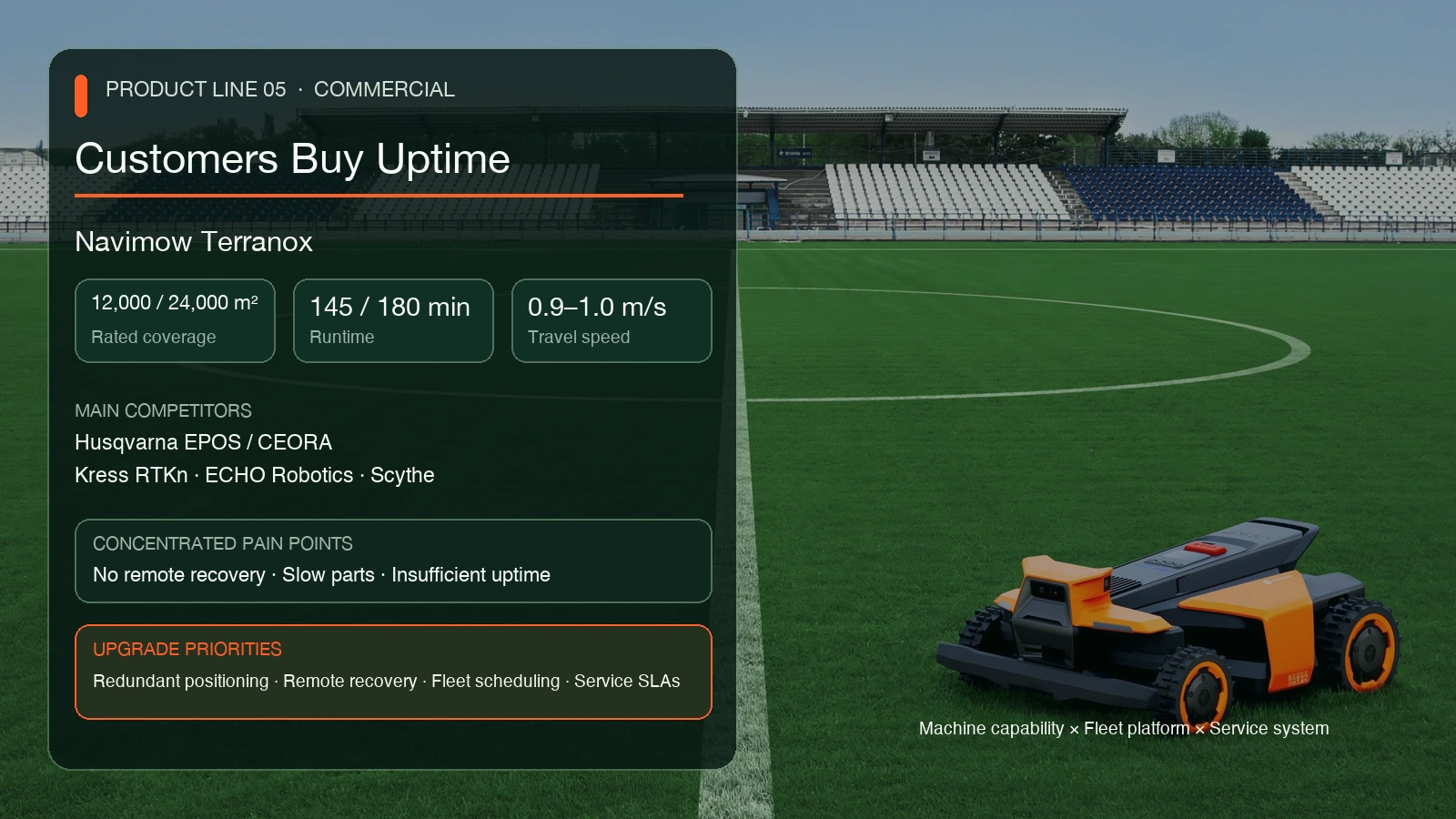
Navimow Terranox targets stadiums, schools, corporate campuses, golf courses and professional grounds-care companies through demonstrations and project quotations. The CM120M1 and CM240M1 are rated for up to approximately 12,000 and 24,000 square meters, with runtimes of about 145 and 180 minutes and travel speeds of roughly 0.9 and 1.0 meters per second. Both use a 43-centimeter dual deck, 12 blades, a 20-to-100-millimeter cutting-height range, a maximum slope of 84% and obstacle clearance of about seven centimeters. Terranox is not simply a larger residential machine. Longer runtime and higher speed are intended to cover continuous open ground.
Terranox continues the wide four-wheel platform and dual-deck form of the X4, but uses a more visible orange-and-black color scheme for personnel awareness and safety management in public spaces. Four-wheel drive, exposed large tires and a low center of gravity emphasize slope stability. A 360-degree RGB camera system and ToF sensing provide surround obstacle detection. The official page does not currently publish body dimensions or weight, so the article retains verifiable figures such as cutting width, runtime and speed rather than filling the gap by visual estimation.
Positioning uses triple-frequency Network RTK, 360-degree visual SLAM and visual-inertial odometry, with local RTK available where Network RTK coverage is absent. NavimowFleet shows location, operating performance and device status in web and mobile interfaces. One operator can assign tasks, edit maps and manage hundreds of machines. At this point, the product boundary has expanded from one mower into positioning infrastructure, a fleet platform and a service system.
Direct competitors include Husqvarna EPOS and CEORA, Kress RTKn and ECHO Robotics. Husqvarna CEORA uses a large modular cutting deck for open properties. Kress uses multiple relatively compact RTK machines across distributed sites. Larger autonomous equipment such as the Scythe M.52 is closer to replacing a stand-on commercial mower. The commercial market is therefore comparing two systems: many small robots working continuously or a smaller number of large machines completing work in concentrated shifts.
Single-machine pricing is not enough for this comparison. Scythe’s standard rental plan starts at $1,800 per month. Professional customers calculate daily area completed, machines managed per operator, time to recover from failure and total cost per area over the mowing season.
What Professional Users Worry About Most
Reliability has not reached the standard for continuous commercial work. A household can rescue a mower occasionally. A grounds-care company must finish within labor schedules and site opening hours. One installer who had deployed a six-acre Terranox AWD wrote:
“Good enough mowers for homeowners, but I don’t think they are there for reliability.” — Terranox installer
A remote failure still sends someone across the site. One user running a Terranox 6 Acre at a commercial airport found that, after RTK loss, neither continue nor restart in the app could restore the task:
“The only resolution is physically walking to the machine and manually recovering it, which completely defeats the purpose of an autonomous mower in a commercial setting I feel.” — Terranox commercial-airport user
Parts and service speed directly reduce fleet availability. One buyer comparing Terranox with other large-area machines described the existing FR4000 fleet:
“The last spare parts took multiple weeks to arrive.” — Large-area robotic mower user
Mapping, safety assessment and staff training remain deployment costs. Public sites also need defined responsibility for pauses, human takeover and incident records.
How the Segment Should Evolve
Positioning and safety need redundancy. When Network RTK fails, the system should transition automatically to local RTK, visual-inertial positioning or a safe return route. Local safety behavior must continue through a network outage. When people, vehicles or temporary events enter a public site, the mower should stop and record the trigger, scene, operator and recovery process as an auditable event chain.
Remote recovery should resolve most exceptions. A fleet manager needs positioning quality, wheel speed, sensor state and battery data from before the stop. The manager should be able to confirm that a temporary obstacle has cleared, replan a short path and continue from the interruption point. A site visit should be reserved for mechanical entrapment or a genuine safety risk. Otherwise, remote management only delivers a faster failure notification.
The fleet platform must become a production scheduling system. Weather, site opening hours, grass growth, electricity prices, charger capacity and staff shifts should determine which machine mows which area and when. When several machines share a site, the platform needs to prevent duplicate work and charging congestion. If one machine stops, its assignment should be divided automatically among nearby units.
Hardware must support rapid field repair. Trained personnel should be able to replace cutting decks, wheel assemblies, batteries, sensors and communications modules beside the field. Critical components need predictive alerts. Manufacturers or dealers should establish parts inventory and replacement-machine pools within a defined service radius, then put remote response, on-site arrival and restoration times into the contract rather than listing warranty years alone.
The business model will eventually be tied to results. One-time purchase will remain, but leasing, per-area pricing and availability guarantees make costs easier to calculate. Acceptance metrics should include autonomous-operation share, remote-recovery success, mean time to repair, on-schedule completion, safety-event rate, energy per area and total cost. Only when manufacturer revenue depends on machines continuing to work will the product roadmap truly center on uptime.
From Specification Racing to Task Completion
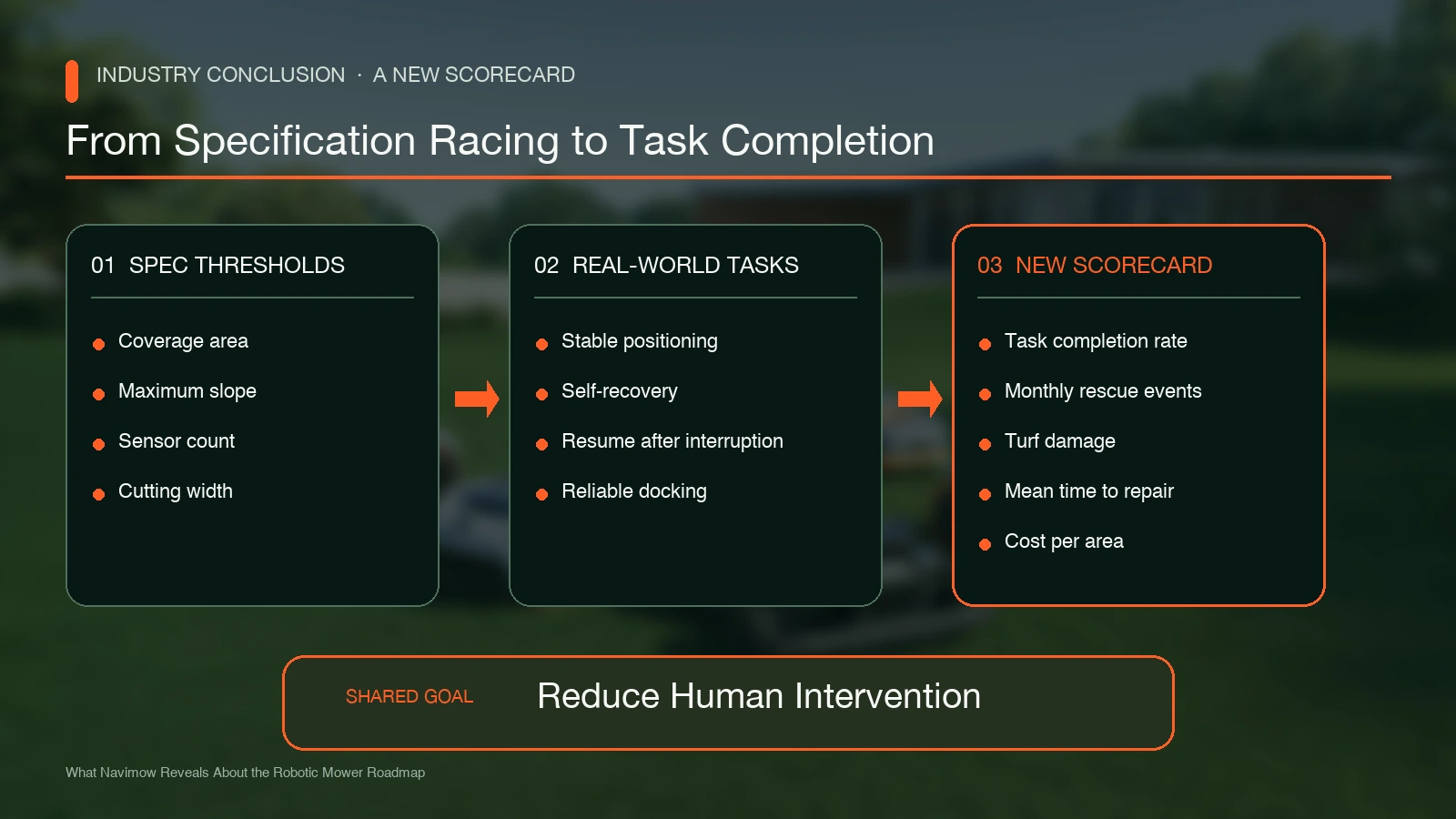
From the i1 to Terranox, Navimow presents a development path from wireless entry products and multi-sensor fusion to all-terrain platforms and fleet management. Each upgrade improves the machine’s ability to handle a more complex environment. The objective remains the same: reduce human intervention.
Coverage area, maximum slope and sensor count remain hardware thresholds for entering the market. As product specifications converge, residential users will ask how many rescues are required in a month and whether one schedule can finish. Professional customers will calculate uptime and cost per area. Task completion will support the next premium more effectively than another slope record.
Robotic mowers have learned to cut grass on their own. The next phase of growth depends on whether owners still have to look after them.
Explore 2026 new models