- The Mijia G1 used inertial navigation and a highly aggressive RMB 899 price.
- Xiaomi worked directly with Silver Star rather than through an ecosystem company.
- The author sees this as a potential signal that Xiaomi’s ecosystem model needed adjustment.
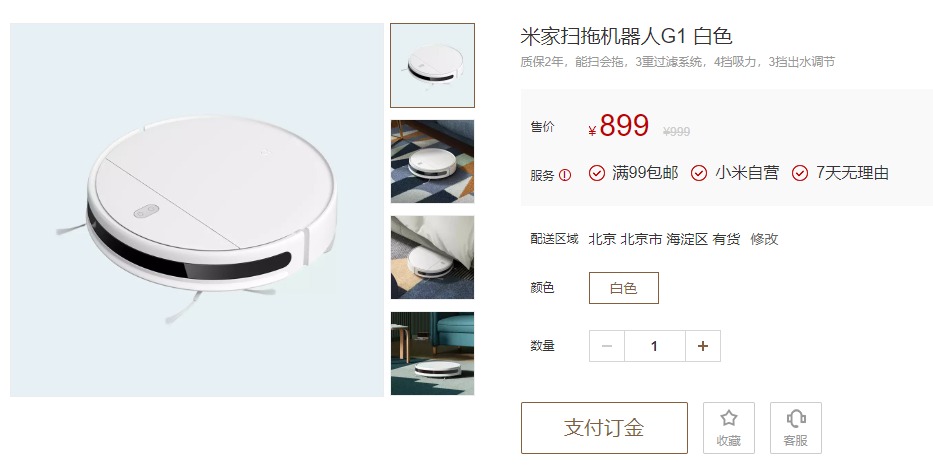
In the past two days, I saw the Mijia sweeping and mopping robot G1 released on Xiaomi Youpin and Mi.com. Several friends asked me what impact this would have on the industry. Because I have been busy recently, I kept delaying. Today I finally made some time to briefly write about its industry impact.
First, let us look at the machine's configuration. The price is RMB 899 with free shipping. This price should be very destructive.
A quick look at the configuration shows that it is fairly standard, but one can see some clues. For example, this product does not use LiDAR or visual navigation; it uses a gyroscope navigation module. In that case, the cost will fall a lot.
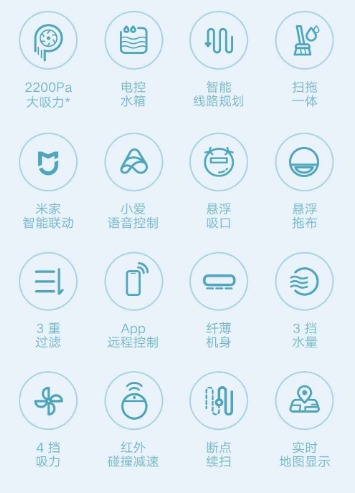
From this, I can already infer a lot of information.
First, this G1 uses inertial navigation. This product should be the first Xiaomi-brand product to use this solution. Previously, Roborock used LiDAR navigation and sold for RMB 1,499. Dreame's solution used visual navigation and sold for RMB 1,299. Now Xiaomi uses inertial navigation and sells for RMB 899.
There had previously been industry rumors that Xiaomi invested in the robot vacuum chip-solution company Zhuhai EAI Semiconductor, so this model should also use EAI's solution.
From the price perspective, RMB 899 is neither too high nor too low among inertial-navigation products. It is fairly standard. If the price goes a bit lower, there should still be room. If this price drops slightly, it will basically wipe out random-navigation robot vacuums on the market. In the industry, low-end machines still have the largest volume. Xiaomi's product still has a chance to reach the level of one million units per year.
Another valuable piece of information is that Xiaomi directly found the manufacturer Shenzhen Silver Star Intelligent for this product. Silver Star is an established company in the robot vacuum industry and is also called the Whampoa Military Academy of the robot vacuum industry.
The key question is that in the past, Xiaomi's cooperation usually went through ecosystem companies and then worked with OEM factories. Now Xiaomi is directly cooperating with an OEM factory. Does this mean the ecosystem model has reached the point where it needs adjustment?
At present, several star companies in the Xiaomi ecosystem, such as Huami, Smartmi, ZMI, and 1MORE, are all vigorously developing their own brands and trying to raise their own-brand share to more than half. Xiaomi's profits are too low and are not enough to support the long-term development of an R&D-oriented company. If a company has no R&D investment, it cannot expand market share through new products. New products can only rely on OEM factories, turning the company into one focused on product-appearance modifications.
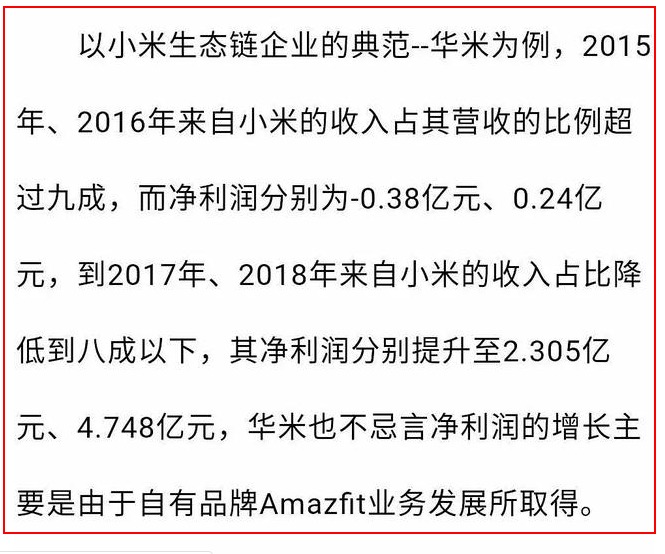
After raising its sons with great difficulty, Xiaomi naturally does not want all of them running away. There are rumors that Xiaomi is asking for higher investment shareholding ratios from companies that join later. In addition, apart from a few leading ecosystem companies with strong R&D capability, many ecosystem companies actually rely on ready-made R&D from OEM factories. In that situation, ecosystem companies play more of a role in product selection and project management.
This strategy should not have been a problem in the early stage of the ecosystem. In the early days, Xiaomi did not have enough people, and ecosystem companies worked together to expand the plate. But now the Xiaomi ecosystem already covers most industries, so the position of project-type ecosystem companies becomes awkward. Xiaomi has the ability and the right to bypass ecosystem companies and directly work with capable OEM factories. This also creates an opportunity to reduce the selling price by a few more percentage points.
If one day the proportion of cooperation between Xiaomi and OEM factories keeps rising, where will ecosystem companies stand?