- Stair-climbing solves a visible pain point that robot vacuums still struggle with.
- A novel mechanism must prove safety, reliability and everyday usefulness.
- MiGo’s challenge is turning technical spectacle into a repeatable consumer category.
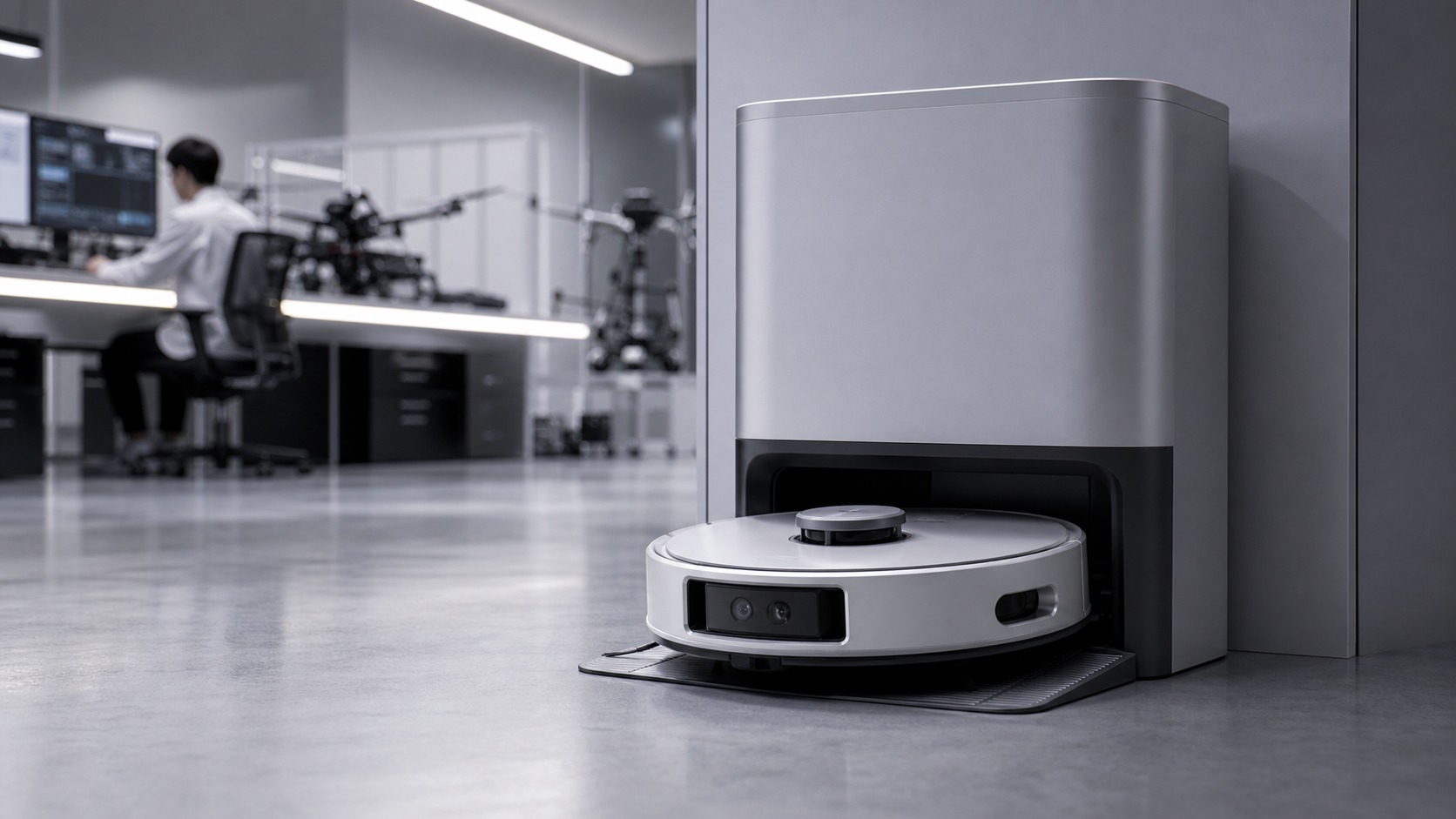
A Groundbreaking Migo Ascender Roborock Vacuum Cleaner
In the past few months, I came across a product on Kickstarter called the Migo Ascender robot vacuum cleaner. This product stands out significantly from current market offerings, which typically feature a base station but lack the ability to navigate stairs.
Product Overview and Features
The Migo Ascender has a square design with one side dedicated to the edge brush for sweeping and the other side equipped with a cloth for mopping. Its compact shape allows it to follow walls and edges effectively, while its low height enables it to clean under beds and sofas. After completing its cleaning tasks, the device returns to the base station, which includes water tanks for rinsing and a dust collection system.
This product essentially covers most of the functionalities found in an all-in-one dock. However, what sets it apart is that it features mechanical arms on both sides. When encountering stairs, these arms can alternate to enable climbing. Additionally, the device can move laterally across the steps to clean them effectively.
Market Potential and Challenges
This should be considered the world's first robot vacuum cleaner capable of navigating stairs. The product has shown significant innovation in terms of design and functionality, which is reflected in its successful crowdfunding campaign. At a price point of $799 per unit, it garnered 2,765 backers with total funding reaching $2,396,869.
However, upon revisiting the Kickstarter page for this product, I noticed several potential issues that could affect its commercial viability:
- Basic Functionality: The square design of the device is primarily aimed at accommodating mechanical arms on both sides. This leaves limited space for integrating basic cleaning functions such as vacuuming and mopping. During operation, the mechanical arms may obstruct the path of debris into the vacuum.
- Mopping Functionality: Mopping is only possible on one side, with mechanical arms potentially blocking the path of the cloth. This could result in dirt or stains being left behind, especially for stubborn substances like soy sauce, which might be blocked by the arms and spread elsewhere during cleaning.
- Design Limitations: The square design has inherent drawbacks. While it can follow edges effectively, its shape makes it difficult to navigate tight spaces such as under tables and chairs. This limitation could lead to frequent entrapment in small areas.
- Path Planning: An analysis of their vacuuming test video revealed that the robot's path planning seemed somewhat haphazard, with no clear algorithmic approach. Given the competitive landscape, it is unlikely that a startup would outperform established industry giants in this area. Without specific details on path planning, there could be significant issues if consumers find basic cleaning unsatisfactory.
- Threshold Crossing: The device's design does not appear to have any mechanism for crossing thresholds, which could create usability challenges.
- Stair Climbing Functionality: This is the core feature of the Migo Ascender, allowing it to navigate different heights of stairs and perform a simple clean-up after climbing. This functionality likely attracted most of the crowdfunding support, indicating a significant need for stair cleaning in markets like North America.
Challenges with Stair Climbing
While this feature seems innovative, there are several practical challenges:
- The variability in staircase height and design (including turns and carpeting) poses a significant challenge for the device to adapt.
- Ensuring the robot does not fall during operation on stairs requires careful engineering, which could be a critical point of failure.
Conclusion
These observations are based on initial video analysis. Detailed testing would provide more comprehensive insights. Any shortcomings in these features could result in substantial negative reviews from consumers.
Unfortunately, I did not find any subsequent reviews or evaluations for this product. The Kickstarter page only mentioned that backers were offered refunds due to production issues and subpar user experience.
Industry Perspective
Despite the challenges, it is important to recognize the innovative spirit of companies like Roborock. Their efforts push the boundaries of product innovation and provide new directions for industry development. Major players can follow this path in their future explorations.
Future Directions
Considering the North American market, where stair cleaning is a necessity, there are opportunities for both vertical and handheld vacuum cleaners. Additionally, multi-story homes or small villas in rural areas could benefit from multiple robot vacuums on different floors, though this would increase costs significantly.
In summary, while the Migo Ascender represents an exciting step forward, it faces several practical challenges that need to be addressed before widespread adoption is feasible.
These two requirements are currently difficult to meet simultaneously. If a choice must be made, I would lean towards achieving multi-floor cleaning. The benefits of this approach are evident, and the market potential is larger. Here are some ideas on how to achieve it:
- Maintain the conventional circular product design as much as possible. How can we use a compact mechanical arm to navigate stairs? It's challenging for the product itself alone. I suggest considering adding auxiliary devices on the stairs that can coordinate with the product’s mechanical arm, allowing quick access to other floors. The advantage of this approach is that it doesn't sacrifice too many core functions of the body; instead, it adds an external module similar to a power-up.
- Attach a drone module to the base station. When market demands require cleaning on other floors, use the drone to transport the device up there. After cleaning, call for the drone to return the device to the base station for self-cleaning and charging. How to achieve this while keeping costs low is something that requires further consideration from industry experts.
Suddenly, I feel DJI has an opportunity here. They possess both drone and robot vacuum capabilities, which could be leveraged in this scenario. Would DJI consider such a solution?