- Midea has scale and manufacturing capability, but floorcare requires focused category strategy.
- Cleaning appliances are not won by supply chain strength alone.
- The article uses Midea’s past to explain why brand definition and product focus matter.
In this article 4 sections
A few days ago, I saw a friend in the group post an announcement from Midea Group regarding its cleaning appliance division.
[To further promote focused integration and collaborative development across relevant industries, all cleaning category-related businesses under the microwave and cleaning division have been transferred to the washing machine division. The microwave and cleaning division has now been renamed as the microwave and oven division. Specific transfer plans for budgets, assets, personnel, and inventory will be completed by August 21.]
Then, a friend from Sohu Finance informed me that they had communicated with industry insiders to confirm the authenticity of this information.
Based on publicly available data, Midea's Microclear Division generated approximately RMB 19 billion in sales for cleaning appliances in 2024, while the washing machine division achieved around RMB 50 billion. From a divisional scale perspective, there has been an upgrade. If we consider only the group’s intentions, it seems that Midea places greater emphasis on the cleaning appliance sector and plans to leverage its major appliance business to promote these products more aggressively.
Previously, Midea aimed for RMB 10 billion in sales within the cleaning appliances industry, while the microwave and oven business itself was around RMB 15 billion. Bringing up a RMB 10 billion segment would have been challenging with just the microwave and oven division's resources. However, with the support of the washing machine division’s substantial scale, this challenge becomes much more manageable.
For instance, binding major appliance sales through bundled promotions such as buy one get one free in retail settings could be a strategy. Requiring dealers to sell a certain percentage of cleaning appliances when selling other products would also help. With unchanged total costs, customers are likely to push these products along with their purchases.
Midea Group's president, Fang Hongbo, mentioned in some interviews that the robot vacuum industry faces challenges due to rapid technological advancements and updates, which may not suit a large company like Midea. He believes that when the industry stabilizes, it will be an opportune time for Midea to make significant moves. The cleaning appliance sector could grow into a business worth several hundred billion yuan, similar to its air conditioning and refrigeration businesses. I believe Midea Group would not abandon this opportunity.
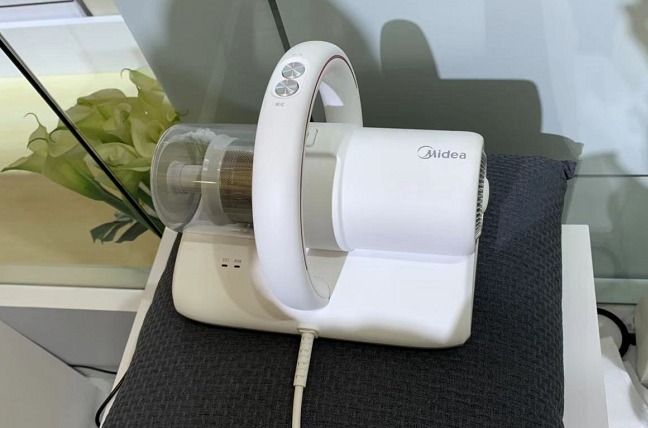
Midea entered the cleaning appliances market in 2005 through acquiring Jiangsu Chunhua Electrical Appliances. Initially, their goal was to become one of the top three manufacturers for contract manufacturing. In recent years, they have been more aggressive with their contract manufacturing business, taking on any projects regardless of price or customer. At our factory, customers often said that Midea offered a better deal than us, a small company.
Midea has since ramped up its efforts in cleaning appliances, relying on some small push rods to become the top producer by volume in one year. They have consistently maintained a position as one of the top three or four contract manufacturers for cleaning appliances.
Many are unaware that Dyson had already reached an agreement with Midea back then, where Midea would manufacture washing machines for Dyson. According to some of my Midea friends, they made significant progress and even produced some products. However, due to Malaysian government interference, Dyson moved its Chinese manufacturing facilities elsewhere, effectively ending the project. They later took over Bissell's contract manufacturing business with much smoother operations.
Midea has also acquired several brands in recent years, such as Eureka from Electrolux and Toshiba in Japan, forming a significant brand portfolio. However, there is a conflict between their own branded products and contract manufacturing. Once they started their own brands, it inevitably impacted the contract manufacturing business. Major clients like Bissell and Shark would likely shift some core projects to other manufacturers. Therefore, making cleaning appliances under its own brand was an inevitable choice for Midea, though the transition process would be extremely challenging.
In previous articles, I wrote about acquisitions in the cleaning appliance industry. A few years ago, TTI Group's cleaning appliance business was up for sale as a whole, and Midea had approached them to acquire Hoover. However, TTI insisted on selling Hoover along with Dirt Devil and Oreck at a target price close to $600 million, which did not materialize.
In 2018, Joyoung acquired SharkNinja in a RMB 10 billion deal that shocked the industry and changed its landscape. At the time of acquisition, the amount was RMB 10 billion; now, Shark's market value is close to RMB 60 billion, having grown significantly. I asked Midea friends about this opportunity, and they said it would have been a good choice if Midea had considered acquiring Shark back then, as their sales target of RMB 10 billion in cleaning appliances could have been achieved much earlier.
Midea has consistently relied on acquisitions to enter various industries, and its acquisition integration capabilities are among the strongest. Many brands have rejuvenated under Midea's stewardship. I believe that in the future, Midea should still consider acquiring a few more brands in the cleaning appliance sector to achieve significant growth. Relying solely on their own brand for development would be extremely challenging.
Currently, some of the better-quality targets in the global cleaning appliances market include:
IRobot: Early Marker in the Robot Vacuum Industry
IRobot, an early and iconic brand in the robot vacuum industry, has seen its sales continuously decline, with a market capitalization of less than one billion US dollars. It can be said that if IRobot does not undergo significant leadership changes, it will struggle to compete against current players such as Roborock, Dreame, and Ecovacs. Given that IRobot's parent company has some military attributes, coupled with the backdrop of ongoing Sino-US trade frictions, Chinese companies face considerable challenges in acquiring IRobot. However, are there any indirect methods? For instance, signing a 20-year exclusive brand license agreement could allow Midea to operate robot vacuum business under the IRobot brand. Leveraging Midea's product development capabilities, this strategy would still be highly competitive in the market.
TTI's Cleaning Appliances Business
TTI has been a powerhouse in power tools for years, becoming the global leader in that sector with annual growth rates consistently above 20%. However, its cleaning appliances business has been continuously declining. For TTI Group, the importance of this segment is waning, making it an attractive option to find a suitable seller. In North America, brands like Hoover still have some recognition. Previously, there were differences in pricing, but if these can be reconciled, such an acquisition would not be out of the question.
Electrolux
Midea's brand presence in Europe and North America is under the Eureka label, a legacy brand primarily known for its presence in the former region with little recognition in Europe. Midea has previously collaborated with Electrolux, and given that Electrolux's cleaning appliances business has significantly shrunk, even selling brand rights in some markets, acquiring Electrolux's small appliance business could provide an opportunity to capture a substantial share of the European market.
Conclusion
Regardless of the approach, it is clear that Midea will not be absent from the cleaning appliances sector. This adjustment marks the beginning of a future comeback; let us watch and see how this unfolds.