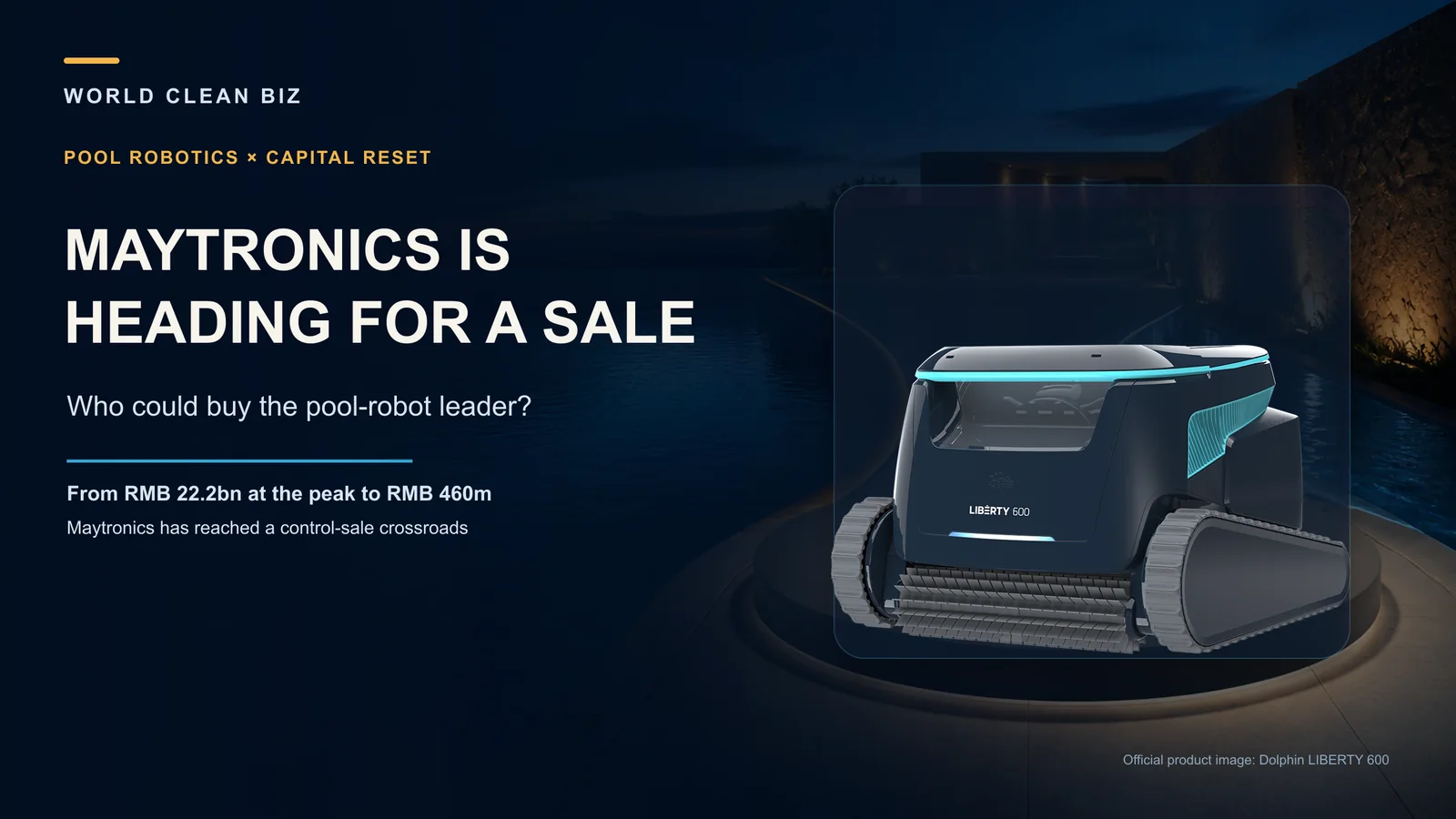
- Maytronics turned a kibbutz-backed invention into Dolphin, one of the defining brands in robotic pool cleaning.
- Its moat combined product reliability, specialist channels, service and a broad residential and commercial portfolio.
- Cordless competition, online price transparency and excess inventory forced a reset; the 2026 recovery now depends on execution, not category leadership alone.
In this article 8 sections
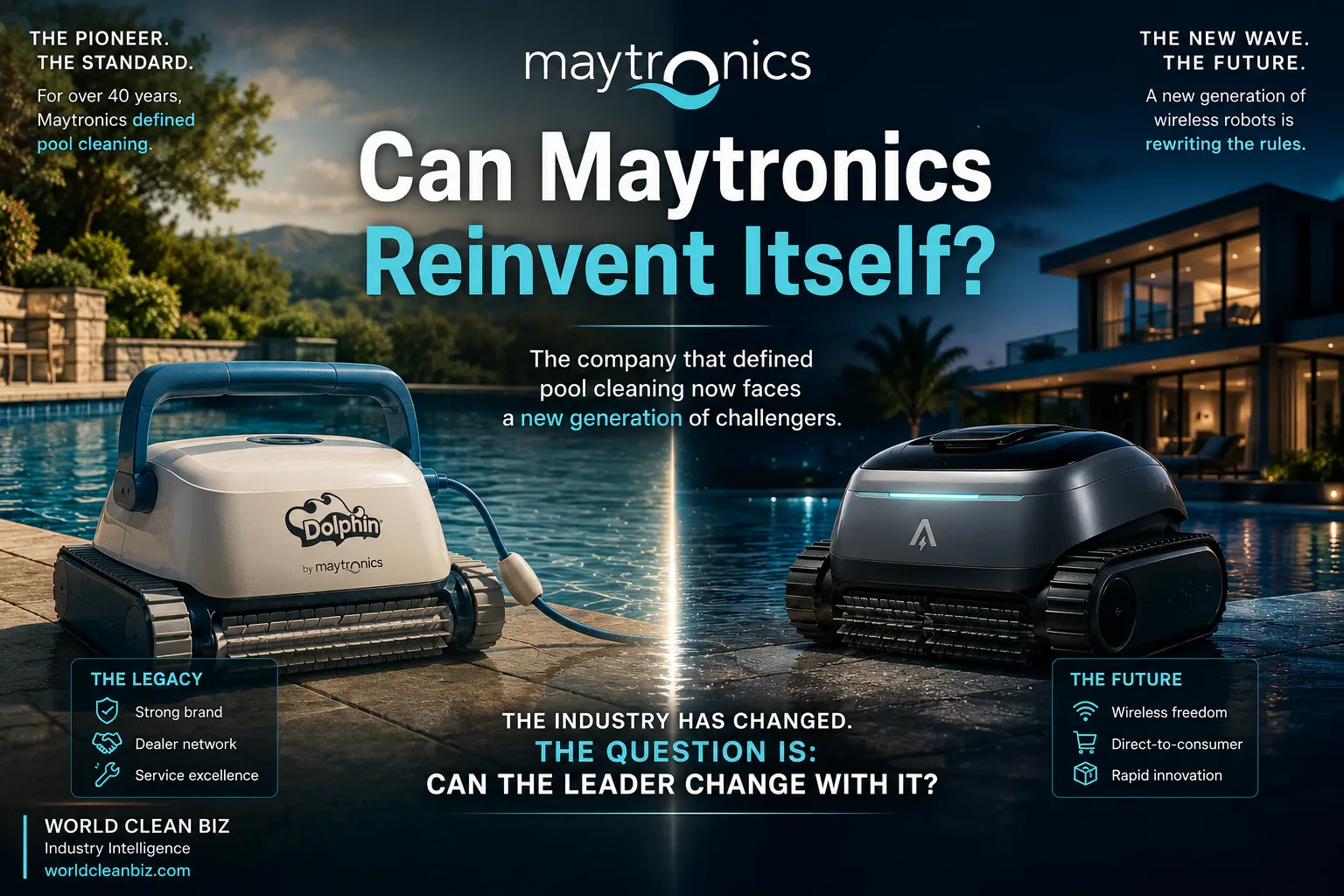
Maytronics built Dolphin into one of the defining brands in robotic pool cleaning. Its advantage was never a single machine: it combined product reliability, specialist pool channels, service and a global portfolio. That system produced decades of growth, but cordless competitors, online price comparison and a post-pandemic inventory correction have forced the Israeli company into a difficult reset.
The FY2025 and Q1 2026 results show why the story matters. Maytronics reported NIS 1.4 billion in 2025 revenue, down 13.6%, while operating cash flow improved as inventory and debt were reduced. In the first quarter of 2026, revenue fell another 10.8%, although management said new product launches were gaining initial traction. The company still has valuable assets; the open question is whether it can turn them into a faster, more competitive operating model.
From a Kibbutz Bet to Dolphin
In Kibbutz Yizre'el in northern Israel, Maytronics' factory is not far from farms and cattle sheds.
This detail is easily overlooked. Today Maytronics is one of the most important companies in the global pool robot market, and Dolphin is a name familiar to many European and American homes and pool service providers. But it didn’t grow out of a Silicon Valley-style entrepreneurial story, but out of the debt pressure of a kibbutz.
In 1982, South African engineer Peter Rasch invented the first robotic pool cleaning device. Later, kibbutz member Lenny Hirsch saw an advertisement for this product in South Africa and thought it might be a business, so he persuaded Yizre'el, who was in financial difficulties, to buy the prototype and rights and bring it back to Israel to continue development.
This is not an easy decision. Calcalist later interviewed early participant Jeremy Furling, who recalled that Yizre'el's debt at the time was about NIS 120 million to NIS 130 million, and cash flow could not even cover the interest. Roughly converted according to the exchange rate in this article, it is about 290 million to 310 million yuan. For an agricultural community, buying a swimming pool cleaning robot is not like an investment, but more like a bet on the future.
Maytronics dates its founding and the launch of Dolphin to 1983 in its official company timeline.
The name Dolphin itself speaks to the path Maytronics would later take. It does not package the product as an underwater vacuum cleaner, but turns it into a reassuring partner that can enter the pool and work independently. Years later, some users would name their Dolphins. For a company that makes hardware, this kind of emotional connection is rare.
In the early days, pool cleaning was still a professional business. Users relied on labor, ductwork, suction and pressure cleaning equipment. Maytronics changed this routine maintenance from "human operating equipment" to "a robot entering the pool by itself." The change later sounded obvious, but in the 1980s it required market education and a sufficiently reliable product.
How Maytronics Built the Dolphin Moat
In the first two decades of Maytronics, almost all of it was answering one question: How can a swimming pool robot be trusted by professional channels?
In 1992, Dolphin 2001 and 3001 were launched to cover residential and commercial swimming pools. In 1997, Dolphin Dynamic introduced dual motors and remote control capabilities. In 1999, the Dolphin 2x2 was targeted at large public swimming pools. In 2002, Dolphin Magic introduced the top access filter basket to reduce the user's trouble of cleaning the filter element. In 2004, Maytronics listed on the Tel Aviv Stock Exchange in an initial transaction that valued it at approximately $26 million. In 2005, the company proposed "a Dolphin for every pool" and developed an anti-tangle swivel system.
These nodes are not like the launch of consumer electronics hot products, but more like the slow variables of an industrial company: cleaning efficiency, navigation, filtering, scrubbing, easy maintenance, after-sales, and channel trust.
After its launch, Maytronics began to transform Dolphin from a product into a global business.
In 2006, the WAVE 300 entered the heavy-duty commercial robot market. In 2007, Maytronics US established its headquarters in Atlanta, covering the United States and Canada. Maytronics France was formed in 2009 after the company acquired MGI International. In 2010, the M-Line was launched, simultaneously entering the Australian market. In 2012, the company supported the Spanish and Portuguese markets. In 2015, the S-Line was launched. In 2020, the Dolphin M600 brought cloud and Wi-Fi connectivity to pool robots, the same year that German wholesaler Bünger & Frese joined Maytronics. In 2021, Dolphin M700 and S400 were launched. In 2022, the company acquired Australia's Orimatech and purchased a 70% stake in ECCXI, a US pool supplies sales and distribution company. In 2023, Dolphin LIBERTY took the brand into cordless pool robots.
Maytronics' later moat was formed from these seemingly trivial expansions. Dolphin's brand, professional swimming pool channels, maintenance and after-sales system, long-term product reliability, and user reputation in mature swimming pool markets in Europe and the United States make it not only a manufacturer, but also a representative company of the swimming pool robot category.
The company's description of itself is also stable. Maytronics says on its vision page that it will allow pool owners to enjoy their pools with less hassle. Translated into business language, it means outsourcing swimming pool maintenance to a set of machines, algorithms, navigation, filtering, scrubbing and service systems.
From Category Leader to Post-Pandemic Peak
By 2019, the model was running smoothly.
That year, Maytronics had revenue of about 2.05 billion yuan. The company disclosed in investor materials that revenue CAGR was 15% and EBITDA CAGR was 23% from 2009 to 2019. The company's official website also states that over the past ten years, it has become No. 1 in the markets in which it operates, with a global residential pool robot market share of approximately 48% and a public pool robot market share of approximately 44%. Those numbers were internal company estimates, but they were enough to illustrate where it was at the time: Maytronics was no longer a niche invention company but the de facto leader in the pool robot category.
The revenue structure in 2019 also speaks to its fundamentals. Private swimming pool robot revenue is approximately 1.68 billion yuan, accounting for 82.1% of total revenue; public swimming pool robot revenue is approximately 170 million yuan, accounting for 8.4%; security and other business revenue is approximately 190 million yuan, accounting for 9.6%. It has always been the home and private pool that will determine the company's growth curve.
The real highlights come in 2021 and 2022.
The pandemic changed European and American households' investment in courtyards, swimming pools and outdoor life. According to Maytronics data, the global installed base in 2021 was approximately 28.5 million pools, including about 18.3 million residential in-ground pools, 9.4 million above-ground pools and 800,000 commercial pools. The number of pools cleaned with robots increased from 4.4 million in 2020 to 5.4 million in 2021, and penetration increased from 16% to 19%.
Maytronics caught this cycle. In 2021, the company's revenue increased by 30.9%. In 2022, it grew again as pool demand, robotic-cleaner penetration and channel stocking moved in the same direction.
At that time, almost all variables were on Maytronics' side: European and American pool stocks were large, robot penetration increased, courtyard consumption heated up, the Dolphin brand was solid, and professional channels were still effective. In the U.S. mall on the company's official website, products have been displayed in categories such as Best Performance, Best Seller, Best Value, Cordless, and Commercial, ranging from Nautilus, Explorer, and M series to LIBERTY wireless series and Wave commercial series, covering different swimming pools, different price ranges, and different usage scenarios.
Optimism ensues.
In the 2022 information, Maytronics raised its 2025 revenue target from approximately 5.56 billion yuan to approximately 6.04 billion yuan. By March 2023, it raised its 2025 revenue target to about 6.52 billion yuan and gave an operating profit margin target of 15% to 19%.
This was the pinnacle of Maytronics and the beginning of a turning point.
Why the Market Turned
In 2023, the industry was still growing on the surface. The global installed base was approximately 30.65 million pools, and robots had entered about 7 million of them, for penetration of roughly 23%. Robot adoption was still rising, but the pattern of growth had changed.
About 575,000 new swimming pools were built in 2023, a decrease of about 29% from 2022. Maytronics gave revenue growth guidance of 13% to 20% in March 2023, but only 0% to 6% excluding ECCXI. This meant that growth increasingly relied on acquisitions, portfolio expansion and channel operations rather than the natural expansion of the core robotics business.
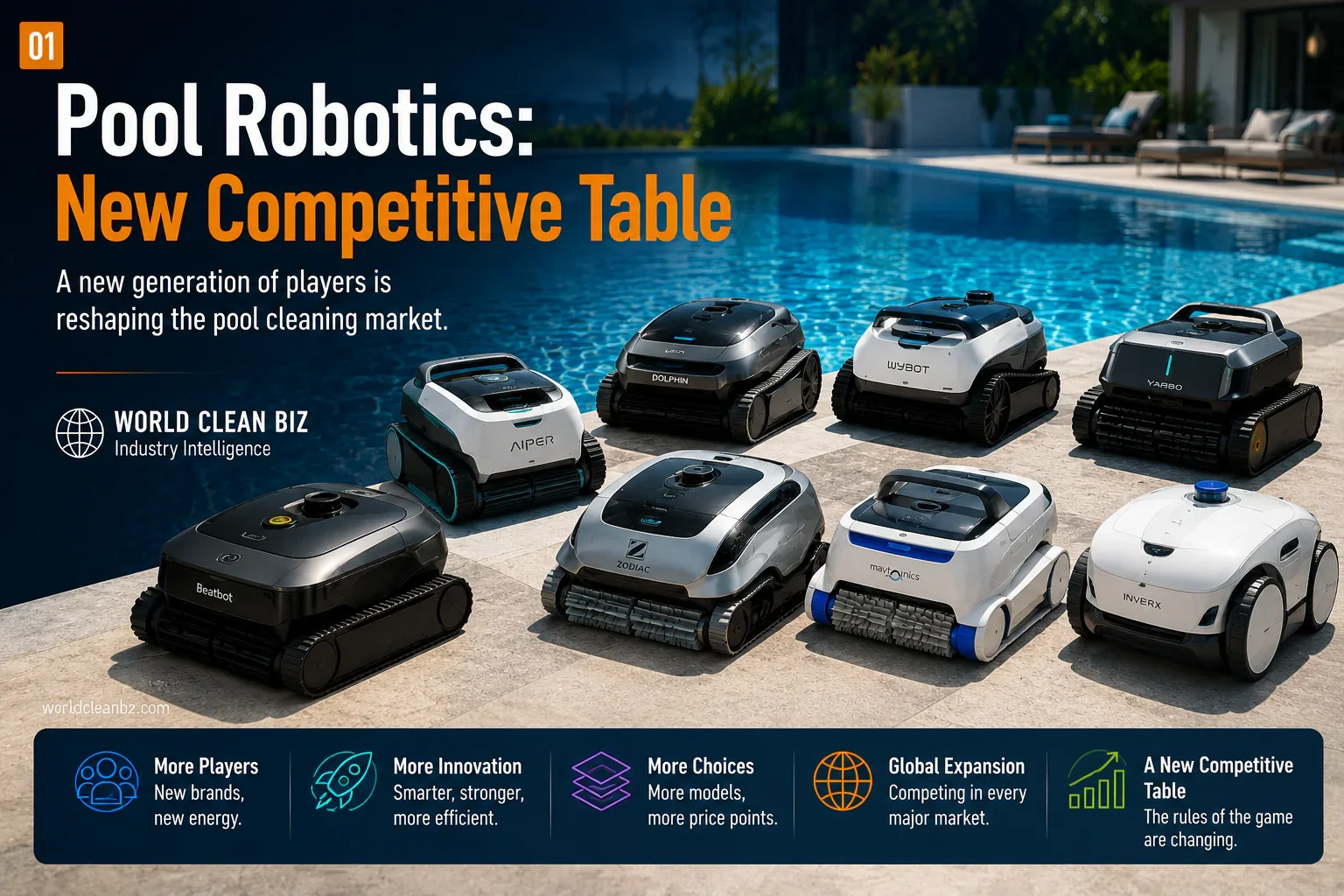
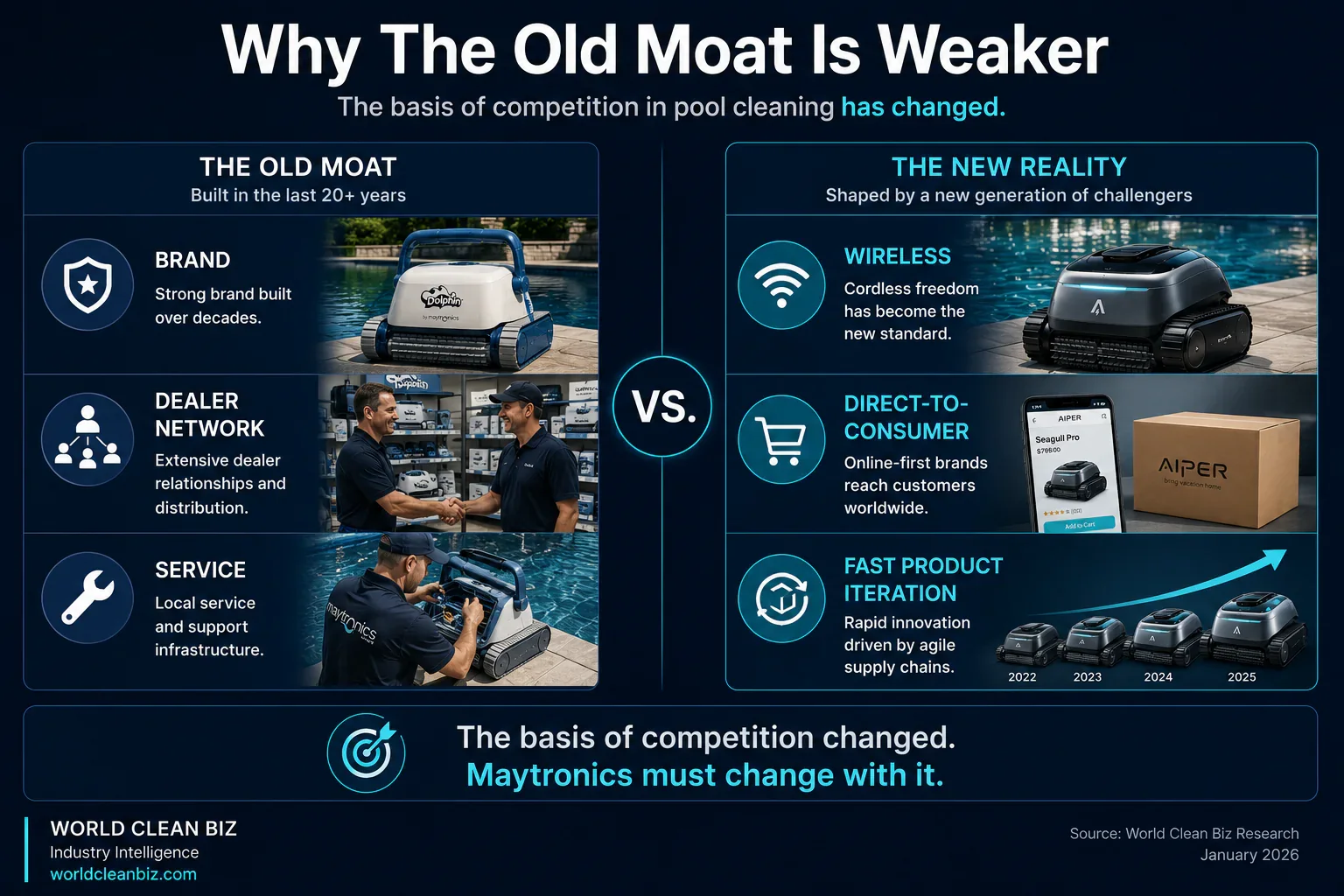
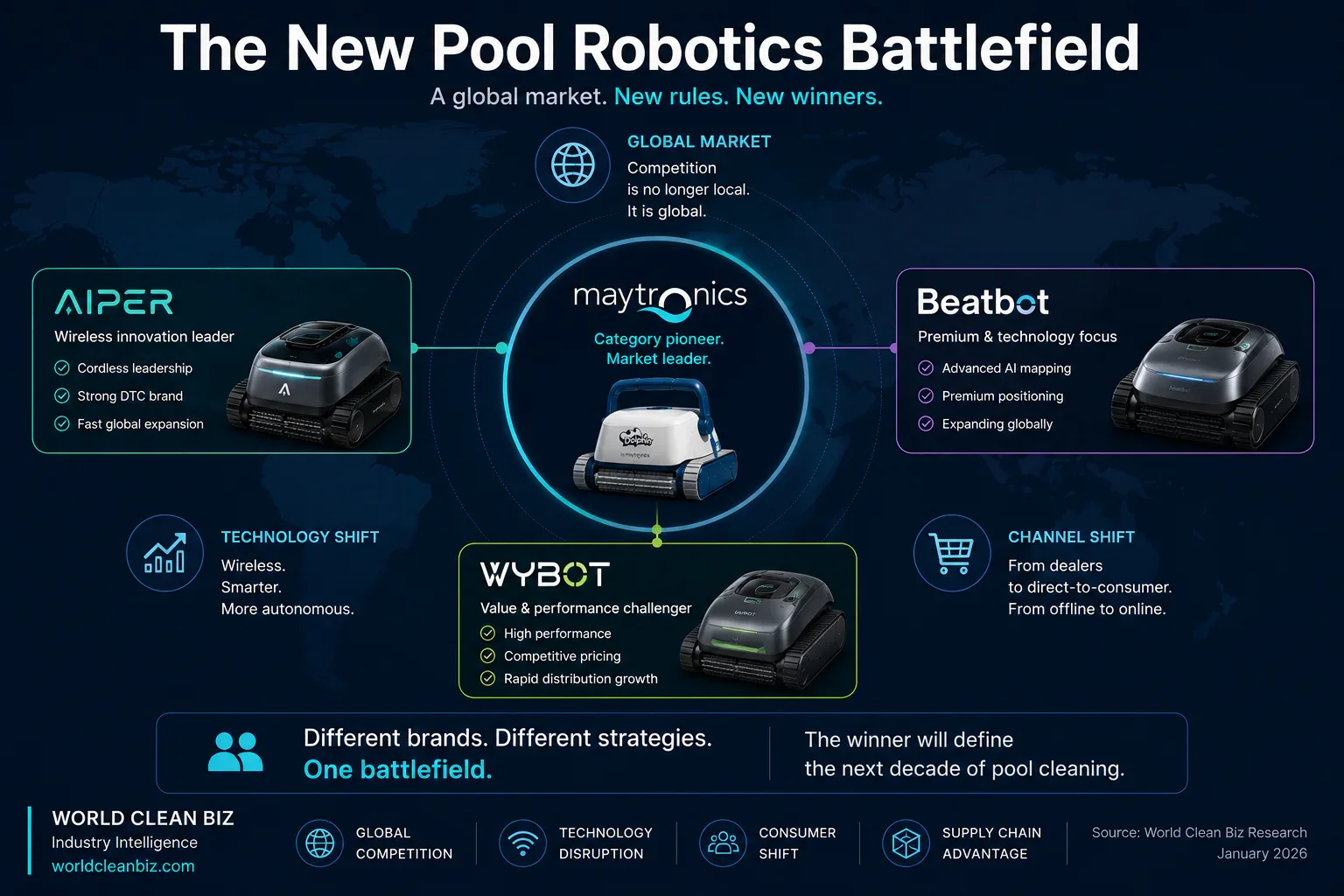
The more critical changes are documented in Maytronics' own materials. In the FY23 investor call profile, the company listed three trends: Rise of Cordless, Multi Brand & Multi Channel offering, and Chinese players online competition.
These three words are a reminder of changes in industry rules.
In the past, Maytronics excelled in wired high-end robots, professional channels, long-term after-sales and brand trust. Users listen to recommendations from pool stores, dealers and pool service providers. Price is important, but not the only decision factor.
After going wireless, the threshold for user use is lowered; after online channels, price comparison becomes easier; after multiple brands are supplied, channels no longer only focus on a few high-end brands. Dolphin's moat hasn't disappeared, but it's starting to be repriced.
The 2025 Reset
In 2025, the pressure reached the financial statements.
In its FY2025 results, Maytronics reported NIS 1.4 billion in annual revenue, a decline of 13.6%, and a net loss of NIS 222.4 million. The company attributed the pressure to intense competition, logistics and operational challenges, currency effects, inventory-clearing actions and significant impairment charges.
The private-pool robot business absorbed the sharpest pressure as cordless products and online competition reset price expectations. Public-pool robots were more stable because professional customers place greater weight on reliability, service and long-term maintenance.
The reset did improve liquidity. Operating cash flow rose to approximately NIS 293.3 million from NIS 129 million, mainly because inventory balances fell by about NIS 247 million. Net debt declined by NIS 168 million to roughly NIS 592 million at year-end. Maytronics strengthened its balance sheet, but the inventory correction and lower activity also compressed profitability.
Management and the 2026 Recovery Test
Management changes also show that the company has entered a period of adjustment. Oren Jacobs joined as global COO in 2025 with experience in supply-chain management, operations and strategic procurement. Amit Magen joined as CFO in July 2025 after leading financing, M&A and turnaround processes. Rafi Benami joined as CEO in 2026 after serving as president and general manager of Applied Materials Israel. The mix of operational, financial and global-technology experience suggests that Maytronics is addressing a business-system problem, not merely a missing product feature.
The most noteworthy thing about this annual report is not just the losses.
The first-quarter 2026 results did not yet prove a turnaround. Revenue was NIS 309.3 million, down 10.8%, and gross margin fell to 28.4% from 37.5% a year earlier. Management pointed to supply constraints, foreign-exchange effects, operational disruption and tariffs, while also reporting encouraging early traction from new products. That makes product launch execution, planning and manufacturing efficiency the next measurable tests.
The most glaring contrast is between goals and reality.
In 2025, actual revenue was far below the 2025 target Maytronics had raised during the post-pandemic boom. The company correctly identified a growing category, but it extrapolated pool investment, robot penetration and channel demand too far into its own sustained growth.
What Maytronics Still Has
The forty-year Maytronics story is not simply the rise and fall of one company.
It went from a risky project in a debt-ridden kibbutz to a global leader in robotic pool cleaning. From one Dolphin, it developed specialist channels, brand trust, a service network and a global distribution system. Those assets did not disappear when growth reversed.
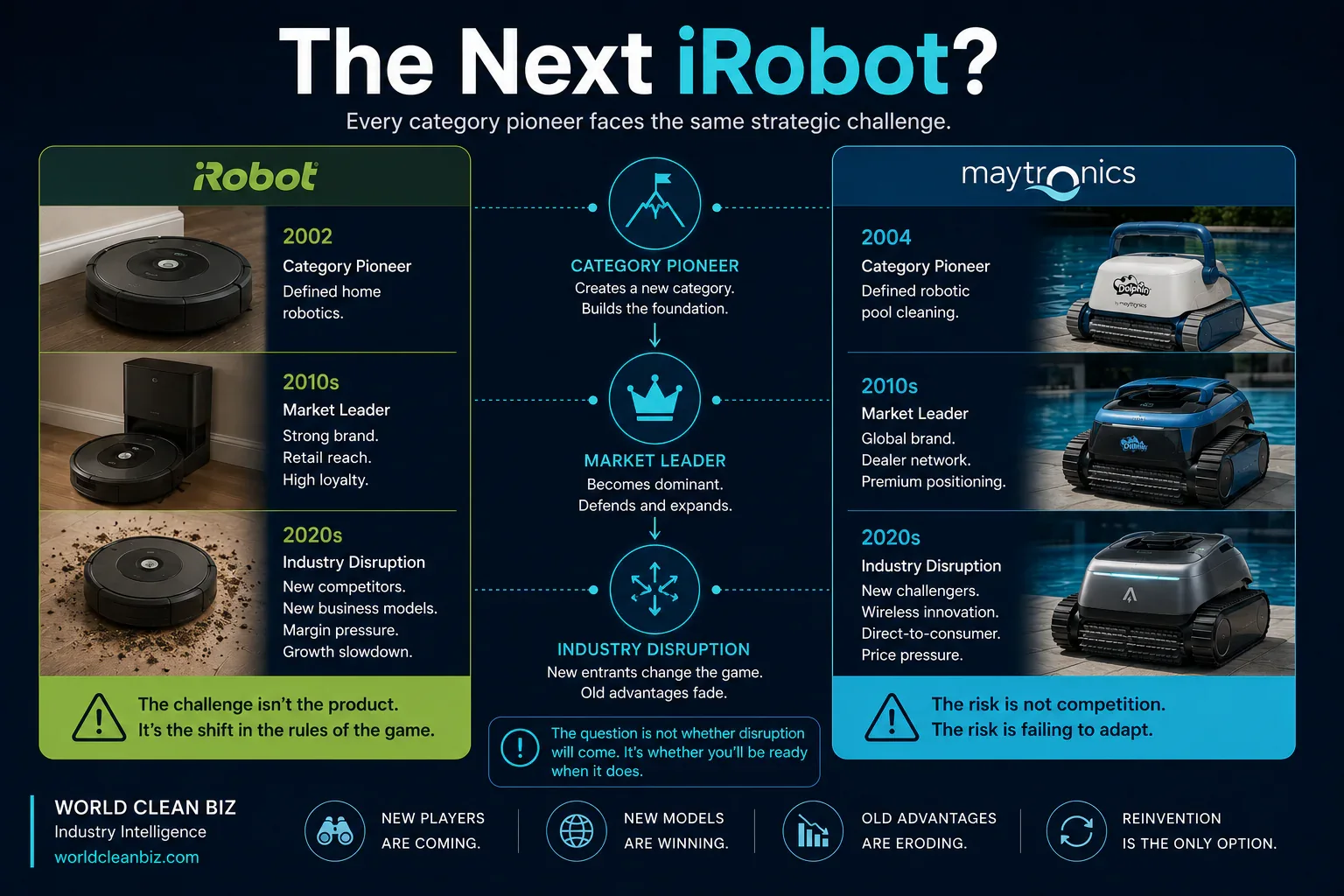
It once defined pool robots. Now, it's being redefined in the face of pool robots.
Maytronics' advantages are still real, but the pool robot industry has changed. Dolphin now competes in a market where cordless convenience, online visibility, price and product-cycle speed matter alongside durability and dealer service. Growth remains available; it no longer flows automatically to the company that defined the category.
For product decisions, use the Dolphin robotic pool cleaner buying guide to match the range to your pool, or compare Dolphin vs Polaris on cleaning platforms, filtration and service. Company history helps explain the channel; the exact model and local support determine the purchase.
Sources
- Maytronics official company timeline: establishment in 1983, Dolphin product iteration, launch in 2004, etc. https://www.maytronics.com/corporate/maytronics-timeline.html
- Maytronics company profile and investor information: company founding date, global channels, Dolphin product positioning, company internal estimated share of residential/public swimming pool robots. https://www.maytronics.com/corporate/investors/company-profile.html
- Maytronics Vision and Values: Mission, Customer Experience, Innovation, Quality and Customer Orientation. https://www.maytronics.com/corporate/vision.html
- Maytronics Management Page: 2025-2026 COO, CFO, CEO and other management backgrounds. https://www.maytronics.com/corporate/Management-team.html
- Maytronics FY2025 results: revenue, loss, inventory, operating cash flow, debt reduction and management's reset priorities. https://brand.maytronics.com/asset/f5b0e7aa-1f93-4e9d-8350-66a8b064b47e/Maytronics-2025-FY-PR-EN.pdf
- Maytronics Q1 2026 results: revenue, margin, operating performance and early new-product traction. https://brand.maytronics.com/asset/5cad6645-d2ba-4ff1-8026-16d51d39ad7e/Q1-2026-PR-EN.pdf
- Maytronics US official store: Dolphin product classification, Nautilus, Explorer, M series, LIBERTY wireless series, Wave commercial series, etc. https://www.maytronics.com/en-us/store/
- Maytronics official/regional history page: 1982 Peter Rasch, 1983 Dolphin, 1992/1997/1999/2002/2004/2005, etc. nodes. https://maytronics.sh/about-us/
- Hadassah Magazine: Kibbutz Yizre'el, Maytronics factory and kibbutz economic relations, CEO Eyal Tryber related statements. https://www.hadassahmagazine.org/2018/04/25/israeli-pool-robots-kibbutz-success-stories/
- Calcalist/CTech: Story details of Lenny Hirsch, Jeremy Furling, kibbutz debt, early purchase of prototypes and entitlements. https://www.calcalistech.com/ctech/articles/0,7340,L-3846072,00.html
- Maytronics Spain 2026 Channel Strategy Description: New Players, Lots of New Products, Consolidation of Specialized Channels. https://www.maytronics.com/es-es/nueva-estrategia-2026.html
If your team is evaluating a pool robot program, World Clean Biz offers robotic pool cleaner sourcing support focused on product direction, supplier capability and execution risk.