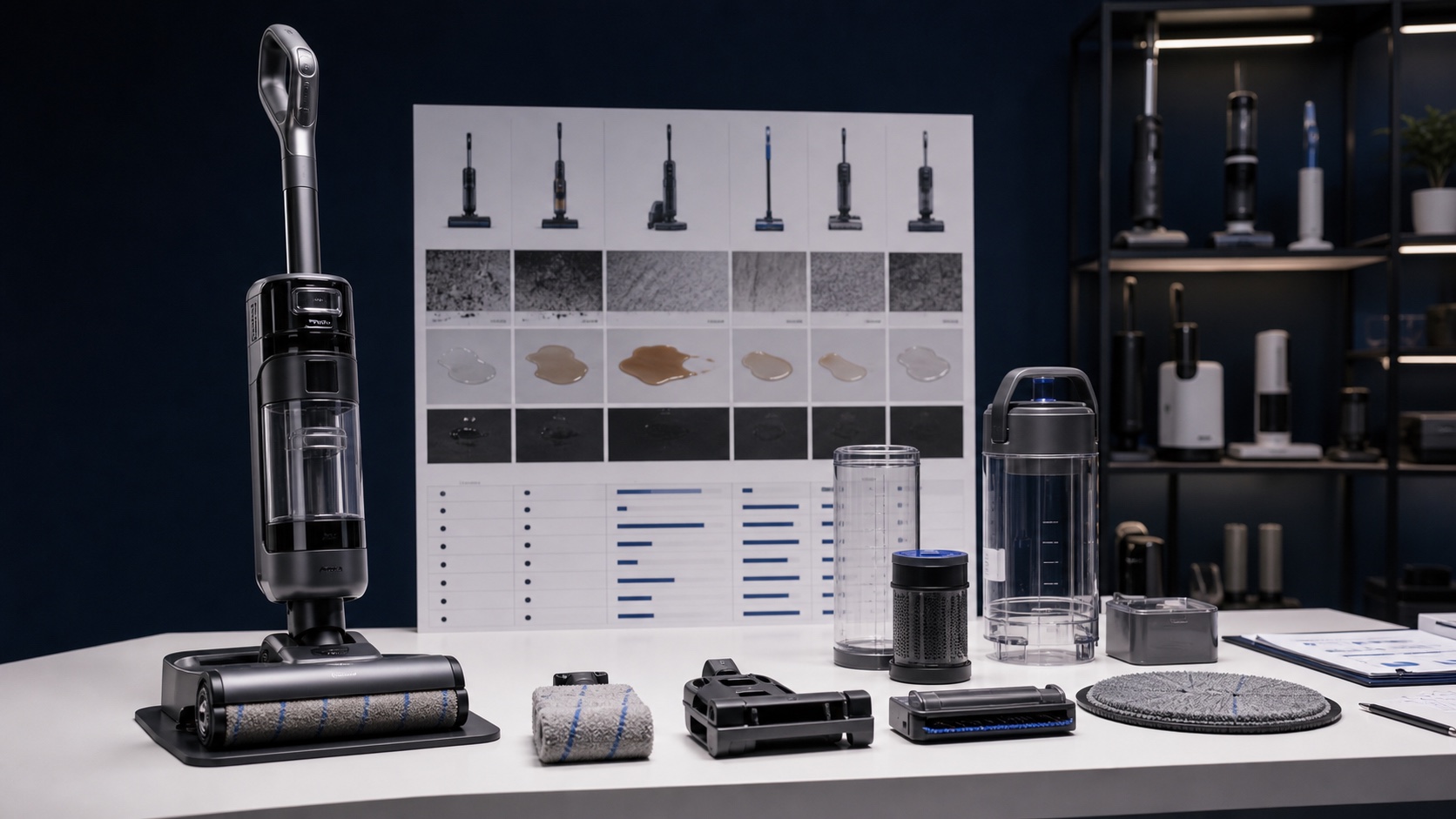
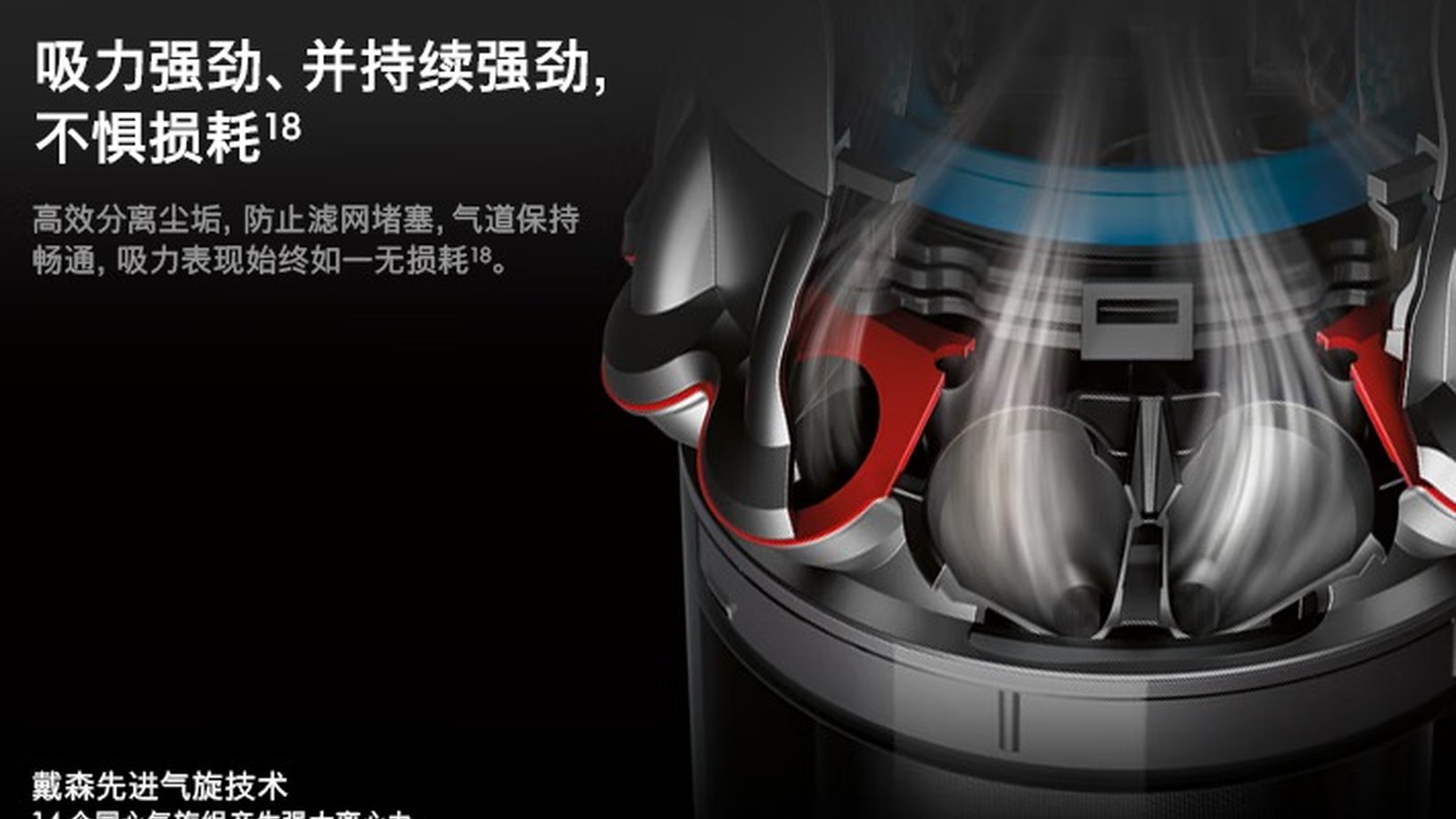
- The author argues Dyson’s V16 primarily stacks motor power with limited practical value.
- Dyson’s robot vacuum and hard floor washer still lag leading Chinese brands by years.
- The article concludes that Dyson’s technology lead is fading while Chinese brands innovate faster.
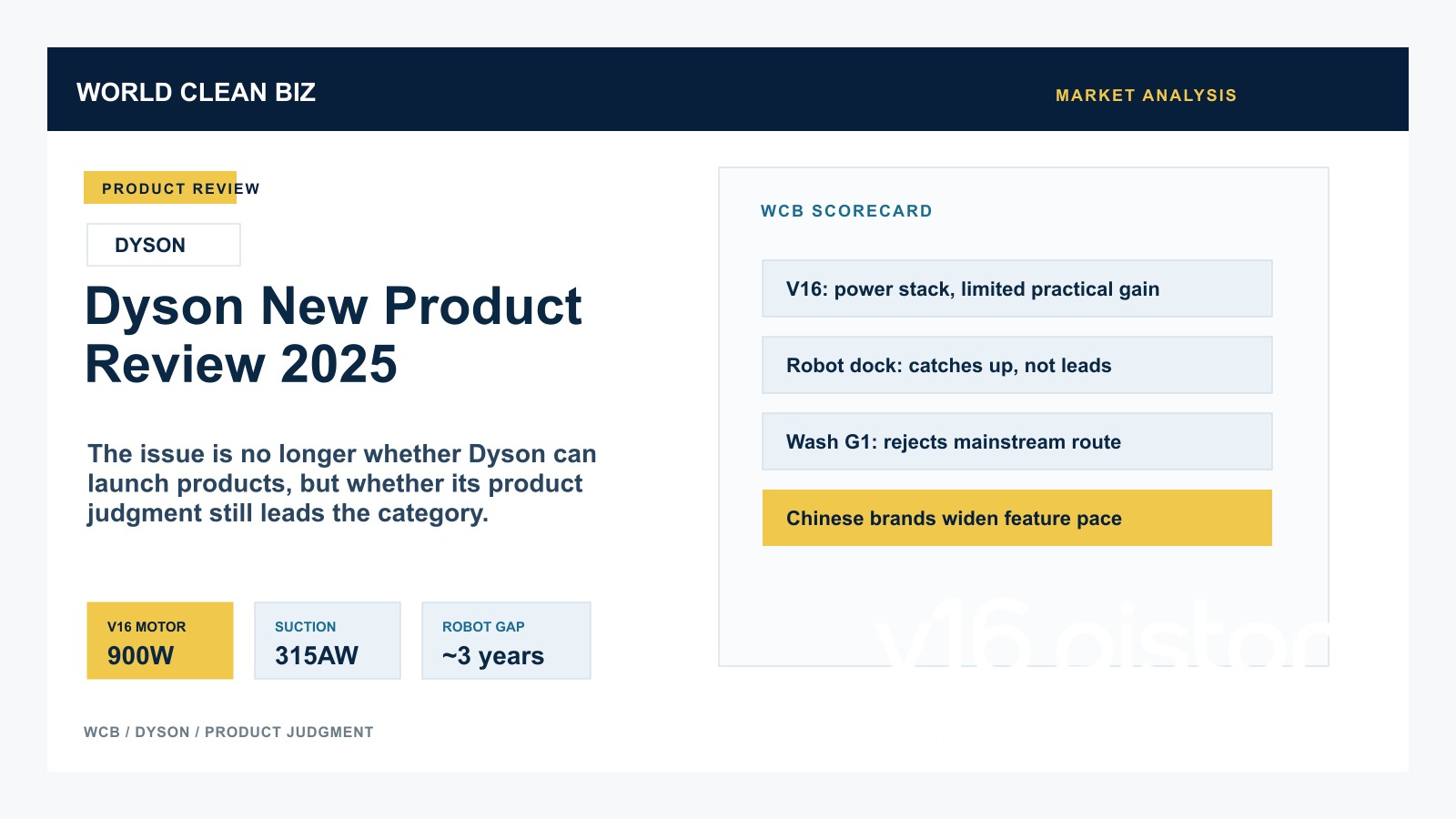
Dyson is a British company known for innovative technology. Its products cover vacuum cleaners, air purifiers and personal-care appliances. Dyson did not attend IFA this time. Instead, it held a new-product debut in a Dyson store next to IFA.
Next, let us look at these products and make some comments.
The products released include the following.
Cordless vacuum cleaner V16 Piston Animal.
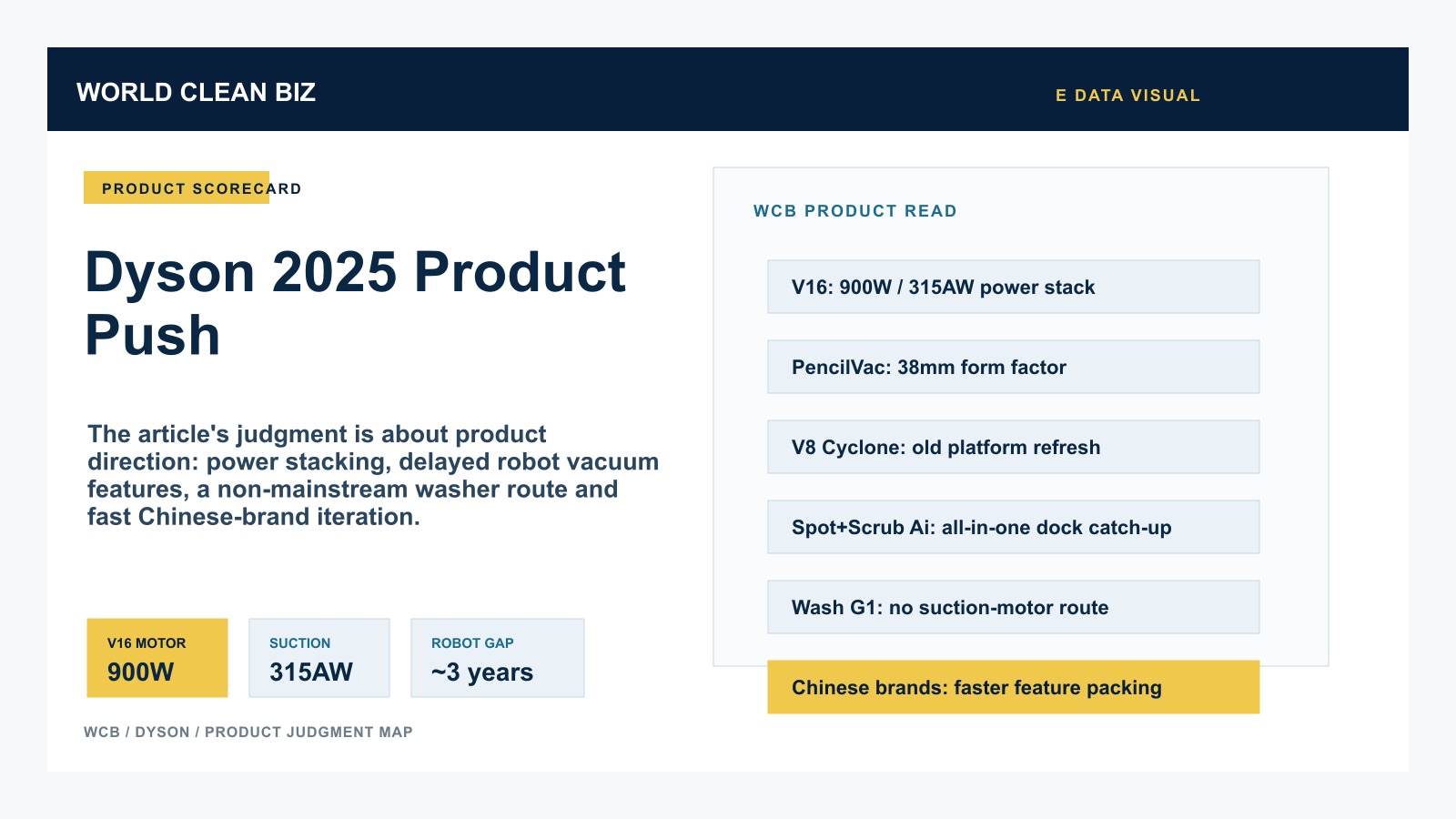
900 W motor, 315 AW suction.
Dual-cone cleaner head for anti-tangling.
Dustbin can hold 30 days of dust.
Compatible with Submarine 2.0.
Supports wet washing and water-volume adjustment.
Retail price: GBP 749.
Denny's comment: the main change in the V16 Piston appears to be the motor becoming 900 W and suction reaching 315 AW. At present, motor performance in cordless vacuum cleaners is seriously excessive. Above 300 W, battery life cannot support it. So increasing to 900 W is simply piling on materials. Runtime at the highest setting should be less than ten minutes and has no practical meaning.
The core function of the dual-cone floor brush is to prevent hair tangling. It can roll hair into a ball and move it to the side. At present, leading brands have already solved anti-tangling well through comb structures and hair-cutting solutions. If two cones are truly needed, my suggestion is to adjust their direction so the small ends on both sides point inward. That way, hair rolled into a ball is not thrown onto the floor but sucked into the dust chamber, somewhat similar to the roller brush of DJI ROMO.
Another change is that the dustbin adds a manual dust-compression dumping mode, which should be somewhat better than before. Its claimed 30-day capacity is relative to large-volume dust such as fluff without manual compression. For solid particles, it is basically useless. So the 30-day dust capacity can be ignored. Dyson's manual dust-compression version also already has similar functions from Dreame, MOVA and others.
There is also a Submarine wet-and-dry floor brush. This brush is not sold separately. Based on package-price comparison, its value should be GBP 150. This brush is equivalent to an attachment similar to a hard floor washer. This concept was released by small accessory factories in Suzhou four years ago. When the Dyson V16 main unit connects to this floor-brush attachment, the suction motor does not work; it is basically only acting as a battery.
Cordless vacuum cleaner PencilVac.
Only 38 mm in diameter, the world's slimmest.
Fluffycones dual brush head solves long-hair tangling.
Expected to enter European and U.S. markets in 2026.
Denny's comment: we have actually used this product. Its biggest feature is the shape. The current dust-cup capacity is 0.08 L, and actual performance is ordinary. The selling price is RMB 4,000. It previously debuted in Japan, and sales were also very ordinary. After discussing other markets with several customers, we are also not optimistic.
Cordless vacuum cleaner V8 Cyclone.
Compared with the original V8, suction is increased by about 30%, reaching 150 AW.
Battery life is extended by 50%.
Replaceable battery, no-trigger button, one-button dustbin release.
Released in the UK on September 17, 2025, and already listed in China.
Denny's comment: this V8 is already an old Dyson model from six years ago. This time, performance was simply improved. With price unchanged and suction and battery life improved, sales may continue after adding quantity without raising price. It is understandable that Dyson currently faces relatively large price pressure. The old V8 from several years ago still has considerable sales, and competing with low-priced, high-performance Chinese brands still depends on the low-priced V8.
If Dyson still needs to rely on low-priced old products to maintain sales, that is a fairly dangerous signal.
Robot vacuum Spot+Scrub Ai.
Dyson's first robot vacuum with an all-in-one dock and built-in AI algorithms.
It has fresh-water mopping, automatic mop cleaning and a cyclone dustbin.
Denny's comment: this is Dyson releasing a robot vacuum again after many years. This product is manufactured by Picea. From product performance, Dyson's configuration has finally caught up with leading companies in the industry. A simple look at the functions suggests it can only be considered an entry-level all-in-one dock model. Popular functions such as hot-water washing, hot-air drying and robotic arms are still absent. It lags leading domestic brands by about three years, and the gap is still widening.
Previously, Dyson's ordinary 360 robot vacuum cost GBP 1,200. Now with a station, I think the price will not be low and should be between GBP 1,500 and GBP 2,000. At present, entry-level all-in-one dock models from other brands are moving toward USD 400 to USD 500. If Dyson prices at this level, selling 50,000 to 60,000 units a year would count as relatively successful. But will consumers buy a product that is extremely expensive and weaker than peers in performance?
Wash G1 hard floor washer upgrade.
This is a hard floor washer different from mainstream models on the market. It has no suction motor, no filter, supports dry and wet use, has low noise and a self-cleaning system. It is expected to launch in 2026.
Denny's comment: Dyson released the first-generation Wash G1 hard floor washer four years ago. It had no hard floor washer suction motor and relied purely on the roller brush to roll debris in. Sales of the first-generation Wash G1 should have been poor, with little market noise.
This time Dyson released an upgraded hard floor washer. I looked at it, and the functions are basically the same as before. It is still a version without a suction motor. Dyson was previously No. 1 in the China market, but because hard floor washers became popular, it has now fallen out of the top ten. After seeing Tineco and Dreame hard floor washers sell well, Dyson also wanted to follow up on hard floor washers, so it released several strange hard floor washer products.
I feel Dyson has an obsession. Even though first-generation G1 sales were terrible, it still refuses to use the mainstream industry route with a suction motor. If Dyson made a product with the same mainstream technology, even at RMB 5,000, many people would likely pay. I think this current hard floor washer still has little appeal. The market may need to give Dyson another lesson before it recognizes reality.
HushJet Purifier.
Jet-style star-shaped nozzle, 24 dBA noise, five-year filter life.
Supports Wi-Fi and voice assistants.
Released in the United States on September 30, 2025, at USD 349.99.
Denny's comment: this is an air purifier with a refreshing appearance. From the current shape, it has many highlights. I think many people should buy it. However, for this kind of pure-shape product, various similar-style products will quickly appear in the next six months.
Air circulation fans Hot+Cool HF1 and Cool CF1.
HF1 combines fan and heater.
Supports app control and energy-saving mode, expected in 2026.
CF1 is a desktop bladeless fan with 29 dB quietness, priced at GBP 249.99 in the UK.
Denny's comment: these two bladeless fans are updates of old designs. For now, they do not seem to have anything particularly special.
Personal care AirWrap Co-anda 2X.
New motor, double air pressure, 30% higher power.
No heat damage.
Smart six-in-one attachments.
Denny's comment: this curling wand upgrades performance and adds various attachments on the original basis. After Laifen brought the price of Dyson-style hair dryers down to the RMB 299 price range, the decline of Dyson's hair dryer and styling wand series is unavoidable. When the prices of domestic brands are only one-tenth of Dyson's, any technological gap becomes very pale.
After looking at Dyson's released products, let us compare them with new products released during the same period by Chinese brands such as Dreame, MOVA and Roborock.
Dreame released a hard floor washer with a robotic arm, a cordless steam hard floor washer, a product combining hard floor washer and fabric cleaner functions, a stair-climbing robot vacuum, a robot vacuum that can change mop cloths by zone, a robot vacuum with a five-axis robotic arm, and many other innovative products.
MOVA also released several impressive things, such as a stair-climbing robot, a robot vacuum that changes mop cloths by zone, and Next Lawn Master X, the first robotic mower with a robotic arm.
Roborock also released three new robotic mowers, fully covering from high-end flagship to entry level.
Compared with Dyson's toothpaste-squeezing style of innovation, domestic Chinese brands have been innovating as if innovation costs nothing, stuffing everything into products. So does Dyson have technology but not update it, or does it truly have no updated technology to offer? I think it is the latter. Dyson really does not have much technology left.
Some people will say Dyson's brand is still very strong, and no matter what product Dyson releases, there will always be a group of loyal consumers supporting it unconditionally. But the characteristic of technology and appliance products is that only companies with strong technology have pricing power and brand appeal. In its early years, Dyson truly led the entire industry technologically and continuously released products that changed the world. That is why it had loyal fans, not the other way around. Once Dyson no longer leads the industry technologically while still having the highest prices in the industry, these fans will quickly switch sides.
Dyson's current products are entirely differentiated for the sake of differentiation, without caring whether the market can accept them. Perhaps Dyson should try to accept a reality: its technical capability has begun to fall behind Chinese competitors, and the gap is widening further.
The world has changed. The decline of the brands we once looked up to is unavoidable. In at most another three to five years, cleaning appliances will be dominated entirely by leading domestic brands. At that time, what will the world look like? We truly do not know.