- Choose Dreame A2 when its 3,000 m² rating, quieter published operation, dual-map workflow and extending EdgeMaster disc fit the property and local service is proven.
- Choose the original GOAT A3000 LiDAR when its wider 33 cm dual-disc deck, 45-minute charging, 30–90 mm height range and published 0.8 m passage fit matter more.
- In the United States, the original A3000 LiDAR is sold out and ECOVACS points buyers to the PRO model, so old-stock warranty, parts and channel status are part of the comparison.
In this article 15 sections
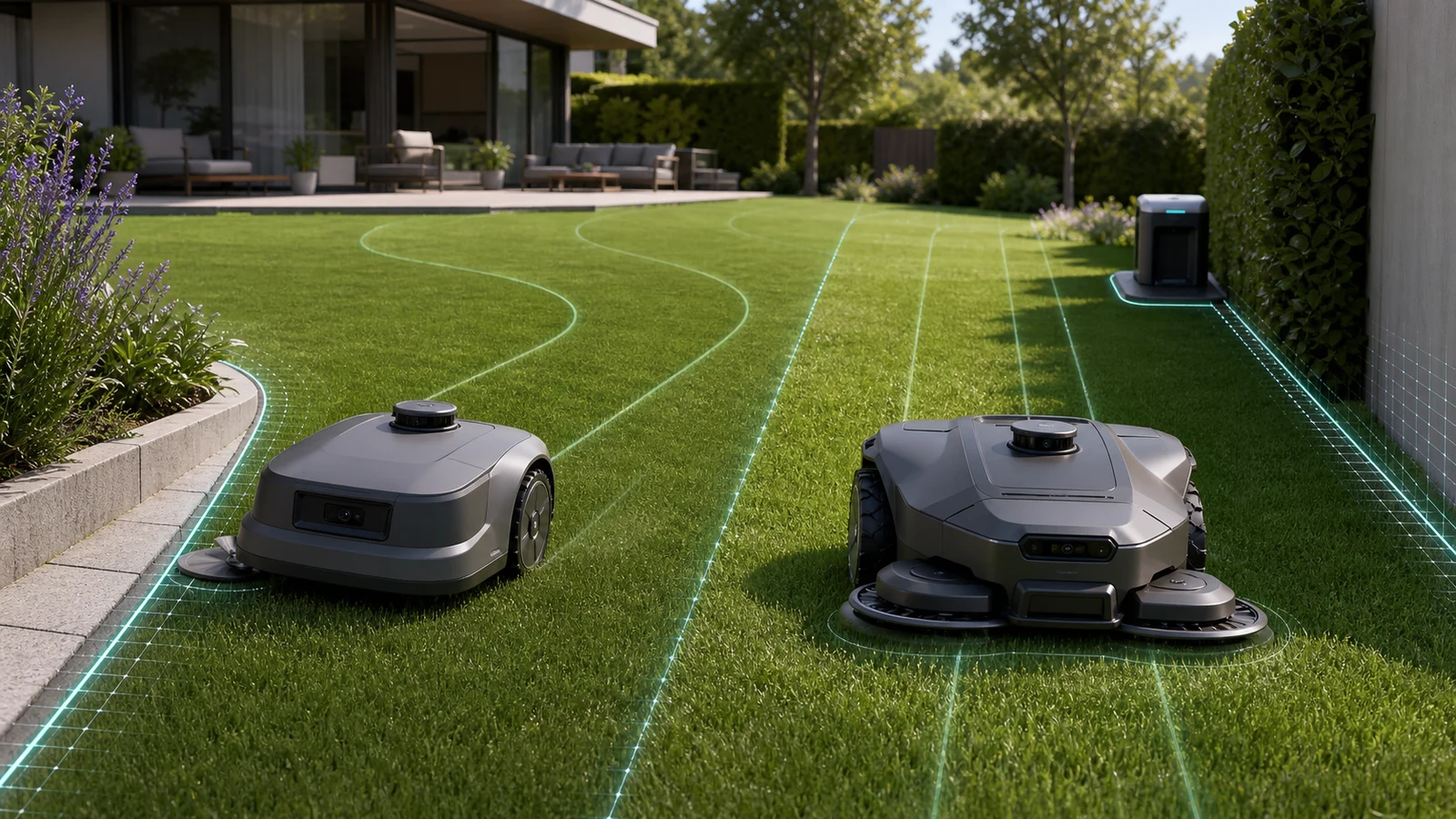
Choose Dreame A2 when a 3,000 m² rating, quiet operation, dual-map management and an extending edge disc fit the lawn and local service is proven. Choose the original ECOVACS GOAT A3000 LiDAR when a wider 33 cm dual-disc deck, 45-minute charging, a taller cutting-height range and a published 0.8 m narrow-passage specification matter more.
The hardware comparison is only half the decision. ECOVACS currently marks the original A3000 LiDAR as sold out in the United States and directs shoppers to the newer PRO. A dealer buying original-model inventory therefore needs evidence of authorized supply, warranty eligibility, firmware support and replacement parts.
Quick Comparison
| Decision factor | Dreame A2 | ECOVACS GOAT A3000 LiDAR, original |
|---|---|---|
| Positioning | Wire-free LiDAR-and-camera mower rated for up to 3,000 m² | Wire-free dual-LiDAR-and-camera mower for medium-to-large lawns |
| Mapping | Guided start plus AI boundary recognition; manual mapping for unclear boundaries | InstantGo automatic mapping plus app editing |
| Navigation sensors | 3D LiDAR, 1080p HDR AI camera | 360° LiDAR, forward 3D ToF LiDAR, AI camera |
| Cutting system | 22 cm single system with extending EdgeMaster disc | 33 cm dual-disc system |
| Cutting height | 30–70 mm | 30–90 mm |
| Published maximum slope | 50% / 26.5° | 50% / 27° |
| Published narrow passage | Not stated on the global product page | 2.62 ft, about 0.80 m |
| Battery and charging | 5 Ah; global page does not publish charge time | 5 Ah; 45±5 minutes |
| Published throughput | 1,000 m²/24h standard; 2,000 m²/24h efficient | 400 m²/h mowing; 500 m² per two hours including charging |
| Noise | Below 55 dB | 62 dBA |
| Current US channel status | Check regional availability and seller | Original model marked sold out; PRO promoted instead |
These are manufacturer specifications, not one controlled side-by-side test. Capacity, throughput and precision claims use different internal methods, so they should not be converted into a universal winner.
Compare the Exact Model and Market
“Dreame A2” can refer to different regional capacities. Dreame’s global page describes the 3,000 m² model, while some local stores also carry an A2 1200. This article uses the global 3,000 m² specification.
ECOVACS now sells an A3000 LiDAR PRO in the United States. It is not the same product as the original A3000 LiDAR. The PRO adds a separate trimming proposition and has its own specification. Do not copy a PRO capability into an original A3000 quotation.
Every request for quotation should state:
- exact model, region code and manufacturing revision;
- seller and authorized-distributor status;
- included charging station, cable, blades, connectivity module and garage;
- app region and mobile-network terms;
- warranty for mower, battery, station and accessories;
- firmware support and spare-parts commitment;
- whether stock is current production, clearance or refurbished.
This model discipline matters more than a small headline performance difference.
Mapping: Guided AI Recognition vs InstantGo
Dreame combines LiDAR grid scanning with visual recognition. Its official instructions are more qualified than “press once and forget it.” The mower must first be guided to the lawn edge. AI boundary recognition can then help when grass and non-grass areas are visually clear. If the boundary is complex or unclear, Dreame says the user must control the mapping process manually.
That qualification is sensible. Gravel blending into dry turf, ivy at an edge, open flower beds and worn grass can confuse any visual boundary classifier.
ECOVACS describes InstantGo as automatic mapping without a physical wire, a complete remote-control mapping lap or an RTK reference station. The map can then be edited in the app, with areas added, merged, split or deleted.
Automatic mapping may reduce commissioning time on a well-defined lawn. It does not remove the need to inspect:
- open roads, ponds, drops and public paths;
- visually ambiguous grass borders;
- narrow connectors between zones;
- the charging route;
- furniture that moves between mapping and mowing;
- seasonal changes in plants, leaves and light.
For a professional installation, save the original map, no-go zones, app version and firmware version at handover.
LiDAR and Vision in Difficult Yards
Dreame’s OmniSense 2.0 uses a 3D LiDAR sensor and 1080p HDR camera. The company publishes a LiDAR range up to 70 m, a 360° × 59° field of view and centimeter-level precision, all based on internal testing.
The GOAT A3000 LiDAR uses two LiDAR roles: a top 360° unit for mapping and a forward 3D ToF unit paired with an AI camera for near-field perception and obstacles.
Both architectures avoid dependence on a separately installed RTK reference station. That can be useful near roofs or trees where satellite reception is difficult. It does not make the machines immune to:
- feature-poor open areas;
- dirty or blocked sensors;
- dense rain, fog or airborne debris;
- moving vegetation;
- repeated walls and hedges;
- changing light and deep shadow.
The correct test is recovery. Deliberately run the mower under the densest canopy, beside the tallest wall and through the narrowest connector. Record pauses, route changes, boundary deviations and rescues across several cycles.
Our RTK vs LiDAR robot mower guide explains why a sensing label should be treated as a system architecture, not a guarantee.
Narrow Passages and Disconnected Areas
ECOVACS publishes a minimum passage width of 2.62 ft, approximately 0.80 m, for the original A3000 LiDAR. Dreame’s global A2 product page does not publish an equivalent minimum, so a precise A2 passage number should not be invented.
Measure the usable corridor, not the gap between walls. Plants, edging, drain channels and wheel clearance reduce the real width. The mower also needs room to enter, align and exit without repeatedly contacting a boundary.
Dreame supports two independent maps, useful for separated front and rear lawns. The official page notes that a second charging station is required for the dual-map feature. That added hardware belongs in the project cost.
ECOVACS supports multiple zones and editable connections on one map. If lawns are physically disconnected, confirm how the mower is transported, placed and localized. “Multi-zone” does not always mean the robot can cross stairs, gates or public paving by itself.
Cutting Width and Lawn Capacity
The cutting deck creates the clearest practical difference.
Dreame A2 uses a 22 cm cutting width. The company rates the mower for a mapped lawn up to 3,000 m² and publishes 1,000 m² per 24 hours in standard mode or 2,000 m² per 24 hours in efficient mode.
The original GOAT A3000 LiDAR uses two cutting discs across 33 cm. ECOVACS publishes 400 m² per mowing hour and 500 m² per two hours including charging.
A wider deck can reduce passes in an open rectangle. A narrower deck may follow tight geometry and local contours more easily. Neither headline predicts the real weekly schedule when a lawn contains islands, slopes, soft soil and long transit routes.
Ask the dealer to calculate:
- net mowable area, excluding buildings, beds and hardscape;
- route length between zones and station;
- allowed mowing hours per day;
- expected weather interruptions;
- desired cut frequency during peak growth;
- reserve capacity for battery ageing and slower difficult zones.
Do not compare Dreame’s per-day figures directly with ECOVACS’ per-hour figure without including charging, route and field conditions.
Edge Cutting: Less Trimming, Not No Trimming
Dreame’s EdgeMaster disc extends outward while cutting. Dreame states a disc-to-edge distance below 5 cm. The feature is intended to increase coverage along high or uneven boundaries.
ECOVACS uses TruEdge with sensor-guided boundary behavior. Its US product page describes mowing as close as 2 inches at unpassable boundaries and ride-on cutting at passable, flush edges.
Both systems remain governed by physical geometry. A blade must stay inside its guard and the chassis needs clearance from walls. A flush paver lets wheels overlap the grass edge; a wall or fence does not.
During a demonstration, measure the remaining strip at:
- a vertical wall;
- a raised curb;
- a hedge with low branches;
- a flush paved path;
- an inward corner;
- a wet or uneven boundary.
Report weekly manual trimming minutes rather than promising “zero edge.”
The broader wire-free robot lawn mower guide covers why virtual boundaries do not eliminate landscape preparation.
Cutting Height and Grass Strategy
Dreame publishes an app-adjustable 30–70 mm range. ECOVACS publishes 30–90 mm in 10 mm increments.
The GOAT’s taller maximum can fit markets and grass programs that intentionally maintain a higher canopy. The range alone does not establish cut quality. Blade speed, blade condition, deck cleanliness, mowing frequency and turf moisture also matter.
Robot mowers should remove small amounts frequently. They are not brush cutters. Bring overgrown grass down gradually with suitable equipment before starting a robotic maintenance schedule.
Slopes and Obstacles
Both brands publish nearly the same maximum slope: 50%, equal to roughly 26.5–27 degrees. The GOAT page also lists 4 cm barrier crossing.
Those figures are screening limits, not permission to operate beside a hazard. A straight dry test slope is different from wet turf, a cross-slope, loose soil or a tight turn at the crest.
Survey:
- slope angle and direction;
- safe distance from ponds, walls and drops;
- drainage and wet-grass conditions;
- roots, holes, curbs and wheel traps;
- room for turning at top and bottom;
- the return-to-charge route.
Test obstacle avoidance with ordinary safe objects, but continue removing hoses, cables, toys and small debris before mowing. AI recognition reduces risk; it does not replace site management.
Charging and Daily Availability
Both models use a 5 Ah battery, but battery capacity alone says little about productivity.
ECOVACS publishes a 45±5 minute charging time and 118 minutes of mowing from 100% to 15% under its test conditions. Dreame’s global page publishes return-and-resume behavior and daily area modes but not an equivalent charging duration.
For procurement, log a complete cycle:
- start and return state of charge;
- active mowing time;
- transit time;
- docking attempts;
- charge time;
- resumed position;
- area completed;
- ambient temperature and grass condition.
One number in a brochure cannot replace this operating record.
App, Connectivity and Security
Dreame A2 uses the Dreamehome app for mapping, zones, schedules, cutting height and mowing direction. The global page says its Link module supports tracking and includes three years of data. Terms can vary by market.
The GOAT uses the ECOVACS HOME app for map editing, cutting settings and schedules. Cellular connectivity may require an optional module and local data plan.
Before resale, confirm:
- which functions work on Wi-Fi only;
- who owns the customer account;
- transfer and factory-reset procedure;
- subscription or data cost after the included term;
- remote video or camera privacy settings;
- firmware policy and offline behavior;
- service access without sharing the customer password.
These questions belong in delivery paperwork, not in an informal message after installation.
Maintenance, Parts and Lifecycle
Both mowers are rated IPX6, making rinsing easier when the manufacturer’s cleaning instructions are followed. Neither should be cleaned while powered or charged.
Routine service includes:
- inspecting and replacing blades and screws;
- removing packed grass from the guarded deck;
- cleaning sensor windows and wheels;
- checking station contacts and cable condition;
- reviewing battery runtime and docking performance;
- installing firmware only with a rollback and support plan.
Dreame supplies a quick-detach blade design and a Link module in the listed package. ECOVACS continues to list manuals, blades, garages, extension cables and connectivity accessories for the original A3000 family.
That continuing support is positive, but US sell-out status still changes the risk. A distributor should get written confirmation of warranty start date, spare-parts horizon and DOA replacement before buying remaining inventory.
Use our robot mower cost and maintenance guide to model the full installed cost rather than comparing mower prices alone.
Dealer and Installer Decision
Choose A2 for a project when:
- the 3,000 m² mapping rating and 2,000 m² efficient daily claim leave adequate reserve;
- the quieter published noise level matters;
- the extending edge disc reduces labor on the actual boundaries;
- two independent maps justify a second station;
- the local Dreame seller can prove mower-specific parts and service.
Choose the original A3000 LiDAR when:
- the 33 cm dual-disc deck and fast charging improve the real schedule;
- the lawn needs a 90 mm maximum cutting height;
- the verified route is at least 0.8 m wide;
- automatic mapping reduces commissioning work;
- authorized old stock has clear warranty and parts coverage.
Choose neither until a site trial if the lawn includes an unprotected drop, ambiguous open boundary, frequently wet steep slope or corridor close to the published minimum.
Site Trial Checklist
- Confirm exact regional SKU and firmware.
- Measure net lawn area, slopes, boundaries and narrow passages.
- Map every zone, connector and no-go area.
- Test under trees, roofs, walls and changing light.
- Measure remaining grass at four edge types.
- Record one full mow-charge-resume cycle.
- Inspect turf after repeated turns and slope travel.
- Test rain return, docking and restart.
- Confirm account transfer, cellular terms and privacy settings.
- Obtain warranty, parts, labor-rate and DOA terms in writing.
FAQ
Which mower covers a larger lawn?
Dreame explicitly rates the global A2 model for maps up to 3,000 m². The original GOAT A3000 LiDAR is marketed for medium-to-large lawns and publishes high hourly throughput. Rated capacity and throughput are different metrics, so select from the required weekly schedule and field test.
Which one cuts faster?
GOAT A3000 LiDAR has a wider 33 cm dual-disc deck and publishes 400 m²/h plus 45-minute charging. Dreame publishes up to 2,000 m² per 24 hours in efficient mode. Because the test methods differ, real speed must be measured on the same lawn.
Which one cuts closer to walls?
Dreame publishes less than 5 cm from disc to edge using its extending EdgeMaster disc. ECOVACS describes about 2 inches at unpassable edges and ride-on cutting at flush passable edges. Boundary shape determines the remaining strip.
Can both handle a 50% slope?
Both manufacturers publish approximately 50% maximum slope. That does not guarantee performance on wet grass, cross-slopes, soft soil or turns near hazards. A supervised site test is required.
Do they need perimeter wire or RTK?
No physical perimeter wire or separate RTK reference station is required for their primary mapping workflows. Dreame may need manual guidance when boundaries are unclear; ECOVACS maps automatically and allows app editing.
Is the original GOAT A3000 LiDAR still available?
ECOVACS’ US product page currently marks it sold out and directs buyers to the A3000 LiDAR PRO. Availability differs by country and seller. Verify whether any offer is authorized old stock, refurbished stock or an import.
Is the A3000 LiDAR PRO included in this comparison?
No. The PRO is a distinct model with different edge hardware and specifications. This article compares the original GOAT A3000 LiDAR.
What should a distributor request before ordering?
Request model and region codes, stock status, warranty eligibility, firmware policy, parts horizon, DOA terms, battery coverage, app region, cellular costs and a sample-unit site test.