- DJI can attract attention quickly, but robot vacuum users judge repeated daily performance.
- Cleaning structure, dock design and service experience can matter more than headline technology.
- ROMO’s weaknesses show why the category is harder than a simple brand extension.

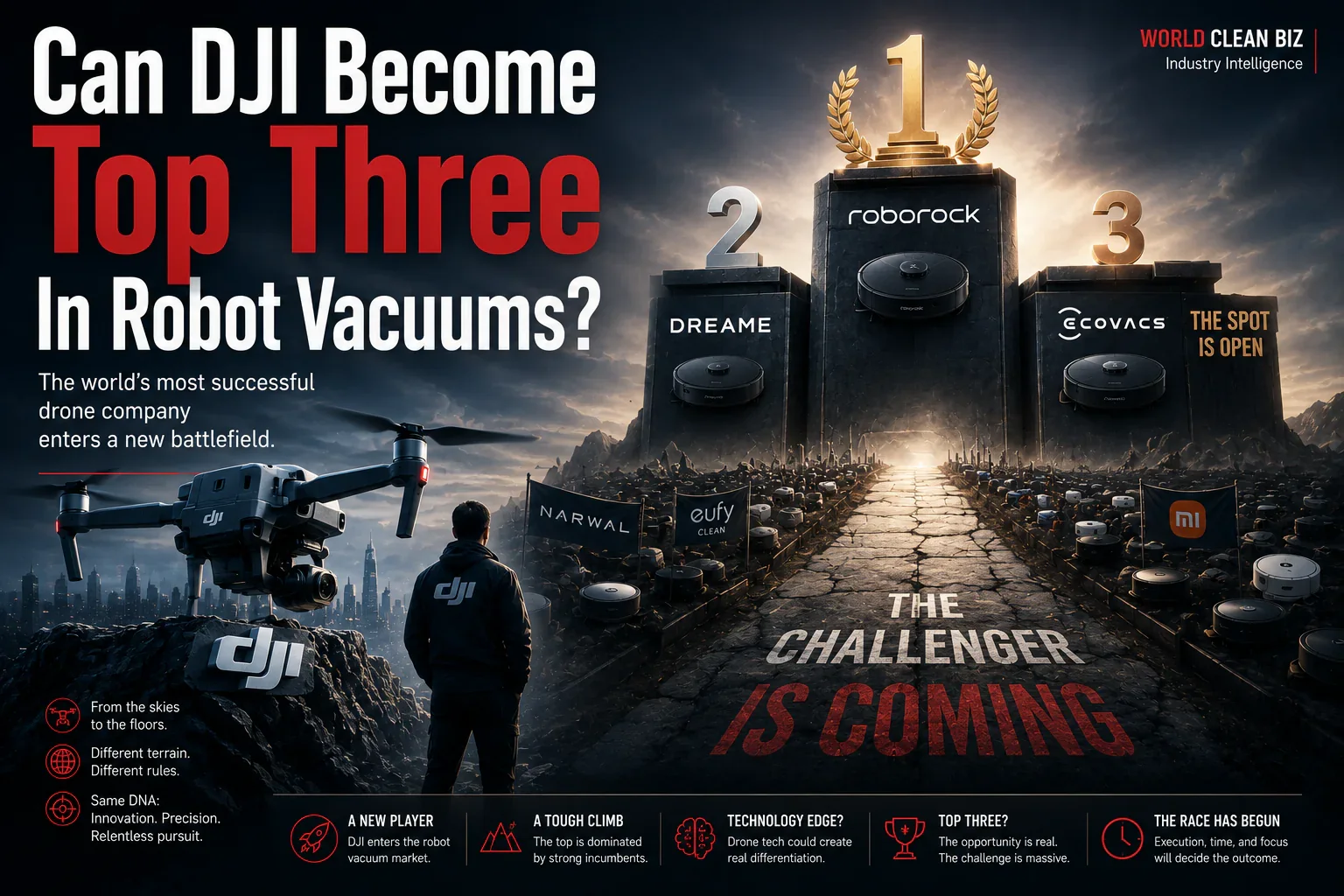
On August 6th, DJI launched the ROMO robot vacuum. After numerous online reviews and evaluations, many people began to exclaim that "DJI is unbeatable," believing that it will eventually defeat companies like Roborock, Narwal, Ecovacs in the future.
As their flagship product, the DJI ROMO is a highly refined product capable of competing with any current market offerings. However, if you consider promoting and marketing this product, you would find that it lacks distinct highlights. Tim from Cinematic Hurricane and other influencers' reviews failed to identify a standout feature for promotion. Previous reports mentioned that the DJI ROMO project team consisted of 300 people, which is significantly fewer compared to companies with thousands of employees. Each product's detail requires individual engineers to work on it piece by piece. We acknowledge DJI's capabilities but cannot overstate its prowess.
Currently, most of this product’s promotional highlights focus on navigation and obstacle avoidance. From the current reviews, ROMO indeed has faster real-time responses. Other functions such as mopping are still in a follower position and have not yet surpassed leading companies.
The next key point is September, when sales will be crucial. If the product sells well in September, it could see significant growth during the Double Eleven promotion. Conversely, if there are issues with previous products, the Double Eleven might face challenges.
Next, setting aside the current quality issues of DJI's products (which can only be discovered after actual use), the following potential problems may arise for the DJI ROMO:
- Pricing Strategy: The price difference between the highest-tier ROMO P and S models is over 1000 yuan, but their specifications are nearly identical, with the only differences being white plastic parts and transparent plastic parts. The cost difference of these plastic components is minimal, at most a few dozen yuan. However, the significant price gap may make people feel that DJI is trying to "cut the grass." There will likely be extensive analysis of the pricing for these models online; some have complained about spending over 7000 yuan on a transparent plastic shell.
- Transparent Design: Achieving a good finish with a transparent design is extremely challenging, and currently, the ROMO's appearance looks quite good. However, maintaining this transparency in the future will be difficult due to issues like dust accumulation inside or fingerprints outside the machine, which could lead to numerous complaints.
- Appearance: The DJI ROMO’s design bears a striking resemblance to Roborock P20. Given that the P20 was already on the market last year, it is unclear why the ROMO still uses this design. This will likely be a major point of criticism.
- Mechanical Arm: Dreame was the first company to use a mechanical arm in a robot vacuum, and the structure of DJI's mechanical arm appears similar to that of Dreame. It remains uncertain whether there are patent issues involved. Given DJI’s capabilities, they should have mitigated various potential patent risks; however, since Dreame likely applied for all possible patents, it is unclear who holds the upper hand.
- Currently, ROMO uses a dual-disc mop. Dual-disc mops were common in earlier models of floor cleaning robots, but over the past two years, the industry has largely shifted to using brushes with real-time water supply systems on the body. This change was made because if there is spilled soy sauce or pet feces on the ground, using a dual-disc mop would spread it everywhere, whereas a brush with a live water system can clean effectively.
- I had noticed that none of the reviews mentioned ROMO's climbing ability and suspected there might be an issue here. After watching some real-world videos tonight, I found that ROMO has weak threshold-crossing capabilities, with some evaluations suggesting a height of 2.5 cm. Threshold crossing is a critical basic function; if it is not done well, it can significantly impact product sales.

DJI's first product received too much attention. If there are no issues with the product itself, it could soar to new heights. However, even minor problems in such high visibility could be magnified. We will continue to monitor how things unfold.