Manual push
- Task scale
- Small areas and rapid spot routes
- Operator
- Operator provides propulsion
- Space
- Compact storage and tight turns
- Limit
- Operator effort and dust control differ from powered vacuum sweepers.
Independent Technical Reference
Walk-behind floor sweeper types, dust control, hopper systems and buyer checks
This profile separates manual and powered walk-behind sweepers and explains brush paths, hopper handling, dust control, route fit and model-specific procurement evidence.
First published 2026-08-09 · Last verified 2026-08-09
This independent category reference is not model-specific purchasing, safety, hazardous-material, textile-care or repair advice. Confirm the current manual, exact configuration, serial range, local compliance and service terms before procurement or use.
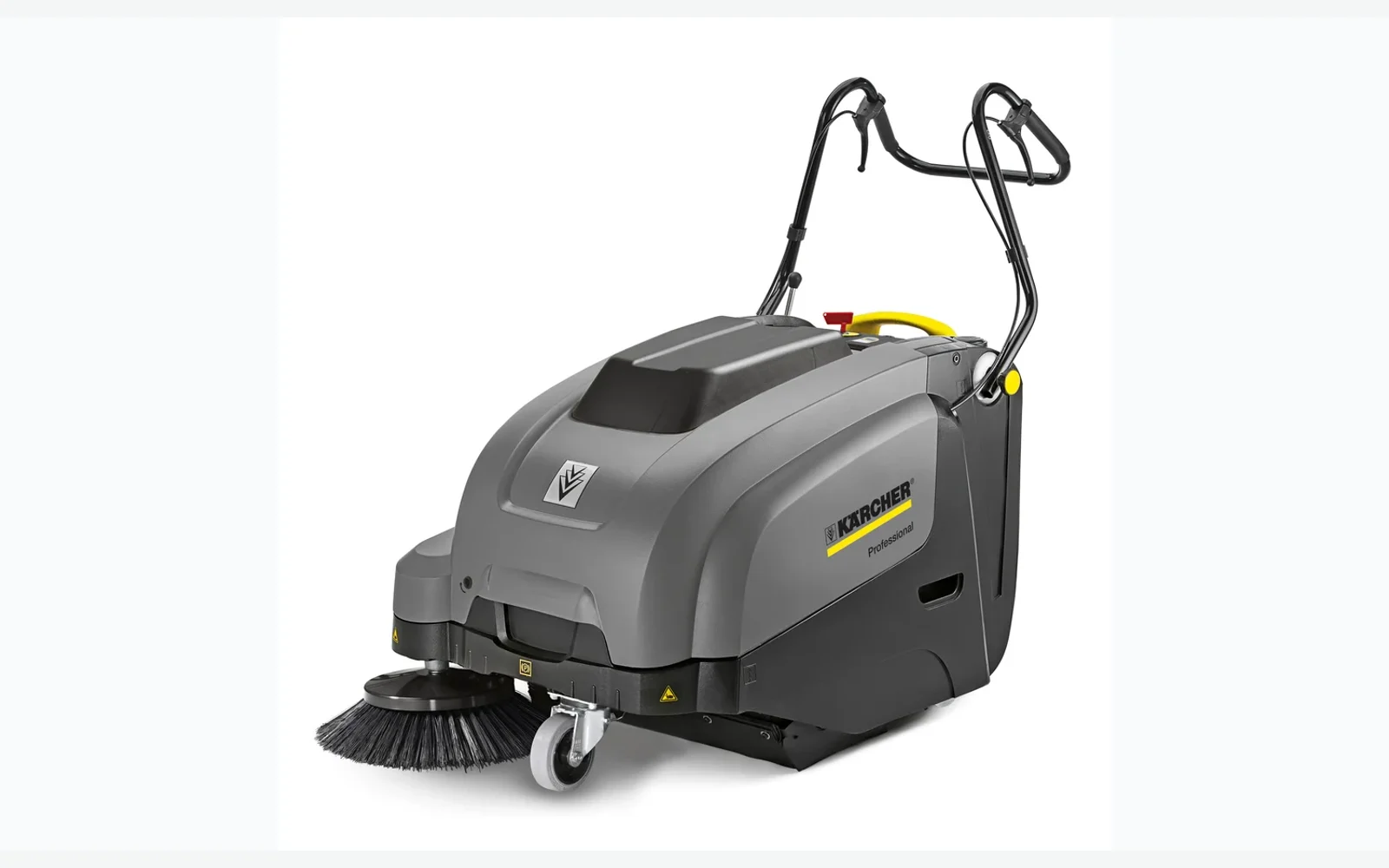
| Fact | Technical reference | Scope boundary |
|---|---|---|
| Category boundary | Operator walks behind during normal sweeping | Named commercial models; no universal width threshold. |
| Propulsion | Manual push or powered traction | Named models and regional configurations. |
| Dust control | Passive collection or active vacuum and filtration | Exact machine architecture. |
| Buyer verification | Measure complete width, turning, operator force, hopper handling and dust exposure | Quoted regional configuration and actual buyer site. |
WCB explanatory visual
An original system map synthesized from reviewed operator manuals. It explains functional flow, not a universal machine architecture.
Side brush
Moves edge debris toward the main path.
Main brush or tandem rollers
Transfers loose debris toward the hopper.
Debris hopper
Stores material for manual emptying.
Vacuum fan and filter
Reduces airborne dust on equipped machines.
Equipment taxonomy
These formats describe operator relationship and task scale. None is a universal winner.
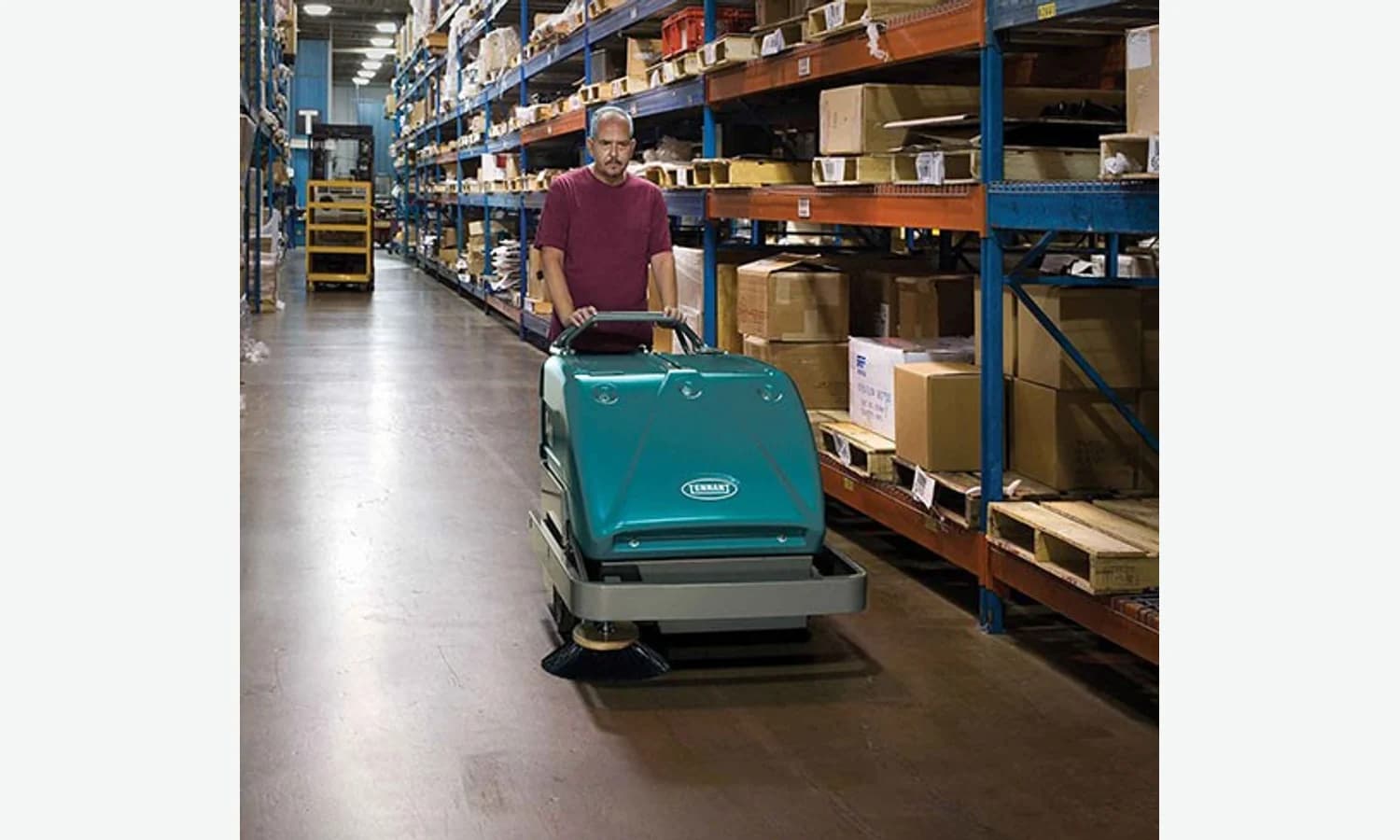
Official Tennant application image of an S10 in a warehouse; achieved pickup and route output require a site trial.
Buyer focusUse the format as a starting point, then compare the operating envelope, utilities, duty cycle, operator workflow, accessory system and the exact configured machine.
Official image sourceSpecification dictionary
| Metric | Purchasing meaning | Reporting boundary | Comparison caution |
|---|---|---|---|
| Sweeping path | Nominal brush coverage | With stated side-brush fitment | Do not convert width directly into achieved output. |
| Hopper volume | Nominal debris storage | Volume, not debris mass | Density and emptying ergonomics affect usable duty cycle. |
| Theoretical area performance | Nominal width-speed output | Manufacturer calculation | Turns, dumping and filter service are excluded. |
| Machine envelope | Door, aisle, lift and storage fit | Complete delivered configuration | Cleaning path is narrower than total machine or turning space. |
Evidence + WCB interpretation
Official application evidence does not establish automatic suitability. Each row shows what still needs to be tested.
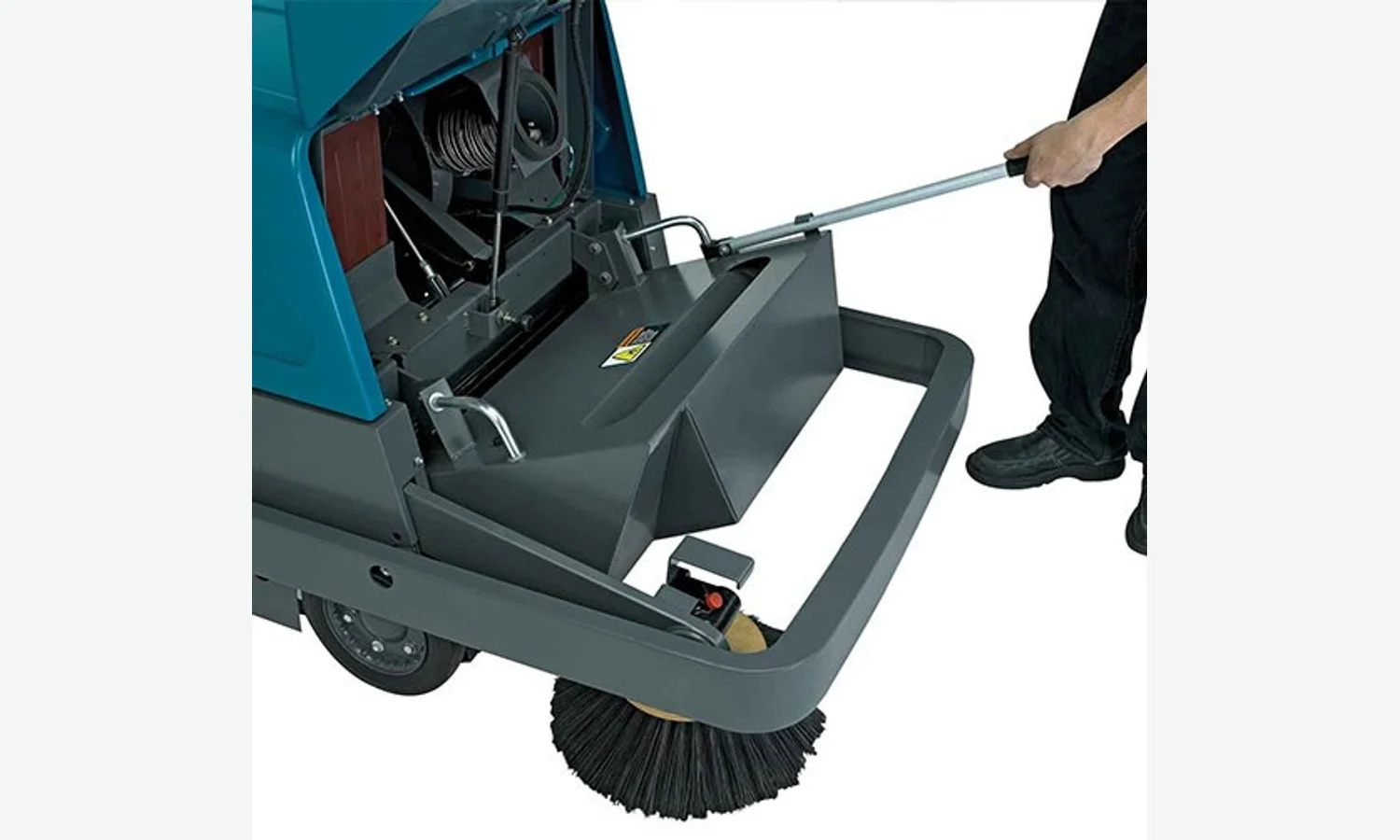
Official Tennant image illustrating manual hopper handling, an important labor and dust-exposure check.
Buyer focusTreat the photographed setting as context only. Validate utilities, surface compatibility, operating space, operator controls, environmental conditions and the planned work process on site.
Official image sourceA full-route trial should include tight turns, representative debris and hopper emptying.
Noise, operator force, dust release and pedestrian separation matter more than maximum width.
Surface joints, gradients, wind and wet debris require demonstration.
System component map
Component families are labels only. No component link or cross-model compatibility is claimed.

WCB diagram separating brush path, hopper, filter, traction, operator route checks. It does not establish part compatibility.
Buyer focusBefore substitution or service work, match the current manual, model and serial range, part number, physical interface, approved material or chemistry, and electrical configuration.
Evidence sourcestennant-s10, nilfisk-sw900, karcher-km75, hako-m600, taski-walk
Gather and lift debris.
Contains collected debris.
Controls airborne dust on vacuum sweepers.
Supports propulsion and steering.
Verified relationships
Representative, not exhaustive. A link means the official source connects the named brand and model; it does not establish a factory, OEM or component-supplier relationship.
| Brand | Model | Subtype | Official specification reference | Market scope | Verified | Source |
|---|---|---|---|---|---|---|
| Tennant | S10 | Industrial battery walk-behind |
| Tennant US | 2026-08-09 | tennant-s10 |
| Nilfisk | SW900 | Battery walk-behind vacuum sweeper |
| Nilfisk global | 2026-08-09 | nilfisk-sw900 |
| Kärcher | KM 75/40 W Bp | Battery walk-behind vacuum sweeper |
| Kärcher US | 2026-08-09 | karcher-km75 |
| Hako | Sweepmaster M600 | Manual push sweeper |
| Hako international | 2026-08-09 | hako-m600 |
| TASKI | balimat 3300 | Large walk-behind sweeper |
| TASKI global | 2026-08-09 | taski-walk |
| Wetrok | Speedmatic Twister | Battery walk-behind sweeper |
| Wetrok webshop | 2026-08-09 | wetrok-twister |
WCB decision support
No composite score or brand ranking. Each row identifies a comparison trap and the next verification action.
Engineering validation
This checklist narrows verification work; it is not a compatibility guarantee or repair manual.
Wet, hot, toxic or combustible material may be prohibited.
Required actionDocument material and obtain written manufacturer approval.
Brush width does not equal machine or turning width.
Required actionMeasure doors, aisles, ramps, lifts and storage.
Wear parts and electrical systems are model-specific.
Required actionRecord model, serial range and exact service part numbers.
Standards boundary
JurisdictionInternational
Version2021
ApplicabilityParticular safety requirements for powered commercial floor-treatment machines, including sweepers; it is not a cleaning-performance ranking.
Technical developments
IEC published edition 5.0 of IEC 60335-2-72.
Evidence record
First published 2026-08-09 · Last verified 2026-08-09 · Last material modification 2026-08-09
IEC
Open official sourceAccessed 2026-08-09 · Published 2021-06-17
Tennant Company
Open official sourceAccessed 2026-08-09
Nilfisk
Open official sourceAccessed 2026-08-09
Kärcher
Open official sourceAccessed 2026-08-09
Hako
Open official sourceAccessed 2026-08-09
TASKI
Open official sourceAccessed 2026-08-09
Wetrok
Open official sourceAccessed 2026-08-09