Independent Technical Reference

Floor Scrubber

Floor scrubber systems, equipment types, performance metrics, components and buyer verification

This technical profile separates documented equipment facts from World Clean Biz procurement interpretation so buyers and engineers can compare floor scrubbers without treating unlike specifications as equivalent.

Included
  • Powered walk-behind, stand-on, ride-on and autonomous machines that scrub and recover liquid in the same operating cycle
  • Commercial and industrial hard-floor applications within the limits stated by the machine manufacturer
Excluded
  • Single-disc rotary floor machines that do not recover liquid
  • Carpet extractors, domestic floor washers, road sweepers and sweeper-scrubbers
  • Model-specific repair instructions or universal component compatibility claims

First published 2026-08-08 · Last verified 2026-08-08

This is an independent category reference, not model-specific purchasing, safety, compatibility or repair advice. Confirm the current manual, configuration, serial range, local compliance and service terms before procurement or engineering work.
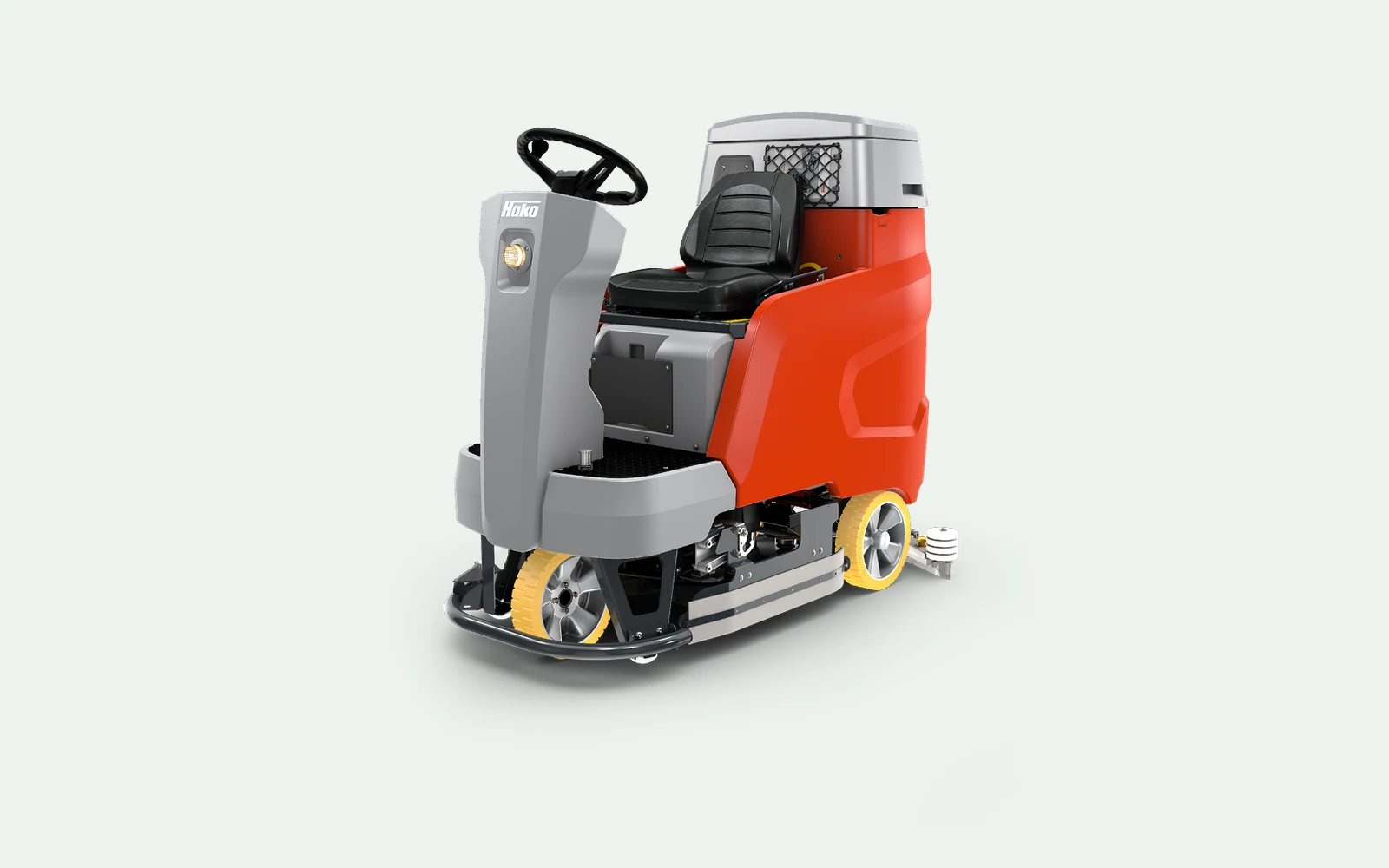
Official equipment reference
Hako Scrubmaster B120 R ride-on floor scrubber shown as an official product reference
Official Hako product image of the Scrubmaster B120 R, used as a real-equipment reference for the floor scrubber category; the category includes other formats and brands. Official image source
Floor scrubber key facts
FactTechnical referenceScope boundary
Cleaning mechanismCleaning solution, rotating or orbital agitation, squeegee collection and vacuum recoveryCommercial walk-behind scrubbers represented by the Tennant T300 and Kärcher B 50 W manuals; other designs require model confirmation.
Operator formatsWalk-behind, stand-on, ride-on and autonomous/roboticTerminology used by the reviewed international and US manufacturer pages; names can vary by market.
Common power sourceBattery power is common; battery chemistry, voltage, charger and runtime are configuration-specificThe reviewed Tennant, Kärcher, Nilfisk and Hako configurations; not a universal statement for every floor scrubber.
Tank arrangementSeparate fresh/solution and recovery tanks are typical in the reviewed machinesReviewed model configurations only.
Cleaning decksDisc, cylindrical/roller and orbital systems appear in current commercial rangesAvailable options depend on exact model and configuration.

WCB explanatory visual

How a floor scrubber works

An original system map synthesized from reviewed operator manuals. It explains functional flow, not a universal machine architecture.

  1. 01

    Solution delivery

    Fresh-water tank, valve/pump and fluid path

    Meters water or cleaning solution to the working area.

    EvidenceThe reviewed manuals describe filling the solution/fresh-water tank and controlling water or detergent delivery during cleaning.

    ScopeGeneric flow synthesized from the reviewed walk-behind manuals; hardware differs by configuration.

    Verified2026-08-08

    Sourcestennant-t300-manual, karcher-b50-manual

  2. 02

    Mechanical agitation

    Brush, pad driver or orbital deck

    Applies motion and contact to loosen soil from the floor surface.

    EvidenceOfficial manuals and product pages identify rotating brush/pad and optional deck technologies used for scrubbing.

    ScopeDeck mechanism and suitable consumable are model- and floor-specific.

    Verified2026-08-08

    Sourcestennant-t300-manual, tennant-t500, karcher-b50

  3. 03

    Soil suspension

    Solution, detergent and dwell interface

    Combines liquid and agitation so loosened soil can be transported toward recovery.

    EvidenceThe manuals describe wet cleaning with solution and agitation before recovery of dirty liquid.

    ScopeExplanatory WCB system step based on the documented wet-cleaning cycle; chemistry and dwell requirements are not universal.

    Verified2026-08-08

    Sourcestennant-t300-manual, karcher-b50-manual

  4. 04

    Squeegee collection

    Squeegee body and blades

    Channels liquid toward the vacuum pickup path.

    EvidenceOfficial documentation identifies the squeegee as part of the water-recovery system and provides blade inspection or replacement instructions.

    ScopeReviewed walk-behind machines; blade geometry and material vary by model and application.

    Verified2026-08-08

    Sourcestennant-t300-manual, karcher-b50-manual

  5. 05

    Vacuum recovery

    Suction motor, hose and airflow path

    Creates airflow to move collected liquid away from the floor.

    EvidenceThe reviewed manuals describe activating suction/vacuuming and maintaining the recovery path.

    ScopeFunctional category description; motor performance and airflow test methods are model-specific.

    Verified2026-08-08

    Sourcestennant-t300-manual, karcher-b50-manual

  6. 06

    Recovery storage

    Recovery tank, float/shutoff and drain path

    Retains recovered liquid for controlled emptying and cleaning.

    EvidenceOfficial manuals and specifications identify recovery/dirty-water tanks and service procedures.

    ScopeReviewed commercial machines; tank safeguards and drain systems differ.

    Verified2026-08-08

    Sourcestennant-t300, nilfisk-sc500-manual, karcher-b50-manual

Equipment taxonomy

Main floor scrubber formats

These formats describe operator relationship and task scale. None is a universal winner.
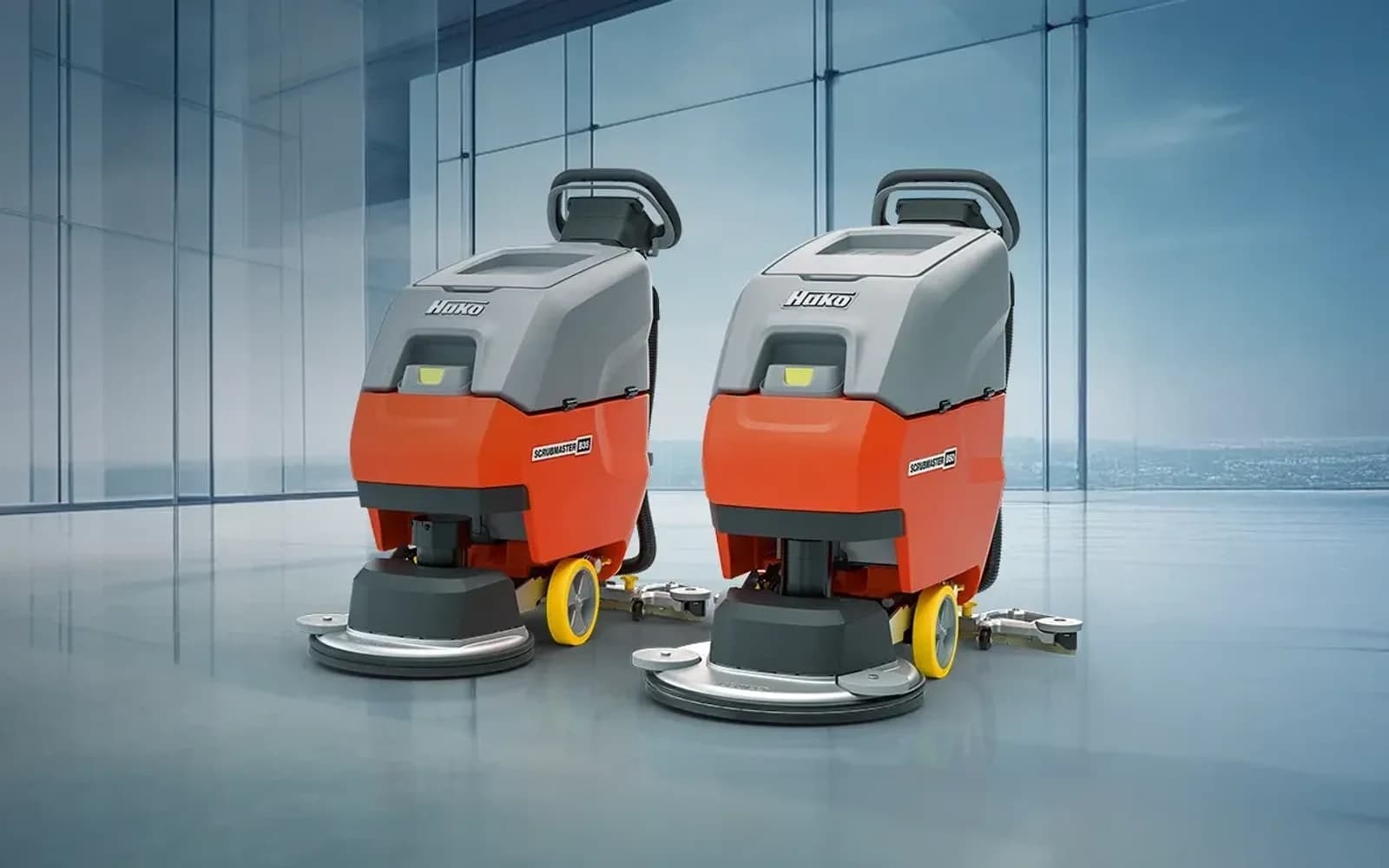
Two Hako Scrubmaster walk-behind floor scrubbers on a hard floor
Official field reference

Official Hako image of the Scrubmaster B35 and B50. It illustrates one walk-behind product format and does not define the whole category or constitute a product recommendation.

Buyer focusUse the format as a starting point, then compare route width, turning space, tank cycle, operator travel and the exact configured machine.

Official image source

Compact

Task scale
Small hard-floor areas and constrained rooms
Operator
Usually walk-behind or hand-guided
Space
Prioritizes maneuverability and storage footprint
Limit
Smaller tanks and working width can increase refill and transit time.

EvidenceOfficial compact/walk-behind product positioning emphasizes confined spaces and smaller areas.

ScopeCategory positioning, not a fixed dimensional threshold.

Verified2026-08-08

Sourceshako-b25, karcher-b50

Walk-behind

Task scale
Small to medium areas; some larger-area models exist
Operator
Operator walks behind and steers the machine
Space
Requires route width, turning room and manageable operator travel
Limit
Theoretical output does not account for refill, turns, obstacles or operator pace.

EvidenceTennant, Nilfisk, Kärcher and Hako identify the reviewed models as walk-behind machines.

ScopeReviewed manufacturer terminology.

Verified2026-08-08

Sourcestennant-t300, tennant-t500, nilfisk-sc500, karcher-b50, hako-b25

Stand-on

Task scale
Facilities balancing travel speed with a compact operator footprint
Operator
Operator stands on an integrated platform
Space
Turning envelope, ramps and platform access require site review
Limit
Manufacturers do not use the term consistently across regions.

EvidenceOfficial manufacturer classification distinguishes stand-on/ride-on machines from walk-behind models.

ScopeManufacturer-labelled products only; no universal category boundary is asserted.

Verified2026-08-08

Sourcesnilfisk-sc500, tennant-t300

Ride-on

Task scale
Medium to large areas and longer operating routes
Operator
Seated operator drives the machine
Space
Confirm aisle turn, doorway, elevator, slope and transport limits
Limit
Larger nominal productivity can be offset by congestion, edge work and support time.

EvidenceHako positions the B120 R ride-on machine for shopping centres, production halls, stations and airports and publishes dimensions and output.

ScopeHako B120 R configurations and comparable ride-on procurement questions.

Verified2026-08-08

Sourceshako-b120

Autonomous or robotic

Task scale
Repeatable routes on mapped medium-to-large hard-floor areas
Operator
Automated cleaning still requires setup, supervision, exception handling and service processes
Space
Traffic, obstacles, docking access, connectivity and approved operating zones require validation
Limit
Autonomy claims are model-specific and do not establish unattended suitability for every site.

EvidenceKärcher describes KIRA B 50 as an autonomous scrubber dryer and states an optional docking station can refill, drain, rinse and charge it.

ScopeKärcher KIRA B 50 official international materials.

Verified2026-08-08

Sourceskarcher-kira

Specification dictionary

What the performance metrics do—and do not—mean

Floor scrubber performance metric dictionary
MetricPurchasing meaningReporting boundaryComparison caution
Cleaning pathNominal working width of the installed cleaning headConfiguration-specific dimension, often reported in millimetres and inchesA wider path does not alone establish achieved output or fit through aisles and doors.
Theoretical area performanceNominal output derived from speed and working width under defined assumptionsManufacturer-reported theoretical or estimated productivityDo not present it as practical cleaned area after turns, overlap, refill, transport and interruptions.
Solution and recovery capacityIndicates liquid carried and recovered before refill or drainNominal tank capacity, not usable cycle volumeTank size alone does not determine runtime because water flow, dosing, soil load and route differ.
Brush or pad pressureA manufacturer-reported contact-force parameter for a named deck/configurationMaximum or operating pressure can use different definitionsHigher stated pressure is not a universal cleaning-quality score and can affect floor finish and consumable wear.
Runtime and chargingConstrains shift coverage, opportunity charging and spare-machine planningBattery, charger, settings, floor resistance and accessory dependentDo not compare a maximum runtime with an achieved duty cycle or assume charger interchangeability.
Sound levelSupports evaluation of occupied-space and daytime-cleaning constraintsReported value depends on operating mode and measurement standardCompare only values with compatible standards, distance, mode and uncertainty.
Turning and maneuverabilityAffects route fit, end-of-aisle turns and edge coverageMachine geometry, squeegee width, steering and operating contextA quoted turning measure must be checked against the full configured envelope and actual route.
Cleaning path evidence

EvidenceOfficial model pages publish one or more cleaning paths tied to head configurations.

ScopeReviewed representative models.

Verified2026-08-08

Sourcestennant-t300, tennant-t500, hako-b25, hako-b120

Theoretical area performance evidence

EvidenceOfficial pages label area performance as theoretical or estimated for reviewed models.

ScopeValues retain each manufacturer's stated label and basis.

Verified2026-08-08

Sourcestennant-t300, hako-b25, hako-b120, karcher-kira

Solution and recovery capacity evidence

EvidenceOfficial specifications list separate solution/fresh and recovery/dirty-water capacities.

ScopeReviewed model configurations.

Verified2026-08-08

Sourcestennant-t300, nilfisk-sc500-manual, hako-b25, hako-b120

Brush or pad pressure evidence

EvidenceTennant publishes maximum down-pressure values for the T300 and T500 configurations.

ScopeTennant source terminology; cross-brand equivalence is not established.

Verified2026-08-08

Sourcestennant-t300, tennant-t500

Runtime and charging evidence

EvidenceOfficial model sources state battery configurations, runtime or charging options.

ScopeNamed configurations only.

Verified2026-08-08

Sourcestennant-t300, karcher-b50, hako-b25

Sound level evidence

EvidenceOfficial sources publish sound values or low-noise modes for named configurations.

ScopeTennant T300 and Hako B25 official claims; not a category-wide threshold.

Verified2026-08-08

Sourcestennant-t300, hako-b25

Turning and maneuverability evidence

EvidenceOfficial ride-on and autonomous materials emphasize maneuverability and confined-space application boundaries.

ScopeReviewed Hako B120 R and Kärcher KIRA B 50 materials.

Verified2026-08-08

Sourceshako-b120, karcher-kira

Evidence + WCB interpretation

Application-fit matrix

Official application evidence does not establish automatic suitability. Each row shows what still needs to be tested.
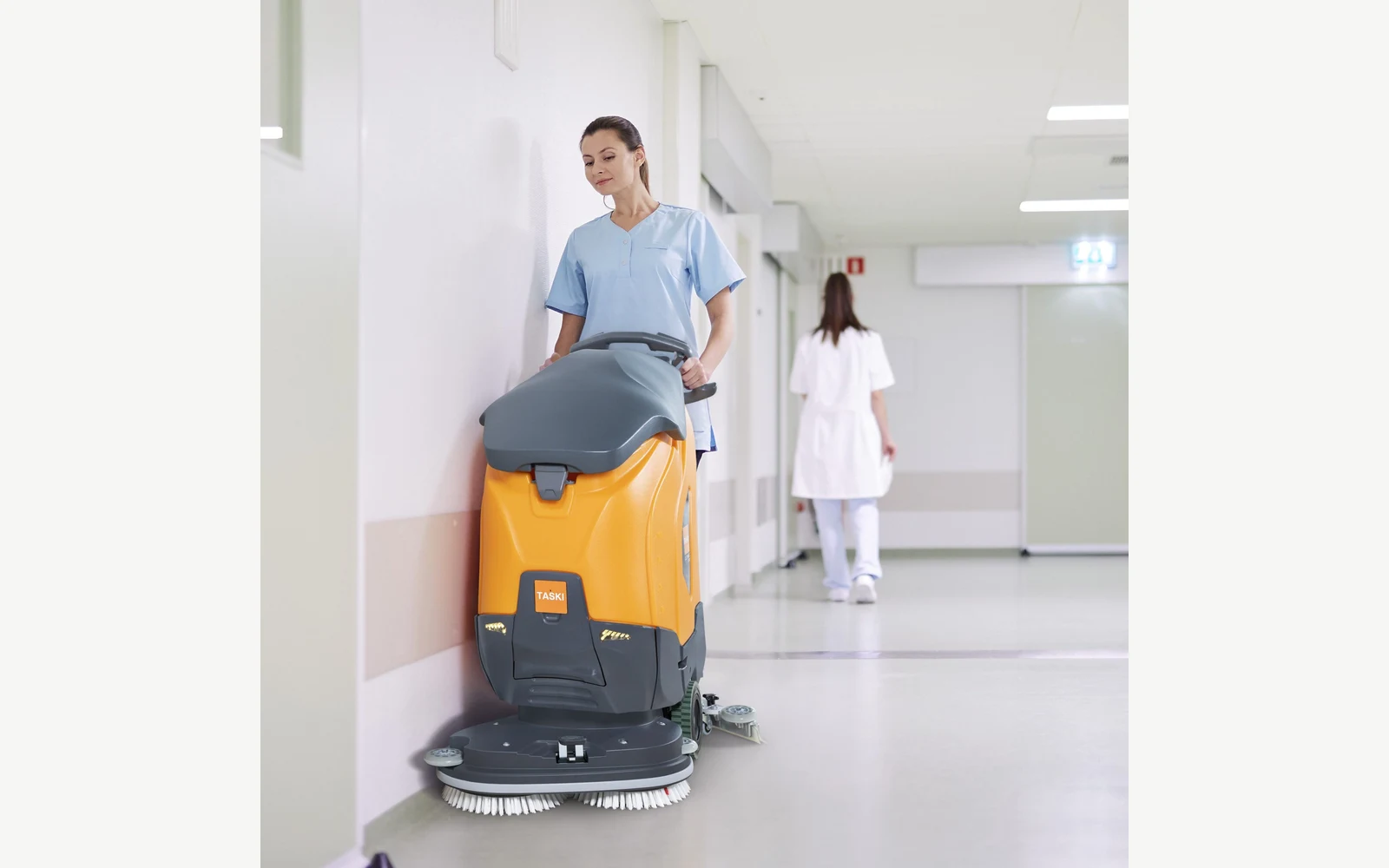
Operator using a TASKI ULTIMAXX floor scrubber in a healthcare corridor
Official field reference

Official TASKI healthcare-use image. The scene highlights occupied-space factors that still require site-specific assessment, including route width, people, noise, floor compatibility and recovery quality.

Buyer focusTreat the photographed setting as context only. Validate aisle and turn dimensions, occupied-space noise, residual moisture, floor finish and the planned cleaning window on site.

Official image source

Retail

EvidenceOfficial product materials identify shops, supermarkets and other public-use spaces among applications for reviewed scrubbers.

ScopeNamed Tennant, Nilfisk, Hako and IEC commercial-use examples; floor and configuration remain site-specific.

Verified2026-08-08

Sourcesnilfisk-sc500, hako-b120, iec-safety

WCB assessment

A compact or maneuverable machine may reduce aisle disruption where recovery quality and occupied-space noise are validated.

Basis
Official application statements plus documented size, noise and recovery attributes.
Limitations
The reviewed sources do not establish suitability for every retail floor, traffic pattern or cleaning chemical.
Buyer action
Map minimum aisle and turn dimensions, then run a timed trial during representative traffic.

Warehousing and manufacturing

EvidenceOfficial sources identify factories, production halls and industrial locations as commercial floor-treatment environments.

ScopeIndoor hard-floor cleaning within manufacturer limits; not explosive, corrosive or road-sweeping environments.

Verified2026-08-08

Sourcestennant-t500-manual, hako-b120, iec-safety

WCB assessment

Route length, debris load, floor joints, slopes and service access can outweigh nominal cleaning width.

Basis
Official intended-use boundaries and large-area application statements.
Limitations
No reviewed source supports hazardous-area use or universal oil/chemical removal.
Buyer action
Document soil type, slope, joints and debris; obtain written configuration approval and a site trial.

Healthcare

EvidenceManufacturer and IEC sources include hospitals or hygiene-sensitive facilities among commercial-use examples.

ScopeGeneral facility-floor application; infection-control protocol and chemical efficacy are outside the equipment-category evidence.

Verified2026-08-08

Sourcesnilfisk-sc500, hako-b25, iec-safety

WCB assessment

Noise, cleanability of tanks, water recovery and local infection-control procedures require joint review.

Basis
Official application and low-noise/hygiene feature descriptions.
Limitations
The sources do not establish disinfection efficacy or healthcare-protocol compliance.
Buyer action
Have infection-control, facilities and service teams approve the complete cleaning process and trial.

Education

EvidenceOfficial sources name schools and classrooms as representative commercial environments.

ScopeHard floors and named model positioning; furniture density and occupied-hour rules vary.

Verified2026-08-08

Sourcestennant-t500-manual, hako-b25, iec-safety

WCB assessment

Compact geometry, handle clearance, sound and simple controls can matter more than peak output in furnished areas.

Basis
Official intended-use and product application descriptions.
Limitations
No single reviewed configuration is proven suitable for every campus surface.
Buyer action
Trial the machine in the tightest furnished room and longest corridor using the intended operator group.

Hospitality

EvidenceTennant's intended-use statement includes hotels and Nilfisk lists hotels among SC500 applications.

ScopeCommercial hard-floor areas, not carpet extraction or guest-room domestic cleaning.

Verified2026-08-08

Sourcestennant-t500-manual, nilfisk-sc500

WCB assessment

Daytime noise, elevator fit, storage, appearance and service response should be weighted alongside output.

Basis
Official intended-use statements and machine dimensions/features.
Limitations
The sources do not support carpet or every specialty floor treatment.
Buyer action
Confirm elevator and storage dimensions and test each representative hard-floor finish.

System component map

Component families and compatibility boundaries

Component families are labels only. No component link or cross-model compatibility is claimed.

WCB diagram of four floor scrubber component verification zones
WCB technical diagram

WCB verification map showing the identifiers and interfaces to confirm for the cleaning deck, recovery path, tanks, and battery and charger configuration.

Buyer focusBefore substitution or service work, match the current manual, model and serial range, part number, physical interface, approved material or chemistry, and electrical configuration.

Evidence sourcestennant-t300-manual, karcher-b50-manual, nilfisk-sc500-manual, hako-b25

Brush, pad and cleaning deck

Provides mechanical agitation at the floor interface.

Common variants
  • Disc brush
  • cylindrical/roller brush
  • pad driver
  • orbital head
Critical checks
  • Deck model and working width
  • brush/pad interface
  • approved material for floor and chemistry
  • wear limit and part number

EvidenceOfficial sources list multiple deck technologies and model-specific replacement procedures.

ScopeNamed configurations; no cross-machine interchangeability is implied.

Verified2026-08-08

Sourcestennant-t500, karcher-b50, karcher-b50-manual

Squeegee assembly and blades

Collects liquid behind the cleaning path and directs it to suction pickup.

Common variants
  • Straight or curved assemblies
  • natural rubber or other model-approved blade materials
Critical checks
  • Assembly width and geometry
  • front/rear blade part number
  • blade material
  • adjustment and wear

EvidenceOfficial pages and manuals identify squeegee design, blade options and maintenance.

ScopeReviewed models; material suitability and fit are model/application-specific.

Verified2026-08-08

Sourceskarcher-b50, nilfisk-sc500-manual, tennant-t300-manual

Solution system

Stores and meters water or cleaning solution to the deck.

Common variants
  • Gravity/valve delivery
  • pump-controlled flow
  • detergent dosing options
Critical checks
  • Tank and hose cleanliness
  • filter and valve/pump part numbers
  • approved detergent
  • flow setting

EvidenceOfficial manuals describe solution tanks, water adjustment and optional dosing systems.

ScopeFunctional grouping; exact hydraulic architecture varies.

Verified2026-08-08

Sourcestennant-t300-manual, karcher-b50-manual, karcher-b50

Vacuum and recovery path

Moves recovered liquid through the hose into the recovery tank.

Common variants
  • Model-specific suction motor and airflow path
  • float or shutoff safeguards
Critical checks
  • Suction motor specification
  • hose sealing and blockage
  • tank lid gasket
  • float/shutoff operation

EvidenceOfficial manuals identify vacuum operation and recovery-path service points.

ScopeReviewed walk-behind machines; airflow values are not normalized across brands.

Verified2026-08-08

Sourcestennant-t300-manual, karcher-b50-manual

Battery and charger

Supplies and replenishes electrical energy for traction, deck and recovery systems.

Common variants
  • Flooded lead-acid
  • gel/AGM
  • lithium-ion
  • on-board or external charger
Critical checks
  • Voltage and chemistry
  • battery management requirements
  • charger part number and input supply
  • approved capacity and mass

EvidenceOfficial model sources publish different battery and charger options.

ScopeNamed configurations only; chemistry or charger substitution is not authorized.

Verified2026-08-08

Sourcestennant-t300, karcher-b50, hako-b25

Traction, controls and sensors

Controls movement, operating modes, safety interlocks and, on robotic machines, navigation.

Common variants
  • Push assist
  • self-propelled traction
  • ride-on controls
  • autonomous sensor/navigation stack
Critical checks
  • Configured drive type
  • braking and slope limits
  • control software/version
  • sensor cleaning and approved operating zone

EvidenceOfficial sources describe self-propelled operation, control features and autonomous navigation/docking functions.

ScopeFeatures vary materially by model and option package.

Verified2026-08-08

Sourceskarcher-b50-manual, tennant-t500, karcher-kira

Verified relationships

Related brands and representative models

Representative, not exhaustive. A link means the official source connects the named brand and model; it does not establish a factory, OEM or component-supplier relationship.

7 verified models
Representative floor scrubber models
BrandModelSubtypeOfficial specification referenceMarket scopeVerifiedSource
TennantT300Walk-behind
  • Cleaning path: 17, 20 or 24 in / 430, 500 or 600 mm
  • Solution tank: 11 gal / 42 L
  • Estimated runtime: up to 3.8 hours
Tennant US product page2026-08-08tennant-t300
TennantT500Walk-behind
  • Cleaning path: 26, 28 or 32 in / 650, 700 or 800 mm
  • Solution tank: 22.5 gal / 85 L
  • Disc, cylindrical or orbital head options
Tennant US product page2026-08-08tennant-t500
NilfiskSC500 20D Li-IonWalk-behind
  • Cleaning width: 530 mm in the SC500 manual
  • Solution and recovery tanks: 45 L each in the SC500 manual
  • Li-ion configuration product number 56394690 on the US page
Nilfisk US product page with SC500 official instruction manual2026-08-08nilfisk-sc500, nilfisk-sc500-manual
KärcherB 50 WWalk-behind
  • Tank volume: 50 L
  • D51, D60, R55 and O51 head choices
  • Gel/AGM or optional lithium-ion battery configurations
Kärcher International category page2026-08-08karcher-b50
KärcherKIRA B 50Autonomous scrubber dryer
  • Area performance: up to 2,300 m²/h
  • Optional docking station supports fresh-water fill, dirty-water empty/rinse and charging
  • Medium-to-large hard-floor application positioning
Kärcher International cleaning-robots page2026-08-08karcher-kira
HakoScrubmaster B25Walk-behind
  • Working width: 43 cm
  • Theoretical area performance: 1,700 m²/h
  • Fresh and dirty water tanks: 25 L each
Hako international English product page2026-08-08hako-b25
HakoScrubmaster B120 RRide-on
  • Working widths: 70–90 cm depending on configuration
  • Theoretical area performance: 4,500–5,800 m²/h
  • Solution and recovery tanks: 120 L each
Hako international English product page2026-08-08hako-b120

WCB decision support

Procurement decision matrix

No composite score or brand ranking. Each row identifies a comparison trap and the next verification action.

WCB assessment

Daily maintenance cleaning

Verify
Achieved route productivity
Comparison trap
Selecting from theoretical area performance alone
Assessment
Use a timed site route including turns, overlap, refill, drain and transit.
Basis
Different source labels and site losses prevent a like-for-like achieved-output ranking.
Limitations
WCB has not independently performance-tested these models.
Buyer action
Put the route, soil condition, operator and acceptance measure into the demonstration protocol.
Engineering check
Confirm the installed deck, programmed speed and flow settings used during the trial.

EvidenceOfficial sources label productivity as theoretical, estimated or up to for representative models.

ScopePublished manufacturer values for named models.

Verified2026-08-08

Sourcestennant-t300, hako-b25, hako-b120, karcher-kira

WCB assessment

Occupied-space cleaning

Verify
Sound measurement and water pickup
Comparison trap
Comparing dBA values without mode or test method
Assessment
Noise and residual moisture should be assessed together in the real occupied route.
Basis
Low-noise operation may change machine settings and reported values are not automatically comparable.
Limitations
Published values do not represent every room acoustic or floor condition.
Buyer action
Measure a representative pass during operating hours and document the configured mode.
Engineering check
Record measurement standard, distance, operating mode and squeegee/blade setup.

EvidenceOfficial model sources report low-noise modes or sound values under named conditions.

ScopeNamed model configurations only.

Verified2026-08-08

Sourcestennant-t300, hako-b25

WCB assessment

Multi-shift operation

Verify
Battery, charger and duty cycle
Comparison trap
Treating maximum runtime as shift coverage
Assessment
Model the full energy window including cleaning load, opportunity charge, cooling and battery life policy.
Basis
Runtime depends on configuration and operating settings.
Limitations
Public sources do not establish the buyer's achieved duty cycle.
Buyer action
Require a written energy balance for the contracted battery and charger combination.
Engineering check
Verify voltage, chemistry, BMS, charger part number, input supply and warranty pairing.

EvidenceOfficial sources show multiple battery chemistries, capacities and charging options.

ScopeNamed configurations; local packs can differ.

Verified2026-08-08

Sourcestennant-t300, karcher-b50, hako-b25

WCB assessment

Tight or furnished routes

Verify
Full configured envelope
Comparison trap
Using cleaning width as machine width or turning clearance
Assessment
The route should be checked with the installed squeegee, deck and operator position.
Basis
The widest and longest operating envelope can differ from nominal cleaning path.
Limitations
Published dimensions do not reproduce local obstacles or turning behavior.
Buyer action
Measure the narrowest opening, turn and storage point, then conduct a physical route trial.
Engineering check
Confirm configuration-specific width, length, turning data, slope and transport limits.

EvidenceOfficial specifications separately report working width, squeegee width and overall dimensions for reviewed models.

ScopeNamed model/configuration dimensions.

Verified2026-08-08

Sourcestennant-t300, nilfisk-sc500-manual, hako-b25, hako-b120

WCB assessment

Autonomous cleaning

Verify
Operational design domain and exception workflow
Comparison trap
Equating autonomous operation with unsupervised suitability everywhere
Assessment
A deployment plan must cover mapping, traffic, obstacles, docking, alerts, supervision and manual edge work.
Basis
Product capability statements do not define the buyer's complete operating environment.
Limitations
WCB has not validated a deployment at the buyer's site.
Buyer action
Run a representative pilot with logged interventions and agreed acceptance thresholds.
Engineering check
Verify safety certification scope, software/version control, connectivity, docking utilities and escalation ownership.

EvidenceKärcher describes KIRA B 50 autonomous functions, sensors and optional docking support.

ScopeKärcher KIRA B 50 international materials.

Verified2026-08-08

Sourceskarcher-kira

Engineering validation

Checks before parts, configuration or service decisions

This checklist narrows verification work; it is not a compatibility guarantee or repair manual.

01

Battery and charger identity

Voltage, chemistry, BMS and charge profile must match the approved machine configuration.

Required actionConfirm machine serial range, battery part number, charger part number, input supply and written warranty pairing.

EvidenceOfficial sources show configuration-specific battery and charger options.

ScopeNamed models; no substitution approval is implied.

Verified2026-08-08

Sourcestennant-t300, karcher-b50, hako-b25

02

Deck and consumable interface

Working width alone does not establish brush, pad driver or orbital consumable fit.

Required actionVerify deck model, drive interface, diameter, material, speed, wear limit and exact part number.

EvidenceOfficial sources list multiple deck technologies and model-specific replacement instructions.

ScopeReviewed models and official accessories only.

Verified2026-08-08

Sourcestennant-t500, karcher-b50-manual

03

Squeegee assembly and blade

Geometry, width, blade material and adjustment affect pickup and physical fit.

Required actionMatch assembly and blade part numbers to model, deck, serial range, floor/chemical and regional parts catalog.

EvidenceOfficial manuals identify model-specific squeegee service and blade options.

ScopeReviewed Tennant, Nilfisk and Kärcher families.

Verified2026-08-08

Sourcestennant-t300-manual, nilfisk-sc500-manual, karcher-b50-manual

04

Electrical and safety scope

Commercial floor-treatment machines and chargers are subject to market-specific safety and electrical requirements.

Required actionObtain the declaration, certification markings, manual and charger input specification for the exact destination-market configuration.

EvidenceIEC 60335-2-72 defines safety scope for powered commercial floor-treatment machines, including battery machines and built-in chargers.

ScopeInternational standard scope; national adoption and legal obligations require local verification.

Verified2026-08-08

Sourcesiec-safety

05

Service and warranty entity

Brand identity does not establish the local contracting, commissioning, parts or warranty provider.

Required actionName the seller, importer, commissioning party, authorized service entity, response time, parts commitment and warranty territory in writing.

EvidenceOfficial sources direct buyers to regional contacts, authorized retailers or service support for configuration and parts.

ScopeCommercial procurement action; no ownership relationship is inferred.

Verified2026-08-08

Sourceshako-b25, nilfisk-sc500, tennant-t300

Standards boundary

Safety and performance references

IEC 60335-2-72:2021

JurisdictionInternational standard; adoption and legal effect vary by market

VersionEdition 5.0, 2021

ApplicabilitySafety requirements for powered ride-on and walk-behind floor-treatment machines for commercial use within the standard's stated scope.

EvidenceIEC states the standard covers commercial machines used for scrubbing and related floor-treatment applications, including battery-powered machines and built-in chargers.

ScopeStandard scope only; purchasers must verify destination-market adoption, certification and exact machine configuration.

Verified2026-08-08

Sourcesiec-safety

IEC 62885-9:2019

JurisdictionInternational performance-measurement standard

VersionEdition 1.0, 2019

ApplicabilityMethods and characteristic performance parameters for commercial walk-behind and ride-on floor scrubbers, sweepers and related floor-cleaning machines.

EvidenceIEC states the document lists performance parameters and measurement methods for machines within its scope.

ScopeThe existence of the standard does not prove that a particular published specification was measured to it unless the manufacturer says so.

Verified2026-08-08

Sourcesiec-performance

Technical developments

Selected changes in floor scrubber systems

  1. Autonomous scrubber platforms add docking and mapped-route workflows

    Kärcher's official KIRA B 50 materials describe autonomous scrubbing, sensor-based navigation and optional docking for water, waste and charging tasks.

    EvidenceKärcher published KIRA B 50 autonomous capability and docking functions in its official product and media materials.

    ScopeKärcher KIRA B 50; not a claim that all autonomous scrubbers have the same functions.

    Verified2026-08-08

    Sourceskarcher-kira, karcher-kira-release

  2. Walk-behind platforms combine multiple deck and battery choices

    Kärcher's B 50 W overview presents disc, roller and orbital head choices with lead-acid and optional lithium-ion configurations plus connected settings.

    EvidenceThe official B 50 W page describes the named deck, battery and connectivity options.

    ScopeKärcher B 50 W international overview and its later page updates.

    Verified2026-08-08

    Sourceskarcher-b50

Evidence record

Sources

First published 2026-08-08 · Last verified 2026-08-08 · Last material modification 2026-08-08

  1. manufacturer

    T300 Walk-Behind Floor Scrubber

    Tennant Company

    Open official source

    Accessed 2026-08-08

  2. manual

    T300 Walk-Behind Floor Scrubber Operator Manual

    Tennant Company

    Open official source

    Accessed 2026-08-08

  3. manufacturer

    T500 Walk-Behind Floor Scrubber

    Tennant Company

    Open official source

    Accessed 2026-08-08

  4. manual

    T500 Walk-Behind Floor Scrubber Operator Manual

    Tennant Company

    Open official source

    Accessed 2026-08-08 · Published 2024-09-01

  5. manufacturer

    SC500 20D Li-Ion

    Nilfisk

    Open official source

    Accessed 2026-08-08

  6. manual

    SC500 Instructions for Use

    Nilfisk

    Open official source

    Accessed 2026-08-08

  7. manufacturer

    B 50 W Push Scrubber Dryer

    Kärcher International

    Open official source

    Accessed 2026-08-08 · Published 2022-12-19

  8. manual

    B 50 W Original Operating Instructions

    Kärcher

    Open official source

    Accessed 2026-08-08 · Published 2024-08-01

  9. manufacturer

    Cleaning Robots: KIRA B 50 Scrubber Dryer Robot

    Kärcher International

    Open official source

    Accessed 2026-08-08

  10. manufacturer

    KIRA B 50 Wins iF Design Award

    Kärcher International

    Open official source

    Accessed 2026-08-08 · Published 2024-03-28

  11. manufacturer

    Scrubmaster B25

    Hako

    Open official source

    Accessed 2026-08-08

  12. manufacturer

    Scrubmaster B120 R

    Hako

    Open official source

    Accessed 2026-08-08

  13. standard

    IEC 60335-2-72:2021

    International Electrotechnical Commission

    Open official source

    Accessed 2026-08-08 · Published 2021-07-12

  14. standard

    IEC 62885-9:2019

    International Electrotechnical Commission

    Open official source

    Accessed 2026-08-08 · Published 2019-10-14